Medical University of Gdańsk Admissions Guide
Everything you need to apply to Medical University of Gdańsk: entrance requirements, application deadlines, tuition and cost of living, and the Medical University of Gdańsk Entrance Exam.
At a glance
Medical University of Gdańsk in brief
- Entrance exam
- Medical University of Gdańsk Entrance Exam
- Language of instruction
- English
- Interview required
- Yes
- Tuition
- €15,100 / year
- Cost of living
- Mid-range among Poland's five medical-school cities — cheaper than Warsaw, pricier than Łódź or Lublin.
- Application deadline
- Provisional for 2027/2028: mirrors the 2026/2027 cycle (admission opens 18 March, deadline 15 July 2026, exam sittings 14 May – 30 July 2026); official 2027/28 dates not yet published
- Subjects tested
- Biology, Chemistry
Source: Medical University of Gdańsk Admissions · Verified 28 Sep 2026
Admission test
Medical University of Gdańsk Entrance Exam
Medical University of Gdańsk requires the Medical University of Gdańsk Entrance Exam for admission. Here are the essential figures.
- Total Questions
- 60
- Test Duration
- 90 min
- Main Sections
- 2
- Maximum Score
- 60
Not sure you'd clear the cutoff?
Take the free Medical University of Gdańsk diagnostic: real questions from its own question bank, scored against its cutoff. No account needed.
What the exam tests
- Biology
- Chemistry
2 tested areas · Medical University of Gdańsk Entrance Exam
Application
Application requirements
- Entrance exam
- Required
- Biology, Chemistry
- Online, proctored via Zoom
- Interview
- Required
- Scholarship
- Not available
- Application fee
- €24
Rankings
Medical University of Gdańsk world ranking, and is it good?
The Medical University of Gdańsk (Gdański Uniwersytet Medyczny, GUMed, MUG) is a public medical university, founded by decree in 1945, and Poland's own ranking places it among the country's best. Perspektywy 2026 puts it 2nd of Poland's nine medical universities (1st in 2025, 2nd in 2024), 4th of 19 for medicine as a field of study, and joint 13th among all Polish academic universities.
Internationally, Times Higher Education ranks it in the 1001–1200 band of its World University Rankings 2027, as in each edition since 2024 (801–1000 in 2023), and 601–800 in the 2026 Clinical and Health table. QS's own site could not be read when this page was checked, so no QS position is given here; every figure above comes from the ranking organisation's own pages.
A ranking says nothing about your chances of a place: admission depends on your school grades, the written exam and the interview, and in 2025 there were 11.9 applicants for each place.
| Edition | World | Clinical and Health |
|---|---|---|
| THE 2027 | 1001–1200 | not published |
| THE 2026 | 1001–1200 | 601–800 |
| THE 2025 | 1001–1200 | not published |
| THE 2024 | 1001–1200 | not published |
| THE 2023 | 801–1000 | not published |
Entry requirements
Medical University of Gdańsk entry requirements for international students
For the six-year Doctor of Medicine in English, GUMed's entry requirements are a secondary-school certificate that would admit you to a university or medical school at home, Biology plus one of Chemistry, Physics or Mathematics at advanced level, English at B2, and its entrance exam: a written test in Biology and Chemistry and an interview, in English. Holders of the IB or EB diploma with Biology HL and one of Chemistry, Physics or Mathematics HL take the interview only.
- School certificate with transcript and grading scale, with an apostille or consular legalisation, and a certified English translation if it is in another language
- A declaration that the certificate admits you to higher education where it was issued, if the certificate does not say so
- English at B2, for example IELTS 5.5, TOEFL iBT 80 or PTE Academic 59; IB English HL or SL counts, schooling in English alone does not
- A passport copy, NAWA's recognition statement and the signed application forms in English and Polish
- Scoring: 60 points for school results, 60 for the written exam and 10 for the interview; you need at least 60% of the interview and 50% of all points to be ranked
- After acceptance: the fee payments, the signed payment catalogue, health insurance, and a medical certificate from an occupational-medicine doctor
Application deadline: 15 July for the 2026 intake, which opened on 18 March 2026; recruitment agencies can close earlier. The 2027 dates are not yet published: MUG's 2027/28 recruitment resolution (No. 91/2026) promises them by 31 May 2027. A compulsory Orientation Week ran from 24 to 30 September 2026.
Fees
Medical University of Gdańsk fees
The fees for the English Division's Doctor of Medicine for students starting in 2026/27, from Rector's Order 41/2026. Tuition is in Polish zloty, the same every year, with no EU/non-EU difference.
| Item | Amount | Notes |
|---|---|---|
| Registration fee | PLN 100 | For candidates applying directly to the Admissions Office |
| Orientation Week fee | PLN 3,100 | Once; PLN 2,050 for candidates from Poland and graduates of GUMed's premedical course |
| Tuition | PLN 32,100 a semester | PLN 64,200 a year, years one to six |
| Premedical Course (optional) | PLN 33,000 | A separate preparatory course |
GUMed may raise fees during your studies once a year, by no more than the previous year's consumer price index and by no more than 30% in total. The deadlines are set by GUMed's fee rules (Rector's Order 80/2025): in the first year, the Orientation Week fee and the first semester's tuition are due three weeks after you are marked "accepted - waiting for payment", and the second semester by 31 January; if you apply for a medical-studies loan, 15 October and 31 January; from the second year, 15 September and 31 January. A visa applicant proves the first semester's payment on acceptance. GUMed's fees page gives 15 October and 15 February; the Order is the binding text.
Premedical Course
The MUG Premedical Course
For school leavers short of the core sciences, MUG runs a Premedical Course in English from October to mid-June (two semesters, PLN 33,000 including textbooks and health insurance), with selection on school grades and English and no entrance exam; its graduates have the opportunity to be accepted onto the six-year MD the following year.
Where it is
Where is the Medical University of Gdańsk, and what is the curriculum?
MUG is in Gdańsk, on Poland's Baltic coast: its address is M. Skłodowskiej-Curie 3a, 80-210 Gdańsk, and the Admissions Office is at al. Zwycięstwa 41-42. Clinical teaching takes place at the University Clinical Centre and selected teaching hospitals in the city.
The Doctor of Medicine is a six-year, 12-semester uniform master's programme of 360 ECTS, taught in English in the Faculty of Medicine since 2002. Graduates receive the Polish lekarz diploma. MUG is a public university: its statute describes it as an academic public university, not a private one.
Sources, read on 19 and 20 October 2026: Fees & terms · Order No. 41/2026, tuition fees 2026/2027 (PDF) · Order No. 80/2025, rules on fees (PDF) · Recruitment procedure: Doctor of Medicine · Admissions criteria · Required documents at the time of registration · FAQ · Times Higher Education: Medical University of Gdańsk · Perspektywy 2026: uczelnie medyczne · Perspektywy 2026: kierunek lekarski · Statut GUMed, consolidated text (PDF, Polish) · Premedical Course · Faculty of Medicine · Recruitment resolution 72/2025, consolidated (PDF, Polish)
The campus
The Medical University of Gdańsk in Aniołki
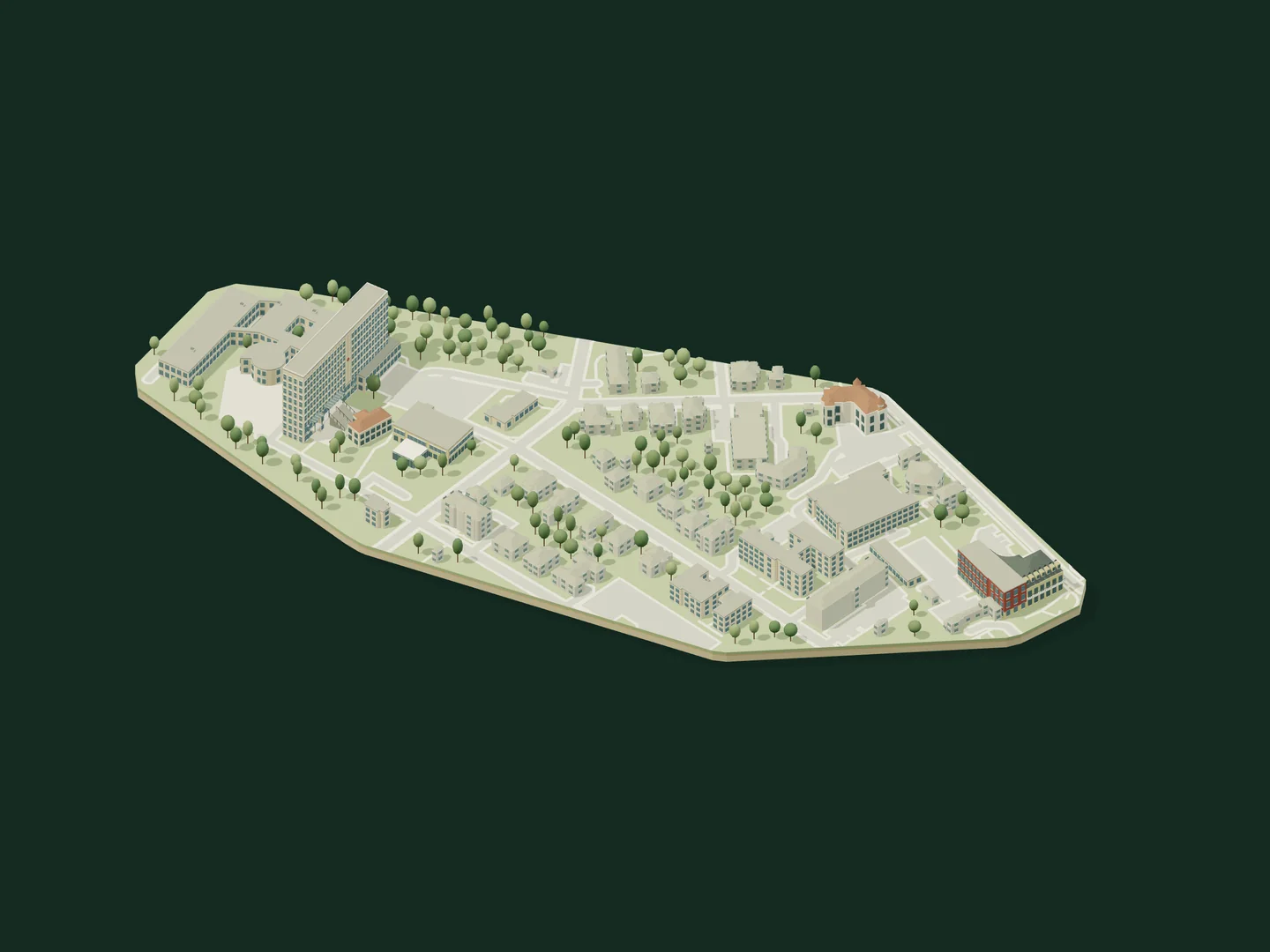
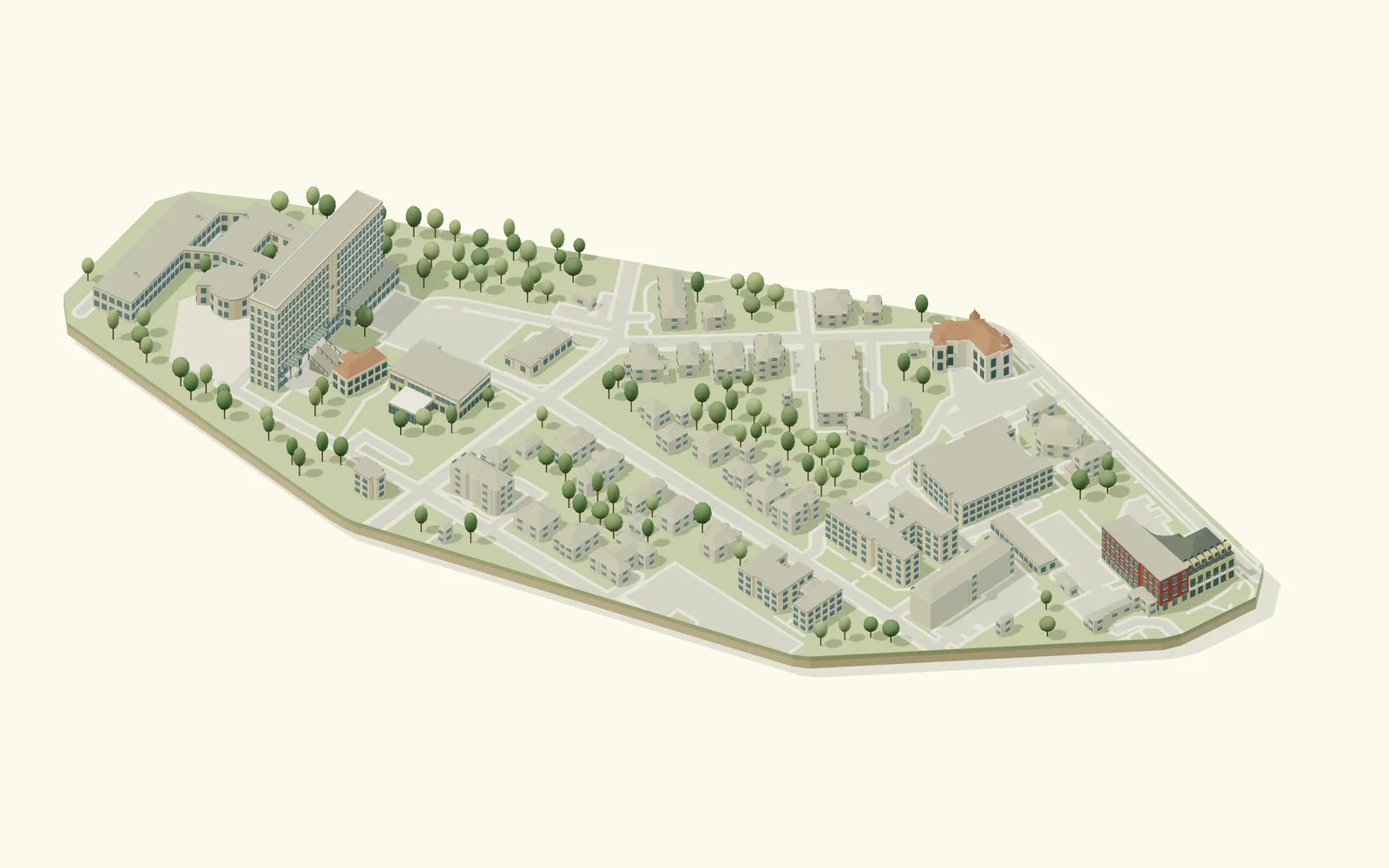
The Medical University of Gdańsk, founded in 1945, teaches in Aniołki, a district of Gdańsk where its buildings stand among the streets rather than on a closed campus. The model shows four of them: Collegium Biomedicum and the Main Library on Dębinki, the Atheneum Gedanense Novum on Aleja Zwycięstwa and the Rectorate on Marii Skłodowskiej-Curie. The other buildings are simplified neighbours, and not all of them belong to the university. The English Division, established in 2001, has taught Medicine since 2002. The University Clinical Centre and the university's other sites are not modelled.
Collegium Biomedicum
Opened in 1975 as the Institute of Medical Biology, at ul. Dębinki 1; students of the Faculty of Medicine take their basic sciences here. Its three lecture halls on the first floor seat 298, 298 and 291, and its floors hold the dissecting rooms of Anatomy and the rooms of Histology, Medical Chemistry, Biochemistry, Physiology, Physics and Biophysics, and Biology and Genetics.
Atheneum Gedanense Novum
The former Old Anatomy building on al. Zwycięstwa 41/42, where the academy held its first inauguration in February 1946, rebuilt as a teaching centre and reopened in spring 2007. Its Auditorium Primum seats 300, beside seminar rooms, the Admissions Office, the Faculty of Medicine's Dean's Office and the university museum, where English Division students have History of Medicine classes.
Main Library
At ul. Dębinki 1, beside Collegium Biomedicum, since 1968, and the largest medical library in the Pomeranian region. Its modernisation, with a newly built reading room in its Science Zone, was completed in 2018; the 2025 student guide lists 246 seats, 27 computer stations, two reading rooms and six study rooms.
Rectorate
The university's main address, ul. Marii Skłodowskiej-Curie 3a: the Rector's office, the Vice-Rector for Student Affairs and the Student Affairs Office.
Student life
Living in Gdańsk as a medical student
Gdańsk is one of the few Polish medical schools in our catalogue to publish competitiveness figures: 72 places proposed for 2026 and 11.9 applicants per place in 2025, applicant data most Polish schools don't disclose. It's a Baltic coastal city in northern Poland, historically a major port and shipbuilding centre.
FAQ
Medical University of Gdańsk admissions FAQ
Yes. Medical University of Gdańsk delivers Medicine in English and runs its admission process in the same language.
At every Polish school in our catalogue, yes: each runs its own remotely proctored exam (Zoom, Microsoft Teams or a school platform), though a few Gdańsk sittings with recruitment partners were held in person in Norway in 2026. This guide includes the setup checklist and flags which format your target school uses.
No. There's no centralised Polish medical entrance exam. Each university writes, times and delivers its own, and question counts alone range from a 12-question oral exam to a 100-question written paper.
If you want to practise in Poland, or to rely on automatic recognition elsewhere in the EU or the UK's European registration route, yes. The LEK is Poland's mandatory final exam for practising in Poland, and the EU Directive's list of Polish medical qualifications pairs the diploma with the LEK certificate and the postgraduate internship certificate.
Yes, it's the 2027 edition, built from the latest admission rules Medical University of Gdańsk has published. Where a 2027 date or detail isn't published yet, confirm it with the university before you rely on it.
Yes. Medical University of Gdańsk-format practice sessions are available inside the simulator and align with the guide section by section.
Ready to prepare for the Medical University of Gdańsk Entrance Exam?
The Medical University of Gdańsk Complete Admissions System — study guide, exam simulator, video courses and application help, built from Medical University of Gdańsk's own syllabus.