Free practice paper · 2027 format

Medical University of Warsaw Competency Test Practice Paper 1 with Answers

WUM publishes no past papers. This is a free full-length paper in the format its Competency Test page describes, with every answer explained: 80 multiple-choice questions in 100 minutes, Biology 30 and Chemistry 30 at one point each, Decision Making 20 at two points each, 100 points in all. All 80 are IvyTest's original questions, written on the topics of WUM's three official syllabuses; none is a real WUM question, and it is not an official Medical University of Warsaw paper.

Before you start

How to sit this paper

Questions
80
Time
100 minutes
Options per question
4 (A to D)
SectionQuestionsTimeMarks (Medicine Competency Test)
Medicine Competency Test80100 min+1 correct, 0 wrong, 0 blank

Sit all 80 questions in one go against a 100-minute clock, in any order: WUM lets you move freely between sections and questions. Use no calculator, only a printout of the WUM Periodic Table and one sheet of paper for working, as on the day; where a question needs a value, the stem gives it. Score Biology and Chemistry at one point a question and Decision Making at two, out of 100: the tally at the end does this for you. Nothing is deducted for a wrong answer, so answer every question.

Sit it timed

Start the clock for one section, as on the day, or for the whole paper. It counts down in the bar at the bottom of the screen; nothing stops you when it ends.

Go to a question

Answered

Section 1 of 1

Medicine Competency Test

80 questions · 100 minutes

Question 1

Biology · The Cell · Foundation

Which statement about viruses is correct?

Show answer and explanation

Answer: B

A virus is nucleic acid in a protein capsid, sometimes inside an envelope, with no metabolism and no ribosomes of its own, so it can be copied only by taking over a host cell's machinery. A virus particle carries either DNA or RNA, not both. Ribosomes belong to cells: 70S ones to prokaryotes. Penicillin blocks the synthesis of the bacterial cell wall; viruses have no cell wall, which is why antibiotics do not treat viral infections.

Question 2

Biology · The Cell · Foundation

Which structure is found in a bacterial cell but not in a human cell?

Show answer and explanation

Answer: C

Most bacteria are enclosed by a cell wall of peptidoglycan (murein); animal cells, human ones included, have no cell wall at all. Both kinds of cell have ribosomes (70S in bacteria, 80S in the human cytoplasm) and a phospholipid plasma membrane. Mitochondria are the other way round: human cells have them and bacteria, being prokaryotes, have no membrane-bound organelles.

Question 3

Biology · The Cell · Standard

What is the main role of cholesterol in the plasma membrane of an animal cell?

Show answer and explanation

Answer: A

Cholesterol molecules sit between the phospholipids. At body temperature they restrain the movement of the fatty-acid tails, so the membrane is less fluid; at low temperature they stop the tails packing tightly, so it does not become rigid: a fluidity buffer. Ion channels, hormone receptors and glucose carriers are all membrane proteins, not lipids.

Question 4

Biology · The Cell · Standard

A human body cell contains 6 pg of DNA in its nucleus during G1. How much DNA does the nucleus contain at the end of G2, and how much does each daughter nucleus receive after mitosis?

Show answer and explanation

Answer: A

DNA is replicated in S phase, so between G1 and the end of G2 the amount doubles, from 6 to 12 pg. Mitosis then shares the sister chromatids equally between two nuclei, each receiving 6 pg, the same as the G1 cell: mitosis keeps the amount of DNA constant from one generation of cells to the next. Halving it again, to 3 pg, is what meiosis II does to gametes, not mitosis.

Question 5

Biology · The Cell · Standard

Human red blood cells are placed in a 0.3% sodium chloride solution. Blood plasma is roughly isotonic with 0.9% sodium chloride. What happens to the cells?

Show answer and explanation

Answer: C

A 0.3% solution has a lower solute concentration (a higher water potential) than the cytoplasm of a red cell, so it is hypotonic: water moves into the cells by osmosis. Red blood cells have no cell wall to resist the pressure, so they swell and can burst (haemolysis). In a hypertonic solution they would shrink (crenation), and in 0.9% there would be no net movement. Osmosis is passive: no pump is involved.

Question 6

Biology · The Chemistry of Life · Foundation

Sweating cools the body. Which property of water explains this?

Show answer and explanation

Answer: A

To evaporate, water molecules must break the hydrogen bonds that hold them to their neighbours, which takes a lot of energy: water's latent heat of vaporisation is high. That energy comes from the skin, which cools. Water is polar, not non-polar, and its specific heat capacity is high, not low. Evaporation breaks hydrogen bonds between molecules; the covalent O–H bonds inside each molecule stay intact.

Question 7

Biology · The Chemistry of Life · Standard

Which of the following describes the formation of one triglyceride molecule?

Show answer and explanation

Answer: A

A triglyceride forms by condensation: each of glycerol's three –OH groups reacts with the –COOH group of a fatty acid, forming an ester bond and releasing one water molecule, so three ester bonds and three waters in all. Peptide bonds join amino acids. Water is used, not released, when a triglyceride is hydrolysed. Glycerol with two fatty acids and a phosphate group is a phospholipid.

Question 8

Biology · The Chemistry of Life · Foundation

In a double-stranded DNA molecule, 30% of the bases are adenine. What percentage of the bases are guanine?

Show answer and explanation

Answer: A

Adenine pairs with thymine and guanine with cytosine, so A = T and G = C (Chargaff's rule). If A is 30%, T is also 30%, together 60%. The remaining 40% is shared equally between G and C: 20% each. 40% is G and C together, and 70% is everything except adenine.

Question 9

Biology · The Chemistry of Life · Challenging

A section of the template strand of a gene reads 3′-TAC GGA-5′. Which mRNA is transcribed from it, and which tRNA anticodon pairs with its first codon?

Show answer and explanation

Answer: A

RNA polymerase builds the mRNA complementary and antiparallel to the template strand, with uracil in place of thymine: T→A, A→U, C→G, G→C, giving 5′-AUG CCU-3′. The anticodon is complementary to the codon: AUG pairs with 3′-UAC-5′ on the tRNA, the one that carries methionine. B keeps thymine, which RNA does not contain; C copies the template instead of pairing with it; D repeats the codon as its own anticodon.

Question 10

Biology · The Chemistry of Life · Standard

The effect of an enzyme inhibitor is overcome when the substrate concentration is raised. What kind of inhibitor is it most likely to be, and where does it bind?

Show answer and explanation

Answer: A

A competitive inhibitor resembles the substrate and competes with it for the active site. The more substrate there is, the more often the substrate wins, so a high substrate concentration restores the maximum rate. A non-competitive inhibitor binds elsewhere (an allosteric site) and changes the enzyme's shape, so extra substrate cannot undo it; nor can it undo an irreversible inhibitor, which permanently blocks the enzyme molecules it has bound.

Question 11

Biology · The Chemistry of Life · Standard

Which stage of aerobic respiration produces most of the ATP, and where in the cell does it take place?

Show answer and explanation

Answer: C

Glycolysis and the Krebs cycle each make only 2 ATP per glucose directly; their main product is reduced NAD and FAD. These carriers pass electrons to the electron transport chain on the inner mitochondrial membrane (the cristae), which pumps protons into the intermembrane space; the protons flow back through ATP synthase, making roughly 26–28 of the 30–32 ATP per glucose. The link reaction happens in the matrix and makes no ATP.

Question 12

Biology · The Chemistry of Life · Standard

Where in the chloroplast do the light-independent reactions (the Calvin cycle) take place, and which products of the light-dependent reactions do they use?

Show answer and explanation

Answer: A

The light-dependent reactions on the thylakoid membranes split water, release oxygen and make ATP and NADPH. The Calvin cycle runs in the stroma, where RuBisCO fixes carbon dioxide, and it spends that ATP and NADPH to reduce the product to triose phosphate. Oxygen is a waste product of the light-dependent stage, not something the Calvin cycle uses, and water is split on the thylakoids.

Question 13

Biology · Genetics · Standard

A single base substitution changes an mRNA codon from UAC, which codes for tyrosine, to UAA. What kind of mutation is this?

Show answer and explanation

Answer: C

UAA is one of the three stop codons (with UAG and UGA), so translation ends early and the protein is truncated: a nonsense mutation. A silent mutation would give another codon for the same amino acid, and a missense mutation a codon for a different amino acid. A frameshift needs an insertion or deletion of bases not in a multiple of three; a substitution keeps the reading frame.

Question 14

Biology · Genetics · Challenging

Two genes, A/a and B/b, lie on different chromosomes. An individual of genotype AaBb is crossed with one of genotype aabb. What proportion of the offspring is expected to show both recessive phenotypes?

Show answer and explanation

Answer: C

Genes on different chromosomes assort independently. The AaBb parent makes four kinds of gamete in equal numbers (AB, Ab, aB, ab); the aabb parent makes only ab. So the offspring are AaBb, Aabb, aaBb and aabb in a 1 : 1 : 1 : 1 ratio, and aabb, recessive for both traits, is 1/4. This is a test cross. 1/16 and 9/16 belong to the dihybrid cross AaBb × AaBb.

Question 15

Biology · Genetics · Standard

Haemophilia A is an X-linked recessive condition. A woman who is a carrier and a man who does not have haemophilia are expecting a son. What is the probability that their son will have haemophilia?

Show answer and explanation

Answer: C

The mother is XᴴXʰ and the father XᴴY. A son receives his Y chromosome from his father and one of his mother's two X chromosomes, each with probability 1/2, so he is XʰY, affected, with probability 1/2. The 1/4 is the probability that any child of theirs is an affected son, before the child's sex is known; the question already says it is a son.

Question 16

Biology · Genetics · Standard

In the polymerase chain reaction (PCR), what happens in the step carried out at about 95 °C?

Show answer and explanation

Answer: A

Each PCR cycle has three steps. At about 95 °C the DNA is denatured: the hydrogen bonds between the bases break and the strands separate. At about 50–65 °C the primers anneal, and at about 72 °C a heat-stable polymerase (Taq) extends them. Ligase is not part of PCR; it joins DNA fragments in cloning.

Question 17

Biology · Genetics · Challenging

An autosomal recessive condition affects 1 in 400 people in a population in Hardy–Weinberg equilibrium. What percentage of the population are heterozygous carriers?

Show answer and explanation

Answer: C

Affected people are homozygous recessive, so q² = 1/400 and q = 1/20 = 0.05. Then p = 1 − 0.05 = 0.95, and the carriers are 2pq = 2 × 0.95 × 0.05 = 0.095, or 9.5%: about one person in ten. 0.25% is q², the affected people themselves; 5% is q, the allele frequency, not a genotype frequency; 90.25% is p², the homozygous dominant people.

Question 18

Biology · Ecology and Evolution · Foundation

Which statement describes the greenhouse effect?

Show answer and explanation

Answer: C

Sunlight, mostly visible and short-wave, passes through the atmosphere and warms the surface, which radiates the energy as long-wave infrared. Carbon dioxide, methane and water vapour absorb that infrared and re-emit it in all directions, part of it back towards the surface. Absorbing ultraviolet is the ozone layer's job, and the ozone hole is a separate problem from the greenhouse effect.

Question 19

Biology · Ecology and Evolution · Standard

In a food chain, the producers fix 50,000 kJ per square metre per year. If about 10% of the energy passes from one trophic level to the next, roughly how much reaches the tertiary consumers?

Show answer and explanation

Answer: C

Count the transfers: producers → primary consumers (5,000 kJ) → secondary consumers (500 kJ) → tertiary consumers (50 kJ). Three steps, each keeping about a tenth. The rest is lost mostly as heat from respiration, and in material not eaten or not digested, which is why food chains rarely have more than four or five links. 5 kJ is one step too many, a quaternary consumer.

Question 20

Biology · Ecology and Evolution · Standard

A population of beetles is divided when a river changes its course. Many generations later, beetles from the two sides can no longer produce fertile offspring together. What has happened?

Show answer and explanation

Answer: A

The two groups were separated geographically, so gene flow stopped; mutation, selection and drift then changed each gene pool independently until the groups were reproductively isolated: two species. That is allopatric speciation. Sympatric speciation happens without geographical separation; convergent evolution is unrelated species coming to look alike; artificial selection is breeding by humans.

Question 21

Biology · Human Health and Physiology · Foundation

Which digestive enzyme is correctly matched with its substrate and with where it acts?

Show answer and explanation

Answer: A

Pepsin is secreted by the stomach wall as pepsinogen, activated by hydrochloric acid, and breaks proteins into polypeptides at about pH 2. Trypsin, from the pancreas, also digests proteins, but in the small intestine. Lipase digests lipids, and salivary amylase digests starch.

Question 22

Biology · Human Health and Physiology · Foundation

Which blood vessel carries oxygenated blood from the lungs to the heart?

Show answer and explanation

Answer: B

The pulmonary veins return oxygenated blood from the lungs to the left atrium; they are the only veins in the adult that carry oxygenated blood. The pulmonary artery does the opposite, taking deoxygenated blood from the right ventricle to the lungs. The venae cavae return deoxygenated blood from the body to the right atrium, and the aorta carries oxygenated blood away from the left ventricle to the body.

Question 23

Biology · Human Health and Physiology · Standard

A vaccine can protect a person against a disease for many years. What is the main reason?

Show answer and explanation

Answer: B

A vaccine presents the pathogen's antigens without causing the disease. The primary immune response makes plasma cells, which produce antibodies, and long-lived memory cells. On a later infection the memory cells start a secondary response that is quicker and larger, usually stopping the pathogen before symptoms. Injected antibodies give passive immunity, which lasts only weeks to months; a vaccine is not an antibiotic and does not alter the body's DNA.

Question 24

Biology · Human Health and Physiology · Standard

Which change would increase the rate at which oxygen diffuses from the alveoli into the blood?

Show answer and explanation

Answer: B

The rate of diffusion rises with the surface area and with the concentration (partial pressure) difference, and falls as the diffusion distance grows (Fick's law). A larger alveolar surface therefore speeds it up. A thicker barrier lengthens the distance, a smaller gradient slows it, and slower blood flow lets the blood fill with oxygen and the gradient shrink.

Question 25

Biology · Human Health and Physiology · Challenging

At a cholinergic synapse, what directly triggers the release of acetylcholine from the presynaptic terminal when an action potential arrives?

Show answer and explanation

Answer: A

The action potential depolarises the terminal and opens voltage-gated Ca²⁺ channels; calcium flows in and makes the vesicles fuse with the presynaptic membrane, releasing acetylcholine by exocytosis. Potassium leaving the cell repolarises the membrane, and sodium entry is what depolarises the postsynaptic cell after acetylcholine binds. Acetylcholinesterase breaks acetylcholine down in the cleft afterwards, ending the signal.

Question 26

Biology · Human Health and Physiology · Standard

After heavy sweating, the secretion of antidiuretic hormone (ADH) increases. What is its effect on the kidney?

Show answer and explanation

Answer: A

Sweating loses water, so the blood becomes more concentrated; osmoreceptors in the hypothalamus detect it and the posterior pituitary releases more ADH. ADH inserts aquaporins into the walls of the collecting ducts, more water is reabsorbed into the blood, and the urine is small in volume and concentrated. B is what happens with little ADH, after drinking a lot. Glucose is normally all reabsorbed in the proximal tubule, with or without ADH.

Question 27

Biology · Plant Science · Standard

What mainly moves water up the xylem of a tall tree?

Show answer and explanation

Answer: A

Water evaporates from the leaf cells and diffuses out through the stomata (transpiration). This creates tension that pulls water up the xylem, because water molecules cling to each other by hydrogen bonds (cohesion) and to the vessel walls (adhesion): the cohesion-tension theory. Companion cells belong to the phloem, which carries sugars (translocation), and root pressure is too small to lift water to the top of a tall tree.

Question 28

Biology · Plant Science · Standard

In a moss, which generation is the green, leafy plant you see, and what is its ploidy?

Show answer and explanation

Answer: B

Mosses are seedless plants with alternation of generations in which the haploid gametophyte dominates: it is the leafy green plant, and it makes gametes by mitosis. After fertilisation the diploid sporophyte grows as a stalk and capsule on top of the gametophyte and depends on it; it makes haploid spores by meiosis. In ferns and seed plants the diploid sporophyte is the dominant generation instead.

Question 29

Biology · Zoology, Protists and Fungi · Standard

Which feature do all chordates have at some stage of their development?

Show answer and explanation

Answer: B

Every chordate has, at least in the embryo, a notochord, a dorsal hollow nerve cord, pharyngeal slits and a post-anal tail. A vertebral column belongs only to vertebrates, one subphylum of the chordates (tunicates and lancelets have none). A ventral solid nerve cord and an exoskeleton are features of arthropods and other invertebrates.

Question 30

Biology · Zoology, Protists and Fungi · Foundation

Which statement about fungi is correct?

Show answer and explanation

Answer: C

Fungi are eukaryotic heterotrophs. Their walls contain chitin, and they digest food outside their bodies with secreted enzymes, then absorb the products through their hyphae: saprotrophic nutrition, which makes many of them decomposers. Cellulose walls and photosynthesis are features of plants, and fungi do not engulf food.

Question 31

Chemistry · Stoichiometry · Standard

How many atoms are there in 9.0 g of water? (H = 1, O = 16; Avogadro's constant = 6.0 × 10²³ mol⁻¹)

Show answer and explanation

Answer: C

The molar mass of H₂O is 2 × 1 + 16 = 18 g/mol, so 9.0 g is 0.50 mol of molecules, 3.0 × 10²³ molecules. Each molecule has three atoms, so there are 1.5 mol of atoms: 1.5 × 6.0 × 10²³ = 9.0 × 10²³. A counts the molecules instead of the atoms; B takes 9 g as one mole; D treats 9 g as a mole of molecules and then triples it.

Question 32

Chemistry · Stoichiometry · Foundation

Methane burns completely: CH₄ + 2 O₂ → CO₂ + 2 H₂O. What mass of carbon dioxide forms from 8.0 g of methane? (C = 12, H = 1, O = 16)

Show answer and explanation

Answer: C

M(CH₄) = 12 + 4 = 16 g/mol, so 8.0 g is 0.50 mol. The equation gives one mole of CO₂ per mole of CH₄, so 0.50 mol of CO₂ forms, and M(CO₂) = 12 + 32 = 44 g/mol: 0.50 × 44 = 22 g. 44 g is the mass from a whole mole of methane, and 11 g halves the answer a second time.

Question 33

Chemistry · Stoichiometry · Challenging

A compound contains, by mass, 40.0% carbon, 6.7% hydrogen and 53.3% oxygen. What is its empirical formula? (C = 12, H = 1, O = 16)

Show answer and explanation

Answer: B

Take 100 g and divide each mass by its atomic mass: C 40.0 / 12 = 3.33 mol, H 6.7 / 1 = 6.7 mol, O 53.3 / 16 = 3.33 mol. Dividing by the smallest, 3.33, gives C : H : O = 1 : 2 : 1, so the empirical formula is CH₂O (the formula of methanal, and the empirical formula of glucose and ethanoic acid too). C₂H₄O would need 54.5% carbon.

Question 34

Chemistry · Atomic Theory · Foundation

Chlorine has atomic number 17. How many protons, neutrons and electrons does the ion ³⁷Cl⁻ have?

Show answer and explanation

Answer: A

The atomic number gives the protons: 17. The mass number 37 is protons plus neutrons, so there are 37 − 17 = 20 neutrons. A neutral atom has 17 electrons, and the 1− charge means one extra: 18. B is the neutral atom, C takes the mass number for the neutrons, and D swaps protons and electrons.

Question 35

Chemistry · Atomic Theory · Challenging

Iron has atomic number 26. What is the electron configuration of the Fe²⁺ ion?

Show answer and explanation

Answer: B

The iron atom is [Ar] 4s² 3d⁶ (18 + 2 + 6 = 26 electrons). When a transition metal forms a cation, the 4s electrons are lost first, because once the 3d orbitals are occupied the 4s electrons are the outermost. Removing two gives Fe²⁺ = [Ar] 3d⁶. A removes 3d electrons instead, C is the neutral atom, and [Ar] 3d⁵ is Fe³⁺.

Question 36

Chemistry · The Periodic Table of the Elements · Standard

An atom has the valence configuration 3s² 3p⁴. Where is the element in the periodic table?

Show answer and explanation

Answer: B

The highest shell occupied is n = 3, so the element is in period 3. Its last electrons enter a p sub-shell, so it is in the p-block. It has 2 + 4 = 6 valence electrons, which places it in group 16 (the oxygen group): it is sulfur, 1s² 2s² 2p⁶ 3s² 3p⁴, atomic number 16.

Question 37

Chemistry · The Periodic Table of the Elements · Foundation

Which of these increases going down group 1 from lithium to potassium?

Show answer and explanation

Answer: C

Each element down the group has one more occupied shell, so the atoms get larger and the outer electron is further from the nucleus and better shielded. It is lost more easily: ionisation energy and electronegativity fall and reactivity rises, so potassium reacts with water far more vigorously than lithium. The metallic bonding weakens as the atoms grow, so the melting point falls too.

Question 38

Chemistry · Bonding · Standard

What is the shape of the ammonia molecule, NH₃, and its approximate H–N–H bond angle?

Show answer and explanation

Answer: B

Nitrogen has four electron pairs around it, three bonding and one lone pair, arranged roughly tetrahedrally (sp³). The lone pair repels the bonding pairs more strongly than they repel each other, squeezing the angle from 109.5° to about 107°, and with only three atoms attached the shape is a trigonal pyramid. 109.5° is methane, with four bonding pairs; 104.5° is water, with two lone pairs.

Question 39

Chemistry · Bonding · Standard

Which of these compounds forms hydrogen bonds between its own molecules?

Show answer and explanation

Answer: D

A hydrogen bond needs a hydrogen atom bonded directly to N, O or F, attracted to a lone pair on an N, O or F of another molecule. Methanol has an O–H group, so its molecules hydrogen-bond to each other. Methoxymethane has an oxygen but all its hydrogens are on carbon, so it can accept a hydrogen bond (from water) but not form one with itself. HCl is polar but chlorine is not one of the three, and methane has only London forces.

Question 40

Chemistry · States of Matter · Foundation

A fixed amount of gas occupies 6.0 dm³ at 100 kPa. At the same temperature, what volume does it occupy at 300 kPa?

Show answer and explanation

Answer: B

At constant temperature Boyle's law applies: p₁V₁ = p₂V₂, so V₂ = (100 × 6.0) / 300 = 2.0 dm³. Tripling the pressure divides the volume by three. 18 dm³ multiplies instead of dividing.

Question 41

Chemistry · States of Matter · Standard

At standard temperature and pressure (0 °C, 101.3 kPa), one mole of an ideal gas occupies 22.4 dm³. What volume do 8.0 g of oxygen gas, O₂, occupy at STP? (O = 16)

Show answer and explanation

Answer: B

Oxygen gas is diatomic, M(O₂) = 32 g/mol, so 8.0 g is 0.25 mol, and 0.25 × 22.4 = 5.6 dm³. 11.2 dm³ comes from using 16 g/mol, the mass of an oxygen atom, instead of the O₂ molecule.

Question 42

Chemistry · Energetics · Challenging

Given: C(s) + O₂(g) → CO₂(g) ΔH = −394 kJ/mol CO(g) + ½ O₂(g) → CO₂(g) ΔH = −283 kJ/mol

What is ΔH for C(s) + ½ O₂(g) → CO(g)?

Show answer and explanation

Answer: B

By Hess's law, burning carbon straight to CO₂ releases the same energy as burning it to CO and then the CO to CO₂. So ΔH(C → CO) + (−283) = −394, and ΔH(C → CO) = −394 + 283 = −111 kJ/mol: reverse the second equation and add it to the first. −677 adds the two values instead, and +111 gets the sign wrong; forming CO from carbon is exothermic.

Question 43

Chemistry · Energetics · Standard

A reaction has a positive ΔH and a positive ΔS. When is it spontaneous?

Show answer and explanation

Answer: C

A reaction is spontaneous when ΔG = ΔH − TΔS is negative. With ΔH positive and ΔS positive, the −TΔS term is negative and grows with temperature, so ΔG becomes negative only once TΔS exceeds ΔH, above T = ΔH / ΔS. Negative ΔH with positive ΔS is spontaneous at every temperature, positive ΔH with negative ΔS at none, and negative ΔH with negative ΔS only at low temperature.

Question 44

Chemistry · Kinetics · Foundation

How does a catalyst increase the rate of a reaction?

Show answer and explanation

Answer: A

A catalyst offers a different route from reactants to products whose energy barrier is lower, so at the same temperature a larger fraction of collisions have enough energy to react. It changes neither ΔH, which depends only on the reactants and products, nor the position of equilibrium, since it speeds the forward and reverse reactions alike. Raising the kinetic energy of the particles is what heating does.

Question 45

Chemistry · Kinetics · Standard

A first-order reaction has a half-life of 20 minutes. The reactant starts at 0.80 mol/dm³. What is its concentration after 60 minutes?

Show answer and explanation

Answer: A

The half-life of a first-order reaction does not depend on the concentration, so 60 minutes is three half-lives: 0.80 → 0.40 → 0.20 → 0.10 mol/dm³. The concentration falls by half in each 20 minutes, not by a fixed amount: 0.27 divides by three as if the decrease were linear, and 0.20 stops after two half-lives.

Question 46

Chemistry · Equilibrium Law · Standard

N₂(g) + 3 H₂(g) ⇌ 2 NH₃(g) ΔH = −92 kJ/mol

Which change increases the equilibrium yield of ammonia?

Show answer and explanation

Answer: B

There are four moles of gas on the left and two on the right, so raising the pressure shifts the equilibrium towards the side with fewer gas molecules, the ammonia (Le Chatelier's principle). The forward reaction is exothermic, so raising the temperature shifts the equilibrium back towards nitrogen and hydrogen. A catalyst only brings the system to equilibrium faster, and removing a reactant shifts it to the left.

Question 47

Chemistry · Equilibrium Law · Standard

For H₂(g) + I₂(g) ⇌ 2 HI(g), the equilibrium concentrations at one temperature are [H₂] = 0.10 mol/dm³, [I₂] = 0.10 mol/dm³ and [HI] = 0.80 mol/dm³. What is Kc?

Show answer and explanation

Answer: C

Kc = [HI]² / ([H₂][I₂]) = 0.80² / (0.10 × 0.10) = 0.64 / 0.010 = 64. The coefficient 2 becomes a square in the expression. 80 forgets to square [HI] (0.80 / 0.010), 8.0 divides by 0.10 only once, and 0.016 is the expression upside down.

Question 48

Chemistry · Solutions · Standard

A sparingly soluble salt AB dissolves as AB(s) ⇌ A⁺(aq) + B⁻(aq). Its solubility product at 25 °C is 1.0 × 10⁻¹⁰. What is its solubility in pure water, in mol/dm³?

Show answer and explanation

Answer: C

If s mol/dm³ dissolves, [A⁺] = [B⁻] = s, so Ksp = s² = 1.0 × 10⁻¹⁰ and s = √(1.0 × 10⁻¹⁰) = 1.0 × 10⁻⁵ mol/dm³. A takes Ksp itself as the solubility, B halves it, and D doubles the right answer, as if each formula unit released two of each ion.

Question 49

Chemistry · Solutions · Challenging

A solution of a weak acid HA, whose degree of dissociation is small, is diluted 100-fold at constant temperature. According to Ostwald's dilution law, what happens to the degree of dissociation?

Show answer and explanation

Answer: C

Ostwald's law gives Ka = α²c / (1 − α); for small α this is Ka ≈ α²c, so α ≈ √(Ka / c). Ka is constant at constant temperature, so dividing c by 100 multiplies α by √100 = 10. Dilution increases the fraction of the acid that dissociates, though the concentration of H⁺ still falls, by about 10-fold, as c falls 100-fold and α rises 10-fold.

Question 50

Chemistry · Acids and Bases · Standard

What is the pH of a 0.010 mol/dm³ solution of sodium hydroxide at 25 °C? (Kw = 1.0 × 10⁻¹⁴)

Show answer and explanation

Answer: C

Sodium hydroxide is a strong base, fully dissociated, so [OH⁻] = 0.010 = 10⁻² mol/dm³ and pOH = 2. At 25 °C pH + pOH = 14, so pH = 12. Equivalently, [H⁺] = Kw / [OH⁻] = 10⁻¹⁴ / 10⁻² = 10⁻¹² mol/dm³. 2 is the pOH reported as the pH, which would make the solution acidic.

Question 51

Chemistry · Acids and Bases · Standard

HCO₃⁻ + H₂O ⇌ CO₃²⁻ + H₃O⁺

According to the Brønsted–Lowry theory, which is a conjugate acid–base pair?

Show answer and explanation

Answer: A

A conjugate pair differs by exactly one proton. HCO₃⁻ donates a proton (it is the acid) and becomes CO₃²⁻, its conjugate base; H₂O accepts the proton (the base) and becomes H₃O⁺, its conjugate acid. So the two pairs are HCO₃⁻/CO₃²⁻ and H₃O⁺/H₂O. Each of the other options pairs a species from one couple with one from the other.

Question 52

Chemistry · Acids and Bases · Standard

Which salt gives an alkaline solution when dissolved in water?

Show answer and explanation

Answer: C

Sodium ethanoate is the salt of a strong base and a weak acid. The ethanoate ion is a weak base and hydrolyses: CH₃COO⁻ + H₂O ⇌ CH₃COOH + OH⁻, so the solution is alkaline. Ammonium chloride, from a weak base and a strong acid, gives an acidic solution (NH₄⁺ donates protons). Sodium chloride and potassium nitrate, from a strong acid and a strong base, are neutral.

Question 53

Chemistry · Oxidation and Reduction · Foundation

What is the oxidation number of manganese in potassium manganate(VII), KMnO₄?

Show answer and explanation

Answer: D

The oxidation numbers in a neutral compound add up to zero. Potassium is +1 and each oxygen −2, so +1 + x + 4(−2) = 0 and x = +7, which is what the (VII) in the name says. +2 is manganese in Mn²⁺, +4 in MnO₂ and +6 in manganate(VI), MnO₄²⁻.

Question 54

Chemistry · Oxidation and Reduction · Challenging

In acidic solution, manganate(VII) ions oxidise iron(II) ions: MnO₄⁻ + Fe²⁺ + H⁺ → Mn²⁺ + Fe³⁺ + H₂O (not balanced)

In the balanced equation, how many Fe²⁺ ions react with each MnO₄⁻ ion?

Show answer and explanation

Answer: C

Manganese goes from +7 to +2, gaining 5 electrons; each iron goes from +2 to +3, losing 1. The electrons gained must equal those lost, so five Fe²⁺ react with each MnO₄⁻: MnO₄⁻ + 5 Fe²⁺ + 8 H⁺ → Mn²⁺ + 5 Fe³⁺ + 4 H₂O. Check the charges: 1− + 10+ + 8+ = 17+ on the left, 2+ + 15+ = 17+ on the right. 8 is the number of H⁺ ions.

Question 55

Chemistry · Electrochemistry · Standard

Standard electrode potentials: Zn²⁺/Zn = −0.76 V and Cu²⁺/Cu = +0.34 V. In a galvanic cell built from these two half-cells, what is the standard EMF, and which electrode is negative?

Show answer and explanation

Answer: A

EMF = E°(cathode) − E°(anode) = +0.34 − (−0.76) = 1.10 V. Zinc has the more negative potential, so it is oxidised (Zn → Zn²⁺ + 2e⁻): it is the anode and, in a galvanic cell, the negative electrode, from which electrons flow through the wire to the copper, where Cu²⁺ is reduced. 0.42 V subtracts the magnitudes and ignores the minus sign.

Question 56

Chemistry · Electrochemistry · Standard

Concentrated aqueous sodium chloride is electrolysed with inert electrodes. What forms at the cathode and at the anode?

Show answer and explanation

Answer: A

At the cathode water is reduced more easily than Na⁺, so hydrogen forms: 2 H₂O + 2e⁻ → H₂ + 2 OH⁻, and the solution around it becomes sodium hydroxide. At the anode, in concentrated chloride, chloride ions are oxidised: 2 Cl⁻ → Cl₂ + 2e⁻. Sodium metal forms only from molten sodium chloride, and oxygen at the anode only when the chloride is very dilute.

Question 57

Chemistry · Organic Chemistry · Standard

Which compound shows geometric (cis–trans) isomerism?

Show answer and explanation

Answer: B

Cis–trans isomerism needs restricted rotation about a C=C double bond and two different groups on each carbon of the double bond. In but-2-ene each double-bond carbon carries H and CH₃, so the two methyl groups can be on the same side (cis) or opposite sides (trans). In the other three, one carbon of the double bond carries two identical groups (two H atoms, or two CH₃ groups), so no isomers are possible.

Question 58

Chemistry · Organic Chemistry · Standard

Which reagent gives a positive result with propanal but not with propanone?

Show answer and explanation

Answer: A

Aldehydes are easily oxidised and ketones are not. Propanal reduces Tollens' reagent, depositing a silver mirror, while propanone does not react; Fehling's solution distinguishes them the same way. 2,4-DNPH gives an orange precipitate with any carbonyl compound, aldehyde or ketone. Neither compound has a C=C bond to decolourise bromine water or an O–H group to react with sodium.

Question 59

Chemistry · Organic Chemistry · Foundation

Ethanoic acid is heated with ethanol and a little concentrated sulfuric acid. What are the products?

Show answer and explanation

Answer: A

A carboxylic acid and an alcohol react, with an acid catalyst, to give an ester and water (esterification, a condensation). The ester is named alcohol part first: ethyl from ethanol, ethanoate from ethanoic acid, so CH₃COOCH₂CH₃, ethyl ethanoate. Methyl ethanoate would need methanol, and ethyl methanoate methanoic acid. Ethanal comes from oxidising ethanol, not from this reaction.

Question 60

Chemistry · Organic Chemistry · Standard

Which describes the secondary structure of a protein?

Show answer and explanation

Answer: B

The primary structure is the amino acid sequence, joined by peptide bonds. The secondary structure is the regular local folding of the backbone into α-helices and β-sheets, held by hydrogen bonds between C=O and N–H groups of peptide bonds. The overall folding held by R-group interactions (ionic, hydrophobic, hydrogen and disulfide bonds) is the tertiary structure, and the combination of several chains, as in haemoglobin, the quaternary.

Question 61

Decision Making · Verbal Reasoning · Standard

Hospital P introduced a new hand-hygiene programme in January. Over the next six months, its rate of hospital-acquired infections fell by 30%. Over the same six months, Hospital Q, in the same city, changed nothing and saw its rate fall by 25%.

Which conclusion is best supported by this information?

Show answer and explanation

Answer: B

Hospital Q's rate fell by 25% with no programme at all, so some factor shared by both hospitals (the season, a fading outbreak, a change in testing) probably lowered infections at both. That makes it likely that much of Hospital P's fall had nothing to do with its programme. The programme may still have helped, perhaps the extra five points, so 'caused the whole fall' and 'does not work' both go beyond the data, and nothing is said about the patients at either hospital.

Question 62

Decision Making · Verbal Reasoning · Standard

"Pupils who eat breakfast score higher on morning tests than pupils who do not. So if the school gives every pupil a free breakfast, morning test scores will rise."

Which assumption does this argument depend on?

Show answer and explanation

Answer: A

The evidence is a correlation, and the conclusion predicts that changing breakfast will change scores, which holds only if breakfast causes the difference. If breakfast-eaters simply come from homes with more support or sleep, giving everyone breakfast would not close the gap. The argument does not need most pupils to skip breakfast (some doing so is enough for scores to rise), and cost and the value of tests are outside it.

Question 63

Decision Making · Verbal Reasoning · Foundation

"Every one of the 40 patients who took Remedy X for a common cold had recovered within ten days. Remedy X therefore cures the common cold."

What is the main flaw in this argument?

Show answer and explanation

Answer: C

Colds normally resolve on their own in about a week to ten days, so all 40 patients would very probably have recovered without the remedy. Without a comparison group that did not take it, recovery tells us nothing about the remedy. Cost is irrelevant to whether it works, forty is not 'too many', and the argument makes no claim about which virus causes colds.

Question 64

Decision Making · Verbal Reasoning · Standard

A city council says its new cycle lanes have made its roads safer: in the year after they opened, road accidents in the city fell by 20%.

Which of the following, if true, most weakens the council's claim?

Show answer and explanation

Answer: B

A city-wide cut in the speed limit at the same moment is a strong alternative explanation for fewer accidents, so the fall can no longer be credited to the lanes. How safe cyclists feel is not evidence about accidents, and cost says nothing about safety. A rise in a similar city without lanes would, if anything, strengthen the council's case.

Question 65

Decision Making · Verbal Reasoning · Challenging

All the nurses on Ward 3 have completed resuscitation training. Some of the staff who have completed resuscitation training have also completed paediatric training. Marta is a nurse on Ward 3.

Which statement must be true?

Show answer and explanation

Answer: B

Marta is a nurse on Ward 3, and all of them have completed resuscitation training, so she has. The 'some' who also have paediatric training may or may not include Marta or any Ward 3 nurse: they could all work elsewhere, so A and D may be true but need not be. C reverses the first statement: all Ward 3 nurses are trained does not mean all trained staff are Ward 3 nurses.

Question 66

Decision Making · Quantitative Reasoning · Foundation

A clinic saw 240 patients in March and 300 in April. By what percentage did the number of patients rise from March to April?

Show answer and explanation

Answer: B

The rise is 300 − 240 = 60 patients, and a percentage change is measured against the starting figure: 60 / 240 = 1/4 = 25%. 20% divides by the new figure, 300, instead of the old; 60% mistakes the number of patients for a percentage; 125% is April as a percentage of March, not the increase.

Question 67

Decision Making · Quantitative Reasoning · Standard

A drug is prescribed at 15 mg per kilogram of body mass per day, given in three equal doses. How many milligrams should each dose contain for a child of 24 kg?

Show answer and explanation

Answer: B

The daily amount is 15 × 24 = 360 mg (15 × 24 = 15 × 20 + 15 × 4 = 300 + 60). Split into three equal doses, each is 360 / 3 = 120 mg. 360 mg is the whole day's amount given as one dose, 1,080 mg multiplies by three instead of dividing, and 40 mg divides the day's 360 mg by three twice.

Question 68

Decision Making · Quantitative Reasoning · Standard

The table shows the staff of a hospital department.

Year | Doctors | Nurses 2023 | 40 | 120 2024 | 45 | 150 2025 | 50 | 160

In which year was the number of nurses per doctor highest?

Show answer and explanation

Answer: B

Divide nurses by doctors: 2023, 120 / 40 = 3.0; 2024, 150 / 45 = 10/3 ≈ 3.33; 2025, 160 / 50 = 3.2. The ratio was highest in 2024. 2025 has the most nurses, but also the most doctors; a ratio has to be worked out, not read from the largest number.

Question 69

Decision Making · Quantitative Reasoning · Foundation

A train leaves at 08:40 and arrives at 11:10, having travelled 300 km. What was its average speed?

Show answer and explanation

Answer: B

From 08:40 to 11:10 is 2 hours 30 minutes, 2.5 hours. Average speed = distance / time = 300 / 2.5 = 120 km/h. The other options are the usual slips: about 130 km/h reads 2 h 30 min as 2.3 hours, and 150 and 100 km/h count only 2 or 3 whole hours.

Question 70

Decision Making · Quantitative Reasoning · Standard

In a survey of 800 students, 35% walk to school, a quarter cycle, and all the others take the bus. How many students take the bus?

Show answer and explanation

Answer: C

35% of 800 is 280 walkers and a quarter of 800 is 200 cyclists, together 480. The rest, 800 − 480 = 320, take the bus; as a share, 100% − 35% − 25% = 40%, and 40% of 800 is 320. 280 is the walkers and 520 is everyone except the cyclists.

Question 71

Decision Making · Problem Solving · Standard

Five patients, Anna, Ben, Carla, Dev and Ewa, are seen one after another. Ben is seen immediately after Dev. Anna is seen before Dev but after Ewa. Carla is seen last.

Who is seen second?

Show answer and explanation

Answer: A

Carla is fifth, so the other four fill places 1 to 4. Ewa comes before Anna, who comes before Dev, so Dev is at least third; Ben follows Dev directly, so Dev cannot be fourth. Dev is therefore third and Ben fourth, leaving Ewa first and Anna second: Ewa, Anna, Dev, Ben, Carla.

Question 72

Decision Making · Problem Solving · Challenging

A pharmacy is open seven days a week. Each of its three pharmacists works exactly five days a week, and at least two pharmacists must be on duty every day.

On how many days a week are all three pharmacists on duty?

Show answer and explanation

Answer: A

Three pharmacists working five days each give 15 pharmacist-days a week. Seven days with at least two each need 14 of them, which leaves exactly one more: one day has three on duty and the other six have two. In symbols, if x days have three, 3x + 2(7 − x) = 15, so x = 1. Any other number would need more or fewer than 15 pharmacist-days.

Question 73

Decision Making · Problem Solving · Foundation

A bacterial culture doubles in volume every hour, and at 6 pm it exactly fills its flask. At what time did it fill a quarter of the flask?

Show answer and explanation

Answer: B

Work backwards: if it is full at 6 pm and doubles every hour, it was half full at 5 pm and a quarter full at 4 pm. 4.30 pm treats the growth as if it were steady, adding the same amount each hour, and 5 pm is when it was half full.

Question 74

Decision Making · Problem Solving · Standard

Jan needs one blood test and compares three clinics. • Clinic P: the test costs €12, and the bus fare is €2 each way. • Clinic Q: the test costs €18; the clinic is within walking distance, and it gives results a day sooner than the others. • Clinic R: the test costs €10, plus a €3 booking fee, and the bus fare is €2 each way.

Including travel there and back, which is cheapest for Jan?

Show answer and explanation

Answer: A

Add every cost, and two bus fares where the trip needs them: P = 12 + 2 + 2 = €16; Q = €18 with no fare; R = 10 + 3 + 2 + 2 = €17. P is cheapest. R has the cheapest test, but the booking fee puts it a euro above P. Q's faster results are true but irrelevant to the cost, and are there to distract.

Question 75

Decision Making · Problem Solving · Standard

In a group of 30 students, 18 study biology, 15 study chemistry and 5 study neither. How many study both biology and chemistry?

Show answer and explanation

Answer: B

30 − 5 = 25 students study at least one of the two. Adding 18 and 15 gives 33, which counts the students who study both twice, so 33 − 25 = 8 study both. Check: 10 biology only + 7 chemistry only + 8 both + 5 neither = 30.

Question 76

Decision Making · Abstract Reasoning · Foundation

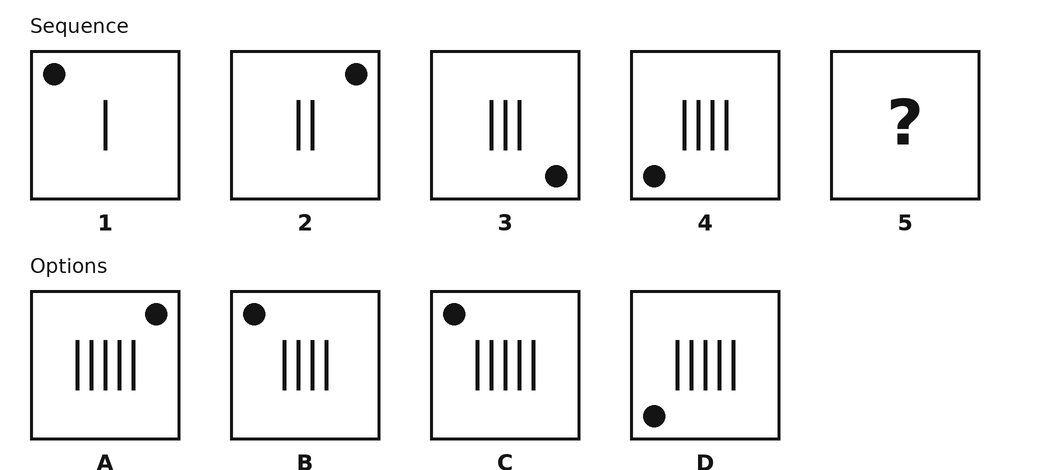
The figure shows a sequence of four boxes and a fifth box left blank. Which of the options A to D comes fifth in the sequence?

Sequence of four boxes. Box 1: a black dot in the top-left corner and 1 vertical line. Box 2: dot in the top-right corner, 2 lines. Box 3: dot in the bottom-right corner, 3 lines. Box 4: dot in the bottom-left corner, 4 lines. Box 5 is a question mark. Option A: dot top right, 5 lines. Option B: dot top left, 4 lines. Option C: dot top left, 5 lines. Option D: dot bottom left, 5 lines.
Show answer and explanation

Answer: C

Two rules work at once. The dot moves one corner clockwise each step (top left, top right, bottom right, bottom left), so in box 5 it is back at the top left. The number of lines goes up by one each step, 1, 2, 3, 4, so box 5 has 5. Only C has both. A moves the dot one corner too far, B forgets to add a line, and D keeps the dot where it was in box 4.

Question 77

Decision Making · Abstract Reasoning · Standard

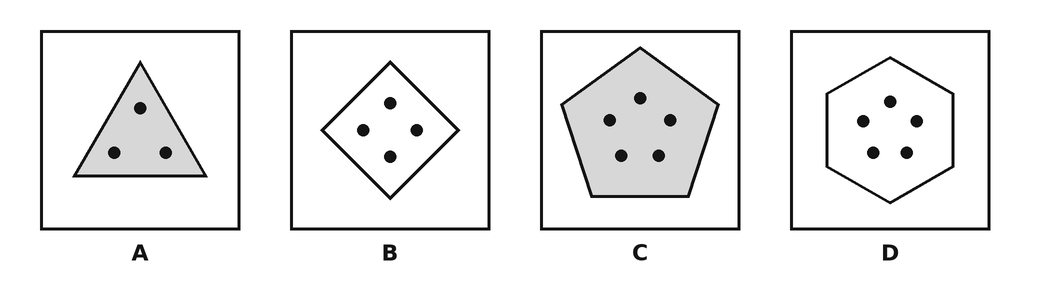
Three of the four figures follow the same rule. Which figure is the odd one out?

Four boxes. A: a grey triangle with 3 black dots inside. B: a white square, turned to stand on one corner, with 4 dots inside. C: a grey pentagon with 5 dots inside. D: a white hexagon with 5 dots inside. The shapes are of slightly different sizes.
Show answer and explanation

Answer: D

In A, B and C the number of dots equals the number of sides: 3 in the triangle, 4 in the square, 5 in the pentagon. D is a hexagon, six sides, with only five dots, so it breaks the rule. The shading (A and C grey, B and D white) and the sizes are distractors: they split the figures two and two, or vary at random, so they cannot single one out.

Question 78

Decision Making · Abstract Reasoning · Standard

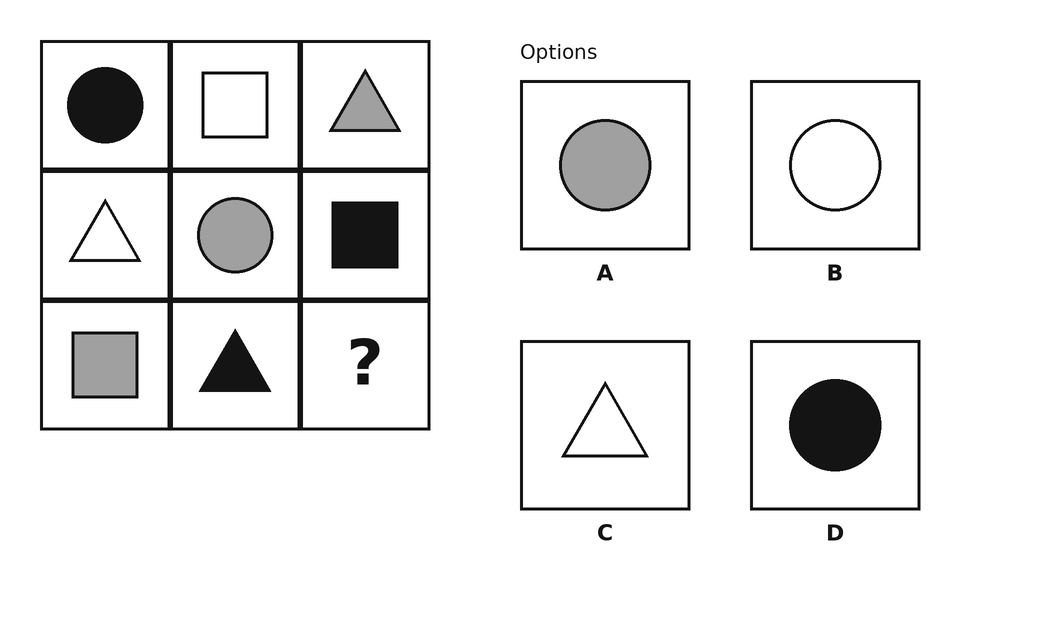
Which of the options A to D completes the grid?

A 3 by 3 grid. Row 1: black circle, white square, grey triangle. Row 2: white triangle, grey circle, black square. Row 3: grey square, black triangle, and a question mark. Options: A grey circle, B white circle, C white triangle, D black circle.
Show answer and explanation

Answer: B

Every row and every column contains each shape once (circle, square, triangle) and each shade once (black, white, grey). Row 3 already has a square and a triangle, so the missing figure is a circle; it already has grey and black, so the circle is white. The third column agrees: it has a grey triangle and a black square, so it needs a white circle. A and D repeat a shade already in the row and column; C repeats the triangle.

Question 79

Decision Making · Abstract Reasoning · Standard

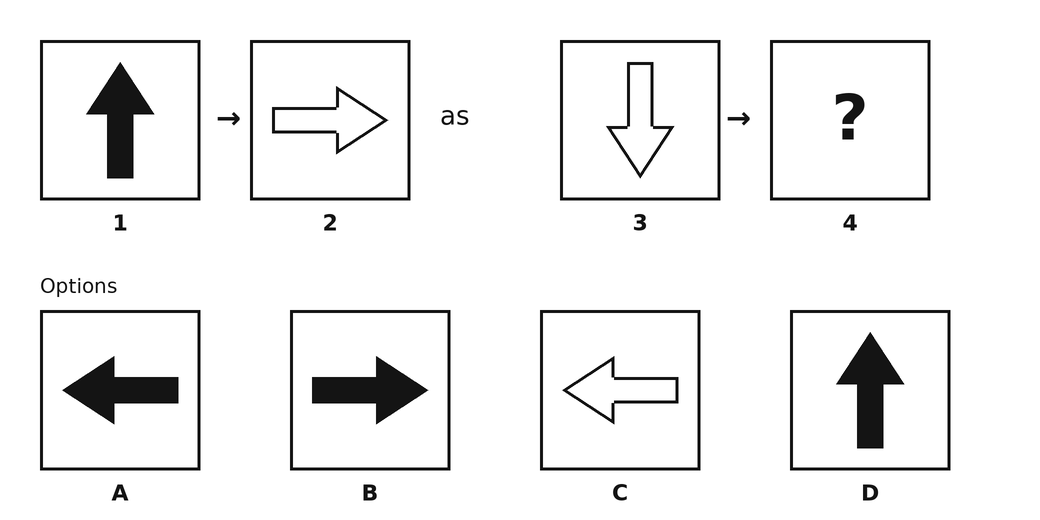
Figure 1 changes into Figure 2 by a rule. Apply the same rule to Figure 3. Which option is Figure 4?

Figure 1: a black arrow pointing up. Figure 2: a white arrow pointing right. Figure 3: a white arrow pointing down. Figure 4 is a question mark. Options: A black arrow pointing left, B black arrow pointing right, C white arrow pointing left, D black arrow pointing up.
Show answer and explanation

Answer: A

From Figure 1 to Figure 2 the arrow turns 90° clockwise (up to right) and its colour is reversed (black to white). Applied to Figure 3, a white arrow pointing down, a 90° clockwise turn points it left and reversing the colour makes it black: option A. B turns it anticlockwise, C forgets to change the colour, and D turns it 180°.

Question 80

Decision Making · Abstract Reasoning · Challenging

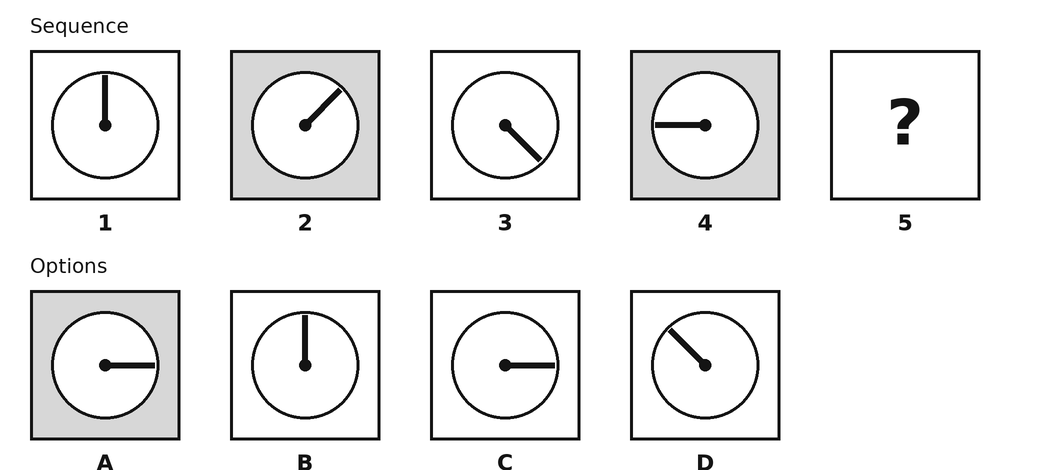
The figure shows a sequence of four dials and a fifth left blank. Which of the options A to D comes fifth?

Four dials, each a circle with one hand. Dial 1, on a white background: hand pointing straight up. Dial 2, grey background: hand pointing up and to the right, 45 degrees clockwise from up. Dial 3, white background: hand pointing down and to the right, 135 degrees from up. Dial 4, grey background: hand pointing left, 270 degrees from up. Dial 5 is a question mark. Options: A grey background, hand pointing right; B white background, hand pointing up; C white background, hand pointing right; D white background, hand pointing up and to the left.
Show answer and explanation

Answer: C

The hand turns clockwise by a growing angle: 45° (up to up-right), then 90° (to down-right), then 135° (to left). The next turn is 180°, from pointing left to pointing right. The background alternates white, grey, white, grey, so dial 5 is white: option C. A keeps the background grey; B adds 90° again; D adds only 45°.

About this paper

Medical University of Warsaw Entrance Exam past papers

The Medical University of Warsaw publishes no past papers and no sample test on its current admission pages. Its competency-test page links the official syllabus of each section (Biology, Chemistry and Decision Making) as PDFs, with the competency-test rules and the WUM Periodic Table you print for the test. The only official preview is the non-graded trial test: the exam platform emails its link in the week before your session, so you can learn the navigation before the scored attempt. IvyTest's practice questions and its free practice paper 1 are its own, written in the format WUM publishes; none is a WUM question.

This paper keeps everything WUM publishes about the test: 80 questions, 100 minutes, Biology 30, Chemistry 30 and Decision Making 20 (verbal reasoning, quantitative reasoning, problem solving and abstract reasoning, five each), two points for a Decision Making question, no negative marking and no calculator. WUM does not publish how many answer options a question has; this paper uses four (A to D), which matches the only sample file on WUM's site. Every question is IvyTest's own, written in that format, and every one has its answer explained.

Next step

How did you do?

One paper shows where you are today. Take the free diagnostic next, or read the Medical University of Warsaw Entrance Exam guide for the syllabus, dates and scoring in full.