

A man with blood group AB and a woman with blood group O have children together. Which blood groups can those children have?
Exam guide · Updated for 2027 admissions
Medical University of Warsaw Entrance Exam 2027: Complete Preparation Guide
Everything you need to know about the Medical University of Warsaw entrance exam, the online competency test WUM uses to select candidates for its English Division medicine degree: format, the 100-point scoring split, syllabus, sample questions, dates and deadlines, fees, entry requirements, online delivery, preparation strategy and practice.
Updated for 2027 admissions · Last updated: 7 October 2026
Medical University of Warsaw Entrance Exam at a glance
Overview
What is the Medical University of Warsaw entrance exam (the WUM competency test)?
The Medical University of Warsaw (WUM) runs its own online competency test for admission to the English Division of its six-year Medicine degree. Poland has no shared national medical entrance exam: each university sets its own, and Warsaw's is structurally unlike the ones its neighbours run. It is not the Polish Matura either, and holding a Matura result does not substitute for it.
The paper is 80 multiple-choice questions in 100 minutes (75 seconds per question on average), sat at home on your own computer under camera proctoring and delivered entirely in English. Three sections are scored: Biology (30 questions), Chemistry (30 questions) and Decision Making (20 questions). You may move freely between sections and questions for the whole 100 minutes; there is no per-section time limit and nothing is locked once answered.
The single most important thing to understand before you start revising is that the question counts and the point counts do not match. Biology and Chemistry questions are worth one point each; Decision Making questions are worth two. So Decision Making is a quarter of the paper by question count and two-fifths of it by score: 40 of the 100 points from 20 of the 80 questions. WUM's own guidance describes Decision Making as the section where the ranking spreads out, and the arithmetic in the scoring section below shows why a candidate can answer eight fewer science questions correctly than a rival and still finish ahead.
Programmes that use the Medical University of Warsaw Entrance Exam
- Medicine (English Division), 6-year MD, Warsaw Campus
Timeline
Medical University of Warsaw Entrance Exam 2027: dates and deadlines
When to expect your exam · 2027 start
- March 202728-29 MarBased on 2026
- April 202725-26 AprBased on 2026
- May 202723-24 MayBased on 2026
- June 20276-7 Jun, 20-21 JunBased on 2026
- July 20274-5 JulBased on 2026
Applications open 1 Mar 2027.
Predicted from this university's past sittings until it publishes its own dates. See every university on the calendar →
- Applications openRecruitment for the English-taught programmes opens on 1 March 2027, under WUM Senate Resolution No. 42/2026
- Application deadline2027/28 not yet published: WUM will announce the detailed dates by 15 February 2027. For 2026/27 the last day to register in ORS was 30 June 2026, and the last day to register for a competency-test session was 1 July 2026
- Application fee credited to ORSCandidate-specific rather than a calendar date: WUM's session page requires the fee to be credited to your ORS account no later than 7 days before the session you choose, and the Admission Board starts qualifying candidates about 14 days before it. International transfers can take several days, so an early transfer buys you scheduling room
- Non-graded trial testCandidate-specific: the exam platform emails you the trial-test link in the week before your session, and the trial test stays open until your competency-test date. It is not graded and exists to check your setup, not your knowledge.
- Competency test sitting2027/28 not yet published. The 2026 online sessions ran on 28-29 March, 25-26 April, 23-24 May, 6-7 June, 20-21 June and 4-5 July 2026
- Results publishedCandidate-specific: WUM says admission results are available about 14 working days after your session, and later when the Admission Board is busy
- Enrolment deadline2027/28 not yet published: Senate Resolution No. 42/2026 ends the whole 2027/28 recruitment on 30 September 2027. In 2026/27 a candidate offered a place had seven days to confirm it and pay the €1,000 confirmation fee, then had to complete the Admission File by the Admission Board's deadline
WUM manages dates, fees and login windows through its ORS online recruitment system rather than through a single annual call document, and can change them within a cycle. Its dates, fees and test rules were re-checked directly against WUM's own pages and documents on 7 October 2026. The 2027/2028 recruitment rules (Senate Resolution No. 42/2026) are published and set 1 March 2027 as the start of recruitment for English-taught programmes and 30 September 2027 as its end, but the session calendar is not yet out. Confirm any date through your ORS account and ed.wum.edu.pl before relying on it.
Structure
Medical University of Warsaw Entrance Exam format
80 questions in 100 minutes, sat as one continuous block with free navigation between sections and questions. The question counts and the point values are both published, and they are not proportional to each other, which is the most consequential feature of the paper.
| Section | Questions | Weighting | Suggested time |
|---|---|---|---|
| Biology | 30 | 30 of 100 points (1 point per question) | *see the note below the table |
| Chemistry | 30 | 30 of 100 points (1 point per question) | *see the note below the table |
| Decision Making | 20 | 40 of 100 points (2 points per question) | *see the note below the table |
| Physics | 0 | Not scored (0 of the 100 points) | WUM publishes a Physics Syllabus and a physics formula sheet, but no physics section is linked from the competency-test page and none is scored. Included here because candidates routinely find the syllabus and revise from it. |
- One continuous 100-minute sitting with free navigation: WUM sets no per-section time limit. 80 questions in 100 minutes is 75 seconds each on average.
Content
Question and subject breakdown
Three scored sections, and a fourth subject WUM publishes a syllabus for but does not test. Read the point column, not the question column: the two science sections are equal in both, and Decision Making is not.
Biology
30% of the score (30 of 100 points, from 30 of the 80 questions)Seven areas from WUM's official Biology Syllabus, in its own order: the cell, the chemistry of life, genetics, ecology and evolution, human health and physiology, plant science, and zoology with protists and fungi. The syllabus sets no per-area question quota. The level is high-school biology rather than university detail: items test the core rule and the standard reversal or absolute-claim trap rather than obscure fact.
Chemistry
30% of the score (30 of 100 points, from 30 of the 80 questions)Thirteen numbered units from WUM's official Chemistry Syllabus, running from stoichiometry and atomic theory through bonding, energetics, kinetics, equilibrium, solutions, acids and bases, redox and electrochemistry to a substantial organic chemistry unit. This is the calculation-heavy section and it is sat without a calculator, so the numbers are designed to resolve on round molar masses and separable powers of ten. A printed copy of the official WUM Periodic Table is permitted, so an item may assume you can look up an atomic number or mass, but not that you can multiply for free.
Decision Making
40% of the score (40 of 100 points, from 20 of the 80 questions)Four equally sized strands, given as approximate counts in WUM's official Decision Making syllabus: verbal reasoning 5 questions, quantitative reasoning 5, problem solving 5 and abstract reasoning 5. The syllabus states that the section requires no specific subject knowledge beyond basic scientific and mathematical material taught in secondary school, that calculators are not allowed, and, uniquely among the three sections, it states outright that there is no negative marking. Each question is worth two points, which is why this is the section WUM itself describes as the one where the ranking spreads out.
Physics
0 questions and 0 points; WUM publishes a Physics Syllabus, but the competency test does not score physicsWUM publishes a Physics Syllabus prepared against Matura standard-level attainment standards, together with a formula sheet covering kinematics, dynamics, gravity, oscillations and waves, optics, thermodynamics, electrostatics, electric current, magnetic fields and contemporary physics. It is not part of the competency test and carries no points. Treat it as optional support for quantitative confidence, and never as a fourth section to revise.
Marks
Medical University of Warsaw Entrance Exam scoring
Two rules govern this paper and they pull in the same direction. First, an incorrect answer and a blank are both worth zero, so leaving a question unanswered can only cost you. Second, not every question is worth the same: Biology and Chemistry items score one point, Decision Making items score two. Those two rules together mean the optimal strategy is unusually simple: answer everything, and protect Decision Making time first.
- Correct Biology question
- +1 point (30 questions, 30 points)
- Correct Chemistry question
- +1 point (30 questions, 30 points)
- Correct Decision Making question
- +2 points (20 questions, 40 points)
- Unanswered question
- 0 points, the same as a wrong answer, so a blank is never the better option
- Maximum possible score
- 100 points
- Negative marking
- None on any section: WUM's competency-test page states that it does not deduct points for incorrect answers, and that a correct answer earns 1 or 2 points and an incorrect one 0
- Answer options per question
- Not stated in any official WUM document checked; the rules summary says only 'multiple choice'. This matters for guessing arithmetic, so the expected values below are given at both four and five options.
- Minimum eligible score
- No pass mark on the test itself. Senate Resolution No. 42/2026 sets the 2027/28 ranking cut-off at no less than 66% of the maximum ranking points, which the Admissions Committee chair may lower if places stay unfilled; a zero in a qualifying subject excludes you.
- Per-subject floors
- None on the test. WUM sets no per-section minimum, and there is no Polish equivalent of the Italian OFA mechanism
- Reserve or replacement questions
- None described: all 80 questions are scored, and no extra time block for reserve items is mentioned anywhere
- How the ranking is built
- 20% of your school-grade points (Biology, Chemistry, and Physics or Mathematics) plus 80% of five times your test score, under Senate Resolution No. 42/2026
Worked example
Start with what the two-point rule does to a head-to-head. Candidate A answers 24 of 30 in Biology, 24 of 30 in Chemistry and 10 of 20 in Decision Making: 24 + 24 + (10 × 2) = 68 of 100. Candidate B answers 20 of 30 in Biology, 20 of 30 in Chemistry and 15 of 20 in Decision Making: 20 + 20 + (15 × 2) = 70 of 100. Candidate B got eight fewer science questions right and finishes two points ahead, because the five extra Decision Making items paid ten points against the eight the science items cost. Be careful about which unit you are improving, though, because the two are easy to confuse. Lifting Decision Making from 50% to 70% accuracy is a gain of 20 percentage points of accuracy on that section, which is 4 more questions, which is 8 raw points on the 100-point scale. Lifting Biology from 50% to 70% is the same 20 percentage points of accuracy, but on 30 questions rather than 20, so it is 6 more questions, and only 6 raw points, because each one is worth half as much. Equal effort, equal accuracy gain, different score. Guessing runs in your favour throughout, since nothing is deducted for a wrong answer: if WUM uses five options, a blind guess is worth (1/5 × 1) + (4/5 × 0) = +0.20 points on a science item and (1/5 × 2) + (4/5 × 0) = +0.40 on a Decision Making item; if it uses four, those become +0.25 and +0.50. A paper answered entirely at random would therefore score about 20 of 100 at five options, or about 25 at four. WUM does not publish the option count, so both figures are given, but the conclusion holds either way, and it is the only guessing advice this exam needs: never leave a box empty.
The IvyTest simulator scores every practice paper against these exact rules.
See the Medical University of Warsaw Entrance Exam simulatorSyllabus
Full Medical University of Warsaw Entrance Exam syllabus
The subject headings and the topics beneath them are official: they are the areas and numbered units of WUM's own Biology, Chemistry and Decision Making syllabuses, in the order those documents give them. None of the three sets a per-topic question quota, so no weighting is implied by position in the list. The Physics group is included last and is explicitly not examined.
Seven official areas. The syllabus's two trailing one-line entries, protists and fungi, carry no sub-bullets of their own and sit with zoology here.
- The cell: viruses, prokaryotic and eukaryotic cells, cell membranes, cell division and the cell cycle, cellular transport, energy in the cell, microbes and biotechnology
- The chemistry of life: chemical elements and water, carbohydrates, lipids and proteins, DNA structure and replication, transcription and translation, enzymes, cell respiration, photosynthesis
- Genetics: chromosomes, genes, alleles and mutations, Mendel's genetics and meiosis, theoretical genetics, patterns of heredity, genetic engineering and biotechnology, population genetics
- Ecology and evolution: communities and ecosystems, the greenhouse effect, ecology and conservation, community ecology, ecosystems and biomes, human impact on ecosystems, conservation of biodiversity, population ecology, the origin of life, species and speciation, human evolution, phylogeny and systematics, classification of organisms
- Human health and physiology: digestion and the transport of digested food, human nutrition and health, the circulatory system, defences against infectious disease and immunity, gas exchange, nerves, hormones and homeostasis, the endocrine system and hormonal control, stimulus and response, perception of stimuli, innate and learned behaviour, the nervous system and the human brain, neurotransmitters and synapses, support and locomotion, muscles and movement, reproduction, the urinary system
- Plant science: the biology of the plant cell, plant structure and growth, plant physiology, reproduction in plants, seedless plants, seed-producing plants
- Zoology, protists and fungi: animal tissues, invertebrates, chordates, parasitology, protists, fungi
Thirteen numbered units, in the official syllabus's own order. Sat without a calculator but with a printed copy of the official WUM Periodic Table, so numeric items are built to resolve by hand.
- Stoichiometry: chemical formulas and the mole concept, Avogadro's constant, chemical reactions and equations, mass relationships in reactions, calculations
- Atomic theory: the nuclear model of the atom, isotopes, electron arrangement in shells, sub-shells and orbitals, electron configuration notation
- The periodic table of the elements: electron configurations and the periodic table, valence configuration of atoms, s, p, d and f blocks and groups, periodic trends in physical and chemical properties
- Bonding: ionic bonding, covalent bonding, molecular orbitals and hybridization, shapes of molecules and ions, intermolecular forces, hydrogen bonding, metallic bonding
- States of matter: changes of state and kinetic theory, gases, the gas laws
- Energetics: exothermic and endothermic reactions, standard enthalpy changes of reaction, calculation of enthalpy change, Hess's law, entropy and free energy, spontaneity of a reaction
- Kinetics: reaction mechanism and collision theory, activation energy, rates of reaction and rate expressions, factors affecting the rate of reaction, order of reaction and half-life
- Equilibrium law: the equilibrium law and its applications, calculations involving equilibrium constants
- Solutions: solubility and the solubility product constant, concentrations of solutions, dissociation, the dissociation or ionization constant and the degree of dissociation, Ostwald's dilution law
- Acids and bases: Arrhenius, Brønsted-Lowry and Lewis definitions, properties of acids and bases, strong and weak acids and bases, the pH scale and pH calculations, indicators, salt hydrolysis, calculations involving acids and bases
- Oxidation and reduction: redox reactions, definitions of reduction, oxidation, oxidizing agent and reducing agent, balancing redox reactions
- Electrochemistry: standard electrode potentials, galvanic cells, cell electromotive force, electrolysis, calculations in electrochemistry
- Organic chemistry: structural, geometric and optical isomerism and tautomerism, functional groups and homologous series, multiple bonds, shapes of molecules and types of organic reaction; alkanes, alkenes, alkynes and arenes; halogenoalkanes; alcohols, phenols and ethers; aldehydes and ketones; carboxylic acids and the factors affecting their acidity; esters, esterification and its mechanism, hydrolysis, lipids and fats; amines and amides and the basicity of amines; amino acids and proteins, peptide bond formation and primary, secondary, tertiary and quaternary structure; carbohydrates as mono-, di- and polysaccharides; synthetic organic polymers made by polymerization and polycondensation; and for each class, the methods of preparation, physical and chemical properties, characteristic reactions and detection
Four strands, given in the official syllabus as approximately five questions each. The syllabus states that no specific subject knowledge is required beyond basic secondary-school scientific and mathematical material, and that no calculator is allowed, so every quantitative item has to be solvable by mental arithmetic, estimation and elimination.
- Verbal reasoning: analysing information presented in written form, drawing conclusions from a passage, identifying assumptions and flaws in an argument, recognising what would strengthen or weaken it, and distinguishing what the text actually supports from what merely sounds plausible
- Quantitative reasoning: reading, analysing and evaluating numerical data, extracting the relevant figures from tables and charts, percentages, ratios, rates and unit conversion, simple arithmetic performed without a calculator, estimation and order-of-magnitude checks
- Problem solving: selecting the relevant information from a longer scenario, applying logic to reach a solution, constraint, ordering and ranking puzzles, working backwards from a stated result, and testing the given options against the constraints
- Abstract reasoning: identifying patterns in abstract figural information, separating the governing rule from decorative distractors of colour, size and position, sequence completion, odd one out, and choosing the figure that completes a set
WUM publishes this syllabus, prepared on the basis of Matura standard-level attainment standards, together with a formula sheet. It carries no questions and no points on the competency test. It is listed here so you can recognise it and put it down.
- Scalars and vectors; motion, frames of reference and the elements of relativistic mechanics
- Forces and dynamics: Newton's laws, momentum and impulse, friction, the four fundamental interactions
- Fields and interactions: gravitation, electric charge and Coulomb's law, magnetic fields and the Lorentz force, electromagnetic waves
- Matter and thermodynamics: the ideal gas, the gas laws, the first and second laws, heat engines and thermal transfer
- Optics and waves: reflection, refraction, lenses and mirrors, interference and diffraction, the photoelectric effect, the eye and vision defects
- Energy, nuclear and modern physics: work, energy and power, mass-energy equivalence, radioactive decay and half-life, fusion in stars, wave-particle duality
Test your Medical University of Warsaw Entrance Exam knowledge
Take free diagnosticDifficulty
How difficult is the Medical University of Warsaw Entrance Exam?
Nothing on this paper is conceptually exotic: it is high-school biology, high-school chemistry and a reasoning section that assumes no syllabus at all. The difficulty is in the weighting, the clock and the fact that there is no published target to aim at.
A quarter of the questions carry two-fifths of the score
Decision Making is 20 of the 80 questions and 40 of the 100 points, because each item is worth two marks against the sciences' one. One Decision Making answer is worth exactly two Biology answers. Candidates who budget their 100 minutes by question count rather than by point value systematically underspend on the section that decides the ranking, and WUM's own guidance describes Decision Making as where the ranking spreads out.
Calculation-heavy chemistry, and no calculator
Thirteen chemistry units include stoichiometry, energetics, kinetics, equilibrium, solutions, pH calculations and electrochemistry, and you sit all of it with a pen, one sheet of paper and a printed periodic table. Online files may not be opened during the test, so even the periodic table has to be printed in advance. The numbers are designed to be tractable by hand, but only if your hand is practised.
Free navigation is a gift and a trap
You can move between sections and questions for the whole 100 minutes and change any answer until time expires. That removes the risk of being stranded mid-section, and it introduces the opposite risk: without section boundaries to enforce pacing, it is entirely possible to spend fifty minutes on chemistry and arrive at a double-weighted Decision Making section with twenty minutes left. 75 seconds a question is the average you have to hold yourself to.
No pass mark to aim at, only a ranking
WUM sets no pass mark on the test and no per-section floor. What decides a place is your ranking: 20% from your school grades and 80% from the test, with a cut-off that the 2027/28 rules put at no less than 66% of the maximum ranking points unless places stay unfilled. WUM does not publish an answer-option count either: its rules say only 'multiple choice'. Both points were checked against WUM's own documents on 28 September 2026, and they mean any specific target test score quoted elsewhere is somebody's estimate.
A published syllabus that isn't on the test
WUM publishes a Physics Syllabus and a physics formula sheet. The competency test scores Biology, Chemistry and Decision Making only, and no physics section is linked from the competency-test page. Candidates who find the physics document while researching and fold it into their revision plan are spending time on 0 of the 100 points.
Benchmarks
What is a good Medical University of Warsaw Entrance Exam score?
WUM publishes no pass mark on the test and no historical cutoffs. Admission is by ranking: your school grades count for 20% and the test for 80%, and the 2027/28 rules set the cut-off at no less than 66% of the maximum ranking points unless places stay unfilled. A target test score here would still be an invention, not a figure.
What can be said precisely is where the points are. Biology and Chemistry are 60 of the 100 between them and are the sections a well-prepared school leaver has most of already. Decision Making is 40 points from 20 questions and assumes no subject knowledge at all, which makes it the section most responsive to deliberate practice and the one where two candidates with identical science preparation separate from each other. That is the shape to plan around in the absence of a number.
Two structural facts are worth more than any cutoff estimate. The first is that a blank scores identically to a wrong answer, so your realistic floor is well above zero and there is no reason to ever run out of time with questions unanswered. The second is that your own scored, timed mocks (run at 80 questions in 100 minutes with Decision Making weighted at two points) tell you more about your position than any number circulating on a forum, because they are measured on the same 100-point scale WUM actually uses.
Pending verification
- · Any pass mark on the test itself: none in any official WUM document checked
- · The number of answer options per question: confirmed absent from every official WUM document checked
- · Historical admission cutoffs or competitive score ranges by year
- · Applicants per cycle for the English Division
- · The 2027/2028 registration deadline and competency-test dates, due by 15 February 2027
These specific numbers aren't public yet — an IvyTest simulator score is the closest benchmark you can get today.
Check your Medical University of Warsaw Entrance Exam scoreStrategy
How to prepare for the Medical University of Warsaw Entrance Exam
12+ weeks
Two sciences at 30 points each, and the 40-point section most people neglect
Full syllabus coverage in Biology and Chemistry, with Decision Making treated as a third subject from week one.
- Sit a full 80-question diagnostic in week one scored on the real 100-point scale, with Decision Making items counted at two points. Scoring a mock out of 80 instead of 100 hides exactly the thing this exam is built around.
- Work Biology's seven official areas and Chemistry's thirteen numbered units in parallel rather than one subject at a time: they are worth the same 30 points each, and neither has a published per-topic quota to prioritise by.
- Give Decision Making a fixed weekly slot from the start. It carries 40 of the 100 points, requires no memorised content, and improves with volume of practice more reliably than either science does.
- Build calculator-free arithmetic into chemistry practice deliberately: round molar masses, powers of ten, cm³-to-dm³ conversions and pH values done on paper. Add full 100-minute timed sittings from week six.
8 weeks
Budget your minutes by points, not by question count
Targeted repair across the two sciences, with Decision Making protected in every session.
- Diagnostic first, then convert each section's result into points rather than percentages: 18 of 30 in Biology is 18 points, while 12 of 20 in Decision Making is 24. Ranking your weaknesses by raw points is the only ranking that matters.
- Split Biology and Chemistry revision by the official area and unit lists so that no published heading goes untouched; neither syllabus tells you which ones carry more questions.
- Two Decision Making sessions a week, rotating verbal reasoning, quantitative reasoning, problem solving and abstract reasoning: the official syllabus gives all four roughly five questions each, so none can be skipped.
- One full timed 100-minute mock a week from week two, scored out of 100 and reviewed the same day. Track how many minutes you actually spent in each section against the 75-second average.
4 weeks
Full 100-minute sittings, scored the way WUM scores them
Volume of timed practice on the real 100-point scale.
- Two full 80-question mocks a week at the 100-minute limit, with Decision Making weighted at two points per item in every score you record.
- After each mock, compute what a 20-percentage-point accuracy gain would have been worth in each section: 4 more Decision Making questions is 8 points, 6 more Biology questions is 6. Spend the following week on whichever conversion is larger for you.
- Rehearse the sitting conditions exactly: camera on, one white sheet of paper and a pen shown to the camera, the official WUM Periodic Table printed on paper because no file may be opened on screen, and no calculator, phone, tablet or watch anywhere in reach.
- Practise the free-navigation habit you intend to use on the day (a first pass answering everything you know, then a second pass on the flagged items) rather than inventing one under time pressure.
Under 4 weeks
Fill every box, and defend the double-weighted section
Triage by point value and by what is still learnable in the time left.
- Take the non-graded trial test as soon as WUM releases it: it opens just after their email and stays open until your test date, it is not scored, and it is the only way to meet the real interface before it counts.
- Put Decision Making first in what remains. It is 40 points, it needs no new content learned, and it is the fastest-improving section this late; chemistry's thirteen units are not going to be rebuilt in three weeks.
- Sit at least two full, scored 100-minute mocks in the final ten days and confirm you are finishing. A question you never reach scores zero, and so does a wrong guess, so an unreached question is a pure, avoidable loss.
- On the day, answer every single question. With no negative marking, a blind guess is worth about +0.2 points on a science item and +0.4 on a Decision Making item, and there is no scenario in which leaving one blank is better.
Get your personalised Medical University of Warsaw Entrance Exam study plan
Take free diagnosticExplore the full Medical University of Warsaw Entrance Exam planPractice
Free Medical University of Warsaw Entrance Exam practice questions
Three questions in the format the exam uses. Choose an answer to see the explanation — nothing is recorded.
What mass of sodium hydroxide (NaOH, molar mass 40 g/mol) is needed to prepare 500 cm³ of a 0.20 mol/dm³ solution?
A hospital ward admitted 250 patients last month and 280 patients this month. By what percentage did admissions increase?
Illustrative examples written by IvyTest to show the question style — not past Medical University of Warsaw Entrance Exam papers.
Past papers
Medical University of Warsaw Entrance Exam past papers
The Medical University of Warsaw publishes no past papers and no sample test on its current admission pages. Its competency-test page links the official syllabus of each section (Biology, Chemistry and Decision Making) as PDFs, with the competency-test rules and the WUM Periodic Table you print for the test. The only official preview is the non-graded trial test: the exam platform emails its link in the week before your session, so you can learn the navigation before the scored attempt. The practice questions on this page are IvyTest's own.
IvyTest is writing a free practice paper in today's Medical University of Warsaw Entrance Exam format, with every answer explained.
University
Medical University of Warsaw medicine admissions
The competency test is one component of an application managed end to end through WUM's ORS online recruitment system. The figures below describe the English Division's six-year Medicine programme at the Warsaw campus.
- Degree
- Medicine, 6-year MD (English Division)
- Language of instruction
- English
- Campus
- Medical University of Warsaw, Warsaw, Poland
- Entrance exam mode
- Online, computer-based, sat at home under camera proctoring: the test is online even though the university and the clinical years are not
- Application process
- Managed through WUM's ORS online recruitment system; the competency test itself is released only once the application fee is credited to your ORS account
- Application fee
- €24 (with the competency test) or €20 (without)
- English certificate
- Required from qualified candidates as part of the final Admission File, at B2: IELTS Academic 6.5, TOEFL iBT 87, FCE 173, CAE, CPE or another accepted equivalent; an IB or EB diploma also counts. For 2027/28 (Senate Resolution 42/2026, Appendix 17) EU citizens whose native language is English, or who finished secondary school in English, need no certificate, and Norwegian, Swedish and Danish school grades of at least 4, C and 7 count; citizenship of an English-speaking country alone is not proof
- Motivation letter
- Not required
- Recommendation letters
- Not required
- Document requirements
- School documents issued abroad need an apostille or legalisation (IB and EB diplomas excepted), and documents not in English or Polish need a certified translation
- Clinical years in Polish
- Taught in years 1 to 3 (Basic Polish, then Polish for Medicine, where you learn to take a patient's history in Polish), ending in a final Polish exam; practical clinical classes start in year 4
- Cost of living
- The priciest of Poland's five medical-school cities in the IvyTest catalogue: budget above Gdańsk, Łódź, Kraków or Lublin
- City
- Poland's capital and largest city, with the country's biggest public-transport network and job market
- Tuition
- €18,800 a year for students starting in 2026/27 (€112,800 for the six years), or two instalments of €9,600 or four of €4,900; the €1,000 confirmation fee counts towards it
- Seats available
- 170 in 2026/27: the Minister of Health's admission limit for WUM's medicine taught in a language other than Polish. WUM publishes no applicant volume
- Interview
- Not a standard stage, though the 2027/28 recruitment rules reserve WUM's right to interview selected candidates
Read the full Medical University of Warsaw admissions guide →
The campus
The Medical University of Warsaw's Banacha campus
The Banacha campus, between Banacha, Żwirki i Wigury, Księcia Trojdena and Pawińskiego streets in Warsaw, is the campus most people mean by the Medical University of Warsaw (WUM). The model shows three of its buildings: the Rectorate, home to the university's authorities and the deans' offices, and the two buildings connected to it, the Library and Information Centre and the Didactic Centre, where lectures, seminars and exams are held. The university hospitals, the Medical Simulation Centre and the sports centre on the same campus are not modelled.
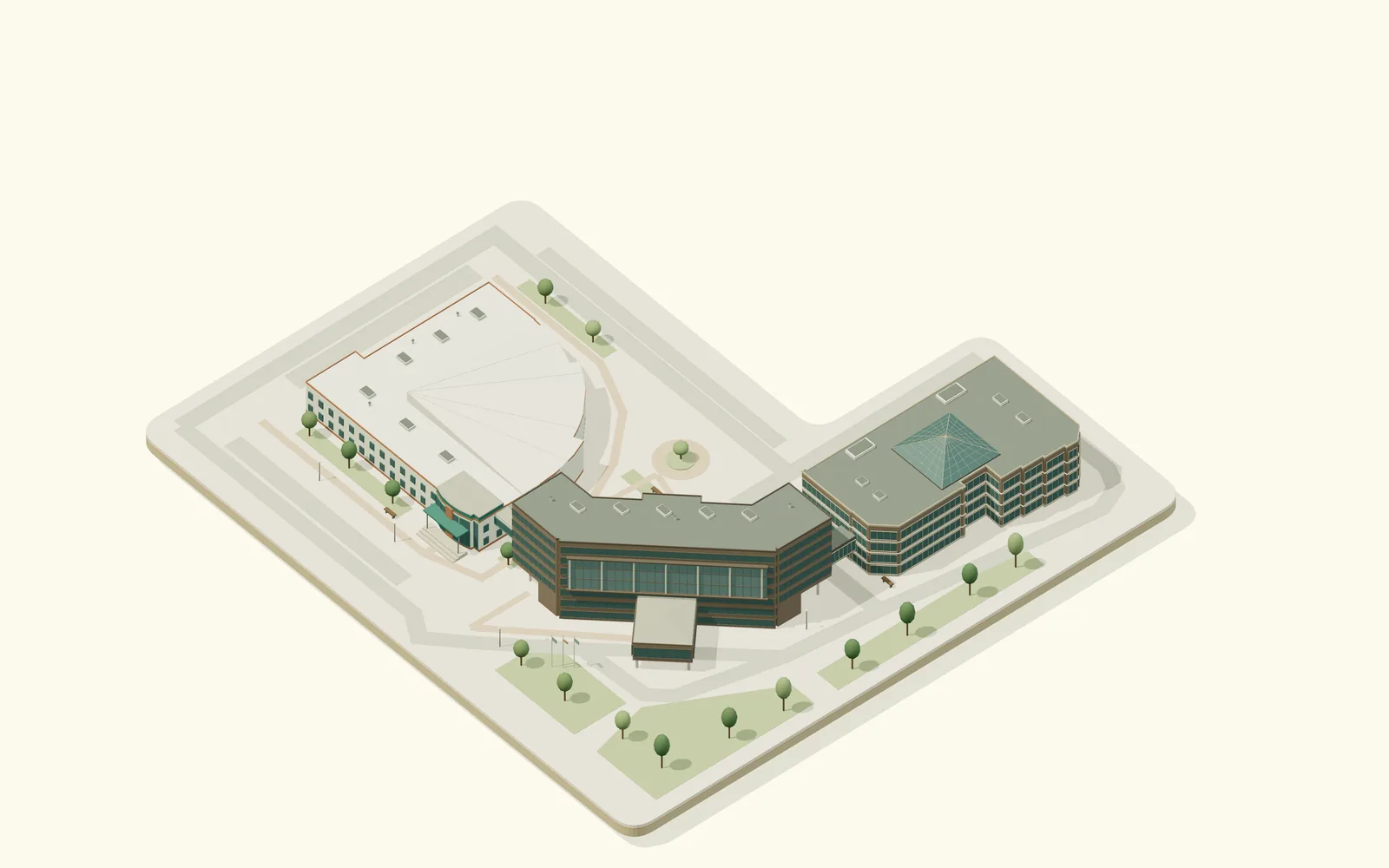
Explore the Banacha campus.
Open it in 3D to turn it and see what each building holds.
Stylized campus illustration, not a map or to scale.
Rectorate
Żwirki i Wigury 61: the seat of the rector and the deans, the deans' offices of the Faculties of Medicine, Medicine and Dentistry, Pharmacy and Health Sciences, and the Centre for Postgraduate Education. In use since 2000, it reopened in August 2024 after two years of modernization, with a new aluminium-and-glass façade in a brown shade matching the library's.
Library and Information Centre
Żwirki i Wigury 63: opened on 26 June 2012, four storeys and over 7,000 m², with multimedia lecture rooms, a 30-seat computer room for electronic exams, the Museum of the History of Medicine and, on the second floor, a 1,000 m² reading room with 230 seats.
Didactic Centre
Księcia Trojdena 2A: open since April 2006, where lectures, seminars and exams are held in its auditorium and lecture rooms. It also houses the Foreign Languages School, the Student Benefits Section and the Careers Office.
Address: ul. Żwirki i Wigury 61, 02-091 Warszawa
IvyTest Medical University of Warsaw Entrance Exam preparation
Ready to prepare properly for the WUM competency test?
Everything above is free and always will be. When you want structure (a syllabus-mapped book across Biology, Chemistry and Decision Making, a simulator that scores on the real 100-point scale with Decision Making weighted at two, lessons for the gaps your results flag, and help with the ORS application itself), that is what the IvyTest Warsaw package is.
Study guide
Biology's seven official areas and Chemistry's thirteen numbered units, plus the Decision Making strands most science-focused preparation leaves out entirely.
Exam simulator
Timed 100-minute mocks at 80 questions, scored out of 100 with Decision Making items weighted at two points, the way WUM actually ranks you.
Video courses
Focused lessons in biology, chemistry and reasoning for the topics your results flag, including calculator-free chemistry arithmetic.
Application support
MedApply: ORS deadlines, documents, legalisation and enrolment steps carried through to a confirmed place.
FAQ
Medical University of Warsaw Entrance Exam frequently asked questions
It is the online test the Medical University of Warsaw uses to select candidates for the English Division of its six-year Medicine degree: 80 multiple-choice questions in 100 minutes across Biology (30 questions), Chemistry (30) and Decision Making (20), scored out of 100 points.
Neither. Poland has no shared national medical entrance test: each university sets its own, and Warsaw's competency test is structurally different from what Gdańsk or Łódź run. It is also not the Matura: a Matura result does not substitute for sitting the competency test.
Online, from home, on your own computer under camera proctoring, and delivered entirely in English. You may have one white sheet of paper and a pen or pencil (shown to the camera before the test and destroyed afterwards), plus a printout of the official WUM Periodic Table. No calculator, phone, tablet, MP3 player or watch is permitted, and because no files may be opened on screen during the test, the periodic table has to be on paper.
Biology and Chemistry questions score one point each, so those two sections are 30 points each. Decision Making questions score two points each, so its 20 questions are worth 40 points: 40% of the score from 25% of the questions, for a total of 100. Wrong answers and blanks both score zero. WUM's own guidance describes Decision Making as the section where the ranking spreads out, which is exactly what the two-point weighting is for.
Guess on everything you cannot work out. WUM's competency-test page states that it does not deduct points for incorrect answers: a correct answer earns 1 or 2 points and an incorrect one 0, on every section, so a wrong answer costs you nothing a blank would not. That makes a blind guess worth roughly +0.2 points on a science item and +0.4 on a Decision Making item, and it means there is never a reason to leave a box empty.
WUM does not publish it. Its rules describe the test only as 'multiple choice', and none of the official Biology, Chemistry or Decision Making syllabuses, nor the official regulations document, states a count; IvyTest re-checked WUM's official sources directly on 28 September 2026 and confirmed the figure is absent rather than merely hard to find. Practically it makes little difference to strategy, since guessing is free either way, and WUM's non-graded trial test will show you the real interface before the scored attempt.
Not on the test: there is no pass mark and no per-section floor. Admission is by ranking, in which your school grades count for 20% and the test for 80%, and WUM's 2027/28 rules (Senate Resolution No. 42/2026) set the cut-off at no less than 66% of the maximum ranking points, a line the Admissions Committee chair may lower if places stay unfilled. Where it actually falls depends on who else applied. Poland also has no equivalent of the Italian OFA mechanism, so there is no extra-coursework consequence attached to a weak section.
No. WUM publishes a Physics Syllabus and a physics formula sheet, which candidates routinely find while researching and assume is examinable, but the competency test scores Biology, Chemistry and Decision Making only: physics is worth 0 of the 100 points. Treat the physics material as optional support for quantitative confidence, not as a fourth section to revise.
The Minister of Health's 2026/27 admission limit gives WUM 170 places in medicine taught in a language other than Polish. WUM publishes no applicant volume or acceptance rate, so any such figure quoted elsewhere is an estimate. What is published is that admission is ranking-driven, which makes the competition explicitly relative to the cohort you sit with.
Within the EU, yes, under the EU's automatic recognition of medical degrees, but Poland's entry asks for more than the diploma. Annex V of the EU Directive on professional qualifications lists the Polish lekarz diploma together with the certificate of the LEK (Lekarski Egzamin Końcowy), Poland's 200-question national final exam, and the certificate of completing the 13-month postgraduate internship (staż), conducted in Polish and arranged through a regional Medical Chamber, so the LEK matters beyond practising in Poland itself. The UK applies the same list: under the Medical Act 1983 (section 21B), a doctor of any nationality who holds it can register with the GMC without the knowledge test other international graduates sit, while a graduate without the LEK and the internship goes through the UKMLA. US-bound graduates need ECFMG certification via USMLE Step 1 and Step 2 CK, the same requirement every international medical graduate faces.
Yes. The IvyTest simulator runs WUM-format practice (80 questions in 100 minutes across Biology, Chemistry and Decision Making, scored out of 100 with Decision Making items weighted at two points) in timed, tutor and review modes, with a free diagnostic available without payment.
Not official ones. WUM publishes no past papers and no sample test on its current admission pages. Its PDFs are the syllabus for each section (Biology, Chemistry and Decision Making), the competency-test rules and the WUM Periodic Table you print for the test. The only official preview is the non-graded trial test, which the exam platform emails in the week before your session so you can learn the navigation. The practice questions on this page are IvyTest's own.
WUM had not published its 2027 session dates on 7 October 2026. Senate Resolution No. 42/2026 opens recruitment for the English-taught programmes on 1 March 2027 and ends it on 30 September 2027, with the detailed dates due by 15 February 2027. In 2026 the online sessions ran on 28-29 March, 25-26 April, 23-24 May, 6-7 June, 20-21 June and 4-5 July; the last day to register in ORS was 30 June and to book a session 1 July 2026.
A school-leaving certificate that admits you to university in the country that issued it, with passing grades in Biology and Chemistry at the level of the extended Polish Matura, plus Physics or Mathematics; a missing subject can be made up with WUM's own exam (pass mark 30%). Then you sit the competency test: exemption through UCAT, BMAT, MCAT, GAMSAT, HPAT or a BSc/MSc is open only to some international candidates. Once qualified, you add a B2 English certificate (such as IELTS Academic 6.5 or TOEFL iBT 87) or an IB or EB diploma. A certificate Poland does not recognise by law needs NAWA recognition first, which takes about 60 days.
For students starting in 2026/27, Medicine costs €18,800 a year, €112,800 for the six years, or two instalments of €9,600 or four of €4,900; Rector's Order No. 58/2026 keeps these fees until you finish your studies. The application fee is €24 with the competency test, €20 on the exempt paths. A candidate offered a place pays a €1,000 confirmation fee that counts towards tuition and is not refunded, except €500 for a written withdrawal before 15 July 2026. WUM accepts bank transfers in euros only.
The six-year MD carries 384 ECTS credits. It runs from morphology (clinical anatomy, histology with embryology) and the scientific basis of medicine, through pre-clinical subjects such as genetics, microbiology, pharmacology and pathomorphology, to the surgical and non-surgical clinical specialties, with 20 weeks of summer clerkship over the course. The 2026/27 first year includes Clinical Anatomy (180 hours), Histology with Embryology and Cytophysiology, Biophysics and Basic Polish (70 hours). Each year's syllabuses are on the English Division's Syllabuses page, and the 2026/27 winter semester began on 1 October 2026.
Yes. WUM's Senate set up the English Division in 1993 to teach Medicine in English, and its About us page says about 700 students from 75 countries now study there, with 80 to 100 graduating each year (its home page counts 614 English Division students). The six-year Medicine programme and a five-year Dentistry programme are taught in English, and the competency test is in English too. Polish is still part of the course: Basic Polish in year 1, then Polish for Medicine in years 2 and 3, where you learn to take a patient's history in Polish, with a final exam covering all three years; practical clinical classes start in year 4.
THE's own World University Rankings 2027 table puts it in the 1001-1200 band, the third-highest Polish medical university, level with Gdańsk, behind Wrocław (451-500) and Łódź (801-1000). By WUM's own reports: in the QS World University Rankings by Subject 2026 it is 451-500 for Medicine, one of seven Polish institutions listed; and in Poland's Perspektywy 2026 ranking its Medicine programme is 2nd of 19. WUM also says its graduates do well in the LEK, Poland's licensing exam. For reviews, its Studies in English page carries video testimonials from students and graduates. IvyTest has read THE's table, not the QS or Perspektywy ones.
WUM says the test checks high-school Biology and Chemistry plus logical problem solving, and needs no exceptional teaching or preparation. What makes it hard is the format and the competition: 80 questions in 100 minutes without a calculator, Decision Making worth 40 of the 100 points, and admission by ranking for 170 places in 2026/27, with a cut-off of at least 66% of the maximum ranking points under the 2027/28 rules. WUM publishes no applicant numbers, acceptance rate or past cut-offs.
Yes: r/WUM, where Medical University of Warsaw applicants ask each other about the Medical University of Warsaw Entrance Exam and share how their preparation is going. It is run by the IvyTest team. Dates, rules and results come only from the university's own pages, listed under Official sources on this page.
Verification
Official sources
- Competency Test: English Division admissionsChecked: 7 October 2026
Medical University of Warsaw, English Division
- Competency Test Sessions: registration and fee deadlinesChecked: 7 October 2026
Medical University of Warsaw, English Division
- Admission & Tuition FeesChecked: 7 October 2026
Medical University of Warsaw, English Division
- Official competency-test syllabuses: Biology, Chemistry and Decision Making (combined PDF)Checked: 7 October 2026
Medical University of Warsaw, English Division
- Regulations for the online competency test and additional exams conducted in 2026Checked: 7 October 2026
Medical University of Warsaw, English Division
- Trial test and competency-test arrangements, Faculty of MedicineChecked: 7 October 2026
Medical University of Warsaw
- Rector's Order No. 58/2026, Appendix 2: tuition fees for English-taught programmes from 2026/2027Checked: 7 October 2026
Medical University of Warsaw
- Admissions Criteria 2026/27: ranking formula and English certificatesChecked: 7 October 2026
Medical University of Warsaw, English Division
- Senate Resolution No. 42/2026: 2027/2028 recruitment rules, Appendix 17 (Medicine in English)Checked: 7 October 2026
Medical University of Warsaw
- Senate Resolution No. 42/2026: 2027/2028 recruitment rules, ranking cut-off (main annex, section 13)Checked: 7 October 2026
Medical University of Warsaw
- Senate Resolution No. 42/2026, Appendix 22: 2027/2028 recruitment datesChecked: 7 October 2026
Medical University of Warsaw
- Minister of Health regulation of 28 August 2026 on admission limits for medicine and dentistry in 2026/2027 (Journal of Laws 2026, item 1167)Checked: 7 October 2026
Minister of Health, Poland
- Recruitment Paths: the competency test, and exemption through UCAT, BMAT, MCAT, GAMSAT, HPAT or a BSc/MScChecked: 7 October 2026
Medical University of Warsaw, English Division
- Information for High School Graduates 2026: predicted grades, NAWA recognition, and seven days to confirm a placeChecked: 7 October 2026
Medical University of Warsaw, English Division
- 6-year Medicine Program (MD): 384 ECTS, the curriculum's subject areas, 20 weeks of clerkship, 170 places in 2026Checked: 7 October 2026
Medical University of Warsaw, English Division
- 1st year curriculum, 6-year program, academic year 2026/2027 (Syllabuses page)Checked: 7 October 2026
Medical University of Warsaw, English Division
- Schedule, academic year 2026/2027 (Rector's Announcement No. 72/2026)Checked: 7 October 2026
Medical University of Warsaw, English Division
- About us: the English Division, established in 1993, about 700 students from 75 countriesChecked: 7 October 2026
Medical University of Warsaw, English Division
- Studies in English: Medicine and Dentistry programmes, student and graduate testimonialsChecked: 7 October 2026
Medical University of Warsaw
- WUM with a higher score in the Times Higher Education World University Rankings 2027 (in Polish): the 1001-1200 bandChecked: 7 October 2026
Medical University of Warsaw
- WUM again with a strong position in the QS World University Rankings by Subject: Medicine 451-500 (2026)Checked: 7 October 2026
Medical University of Warsaw
- WUM in the Perspektywy Higher Education Ranking 2026: Medicine 2nd of 19Checked: 7 October 2026
Medical University of Warsaw
- 2nd year syllabuses 2025/2026: Polish for Medicine (60 hours, history-taking in Polish)Checked: 12 October 2026
Medical University of Warsaw, English Division
- 3rd year syllabuses 2025/2026: Polish for Medicine, Communication Skills, and the final Polish exam covering years 1 to 3Checked: 12 October 2026
Medical University of Warsaw, English Division
- English Division home page: 614 English Division studentsChecked: 12 October 2026
Medical University of Warsaw, English Division
- THE World University Rankings 2027: the full tableChecked: 12 October 2026
Times Higher Education
- Directive 2005/36/EC on the recognition of professional qualifications, consolidated text of 29 October 2025, Annex V point 5.1.1 (Poland: the lekarz diploma with the LEK and postgraduate internship certificates)Checked: 12 October 2026
Publications Office of the European Union (EUR-Lex)
- Medical Act 1983, section 21B: registration with a relevant European qualification, without the knowledge test, for applications made since IP completion day (Brexit)Checked: 12 October 2026
legislation.gov.uk (The National Archives)
Last reviewed by IvyTest editorial team: 7 October 2026. Admission rules change every cycle — always confirm against the official Medical University of Warsaw call for applications before acting on a deadline.
Find out how ready you are for the WUM competency test.
The diagnostic takes one sitting, scores you on the real 100-point scale with Decision Making weighted at two, and shows you which section is actually costing you points. No payment, no commitment.