
A sample of double-stranded DNA is found to contain 32% adenine. What percentage of the bases in the sample is guanine?
Exam guide · Updated for 2027 admissions
Szeged Entrance Exam 2027: Complete Preparation Guide
Everything you need to know about the Szeged entrance exam, the University of Szeged's own test for its English-taught Medicine, Dental Medicine and Pharmacy programmes at the Albert Szent-Györgyi Medical School: format, topic list, sample tests, scoring, the Physics alternative, the oral exam that follows, dates and deadlines, preparation strategy and practice.
Updated for 2027 admissions · Last updated: 16 October 2026
Szeged Entrance Exam at a glance
Overview
What is the University of Szeged entrance exam?
The University of Szeged admits to its English-taught Medicine, Dental Medicine and Pharmacy programmes through its own entrance examination at the Albert Szent-Györgyi Medical School, the faculty named after the city's Nobel laureate. As with every Hungarian medical school, there is no national test behind it: Szeged, Semmelweis, Debrecen and Pécs each write and deliver their own, and Szeged's is the shortest of the four by time: one hour, start to finish.
The written paper is 60 multiple-choice questions in 60 minutes: 20 Biology, 20 Chemistry and 20 General and Medical English. The three sciences use five options (A-E) and the English section uses four (a-d), confirmed item by item on all four of the university's own sample papers. It is delivered online on Coospace and invigilated over Zoom, with a periodic table and a calculator prepared in advance for the Chemistry section. Physics can replace Chemistry on request, in sittings hosted by the Admissions Office, though not for Stipendium Hungaricum applicants, and it replaces it rather than adding to it, so a Physics-route candidate still faces exactly 60 questions.
Two delivery rules change how the exam is actually sat. Questions appear one at a time with no backward navigation, and an answer has to be selected before you can move on, so in practice nothing can be left blank. Because wrong answers deduct nothing, that combination removes the usual guess-or-skip decision entirely: the exam requires a guess on every item you cannot answer, and the only lever you have is how many options you can eliminate first. After the written paper, a separate oral examination of about 20 minutes follows on Zoom, pairing general conversation with two Biology and two Chemistry questions asked in English.
Programmes that use the Szeged Entrance Exam
- Medicine (English-taught, Albert Szent-Györgyi Medical School, Szeged)
- Dental Medicine (English-taught, Szeged)
- Pharmacy (English-taught, Szeged)
Timeline
Szeged Entrance Exam 2027: dates and deadlines
When to expect your exam · 2027 start
- January 202726-28 JanPublished
- February 202723-25 FebPublished
- March 20279-11 Mar, 22-24 MarPublished
- April 202720-22 AprPublished
- May 202711-13 May, 25-27 MayPublished
- June 20278-10 Jun, 22-24 JunPublished
Applications open 1 Dec 2026.
Dates the university has published for this cycle. See every university on the calendar →
- Applications open1 December 2026
- Application deadline1 June 2027 (23:59 CET)
- Entrance examination sessions26 January to 24 June 2027
- Oral examinationDay 2 or 3 of each session
- Results publishedResults date not yet announced
- Enrolment deadlineEnrolment deadline not yet announced. The first semester's tuition is due within 14 days of the Admission Letter, and students admitted by 1 April get €300 off it, so the useful date may be earlier than the formal one
| Session | Register by | Written test, then orals |
|---|---|---|
| 1 | 19 January 2027 | 26-28 January 2027 |
| 2 | 16 February 2027 | 23-25 February 2027 |
| 3 | 2 March 2027 | 9-11 March 2027 |
| 4 | 16 March 2027 | 22-24 March 2027 |
| 5 | 13 April 2027 | 20-22 April 2027 |
| 6 | 4 May 2027 | 11-13 May 2027 |
| 7 | 18 May 2027 | 25-27 May 2027 |
| 8 | 1 June 2027 | 8-10 June 2027 |
| 9 | 15 June 2027 | 22-24 June 2027 |
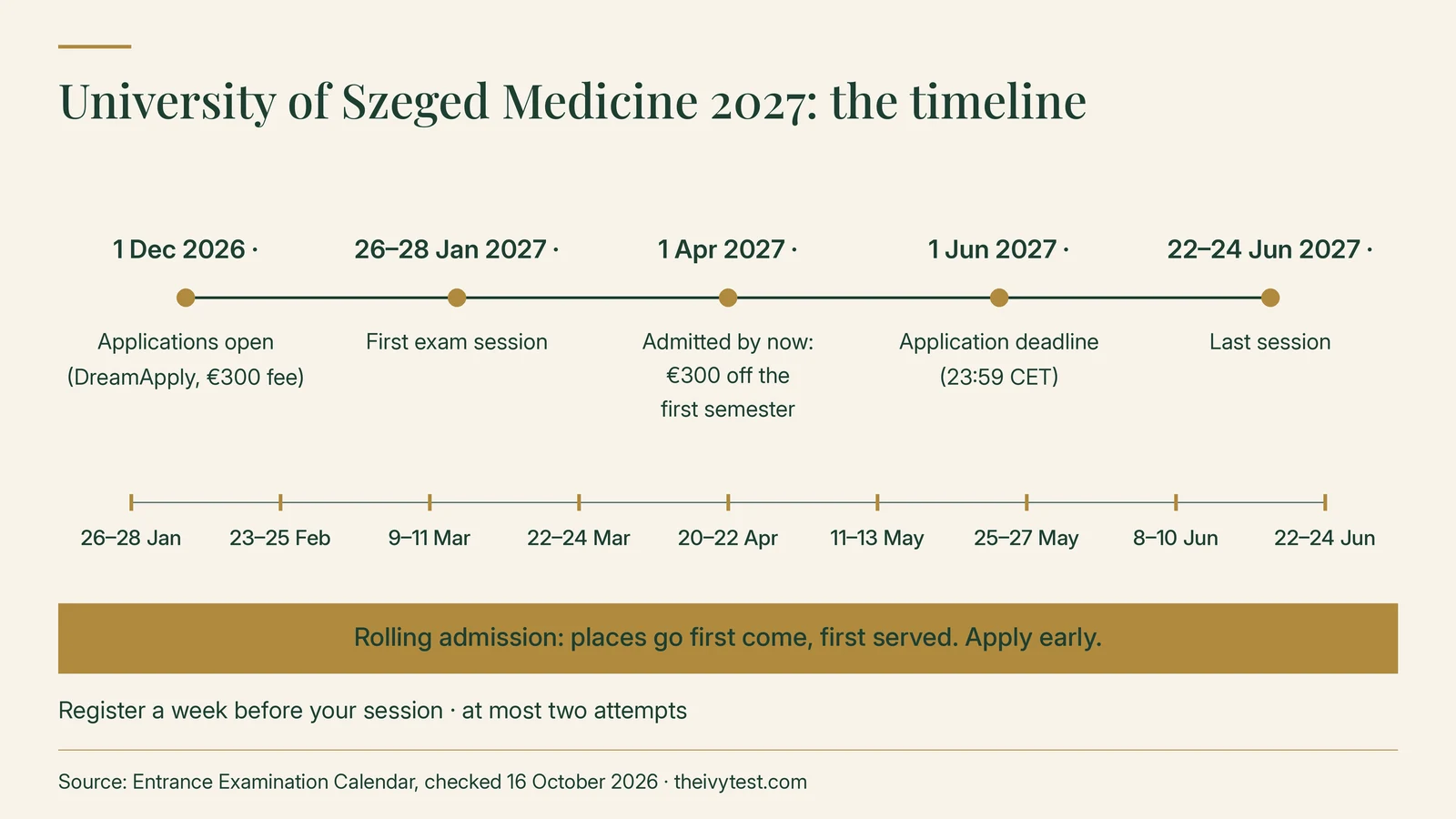
Szeged publishes no admission Call comparable to the Italian ones, and none of its published entrance-examination materials names an academic year. The binding sources are its own pages at med.u-szeged.hu, read directly on 28 September 2026, when the online-application page already gave the 2027/2028 window (1 December 2026 to 1 June 2027 for General Medicine), together with the official Entrance Examination Topics PDF and the current Biology, Chemistry and English sample papers. The Physics sample paper is still the 2022 edition, live and unchanged, and the only one the university serves, but not itself dated as current. IvyTest re-checks these pages and updates this guide when the next cycle's materials appear. On 16 October 2026 the Entrance Examination Calendar listed nine 2027 sessions, from 26-28 January to 22-24 June 2027; the first falls before the 'end of February' the exam page still gives, so go by the calendar and check it again before you register.
Structure
Szeged Entrance Exam format
Sixty questions in sixty minutes: a minute each, with no per-question limit imposed, so the hour is yours to manage. But only forwards: items are presented one at a time, an answer must be selected before you proceed, and you cannot return. A periodic table and a calculator are prepared in advance for the Chemistry section. The Physics row below is an alternative to Chemistry, not an addition to it.
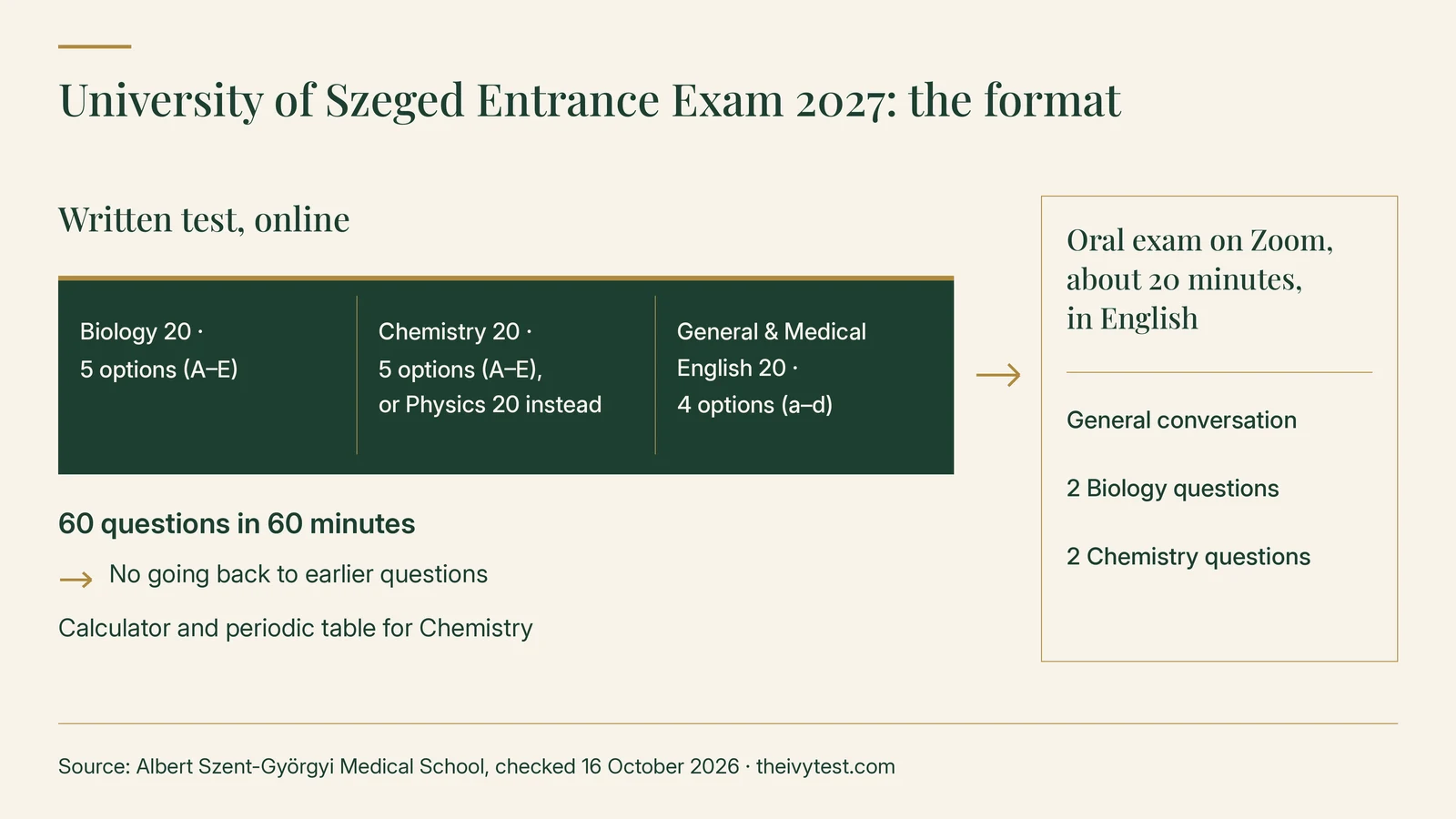
| Section | Questions | Weighting | Suggested time |
|---|---|---|---|
| Biology | 20 | 33% (20 of 60); five options (A-E) | *see the note below the table |
| Chemistry | 20 | 33% (20 of 60); five options (A-E) | One continuous 60-minute sitting; a periodic table and a calculator are prepared in advance for this section |
| Physics (on request, instead of Chemistry) | 20 | 33% (20 of 60) if taken; five options (A-E) | Offered in sittings hosted by the Admissions Office and not available to Stipendium Hungaricum applicants; it replaces the Chemistry block rather than adding to it |
| General and Medical English | 20 | 33% (20 of 60); four options (a-d) | *see the note below the table |
- One continuous 60-minute sitting; Szeged sets no per-section or per-question time limit
Content
Question and subject breakdown
Three blocks of 20, weighted identically, with a genuine choice inside the second one. Szeged publishes an official Entrance Examination Topics list covering Biology, Chemistry and Physics, and, like its Hungarian peers, no syllabus at all for the English section that carries the same 20 marks as either science.
Biology
33%Compulsory, and organised around the four official headings: Cell Biology, Physiology, Genetics and Evolution. In practice that spans biological molecules and enzymes, cell structure and organelles, the membrane and transport, cellular respiration and ATP production, replication, transcription and translation with base-pairing arithmetic, mitosis and meiosis, bacterial cells and viruses, then a long physiology run through digestion, gas exchange, excretion, circulation, blood and immunity, the musculoskeletal system, the endocrine system and reproduction, and the nervous system and sense organs, closing on genetics, inheritance and evolution. Five options per item; the 2025 sample paper contains no figures.
Chemistry
33%The default second science, following the official list's two headings: General and Inorganic Chemistry, and Organic Chemistry. Atomic structure and the mole, the periodic table and periodic properties, bonding and molecular geometry, intermolecular forces and types of solid, solutions and concentration, equilibrium, acids, bases and pH, redox, and the compounds of carbon, nitrogen, phosphorus and sulfur; then functional groups, isomerism and reaction types, hydrocarbons, alcohols, ethers and phenols, oxo compounds and carboxylic acids, amines, amino acids and the peptide bond, and carbohydrates and nucleic acid components. A periodic table and a calculator are prepared in advance, so numerical items are squarely in scope.
Physics (on request, instead of Chemistry)
33% if takenA real alternative rather than an extra: taken on request in sittings hosted by the Admissions Office, and not available to Stipendium Hungaricum applicants. Twenty five-option questions covering kinematics, Newton's laws and forces, work, energy and momentum, torque, equilibrium and circular motion, simple harmonic motion and elasticity, fluids and buoyancy, heat and thermal properties, gases and thermodynamics, waves and sound, optics, electrostatics and capacitance, current, resistance and circuits, magnetism and alternating current, and atomic physics. Worth knowing before you choose it: the only Physics sample paper Szeged serves is the 2022 edition, so there is less recent material to calibrate against than for Biology or Chemistry.
General and Medical English
33%The only four-option section, and the only one with no official syllabus: the Entrance Examination Topics list covers the sciences alone. The 2025 sample splits ten grammar and vocabulary items from ten medical terminology items, though that 10/10 division is an observation of one paper rather than a published rule. The general half covers tenses and aspect, verb patterns and the passive, prepositions, quantifiers and possessives, and collocation and formal register; the medical half covers anatomical and body-region terms, everyday equivalents of clinical words, eye and ear terminology, instruments, specialists, drug classes and symptom vocabulary.
Marks
Szeged Entrance Exam scoring
Szeged's marking is the simplest of the four Hungarian schools in our catalogue, and the delivery makes it simpler still: a correct answer scores one point, a wrong answer deducts nothing, and you are not permitted to leave anything blank in the first place. Szeged publishes no Call document, so these rules come from its own entrance-examination page as carried in the source material, cross-checked against the official sample papers for the option counts.
- Correct answer
- +1 point
- Incorrect answer
- 0 points (wrong answers deduct nothing)
- Unanswered question
- Not possible in practice: an answer must be selected before you can move to the next item
- Revisiting a question
- Not possible: items are presented one at a time with no backward navigation
- Maximum possible score
- 60 points (three blocks of 20)
- Answer options
- 5 (A-E) in Biology, Chemistry and Physics; 4 (a-d) in General and Medical English
- Minimum eligible score
- No entrance-exam pass mark, qualifying threshold or cut-off appears on the official FAQ or on any other official page checked on 21 September 2026
- Minimum GED score (a different thing)
- 165 per subject for Medicine, 145 for the Foundation Year: a school-leaving-equivalency gate that decides whether you may apply at all, checked before you ever sit the entrance exam, and not a score on it (165 is the Foreign Students' Secretariat FAQ's figure for Medicine; the faculty's English FAQ, read on 16 October 2026, says 145, so ask the Admissions Office which applies)
- Per-subject floors
- None published: Hungary has no counterpart to the Italian OFA subject floors
- Permitted materials
- A periodic table and a calculator, prepared in advance for the Chemistry section
- What follows the written paper
- A separate oral examination of about 20 minutes on Zoom: general conversation plus two Biology and two Chemistry questions in English
Worked example
Because no answer can be skipped and no wrong answer costs anything, the usual guess-or-skip calculation does not exist here: every unknown item is a forced guess with a strictly positive expected value, and the only question is how well informed the guess is. That makes the floor of a completely blind paper computable. A blind guess on a five-option science item returns 1/5 = +0.20 marks; on a four-option English item it returns 1/4 = +0.25. With 40 five-option science items and 20 four-option English items, guessing blindly at all sixty has an expected value of (40 × 0.20) + (20 × 0.25) = 8 + 5 = 13 marks out of 60, or about 21.7%. Everything above that line you earn by narrowing the field: cutting a five-option item down to two plausible answers lifts its expected value from 0.20 to 0.50, worth +0.30 marks, and cutting a four-option item to two lifts it from 0.25 to 0.50, worth +0.25. Now the units, which on this paper behave unusually cleanly. Because the scale is 60 marks with one point per item, no penalty and no possible blanks, the percentage of items you answer correctly and the percentage of the maximum score you achieve are the same number: 45 correct is 45 marks is 75%, exactly. That equivalence does not survive inside a section, though, and confusing the two is the commonest way people overstate an improvement: lifting your accuracy by 15 percentage points across the 20-question Biology block gains 0.15 × 20 = 3 marks, which is 5 percentage points of the 60-mark paper, not 15. Say which you mean: points of accuracy within a block, or marks on the paper.
The IvyTest simulator scores every practice paper against these exact rules.
See the Szeged Entrance Exam simulatorSyllabus
Szeged entrance exam topic list
The Biology, Chemistry and Physics groups below carry every bullet of Szeged's official Entrance Examination Topics list (2023 edition), regrouped into pools of comparable size with nothing added. The English group is derived from the 2025 General and Medical English sample paper rather than from any published syllabus, because the official topics list covers the sciences only. Remember that Physics replaces Chemistry rather than joining it.
Official. Szeged's four headings (Cell Biology, Physiology, Genetics and Evolution), with the two largest blocks split into workable groups. The 2025 sample paper contains no figures.
- Biological molecules and enzymes: the types and functions of lipids, biologically important carbohydrates, primary, secondary, tertiary and quaternary protein structure, the structure of DNA and RNA, the types and function of RNA molecules, and what enzymes are and how they are regulated
- Cell structure and organelles: the cell as the basic structural and physiological unit, the nucleus, chromosomes, endoplasmic reticulum, Golgi apparatus, ribosomes and their composition, lysosomes, the cytoskeleton, and prokaryotic against eukaryotic organisation
- The cell membrane and transport: the structure of the cell membrane, membrane transport including simple and facilitated diffusion, osmosis, active transport and the sodium-potassium pump, and exocytosis and endocytosis including phagocytosis and pinocytosis
- Cellular respiration and ATP production: glycolysis, the citric acid cycle, and the mechanism of ATP production in the mitochondria
- Replication, transcription and translation: DNA replication and the enzymes involved including helicase, primase, polymerase and ligase, leading and lagging strands, transcription, translation, codons and anticodons, and base-pairing arithmetic
- Mitosis and meiosis: mitosis, meiosis, the phases of the cell cycle including S phase, crossing over and independent assortment, and the differences between the two divisions
- Bacterial cells and viruses: the structure of the bacterial cell, transformation, conjugation and transduction, and the structure of viruses
- Digestion and absorption: the parts of the digestive system, the digestive enzymes, absorption of food and water, the emulsifying role of bile, and the liver's conversion of glucose
- Respiration and gas exchange: the parts of the respiratory system, the mechanism of inhalation and exhalation, and oxygen and carbon dioxide exchange in the lungs and its dependence on diffusion
- Excretion and kidney function: the parts of the excretory system, and water and ion transport in the kidneys
- Circulation, blood and immunity: the parts of the circulatory system, the structure and function of the heart including the pacemaker and the conducting tissue, the vessels entering and leaving each chamber, blood composition and cell types, and the cellular and humoral immune responses
- Bones, joints and muscle contraction: muscles, bones and joints, the roles of tendons and ligaments, and the mechanism of muscle contraction
- Endocrine system and reproduction: the pituitary, adrenal, thyroid and pancreatic glands and their hormones, local hormones, hormonal regulation of blood glucose, hormonal regulation of stress, the parts of the male and female reproductive systems, the ovarian and uterine cycles, and hormonal control of the reproductive system
- Nervous system and sense organs: the autonomic nervous system, central against peripheral nervous system, the spinal cord and spinal reflexes, the parts of the human brain and the functions of the lobes, nerve cell structure, resting and action potential, neurotransmitters and synaptic transmission, the structure of the eye and the mechanism of vision, the auditory system and the mechanism of hearing, the olfactory system, and mechanoreceptors and chemoreceptors
- Genetics and inheritance: the laws of Mendel, the structure of genes, levels of gene expression, the lactose operon, the genetic code with its redundancy and non-ambiguity, mutations and their types and consequences, human chromosome number aberrations and genetic diseases, and dominant-recessive and sex-linked inheritance
- Evolution and the origin of life: Darwin's theory, variation and natural selection, the species concept, and the origin of life
Official. Szeged's two headings (General and Inorganic Chemistry, and Organic Chemistry), split into workable groups. A periodic table and a calculator are prepared in advance for this section, so numerical items are in scope.
- Atomic structure and the mole: elements and compounds, the mole concept and Avogadro's number, conversion between particles, moles and grams, the basic structure of atoms, the quantum numbers, atomic number and mass number, isotopes and neutron count, balancing simple chemical equations, and empirical and molecular formulas
- The periodic table and periodic properties: groups and periods, metals and nonmetals, the symbols and names of common elements, atomic radius, ionisation energy, electronegativity and electron affinity
- Chemical bonding and molecular geometry: the types of chemical bonding, ionic, covalent and metallic bonds, polar and nonpolar bonds, Lewis structures, counting bonding and nonbonding electron pairs, and the geometry of molecules and molecular polarity
- Intermolecular forces and types of solid: London dispersion forces, dipole-dipole interaction, hydrogen bonding and their effect on boiling point, and ionic, molecular, metallic and covalent network solids
- Solutions and concentration: solutions and the ways of expressing their composition, molarity and mass percent, density and the mass of a solution, and dilution
- Chemical equilibrium: dynamic equilibrium, Le Chatelier's principle, the effect of concentration, temperature and pressure or volume changes, and worked gas-phase equilibria with the direction of the shift
- Acids, bases and pH: the acid-base theories, the definition of pH and the pH scale, examples of strong and weak acids and bases, and calculating pH for monoprotic strong acids
- Oxidation and reduction: the definitions of oxidation and reduction, oxidation numbers and the rules for assigning them, and recognising a redox reaction among neutralisation and precipitation reactions
- Compounds of carbon, nitrogen, phosphorus and sulfur: carbon and its inorganic compounds, nitrogen and its compounds, phosphorus and its compounds, and sulfur and its compounds
- Functional groups, isomerism and reaction types: functional groups and their recognition from a structure, the types of organic reaction including addition, substitution, elimination, combustion and hydrolysis, and isomerism in organic compounds with types and examples including structural and constitutional isomers
- Hydrocarbons: alkanes with their nomenclature and physical and chemical properties, alkenes and alkynes with their nomenclature and properties, aromatic hydrocarbons and their reactions, IUPAC naming from a drawn skeletal structure, and the general formula of an acyclic alkane
- Alcohols, ethers and phenols: the classification and preparation of alcohols, their physical properties, their chemical properties and most important representatives, and ethers and phenols
- Oxo compounds and carboxylic acids: the classification of oxo compounds and their oxidation-reduction reactions, carboxylic acids with their nomenclature and physical and chemical properties, reaction with hydroxide bases, and the carboxylic acid derivatives esters and amides
- Amines, amino acids and the peptide bond: the classification and nomenclature of amines, examples of their chemical reactions, the proteinogenic amino acids, and the peptide bond
- Carbohydrates and nucleic acid components: the definition and classification of carbohydrates, the most important representatives across mono-, di- and polysaccharides, and the components of nucleic acids
Official. Szeged's Physics topic list, printed in mixed order, regrouped into conventional areas. Young's modulus and the reference sound level appear in the sample paper rather than in the official list and are carried for that reason. The only Physics sample Szeged serves is the 2022 edition.
- Kinematics: speed and velocity, average speed over an interval, acceleration, free fall, scalar and vector quantities, and units with their multiples and submultiples
- Newton's laws and forces: Newton's laws, force and the principle of superposition, forces of friction, Hooke's law, mass and weight, and the universal law of gravitation
- Work, energy and momentum: work and kinetic energy, the work-energy theorem, potential energy, the law of conservation of energy, and linear momentum and its conservation in recoil and collision problems
- Torque, equilibrium and circular motion: torque and lever arm, the conditions of equilibrium, uniform circular motion, and centripetal acceleration and centripetal force
- Simple harmonic motion and elasticity: simple harmonic motion with displacement, velocity and acceleration, period, amplitude, frequency and angular velocity, spring force, and the elongation of a loaded rod with Young's modulus
- Fluids and buoyancy: pressure in fluids, Pascal's principle, the pressure-depth relation, the hydraulic press, Archimedes' principle and buoyancy, and apparent weight when submerged
- Heat and thermal properties: the concept of temperature and temperature scales, thermal expansion, heat capacity and specific heat, and change of phase with latent heat
- Gases and thermodynamics: the ideal gas law, isothermic, isobaric and isochoric processes, the kinetic theory of gases, and the first law of thermodynamics
- Waves and sound: mechanical waves and the relation between wavelength, frequency and speed, interference, diffraction, standing waves and resonance, sound and the standard reference sound level, and the Doppler effect
- Optics: light as an electromagnetic wave, reflection and refraction, dispersion and the colours of light, optical lenses and mirrors, optical instruments, and real and virtual images with focal length
- Electrostatics and capacitance: electric charges and Coulomb's law, the electric field and field lines, electric flux and Gauss's law, electrical potential and equipotential surfaces, capacitance, capacitors and the energy stored in a capacitor
- Current, resistance and circuits: electrical current, resistance and Ohm's law, Kirchhoff's rules, resistors in series and in parallel, potential difference across a component, and the ampere-hour as a unit of charge
- Magnetism and alternating current: the magnetic field and magnetic force, the force on a current-carrying wire in a magnetic field, magnetic induction with Faraday's and Lenz's laws, alternating current and effective values, and R, L and C in an alternating circuit with resonance
- Atomic physics: the structure of the atom, electron shell structure, excitation and relaxation, and ionisation
Derived, not official. The Entrance Examination Topics list covers the sciences only, so these six areas come from the 2025 General and Medical English sample paper. That paper split ten grammar and vocabulary items from ten medical terminology items, but the 10/10 division is an observation of one paper rather than a published rule. Four options per item.
- Tenses and aspect: present, past and future forms, the future continuous, past perfect and past perfect continuous, and inferring time and aspect from the surrounding context rather than from an explicit time marker
- Verb patterns and the passive voice: verb plus object plus infinitive after want and similar verbs, gerund and infinitive complements, the simple passive, and modal perfect passive forms such as might have been delivered
- Prepositions, quantifiers and possessives: fixed prepositional phrases such as out of kindness, the by plus -ing pattern, transport and place expressions such as from platform 3, quantifiers including everything, all and every, and possessive pronouns and of-possessive structures such as friends of ours
- Collocation and formal register: choosing the most natural collocation rather than the merely grammatical option, formal written openings such as with regard to and as regards, and letter and email phrasing such as I wish to clarify
- Medical terminology and body regions: anatomical and body-region terms such as mammary, thoracic and femoral, protective and covering structures such as the meninges and the myelin sheath, eye and ear terminology including the tympanic membrane, diplopia and myopia, and medical terms with their everyday equivalents such as clavicle and collar bone
- Clinical vocabulary and disease: clinical and laboratory instruments and what they are used for, such as the pipette and the stethoscope, medical specialists and their fields, drug classes matched to the complaint they treat such as antacids for heartburn, symptom vocabulary, and infectious against non-infectious disease
Test your Szeged Entrance Exam knowledge
Take free diagnosticDifficulty
How difficult is the Szeged Entrance Exam?
Szeged's paper is the shortest of the four Hungarian exams in our catalogue by time, and the most forgiving on paper: no penalty, a calculator and periodic table for Chemistry, a full minute per question. What makes it hard is that it gives you exactly one pass at each item, and one of its three blocks has no syllabus.
One pass, one answer, no way back
Questions are presented one at a time, an answer must be selected before you move on, and there is no backward navigation. That removes every recovery habit candidates rely on: no flagging, no final sweep, no returning after a later question reminds you of something. It also means an item you rush past is gone for good, which is the real reason to pace evenly rather than to bank time.
You are forced to guess, so elimination is the whole skill
Since a blank is impossible and a wrong answer costs nothing, there is no decision to make about whether to guess, only about how well. Guessing blindly at all sixty items expects about 13 marks. Every mark above that floor comes from narrowing the field, and narrowing a five-option item to two is worth +0.30 marks on that item, which is more than most candidates realise they are leaving behind.
A third of the paper has no published syllabus
The official Entrance Examination Topics list covers Biology, Chemistry and Physics. General and Medical English is worth the same 20 marks and has no topic list at all: the only official material is the 2025 sample paper. It is also the only four-option section, which makes each of its items slightly cheaper to guess and slightly more expensive to ignore.
Physics is a real alternative, with a real caveat
Physics can replace Chemistry on request, in sittings hosted by the Admissions Office, but not for Stipendium Hungaricum applicants, and it replaces rather than supplements, so the total stays at 60 questions. Before choosing it, note that the only Physics sample Szeged serves is the 2022 edition, against 2025 papers for the other three sections: there is simply less recent material to calibrate your preparation against.
The oral asks science questions, not just about you
The roughly 20-minute Zoom oral pairs general conversation with two Biology and two Chemistry questions asked in English. That is a narrower and more predictable format than most interviews (four science questions is a target you can actually rehearse for), but it does mean fluent motivation answers alone will not carry it, and it applies even to candidates who sat Physics in the written paper.
Benchmarks
What is a good Szeged Entrance Exam score?
There is no published entrance-exam threshold. IvyTest re-checked five official Szeged pages on 21 September 2026, including the official FAQ: no pass mark, qualifying threshold or cut-off score for either the written or the oral exam appears on any of them.
One official figure is routinely mistaken for a pass mark and is not one. Szeged publishes a minimum GED (school-leaving equivalency) score of 165 per subject for Medicine, and 145 for the Foundation Year. That is an eligibility gate that decides whether you are allowed to apply at all, and it is checked before you ever sit the entrance examination; Szeged's own FAQ frames it as a different thing from an exam result. If you see 165 quoted as the score you need on the entrance exam, it has been misread.
In the absence of a threshold, use the structure of the paper to set your target. Sixty marks, three equal blocks of twenty, no penalty, nothing skippable, and a blind-guessing floor of about 13 marks, so the honest measure of readiness is how far above that floor you sit on full, one-pass mocks, block by block. Keep the three blocks even rather than peaking in one: twenty marks lost in General and Medical English cost exactly what twenty lost in Biology would. And build in the oral, which is separately assessed and asks four science questions you can genuinely rehearse for.
Pending verification
- · Any entrance-exam pass mark, minimum eligible score or ranking rule
- · How the written paper and the roughly 20-minute oral examination are weighted against each other
- · Whether a 2025 or later Physics sample paper replaces the 2022 edition
- · The 2027/28 entrance-examination calendar
- · Seats available and applicants per cycle
These specific numbers aren't public yet — an IvyTest simulator score is the closest benchmark you can get today.
Check your Szeged Entrance Exam scoreStrategy
How to prepare for the Szeged Entrance Exam
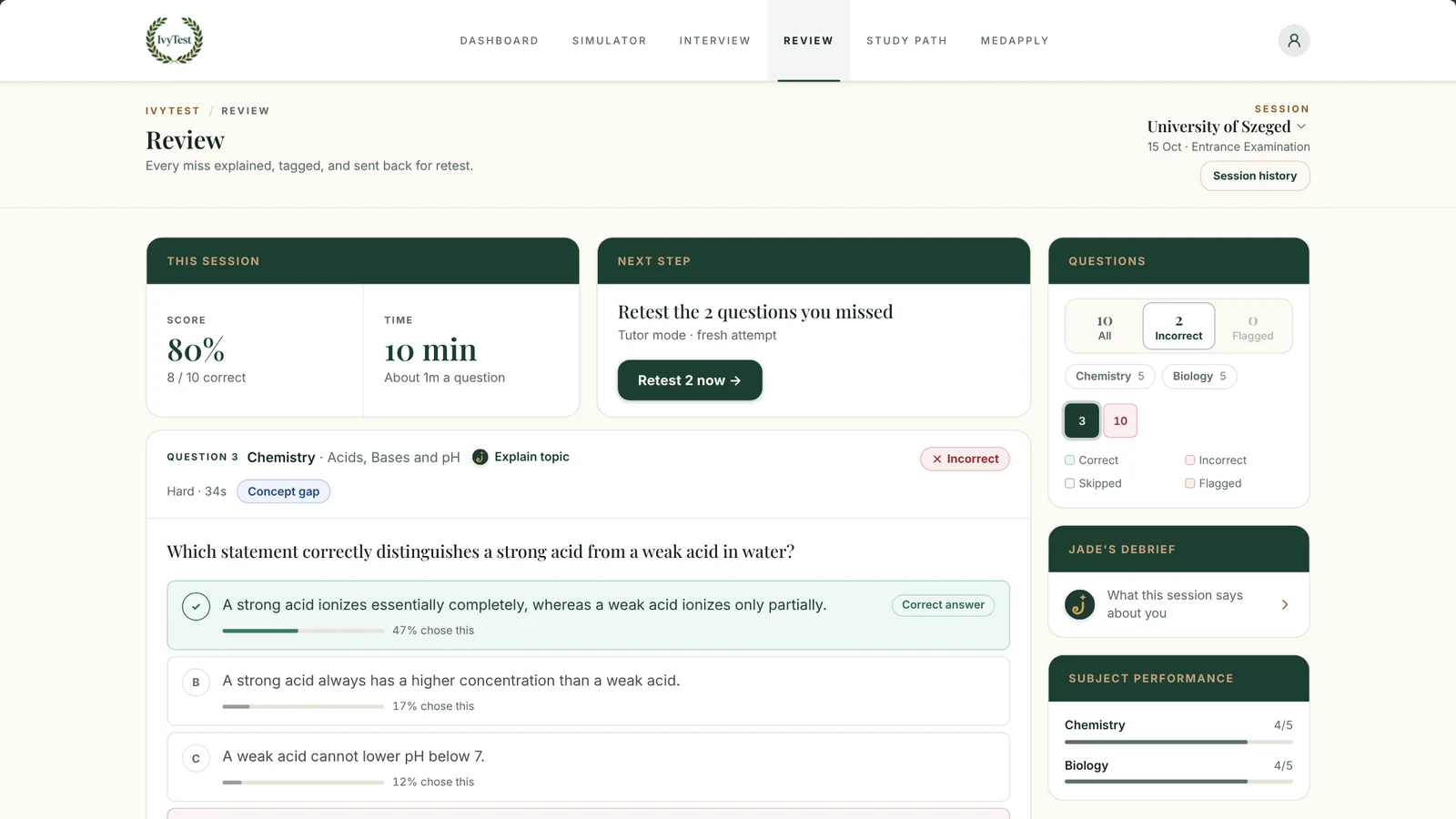
The oral exam: what it asks, with practice prompts and model answers
12+ weeks
Three equal blocks, practised one item at a time
Even coverage of Biology, your chosen second science and English, on a no-going-back format from the start.
- Decide early whether you are taking Chemistry or Physics, and check eligibility first: the Physics route is offered only in Admissions Office sittings and is not available to Stipendium Hungaricum applicants. Factor in that the only Physics sample paper is the 2022 edition.
- Sit a 60-question diagnostic in week one under the real rules (one item at a time, an answer required before moving on, no revisiting), and read it as three separate scores. The blocks carry 20 marks each, so an imbalance anywhere costs the same.
- Give General and Medical English a full third of your calendar. It has no official syllabus, it is the only four-option section, and it splits between B2-level grammar and usage and medical terminology, including everyday equivalents such as clavicle for collar bone, which are learnable in a way that grammar intuition is not.
- Work Chemistry numerical items with the periodic table and calculator you will actually be given, and Biology with base-pairing and genetics arithmetic done by hand at speed.
8 weeks
Repair the weakest block, and train elimination explicitly
Targeted work plus the one skill this format rewards above all others.
- Diagnostic first, then rank the three blocks by marks lost rather than by how comfortable each feels.
- Add a specific elimination drill to every session: for each item you cannot answer outright, write down which options you can rule out and why, before choosing. On a paper that forces a guess on every unknown, this is the only mechanism that raises your score above the blind-guess floor.
- One full 60-minute, 60-question mock a week from week two, sat one item at a time with no revisiting, reviewed the same day and logged by cause: content gap, misread stem, or rushed past.
- Start rehearsing the oral now: general conversation plus two Biology and two Chemistry questions in English. Four science questions is a small enough target to prepare properly.
4 weeks
Sixty minutes, sixty items, one pass each
Volume of timed practice under exactly the real delivery rules.
- Two full 60-question mocks a week at the 60-minute limit, always one item at a time with no backward navigation: practising on a paper you can flag and revisit builds a habit the real exam will not honour.
- Practise pacing to a flat minute per item. Because you cannot come back, time saved early has no value beyond finishing, while an item rushed past is lost permanently.
- Drill the two-option decision. Cutting a five-option item to two lifts its expected value from 0.20 to 0.50 marks and a four-option item from 0.25 to 0.50: across twenty items that is the difference between about four or five marks and ten.
- Rehearse the real setup: the Coospace platform, Zoom invigilation, and the periodic table and calculator ready for the Chemistry section.
Under 4 weeks
Consolidate three blocks, then rehearse four questions
Triage on a short paper, with the oral given real time.
- Stop adding new content. Consolidate the highest-frequency areas of the official topic list (in Biology, gene expression, circulation and the endocrine system; in Chemistry, the mole, equilibrium, pH and functional groups), and let the long tail go.
- Spend recovered hours on the English block's medical terminology, which converts to marks faster than anything else in a short window: body-region terms, everyday equivalents, instruments, specialists and drug classes.
- Sit at least two complete, timed one-pass mocks in the final ten days, then taper.
- Rehearse the oral out loud: two Biology and two Chemistry questions in English, plus a general conversation. Then confirm your sitting: the 2027 calendar has nine sessions, from 26-28 January to 22-24 June 2027, and you may sit at most two per application period.
Get your personalised Szeged Entrance Exam study plan
Take free diagnosticExplore the full Szeged Entrance Exam planPractice
Free Szeged Entrance Exam practice questions
Three questions in the format the exam uses. Choose an answer to see the explanation — nothing is recorded.
For the equilibrium N₂(g) + 3H₂(g) ⇌ 2NH₃(g), the forward reaction is exothermic. Which change shifts the position of equilibrium towards the products?
Which everyday term means the same as 'clavicle'?
Illustrative examples written by IvyTest to show the question style — not past Szeged Entrance Exam papers.
Past papers
Szeged Entrance Exam past papers
The University of Szeged publishes no past papers, but its Entrance Examination page links four sample tests as free PDFs: Biology, Chemistry and English Language (2024) and Physics (2022). Each holds one section's 20 questions, without an answer key. The answer-option counts on this page were confirmed on them. The practice questions on this page are IvyTest's own, and so is the free sample test below, which answers and explains every question.
University
University of Szeged medicine admissions
The written paper and the oral examination sit inside a rolling application process. Tuition is set in euros, and the first semester's is due within 14 days of the Admission Letter.
- Degrees
- Medicine, Dental Medicine and Pharmacy (English-taught) at the Albert Szent-Györgyi Medical School
- Language of instruction
- English
- Campus
- Albert Szent-Györgyi Medical School, Szeged
- Tuition
- €15,800 / year
- Application fee
- €300
- Interview
- Yes. A separate oral examination of about 20 minutes on Zoom: general conversation plus two Biology and two Chemistry questions in English
- Admissions type
- Rolling
- Eligibility gate
- Minimum GED score of 165 per subject for Medicine (145 for the Foundation Year)
- English certificate
- Not among the documents required for Medicine
- Motivation letter
- Required
- Recommendation letters
- Optional
- Document requirements
- Attested copies in English, or certificates with an authorized English translation
- Cost of living
- Around €450 / month for a single-person budget
- International student body
- Around 1,045 international students at the Faculty of Medicine, within roughly 4,500 from about 130 countries university-wide
- Seats available
- Close to 250 a year
- Application process
- Apply directly to the university on a rolling basis, sit the 60-question written paper online via Coospace, then a separate oral examination on Zoom
IvyTest Szeged Entrance Exam preparation
Ready to prepare properly for the Szeged entrance exam?
Everything above is free and always will be. When you want structure (a syllabus-mapped book covering all three blocks including the English section Szeged publishes no topics for, a simulator that runs the real one-pass, no-going-back format, lessons for the gaps your results flag, and help with the application itself), that is what the IvyTest Szeged package is.
Study guide
Szeged's official Biology, Chemistry and Physics topic lists in full, plus the General and Medical English content the official list does not cover.
Exam simulator
Timed 60-minute mocks in the real mixed-option format, delivered one item at a time with no backward navigation, with per-block analytics and elimination practice built in.
Video courses
Focused lessons in biology, chemistry, physics and medical terminology for the topics your results flag.
Application support
MedApply: the GED eligibility gate, rolling sitting dates, documents, legalisation and enrolment steps carried through to a confirmed place.
FAQ
Szeged Entrance Exam frequently asked questions
It's Szeged's own admission assessment for its English-taught Medicine, Dental Medicine and Pharmacy programmes at the Albert Szent-Györgyi Medical School: a written paper of 60 multiple-choice questions in 60 minutes (20 Biology, 20 Chemistry (or Physics on request) and 20 General and Medical English), followed by a separate oral examination of about 20 minutes on Zoom.
Neither. There is no shared Hungarian medical entrance test, and the four schools' papers differ substantially. Szeged's is the shortest by time at 60 questions in 60 minutes, and its delivery requires an answer before you can move to the next item, so nothing can be left blank. Semmelweis runs four separately timed 20-minute tests with English worth half the marks; Debrecen tests Biology plus your choice of Chemistry or Physics with no English section; Pécs runs 100 questions with 60 of them English.
The written paper is delivered online on the Coospace platform and invigilated over Zoom. The oral examination that follows is also conducted on Zoom. A periodic table and a calculator are prepared in advance for the Chemistry section.
A correct answer scores one point and a wrong answer deducts nothing, out of a maximum of 60. The question of whether to guess does not really arise: items are presented one at a time and an answer must be selected before you can move on, so nothing can be left blank. Guessing blindly at all sixty would expect (40 × 1/5) + (20 × 1/4) = 13 marks, because the three sciences use five options and the English section uses four. Every mark above that comes from eliminating options: narrowing a five-option item to two raises its expected value from 0.20 to 0.50.
No entrance-exam pass mark is published, confirmed absent on the official FAQ and four other official pages checked on 21 September 2026. The 165 figure is a different thing entirely: it is a minimum GED, or school-leaving equivalency, score of 165 per subject for Medicine (145 for the Foundation Year), which decides whether you may apply at all and is checked before you ever sit the entrance exam. Szeged's own FAQ frames it as separate from an exam result, and it should never be quoted as one. Note that Szeged's two official FAQs disagree on that GED figure for Medicine: the Foreign Students' Secretariat's says 165, the faculty's English FAQ (read on 16 October 2026) says 145, so confirm it with the Admissions Office.
No. Szeged publishes no per-block minimum, and Hungary has no counterpart to the Italian Obblighi Formativi Aggiuntivi mechanism. The three blocks are simply equally weighted at 20 marks each.
No, you cannot. Questions are presented one at a time with no backward navigation, and an answer must be selected before you proceed, so there is no flagging, no final sweep, and in practice no blanks. Practise on mocks that enforce the same rule, because a habit built on being able to revisit is a habit this exam will not honour.
Yes, on request, in sittings hosted by the Admissions Office, but it is not available to Stipendium Hungaricum applicants. Physics replaces the Chemistry block rather than adding to it, so a Physics-route candidate still sits exactly 60 questions. One thing to weigh before choosing it: the only Physics sample paper Szeged serves is the 2022 edition, while Biology, Chemistry and English have 2025 papers.
Szeged says it admits close to 250 students a year to its English Language Programme in Medicine, but publishes no applicant figure, so any acceptance rate quoted elsewhere is an estimate rather than a university number. What is documented is scale: around 1,045 international students are enrolled at the Faculty of Medicine, within a wider international community of roughly 4,500 students from about 130 countries university-wide. The 2027 calendar has nine sessions, from 26-28 January to 22-24 June 2027, with up to two attempts per application period.
Within the EU, yes: automatically, as a standard Hungarian medical degree. There's no separate Hungarian licensing exam afterwards: the closing exam (záróvizsga) is built into the sixth year of the degree itself, and registration with the national healthcare register is automatic. A specialist exam (szakvizsga) applies later, only to those pursuing specialty practice. Outside the EU recognition isn't automatic as a rule, but the UK is an exception. Under the Medical Act 1983 (section 21B, as in force on 12 October 2026), a Hungarian medical degree is a 'relevant European qualification', so a graduate who applies to the GMC with one, whatever their nationality, is not asked to show the knowledge and skills other international graduates prove through PLAB/UKMLA; evidence of English is still required, and the rule is UK policy that can change. US-bound graduates need ECFMG certification via USMLE Step 1 and Step 2 CK, the same requirement every international medical graduate faces.
Yes. The IvyTest simulator runs Szeged-format practice (60 questions in 60 minutes across Biology, Chemistry or Physics and General and Medical English, in the real five-option science and four-option English mix, delivered one item at a time with no backward navigation) in timed, tutor and review modes, with a free diagnostic available without payment.
Szeged publishes no past papers, but its Entrance Examination page links four sample tests as free PDFs: Biology, Chemistry, English Language and Physics (the 2022 edition). Each holds one section's 20 questions, with no answer key. The same page links the official Entrance Exam Topics PDF; every Biology, Chemistry and Physics topic on it is in the topic list on this page.
Applications for 2027/2028 open on 1 December 2026, and the General Medicine deadline is 1 June 2027 (23:59 CET); transfer applicants apply by 15 May 2027. The 2027 calendar has nine online sessions, from 26-28 January to 22-24 June 2027, and you may sit at most two in one application period. Admission is rolling, and students admitted by 1 April get €300 off their first semester.
You must be 18 by 31 December of the year you apply, hold a school-leaving certificate (final-year students may apply) and not have failed Biology, Chemistry, Physics, Mathematics or English in your final year; Medicine also asks for a GED score of 165 per subject. Then you sit the entrance exam, unless you have A grades in two A2-level sciences, grade 5 in two Higher Level IB sciences or a First Class BSc. You apply on DreamApply; the Admissions Office answers at [email protected], and about the exam at [email protected].
For students starting in 2027/2028, tuition is €7,900 a semester: €15,800 a year in years 1 to 5 and €7,900 for the sixth year. The first semester is paid in one amount within 14 days of the Admission Letter and includes a €1,600 deposit. Applying costs €300, which covers the entrance exam. Tuition includes health insurance valid in Hungary, but not textbooks, housing or living costs.
Medicine takes 12 semesters and at least 360 credits, and leads to the title Doctor of Medicine. Years 1 and 2 are the Basic Module, year 3 the Preclinical Module, years 4 and 5 the Clinical Module, and the sixth year is 40 weeks of clinical rotations, ending with a thesis, a written test and a patient examination. Hungarian is taught from the first semester, and the Medical School publishes each year's curriculum and suggested study plan as a PDF.
Szeged's own page says QS has ranked it the best Hungarian higher education institution for more than a decade. QS's own tables put Szeged first in Hungary in every edition from 2020 to 2024 (601-610 in 2024), but not since: in QS 2025 Eötvös Loránd University (564) placed above Szeged (=570), and in QS 2026 Szeged (=597) was third in Hungary, behind the University of Debrecen (=563) and Eötvös Loránd (=584). These rank the whole university, not its medical school. The Medical School is named after Albert Szent-Györgyi, its former rector, who won the Nobel Prize in 1937; its alumna Katalin Karikó won one in 2023.
Yes: r/SzegedMedicine, where University of Szeged applicants ask each other about the Szeged Entrance Exam and share how their preparation is going. It is run by the IvyTest team. Dates, rules and results come only from the university's own pages, listed under Official sources on this page.
Verification
Official sources
- Entrance examination, Albert Szent-Györgyi Medical SchoolChecked: 16 October 2026
University of Szeged
- Frequently asked questions (pass mark, GED eligibility score)Checked: 16 October 2026
University of Szeged
- Entrance Examination Topics (official Biology, Chemistry and Physics topic list, 2023 edition)Checked: 16 October 2026
University of Szeged
- Official Biology, Chemistry and General and Medical English sample papersChecked: 16 October 2026
University of Szeged
- Official Physics sample test, 2022 editionChecked: 16 October 2026
University of Szeged
- Online application for international students, 2027/2028 (opens 1 December 2026; General Medicine deadline 1 June 2027; the €300 application and entrance-examination fee)Checked: 16 October 2026
University of Szeged, Albert Szent-Györgyi Medical School
- Tuition fees for students who begin their studies in 2027/2028 (tuition, the €1,600 deposit, the 1 April early-bird discount)Checked: 16 October 2026
University of Szeged, Albert Szent-Györgyi Medical School
- How to apply: General Medicine (documents, motivation letter, optional reference letter)Checked: 5 October 2026
University of Szeged, Albert Szent-Györgyi Medical School
- Medical Programme (MD): entry requirements, exemptions from the entrance exam and intake of close to 250 a yearChecked: 16 October 2026
University of Szeged, Albert Szent-Györgyi Medical School
- Curriculum 2026/2027 (modules, credits and the suggested study plan)Checked: 16 October 2026
University of Szeged, Albert Szent-Györgyi Medical School
- Contact information: Admissions OfficeChecked: 16 October 2026
University of Szeged, Albert Szent-Györgyi Medical School
- Why choose us? (the QS ranking statement)Checked: 7 October 2026
University of Szeged, Albert Szent-Györgyi Medical School
Last reviewed by IvyTest editorial team: 16 October 2026. Admission rules change every cycle — always confirm against the official University of Szeged call for applications before acting on a deadline.
Find out how ready you are for the Szeged entrance exam.
The diagnostic takes one sitting and returns a block-by-block picture of where you stand, run the way Szeged runs it, one item at a time with no going back. No payment, no commitment.