
An adult at rest has a stroke volume of 70 mL and a heart rate of 72 beats per minute. What is the cardiac output?
Exam guide · Updated for 2027 admissions
Pécs Entrance Exam 2027: Complete Preparation Guide
Everything you need to know about the University of Pécs medical school entrance exam for its English-taught General Medicine and Dentistry programmes: the official sample tests and topic list, the four components and their real weighting, dates, scoring, the online interview, preparation strategy and practice.
Updated for 2027 admissions · Last updated: 15 October 2026
Pécs Entrance Exam at a glance
Overview
What is the University of Pécs entrance exam?
The University of Pécs runs its own entrance exam and interview for its English-taught General Medicine and Dentistry programmes. Like the other Hungarian medical schools, it sits outside any national system: there is no shared Hungarian medical entrance test, and Pécs's paper is not interchangeable with Semmelweis's, Debrecen's or Szeged's.
The written part is 100 multiple-choice questions in 100 minutes, and its balance is the single thing most candidates get wrong. Biology is 20 questions and Chemistry is 20; General English is 40 and Medical English is 20. Sixty per cent of this paper is English. That is not a formality attached to a science test; it is the majority of the marks, and it is where a candidate who treats English as already handled loses the exam.
Two practical features shape how you sit it. A simple calculator is permitted, which matters because roughly half the Chemistry sample paper is calculation; mobile phones, smart watches and other electronic devices are not. And the written exam is followed by a separate personal interview of 20 to 30 minutes with a university professor, taken over Zoom or Microsoft Teams or in person, covering motivation and medicine-related questions. It is not only a conversation about motivation: Pécs's own FAQ says it includes two Biology and two Chemistry questions.
Programmes that use the Pécs Entrance Exam
- General Medicine (English-taught, Pécs Campus)
- Dentistry (English-taught, Pécs Campus)
Timeline
Pécs Entrance Exam 2027: dates and deadlines
When to expect your exam · 2027 start
- March 2027Weekly from 3 MarPublished
- April 2027Weekly from 7 AprPublished
- May 2027Weekly from 5 MayPublished
- June 2027Weekly from 2 JunPublished
- July 2027Weekly, 7 to 14 JulPublished
Applications open 1 Nov 2026.
Dates the university has published for this cycle. See every university on the calendar →
- Applications open1 November 2026
- Application deadline30 June 2027
- Entrance exam and interview sittingsEvery Wednesday, 3 March to 14 July 2027
- Results publishedNo calendar date: the Entrance exam in Pécs page says results come out within a week of the exam
- Enrolment deadlineEnrolment deadline not yet announced
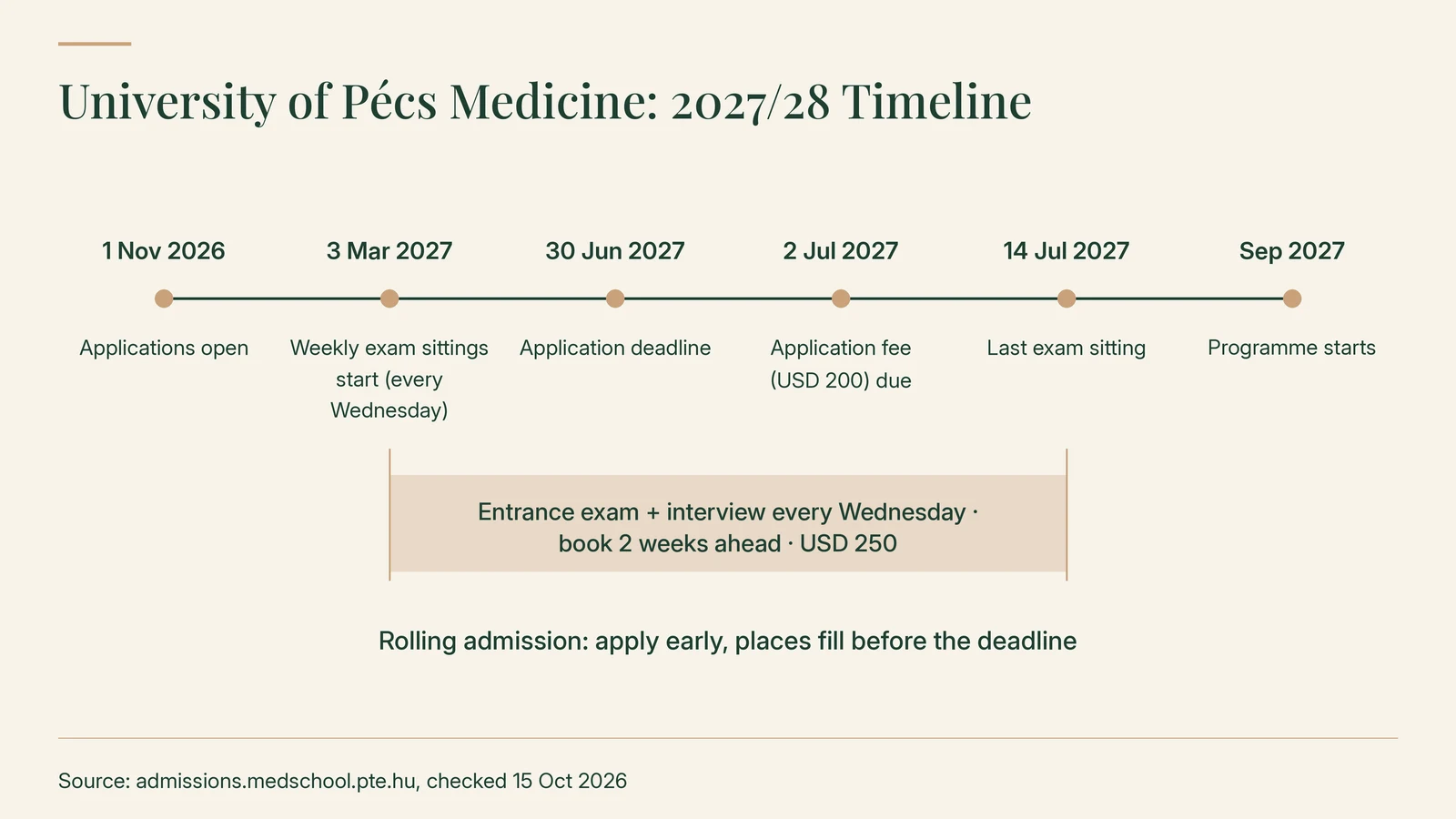
Pécs publishes no dated Call document; the binding sources are its own admissions pages at admissions.medschool.pte.hu, together with the official entrance-exam topics page and sample tests. Its Online application page already gives the 2027/28 application window, 1 November 2026 to 30 June 2027, and its exam pages give the 2027 exam days, every Wednesday from 3 March to 14 July 2027 (both re-checked on 15 October 2026). Because admission is rolling (a weekly exam slot rather than one national date), the useful question is not only 'when is the deadline' but 'are places still open', and that has to be checked live. IvyTest re-checks the official pages and updates this guide when anything changes.
Structure
Pécs Entrance Exam format
One continuous written part of 100 multiple-choice questions in 100 minutes: a minute a question on average, across four components of very unequal size. No per-section time limit is published, and the official pages do not state whether candidates may move freely between the sections, so plan to pace yourself across the whole hundred rather than assuming either a fixed order or free navigation. A simple calculator is permitted.
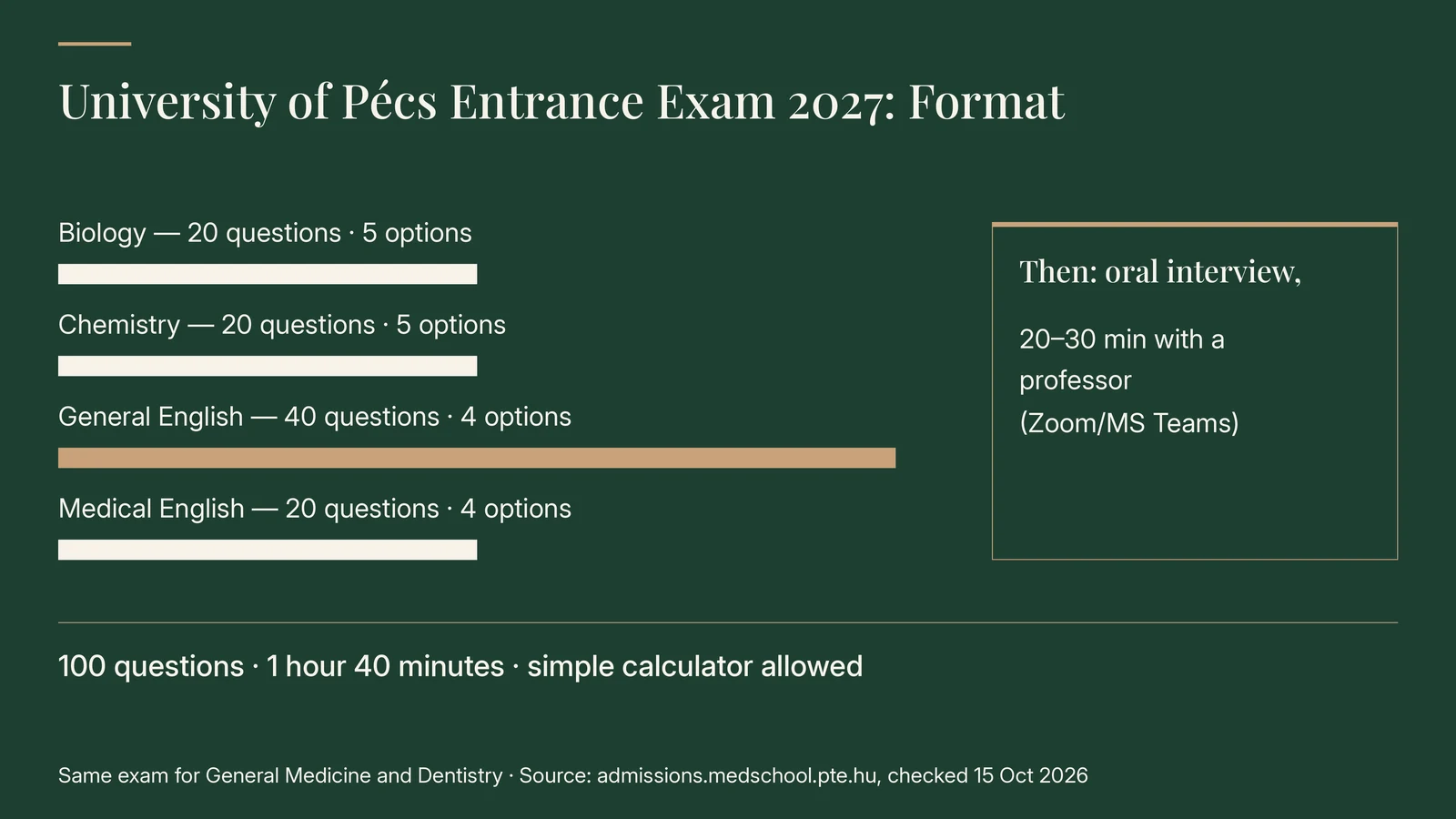
| Section | Questions | Weighting | Suggested time |
|---|---|---|---|
| Biology | 20 | 20% (20 of 100) | *see the note below the table |
| Chemistry | 20 | 20% (20 of 100) | *see the note below the table |
| General English | 40 | 40% (40 of 100), the largest single component | *see the note below the table |
| Medical English | 20 | 20% (20 of 100) | *see the note below the table |
- One continuous 100-minute sitting; Pécs publishes no per-section time limit
Content
Question and subject breakdown
Four components, and the two sciences are the minority. Pécs publishes an official topic list for Biology and Chemistry (30 numbered Biology areas and 20 numbered Chemistry areas) and no syllabus whatsoever for either English section, which between them carry 60 of the 100 marks.
Biology
20%Twenty questions against an official list of 30 numbered topic areas, so coverage is broad and depth is moderate: cells, viruses and biomolecules, organelles and membrane transport, cell division, molecular genetics from Griffith through translation, human genetics and inheritance, the musculoskeletal system and skin, circulation, blood and respiration, the nervous and endocrine systems, digestion, liver and excretion, and immunity, reproduction and development. The reference text Pécs points to is OpenStax Biology 2e. Item shape matters here: the sample paper is text-only with no figures, a substantial minority of items present numbered statements and offer combinations such as '1,3' or '2,4' as the answers, and several ask which statement is wrong rather than which is right.
Chemistry
20%Twenty questions against 20 official topic areas: essential elements and water, atomic structure and the periodic table, bonding and intermolecular forces, stoichiometry and the gas laws, solutions and concentration, kinetics and equilibrium, acids, bases, buffers and pH, redox and electrochemistry, hydrocarbons and aromatics, functional groups and organic reactions, and biomolecules. Reference text: OpenStax Chemistry 2e. This is the most computational component: roughly half of the sample paper is calculation, which is exactly why a simple calculator is permitted, and four sample items are built on drawn structural formulas rather than text.
General English
40%The single largest component of the exam, and one with no published syllabus at all. Every sampled item is a single-gap sentence completion with four lower-case options (a-d), no reading passage and no figures, which makes this a grammar and usage test rather than a comprehension test. The evidenced emphasis is upper-intermediate B2: tenses and aspect, modal verbs, conditionals, wishes and regrets, the passive voice, relative clauses, comparison and degree, and verb patterns such as used to against be used to. Because the sample supplies only 20 items against 40 on the real paper, expect areas the sample never touches.
Medical English
20%Twenty questions testing recognition of clinical vocabulary rather than clinical knowledge; the items stay answerable from language alone. The evidenced areas are medical specialties matched to the organ or system they treat, word roots, prefixes and suffixes such as -itis, -osis, -pathy, -penia, -ectomy, -otomy and -algia, anatomy and physiology terminology, clinical synonyms of the 'means the same as' type, and scientific adjectives such as empirical, aetiological, pathological and physiological. Four options (a-d), mixing gap-fill with synonym matching.
Marks
Pécs Entrance Exam scoring
Pécs publishes no marking scheme. IvyTest fetched the official FAQ, the About the exam page and the Entrance exam in Pécs page directly on 21 September 2026: none of the three mentions negative marking, penalties or blank-answer scoring in either direction. That distinction is worth making precisely: the official pages are silent on a penalty, which is not the same as officially ruling one out, and any guide that says Pécs 'states there is no negative marking' has turned an absence into a claim.
- Answer options (Chemistry)
- 5 (A-E), one correct; all 20 items on the official sample
- Answer options (Biology)
- Mixed: 14 of 20 sample items had 5 options (A-E), 6 had 4 (A-D)
- Answer options (General and Medical English)
- 4 (a-d), one correct; all 30 sampled items
- Correct answer
- Not published. IvyTest practises against +1 as a neutral default
- Incorrect answer
- No negative-marking rule is published, and no official page rules one out either. IvyTest practises against 0 rather than importing another university's penalty
- Unanswered question
- Not published; treated as 0 under the same neutral model
- Minimum eligible score
- Confirmed absent from every official Pécs page examined to date
- Per-subject floors
- None published: Hungary has no counterpart to the Italian OFA subject floors
- Calculator
- A simple calculator is permitted; phones, smart watches and other electronic devices are prohibited
- What follows the written exam
- A separate 20–30 minute personal interview with a university professor, over Zoom or Microsoft Teams or in person, including two Biology and two Chemistry questions
Worked example
Start with what a blind guess is worth, because Pécs's mixed option counts make the answer more interesting than usual. Under the neutral +1 / 0 / 0 model, a guess on a four-option item returns 1/4 = +0.25 and on a five-option item 1/5 = +0.20. This paper has 66 four-option items (40 General English, 20 Medical English and the 6 four-option Biology items on the sample) and 34 five-option items (all 20 Chemistry plus 14 Biology). Guessing blindly at all 100 therefore has an expected value of (66 × 0.25) + (34 × 0.20) = 16.5 + 6.8 = 23.3 marks, not 20, and not 25. A blank is worth 0 under every model available, so no question on this paper should be left empty. Now the part that actually changes how you revise, and the unit it has to be stated in. Because the paper is 100 questions, one mark is one percentage point of the written total, which makes the component sizes decisive. Lifting your accuracy by 15 percentage points across the 60 English questions, from 55% to 70%, wins 0.15 × 60 = 9 marks, or 9 percentage points of the paper. Lifting your accuracy by the same 15 percentage points across the 20 Biology questions wins 0.15 × 20 = 3 marks, or 3 points of the paper. Identical improvement in accuracy; three times the return in marks. Whenever you say an improvement is 'worth' something here, say whether you mean percentage points of accuracy within a component or marks on the 100-point paper: on a paper this lopsided the two numbers diverge by a factor of three.
The IvyTest simulator scores every practice paper against these exact rules.
See the Pécs Entrance Exam simulatorSyllabus
Pécs entrance exam topic list
The Biology and Chemistry groups below carry Pécs's official topic lists: all 30 numbered Biology areas and all 20 numbered Chemistry areas, regrouped into pools of comparable size, with nothing added. The two English groups are derived from the university's own Sample Test 1 rather than from any published syllabus, and should be read as an evidence-based emphasis map, not an exhaustive list: the sample supplies 20 general-grammar items against 40 on the real paper, and 10 medical items against 20.
Official. Ten groups covering all 30 numbered topic areas of the Pécs entrance-exam topics page. Reference text: OpenStax Biology 2e.
- Cells, viruses and biomolecules: eukaryotic and prokaryotic cells, cell size, circular and linear DNA, the cell wall, binary fission compared with mitosis, viruses as acellular obligate intracellular agents, capsid and envelope, DNA and RNA genomes, why viruses are not prokaryotes, carbohydrates, lipids, proteins and nucleic acids, their monomers and major functions, structural and storage molecules, enzymes
- Organelles and membrane transport: the phospholipid bilayer and membrane proteins, diffusion, osmosis, facilitated diffusion, active transport, endocytosis and exocytosis, concentration gradients, the nuclear envelope, pores, chromatin and nucleolus, microtubules, microfilaments and intermediate filaments, tubulin, the mitotic spindle, centrioles, cilia and flagella, rough and smooth endoplasmic reticulum, the Golgi apparatus and lysosomes, protein modification and sorting, autophagy, the mitochondrial double membrane and mitochondrial DNA, evidence for endosymbiosis
- Cell division: the cell cycle, prophase, metaphase, anaphase and telophase, cytokinesis, chromosome movement, growth and repair, reduction division, homologous chromosomes, crossing over, independent assortment, gamete formation, genetic variation, and mitosis compared with meiosis
- Molecular genetics: Griffith's transformation experiment, Avery-MacLeod-McCarty, the Hershey-Chase phage experiment, semiconservative replication, complementary pairing, DNA polymerase and helicase, leading and lagging strands, Okazaki fragments, proofreading, transcription, template and coding strands, RNA polymerase, 5' to 3' directionality, writing a complementary RNA sequence with U for T, codons, start and stop codons, degeneracy, reading frame, ribosome subunits, mRNA, tRNA and rRNA, codon-anticodon pairing, and initiation, elongation and termination
- Human genetics and inheritance: genotype and phenotype, dominant and recessive inheritance, autosomal and sex-linked patterns, Punnett squares and pedigree reasoning, ABO and Rh genotypes, phenylketonuria and comparable single-gene disorders, incomplete dominance, and mutation types including frameshift, base substitution, missense and nonsense
- Skeleton, muscle and skin: the axial and appendicular skeleton, skull, vertebral column and ribs, the pectoral and pelvic girdles, the limbs, bone functions, joints and bone tissue, the sarcomere, actin and myosin, the sliding filament theory, Z lines, calcium and ATP, what shortens and what does not during contraction, the epidermis and dermis, skin glands and hair, thermoregulation, protection, sensory receptors and the vitamin D link
- Circulation, blood and respiration: heart chambers and valves, the direction of blood flow, the pulmonary and systemic circuits, the pacemaker and autonomic regulation of heart rate, cardiac output as stroke volume times heart rate, plasma, red and white blood cells and platelets, haemoglobin and its four polypeptide chains, ABO and Rh blood groups, clotting basics, the airways and alveoli, gas exchange, inspiration and expiration, the diaphragm, tidal volume, the oxygen-haemoglobin dissociation curve and its pH dependence, and carbon dioxide transport as bicarbonate
- Nervous and endocrine systems: the central and peripheral nervous systems, neurons, action potentials, synapses, the autonomic nervous system, sympathetic and parasympathetic effects, steroid and peptide hormone mechanisms and which class enters the target cell, the pituitary, thyroid, pancreas, adrenal glands and gonads, target tissues such as the gonads for luteinising hormone, and feedback control
- Digestion, liver and excretion: the digestive tract, enzymes matched to their substrates and products including maltase, lipase and pepsin, absorption, bile, water-soluble and fat-soluble vitamins, the roles of the pancreas and liver, liver metabolism, detoxification, glycogen and plasma proteins, the spleen's immune and blood-filtering functions, the nephron, filtration, reabsorption and secretion, urine formation, urea, and osmoregulation with water and salt balance
- Immunity, reproduction and development: innate and adaptive immunity, physical barriers, phagocytes and lymphocytes, antibodies, vaccination, inflammation, immune memory, male and female reproductive anatomy, gametogenesis, fertilisation, the menstrual cycle, sex hormones, and the basics of embryonic development
Official. Eleven groups covering all 20 numbered topic areas. Reference text: OpenStax Chemistry 2e. Roughly half the sample paper is calculation, and a simple calculator is permitted.
- Essential elements and water: bioelements and trace elements, water polarity, hydrogen bonding, the solvent properties of water, and the behaviour of acids and bases in aqueous systems
- Atomic structure and the periodic table: protons, neutrons and electrons, atomic number and mass number, isotopes and ions and why an ion is not a different element, electron configuration basics, groups and periods, metals and nonmetals, trends in atomic radius, ionisation energy, electron affinity and electronegativity, the halogens and alkali metals, and inferring common ion charges from group position
- Chemical bonding and intermolecular forces: ionic, covalent and polar covalent bonding, basic molecular geometry, polar and nonpolar molecules, combining bond polarity with molecular shape, hydrogen bonding, dipole forces, London forces, and identifying substances containing covalent bonds only while excluding ionic salts that contain covalent polyatomic ions
- Stoichiometry and gas laws: the mole and molar mass, Avogadro's number, balancing equations, conversions between mass, amount, particle number and gas volume, the limiting reactant, the molar volume of about 22.4 L at STP, pressure, volume and temperature relationships, ideal gas reasoning and gas stoichiometry
- Solutions and concentration: molarity as amount over volume in litres, mass percent, density, dilution, converting millilitres to litres, and obtaining the total mass of a solution from its density and volume
- Kinetics and chemical equilibrium: the factors affecting reaction rate, dynamic equilibrium, Le Chatelier's principle, the effects of pressure, concentration and temperature changes, exothermic and endothermic shifts, and comparing moles of gas on each side before deciding a pressure effect
- Acids, bases, buffers and pH: the Arrhenius and Brønsted concepts, strong and weak acids and bases, pH and pOH and the relation pH + pOH = 14, hydrogen and hydroxide ion concentrations, buffers, and ranking solutions of equal concentration by increasing pH from strong acid through weak acid, neutral salt and weak base to strong base
- Redox and electrochemistry: assigning oxidation numbers so that they sum to the charge on the species, oxidation as electron loss and reduction as electron gain, identifying redox reactions from oxidation-number changes rather than from the look of the equation, and basic electrochemical cells
- Hydrocarbons and aromatic compounds: alkanes, alkenes and alkynes, saturation, elements of nomenclature, structural formulas, addition to double bonds including HBr addition and major-product logic, benzene and aromatic stability, substitution rather than addition as the aromatic pattern, and common aromatic derivatives
- Functional groups and organic reactions: alcohols, phenols and ethers, polarity and hydrogen bonding, the carbonyl group and the aldehyde-ketone distinction, carboxylic acids, esters and amides, esterification, soaps and fatty acid salts, amines and their basicity, nitrogen heterocycles, distinguishing an amide from an amine, recognising R-O-R, R-COOH, R-COO-R and R-CONH-R from drawn structures, and structural isomerism judged on connectivity rather than on molecular formula alone
- Biomolecules: monosaccharides, aldose and ketose, pentose and hexose, counting chiral carbons, D and L notation from the lowest chiral centre, Fischer projections and open-chain forms, amino acid structure, zwitterions, peptide bonds, primary to quaternary protein structure, enzymes as proteins, fatty acids, triglycerides, phospholipids and sterols, hydrolysis and saponification, nucleosides and nucleotides as base plus sugar plus phosphate, DNA and RNA differences, and ATP
Derived, not official. Pécs publishes no grammar syllabus; these seven areas come from the university's own English Sample Test 1 and from the exam's structure. Every sampled item is a single-gap sentence completion with four options and no reading passage. Target level: solid upper-intermediate B2, and expect areas the sample never touches, since it covers 20 items against 40 on the real paper.
- Tenses and aspect: past simple, present perfect with for and since, past perfect, past continuous, future continuous, stative verbs that resist continuous forms, and choosing between finished past time and present relevance
- Modal verbs: must and mustn't for obligation and prohibition, needn't and don't have to for lack of necessity, should for advice, shouldn't have plus past participle for regret and criticism, and might have and can't have for deduction about the past
- Conditionals, wishes and regrets: first, second and third conditionals, unless as if-not with a present-simple verb for future meaning, hypothetical advice with if I were you, wish plus past perfect for past regret, and would for future irritation and requests
- Passive voice: passive formation across tenses, perfect passive forms such as had been plus past participle, choosing the passive when the agent is unknown or unimportant, and distinguishing passive from active past forms
- Relative clauses: defining and non-defining clauses, which against that, comma use, a clause commenting on a whole preceding sentence, and preposition plus which or whom, such as of which after proud
- Comparison and degree: the same as and similar to, comparative and superlative forms, too plus adjective plus to-infinitive, and the placement of enough relative to an adjective and to a noun
- Verb patterns and common structures: used to against be used to and get used to, shall for offers and suggestions, adjectives rather than adverbs after linking verbs such as look and taste, cause or make plus object plus infinitive, and verb plus gerund or infinitive
Derived, not official. Pécs publishes no vocabulary list; these five areas come from items 21-30 of the official English Sample Test 1 and show the register and question style rather than the full vocabulary universe. The level target is recognition of common clinical vocabulary: items stay answerable from language, not from medical training.
- Medical specialties: matching an organ or system to the specialist who treats it: angiology, urology, pulmonology, nephrology, cardiology, stomatology, dermatology and other common branches, with near-miss specialties used as distractors
- Word roots, prefixes and suffixes: -itis for inflammation, -osis for a condition or process, -pathy for disease, -penia for deficiency or diminution, -ectomy, -otomy and -algia, common Greek and Latin roots for organs and tissues, and building or decoding a term from its parts
- Anatomy and physiology terminology: cardiology terms such as the SA node, atria, conduction and heart block, musculoskeletal terms such as range of motion and osteoporosis, common condition names such as hypertension and rheumatoid arthritis, and everyday clinical phrasing for structures and processes
- Clinical vocabulary and synonyms: predisposition and susceptibility, deteriorating and degenerative, impairment and impediment, high-frequency academic verbs such as strive, and choosing the nearest synonym for a term as it is used in a clinical sentence
- Scientific adjectives: empirical, aetiological, pathological and physiological: separating observation-based from cause-based, disease-based and function-based description, and applying the right adjective to a method, a finding or a process
Test your Pécs Entrance Exam knowledge
Take free diagnosticDifficulty
How difficult is the Pécs Entrance Exam?
Nothing on this paper is conceptually hard. Its difficulty is entirely in the weighting, the pace and how little of the marking is published, plus one item shape that catches candidates who have only ever practised ordinary multiple choice.
Sixty per cent of the paper is English
General English is 40 questions and Medical English is 20, against 20 each for Biology and Chemistry. That is not a science exam with a language section attached; it is a language exam with a science section attached. Candidates who allocate their revision the way they imagine a medical entrance exam should be weighted (sciences first, English if there is time) systematically underperform on the two components that carry three fifths of the marks.
Statement-combination and negatively phrased items
A substantial minority of the Biology and Chemistry sample items present numbered statements and offer combinations such as '1,3' or '2,3,4' as the answer options, so you have to be right about every statement in the combination, not just recognise one true claim. Several Biology items also ask which statement is wrong rather than which is right. Both shapes punish skim-reading far more than a standard single-best-answer item does.
A hundred questions in a hundred minutes, and no published pacing rule
One minute a question sounds generous until you notice that about half the Chemistry section is calculation and four of its sample items are built on drawn structural formulas. No per-section time limit is published, and the official pages do not say whether you can move between sections, so the safest habit is to keep a running pace across the whole hundred rather than assume you can bank time and return.
Nothing about the marking is published
No marks per question, no negative-marking rule, no pass mark: confirmed absent across every official Pécs page checked, rather than merely hard to find. Note carefully that the pages are silent rather than affirmatively declaring there is no penalty; a guide that says Pécs 'states there is no negative marking' has converted an absence into a claim. Practise against a neutral model and do not import another school's penalty convention.
Rolling admission makes the calendar part of the exam
The exam and interview are offered weekly from early March to mid-July, and Pécs's own guidance says applying earlier leaves more seats available. That turns the usual preparation question inside out: the trade-off is not how long you can revise, but how long you can revise before the places you are revising for are gone.
Benchmarks
What is a good Pécs Entrance Exam score?
There is no published number to aim at. IvyTest checked nine official Pécs pages on 21 September 2026 (About the exam, Entrance exam in Pécs, the FAQ, the entrance-exam topics page, the sample-tests page and the official information PDF among them), and none states a minimum score, a pass mark or a qualifying threshold. This is a confirmed absence rather than something merely hard to find.
Because neither the marking scheme nor the threshold is published, the only honest preparation target is a proportion of questions answered correctly under real conditions, measured component by component. That is also the most useful target, because the components are so unequal: a candidate at 85% in Biology and 50% in General English is scoring 17 + 20 = 37 of those 60 marks, while a candidate at 65% in both is scoring 13 + 26 = 39: a better total from the weaker science. Track the four components separately and weight the effort by size, not by which one feels most like medicine.
The interview is assessed separately and differently from the written paper. It runs 20 to 30 minutes with a university professor, over Zoom or Microsoft Teams or in person, and covers motivation and medicine-related questions; Pécs's FAQ adds that it includes two Biology and two Chemistry questions. Prepare it as an interview (reasons, experiences, awareness of what the degree involves) and be ready to explain core Biology and Chemistry aloud as well.
Pending verification
- · Any marking scheme: marks per correct answer, and whether wrong answers are penalised
- · Any pass mark, minimum eligible score or ranking rule
- · Whether candidates may move freely between the four sections, and any per-section time limit
- · How the written exam and the interview are weighted against each other
- · Seats available and applicants per cycle
These specific numbers aren't public yet — an IvyTest simulator score is the closest benchmark you can get today.
Check your Pécs Entrance Exam scoreStrategy
How to prepare for the Pécs Entrance Exam
12+ weeks
Budget your time the way the paper budgets its marks
Sixty per cent English, forty per cent science, from week one, not as an afterthought.
- Sit a full 100-question diagnostic in week one and read it as four separate numbers. Then set your weekly hours in roughly the paper's own proportions: more time on General English than on Biology and Chemistry combined feels wrong and is correct.
- Work General English as a structured B2 grammar course rather than as vocabulary browsing: tenses and aspect, modals, conditionals, the passive, relative clauses, comparison, and verb patterns such as used to against be used to, which is the single most frequently confused pair in this register.
- Build Medical English from word parts rather than word lists: -itis, -osis, -pathy, -penia, -ectomy, -otomy and -algia, plus the common organ and tissue roots. A candidate who can decode an unfamiliar term from its parts does not need to have met it before.
- Cover Biology and Chemistry against Pécs's own topic lists using the OpenStax texts it names, and practise statement-combination items specifically: being right about three statements at once is a different skill from picking one right answer.
8 weeks
Fix the cheapest marks first
Targeted repair, ranked by marks available rather than by subject preference.
- From your diagnostic, compute marks lost per component, not percentage accuracy per component. Forty per cent accuracy in General English is losing 24 marks; the same accuracy in Biology is losing 12.
- Drill Chemistry calculations with the simple calculator you will actually be allowed: about half the Chemistry section is numerical, so calculator fluency is worth real marks.
- One full 100-minute, 100-question mock a week from week two, reviewed the same day, logging wrong answers by cause: content gap, misread stem, combination item where one statement was wrong, or ran out of time.
- Prepare the interview in parallel. It is a 20-to-30-minute conversation with a professor about motivation and medicine, and Pécs's FAQ says it includes two Biology and two Chemistry questions, so it cannot be improvised convincingly.
4 weeks
Full 100-minute sittings, and never a blank
Volume of timed practice at the real pace and the real mix.
- Two full 100-question mocks a week at the 100-minute limit, in the real proportions: 20 Biology, 20 Chemistry, 40 General English, 20 Medical English.
- Answer every item. Under the neutral model a four-option guess is worth +0.25, a five-option guess +0.20, and a blank exactly 0: guessing blindly at all 100 would still expect about 23 marks, so there is never a reason to leave one empty.
- Practise reading statement-combination items in full before looking at the options, and slow down deliberately on any stem containing 'wrong', 'not' or 'except'.
- Rehearse the real setup: a simple calculator to hand, phone and smart watch away, and the online platform tested in advance, since recent sittings have been planned mostly online.
Under 4 weeks
Consolidate English, hold the sciences, book early
Triage on a lopsided paper, with the rolling calendar taken seriously.
- Stop adding new science content. Consolidate the highest-frequency Biology and Chemistry areas and let the long tail go: they are 40 marks between them.
- Spend the recovered hours on the 60 marks of English, which is where a short window converts fastest: a focused pass through B2 modals, conditionals and verb patterns, plus a medical word-parts list learned as roots rather than as terms.
- Sit at least two complete, timed 100-minute mocks in the final ten days, then taper.
- Check live seat availability and book your Wednesday slot rather than waiting. Pécs's own guidance is that earlier applicants find more seats available: on a rolling exam, waiting to be readier has a real cost.
Get your personalised Pécs Entrance Exam study plan
Take free diagnosticExplore the full Pécs Entrance Exam planPractice
Free Pécs Entrance Exam practice questions
Three questions in the format the exam uses. Choose an answer to see the explanation — nothing is recorded.
What is the oxidation number of sulfur in the sulfate ion, SO₄²⁻?
A laboratory report notes that the patient has developed leucopenia. The suffix -penia indicates:
Illustrative examples written by IvyTest to show the question style — not past Pécs Entrance Exam papers.
Past papers
Pécs Entrance Exam past papers
The University of Pécs publishes no past papers, but its own Sample tests page offers Biology, Chemistry and English sample tests as free PDFs, each with a separate PDF of solutions. They are the official picture of the paper: the answer-option formats on this page were counted on them, though they are shorter than the real paper. The practice paper on this page is IvyTest's own and full length: all 100 questions in the real format.
University
University of Pécs medicine admissions
Pécs admits on a rolling basis, which changes what the numbers below mean: the binding constraint is usually seat availability at the moment you apply rather than a calendar deadline.
- Degrees
- General Medicine and Dentistry (English-taught); both admitted through this entrance exam
- Language of instruction
- English
- Campus
- Pécs Campus, Hungary
- Tuition
- Around €15,400 / year
- Application fee
- Around €415
- Admissions type
- Rolling
- Interview
- Yes: a separate 20–30 minute personal interview with a university professor, over Zoom or Microsoft Teams or in person, on motivation and medicine-related questions including two Biology and two Chemistry questions
- English certificate
- Not required
- Motivation letter
- Not required
- Recommendation letters
- Not required
- Document requirements
- Official copies of your school-leaving certificate and transcript, in English or with an authorized translation
- Cost of living
- The most affordable of Hungary's four medical-school cities in our catalogue
- Student body
- Around 3,500 students from some 67 countries at the medical school
- Seats available
- Pécs publishes no seat count for the English-taught programmes, only that availability falls as the rolling cycle progresses
- Application process
- Apply directly to the university on a rolling basis from 1 November, sit your assigned Wednesday exam slot, then a separate 20–30 minute personal interview over Zoom or Microsoft Teams or in person
IvyTest Pécs Entrance Exam preparation
Ready to prepare properly for the Pécs entrance exam?
Everything above is free and always will be. When you want structure (a syllabus-mapped book that gives the 60 marks of English the space they actually deserve, a simulator that runs the real 100-question mixed-option paper, lessons for the gaps your results flag, and help with the application itself), that is what the IvyTest Pécs package is.
Study guide
All four components in their real proportions: Pécs's official Biology and Chemistry topic lists in full, plus the B2 grammar and medical word-parts content Pécs publishes no syllabus for.
Exam simulator
Timed 100-minute mocks in the real mix: five-option science items, four-option English items, statement-combination questions and negatively phrased stems, with per-component analytics.
Video courses
Focused lessons in biology, chemistry, B2 grammar and clinical terminology for the topics your results flag.
Application support
MedApply: rolling-cycle timing, the weekly exam slot, documents, legalisation and enrolment steps carried through to a confirmed place.
FAQ
Pécs Entrance Exam frequently asked questions
It's Pécs's own admission assessment for its English-taught General Medicine and Dentistry programmes: a written paper of 100 multiple-choice questions in 100 minutes (Biology 20, Chemistry 20, General English 40 and Medical English 20), followed by a separate 20-to-30-minute personal interview with a university professor over Zoom or Microsoft Teams.
Neither. There is no shared Hungarian medical entrance test, and the four schools' papers differ structurally. Pécs puts 60 of its 100 questions into English, which is the highest English share of the four. Semmelweis runs four separately timed 20-minute tests; Debrecen tests Biology plus your choice of Chemistry or Physics and has no English section at all; Szeged runs 60 questions in 60 minutes with a single combined English component.
Recent sittings have been planned mostly online, delivered in English on the university's platform, and paper-based sittings may also be organised by schools or official representatives. A simple calculator is permitted; mobile phones, smart watches and other electronic devices are prohibited. The interview can be taken online over Zoom or Microsoft Teams, or in person in Pécs, in Budapest or abroad at a sitting run by the Medical School or its representatives.
Pécs publishes no marking scheme. IvyTest fetched the official FAQ, About the exam and Entrance exam in Pécs pages on 21 September 2026: none of them mentions negative marking, penalties or blank-answer scoring in either direction: they are silent, not affirmative, so be wary of any guide claiming Pécs states there is no penalty. Under the neutral model IvyTest practises against, a four-option guess is worth +0.25, a five-option guess +0.20, and a blank exactly 0. Guessing blindly at all 100 items would expect about 23.3 marks, given the paper's 66 four-option and 34 five-option questions, so there is no item worth leaving empty.
None is published. IvyTest checked nine official Pécs pages on 21 September 2026 and found no minimum score, pass mark or qualifying threshold on any of them. This is a confirmed absence, not just something hard to find.
No. Pécs publishes no per-section minimum, and Hungary has no counterpart to the Italian Obblighi Formativi Aggiuntivi mechanism.
Because the programmes are taught and examined in English, and Pécs tests it as two scored written components rather than as a fluency check. General English is 40 questions of B2-level grammar and usage in single-gap sentence completion form; Medical English is 20 questions on clinical vocabulary, word parts and specialties. Together they are 60 of the 100 marks: three times the weight of Biology, and three times the weight of Chemistry.
It varies by section, and no official page states a fixed count. Counted directly on the university's own sample papers: all 20 Chemistry items have five options (A-E); Biology is mixed, with 14 of 20 at five options and 6 at four; and all 30 sampled General and Medical English items have four options (a-d). Expect roughly two thirds of the real paper to be four-option.
Pécs publishes no seat count or applicant figure, so any acceptance rate quoted elsewhere is an estimate. What the university does say is more immediately useful: admission is rolling, the exam runs weekly from early March to mid-July, and applying earlier leaves more seats available. The medical school has around 3,500 students from some 67 countries.
Within the EU, yes: automatically, as a standard Hungarian medical degree. There's no separate Hungarian licensing exam afterwards: the closing exam (záróvizsga) is built into the sixth year of the degree itself, and registration with the national healthcare register is automatic. A specialist exam (szakvizsga) applies later, only to those pursuing specialty practice. Outside the EU recognition isn't automatic as a rule, but the UK is an exception. Under the Medical Act 1983 (section 21B, as in force on 12 October 2026), a Hungarian medical degree is a 'relevant European qualification', so a graduate who applies to the GMC with one, whatever their nationality, is not asked to show the knowledge and skills other international graduates prove through PLAB/UKMLA; evidence of English is still required, and the rule is UK policy that can change. US-bound graduates need ECFMG certification via USMLE Step 1 and Step 2 CK, the same requirement every international medical graduate faces.
Yes. The IvyTest simulator runs Pécs-format practice (100 questions in 100 minutes across Biology, Chemistry, General English and Medical English, in the real mixed four- and five-option format, including statement-combination and negatively phrased items) in timed, tutor and review modes, with a free diagnostic available without payment.
Yes. Pécs's own Sample tests page offers Biology, Chemistry and English sample tests as PDFs, each with a separate PDF of solutions, free to download. They are the closest thing to past papers the university publishes, and the answer-option formats on this page were counted on them. IvyTest's free practice paper adds a full-length one: 100 questions in the real format, with every answer explained and a Save as PDF button.
Dentistry, yes: the written exam and the oral interview are one exam for General Medicine and Dentistry, so this guide covers both. Pharmacy (PharmD) and Biotechnology (BSc and MSc) have no written exam: their applicants sit only the oral interview, 20 to 30 minutes with a university professor over Zoom or MS Teams, between March and mid-July 2027, booked two weeks ahead with the USD 250 exam fee.
General Medicine is a six-year M.D. taught in English: ten semesters of study and a final year of clinical rotations. The Basic module covers the healthy body, the Preclinical module disease processes and patient examination, and the Clinical module specific diseases, mostly on the wards. Expect 25 to 30 hours of classes a week.
On the facts it publishes: its M.D. diploma is accepted across the European Union and in several other countries, including Norway, the USA, Canada and Israel, and 3,500 students from 67 countries study at its Medical School. General Medicine has 180 places a year. Whether it suits you depends on your budget, the city and the exam.
No. This page is about the Medical School's exam for General Medicine and Dentistry. The Medical School's programmes are General Medicine, Dentistry, Pharmacy and Biotechnology; Computer Science admits through another part of the University of Pécs, so check that programme's own admission page.
Yes: r/UniversityOfPecs, where University of Pécs applicants ask each other about the Pécs Entrance Exam and share how their preparation is going. It is run by the IvyTest team. Dates, rules and results come only from the university's own pages, listed under Official sources on this page.
Verification
Official sources
- About the exam: English-language Medical ProgrammesChecked: 5 October 2026
University of Pécs Medical School
- Entrance exam in PécsChecked: 5 October 2026
University of Pécs Medical School
- Frequently asked questionsChecked: 5 October 2026
University of Pécs Medical School
- Entrance exam topics (official Biology and Chemistry topic lists)Checked: 5 October 2026
University of Pécs Medical School
- Official Biology, Chemistry and English Sample Test 1 (source of the option counts and item shapes)Checked: 5 October 2026
University of Pécs Medical School
- Online application (2027/28 application window: 1 November 2026 to 30 June 2027)Checked: 5 October 2026
University of Pécs Medical School
- Tuition Fees & Costs (2027/28 tuition in USD)Checked: 5 October 2026
University of Pécs Medical School
- Application and exam feesChecked: 5 October 2026
University of Pécs Medical School
- Entry requirements (B2 English, no language certificate needed)Checked: 5 October 2026
University of Pécs Medical School
- Application file (documents in English or with an authorized translation)Checked: 5 October 2026
University of Pécs Medical School
Last reviewed by IvyTest editorial team: 15 October 2026. Admission rules change every cycle — always confirm against the official University of Pécs call for applications before acting on a deadline.
Find out how ready you are for the Pécs entrance exam.
The diagnostic takes one sitting and returns a component-by-component picture of where you stand, weighted the way the real paper is, not the way candidates assume it is. No payment, no commitment.