
Both parents have blood group AB. Which blood group is IMPOSSIBLE for their child?
Exam guide · Updated for 2027 admissions
Palacký University Medicine Entrance Exam 2027: Complete Preparation Guide
Everything you need to know about the Palacký University medicine entrance exam for the Faculty of Medicine and Dentistry in Olomouc: the Physics-or-Mathematics choice, what the official sample tests actually show, the syllabus, the interview, 2027 dates and the application deadline, fees, preparation strategy and practice.
Updated for 2027 admissions · Last updated: 16 October 2026
Palacký University Olomouc Entrance Exam at a glance
Overview
What is the Palacký University medicine entrance exam?
Palacký University's Faculty of Medicine and Dentistry, in Olomouc, sets its own written entrance examination for its English-taught General Medicine and Dentistry programmes. There is no national Czech medical admission test, and Palacký is a separate university from both Charles and Masaryk, so this is a distinct paper with its own published topic list and its own official sample tests.
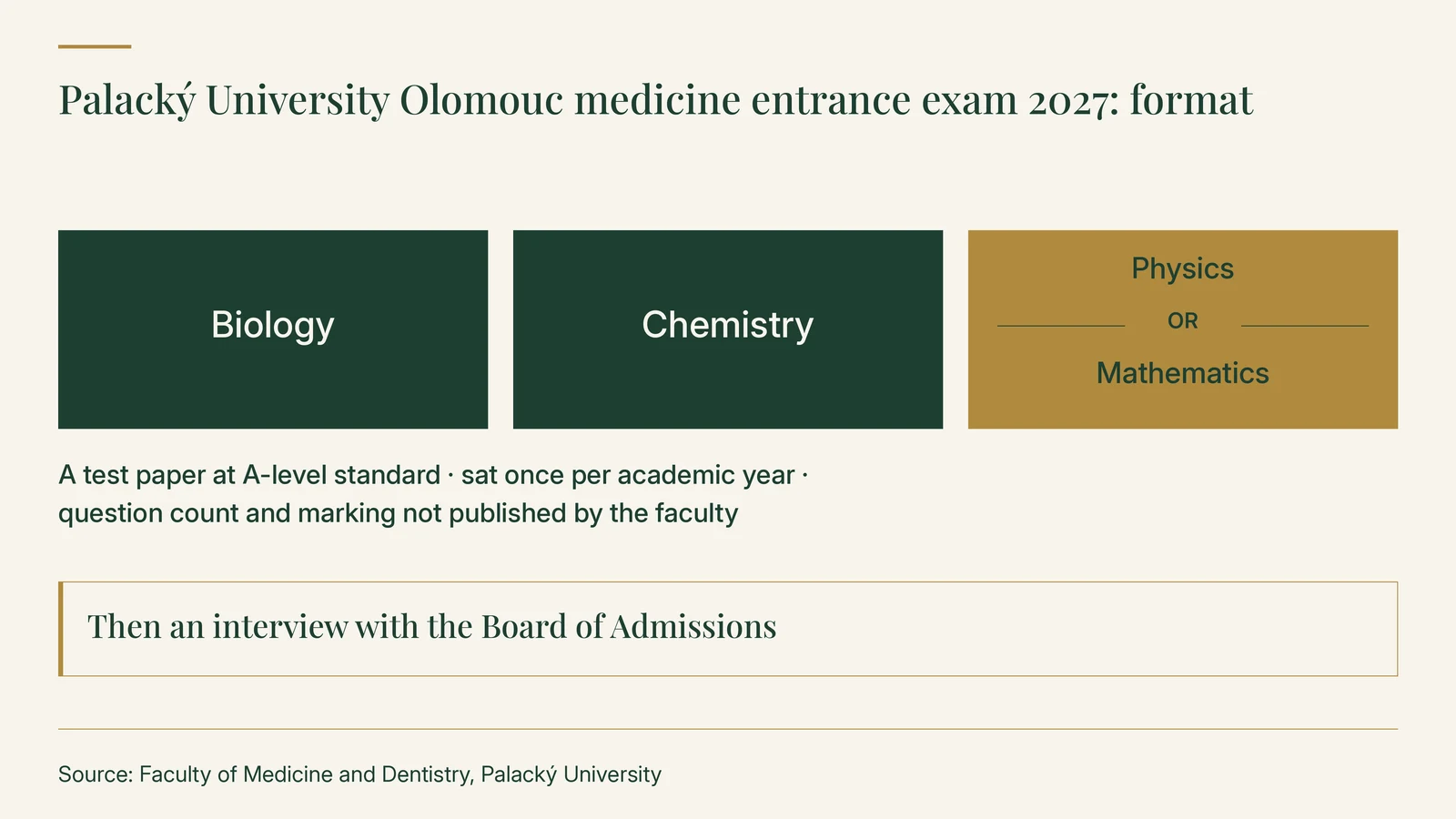
The examination's shape is official and simple to state: written papers in Biology, Chemistry and Physics or Mathematics. Biology and Chemistry are compulsory; the third paper is a choice between two tracks and you sit one of them. The examination may be taken only once per academic year, and its level, the Faculty says, corresponds to the British A-levels. The Faculty's 2026-2027 admissions notice adds a successful interview with the Board of Admissions after the written papers. Where Palacký is unusual is in what it does not publish: no document equivalent to an Italian Call exists, and with it no live-paper question count, no duration, no marking scheme and no pass mark. IvyTest downloaded and read every official sample test in full on 21 September 2026, and none of them states any of those four things either.
What the sample tests do show is a format that varies from paper to paper more than any other exam in this Czech catalogue. The Biology sample runs 25 questions and the Chemistry sample 42, both mostly five-option (a to e) with a few four-option items early on. The Mathematics sample is ten questions, uniformly four-option. The Physics sample is 35 questions and genuinely mixed within itself: items 1 to 20 are four-option single-answer, items 26 to 35 are six-option single-answer, and items 21 to 25 are six-option and explicitly headed 'Select one or more', with an answer key that confirms multi-option sets. That multi-select block has no parallel anywhere else in this batch, and it changes what partial knowledge is worth.
Programmes that use the Palacký University Olomouc Entrance Exam
- General Medicine (English-taught, Olomouc), 6-year MUDr
- Dentistry (English-taught, Olomouc); the Faculty of Medicine and Dentistry admits into both
Timeline
Palacký University Olomouc Entrance Exam 2027: dates and deadlines
When to expect your exam · 2027 start
- January 2027any dateBased on 2026
- February 2027any dateBased on 2026
- March 2027any dateBased on 2026
- April 2027any dateBased on 2026
- May 2027any dateBased on 2026
- June 2027any dateBased on 2026
- July 2027any dateBased on 2026
- August 2027any dateBased on 2026
Applications usually open 1 Nov 2026 (based on 2025).
Predicted from this university's past sittings until it publishes its own dates. See every university on the calendar →
- Applications open1 November 2026
- Application deadline31 July 2027
- Entrance examination sittingsThe Faculty says the 2027 dates and venues will be posted by the end of 2026. For 2026 the official list ran from 6 January to 28 August 2026, mostly online, with sittings in Olomouc on 20 April, 14 May, 30 June, 16 July, 30 July, 19 August and 28 August. Non-EU applicants are advised to choose a date no later than May, because a Czech residence permit can take up to three months
- Results publishedNo calendar date: under the 2026-2027 admissions notice, applicants learn the result within one week of their interview with the Board of Admissions
- Enrolment deadlineNot yet announced for September 2027; in 2026/27, first-year teaching began on 14 September 2026
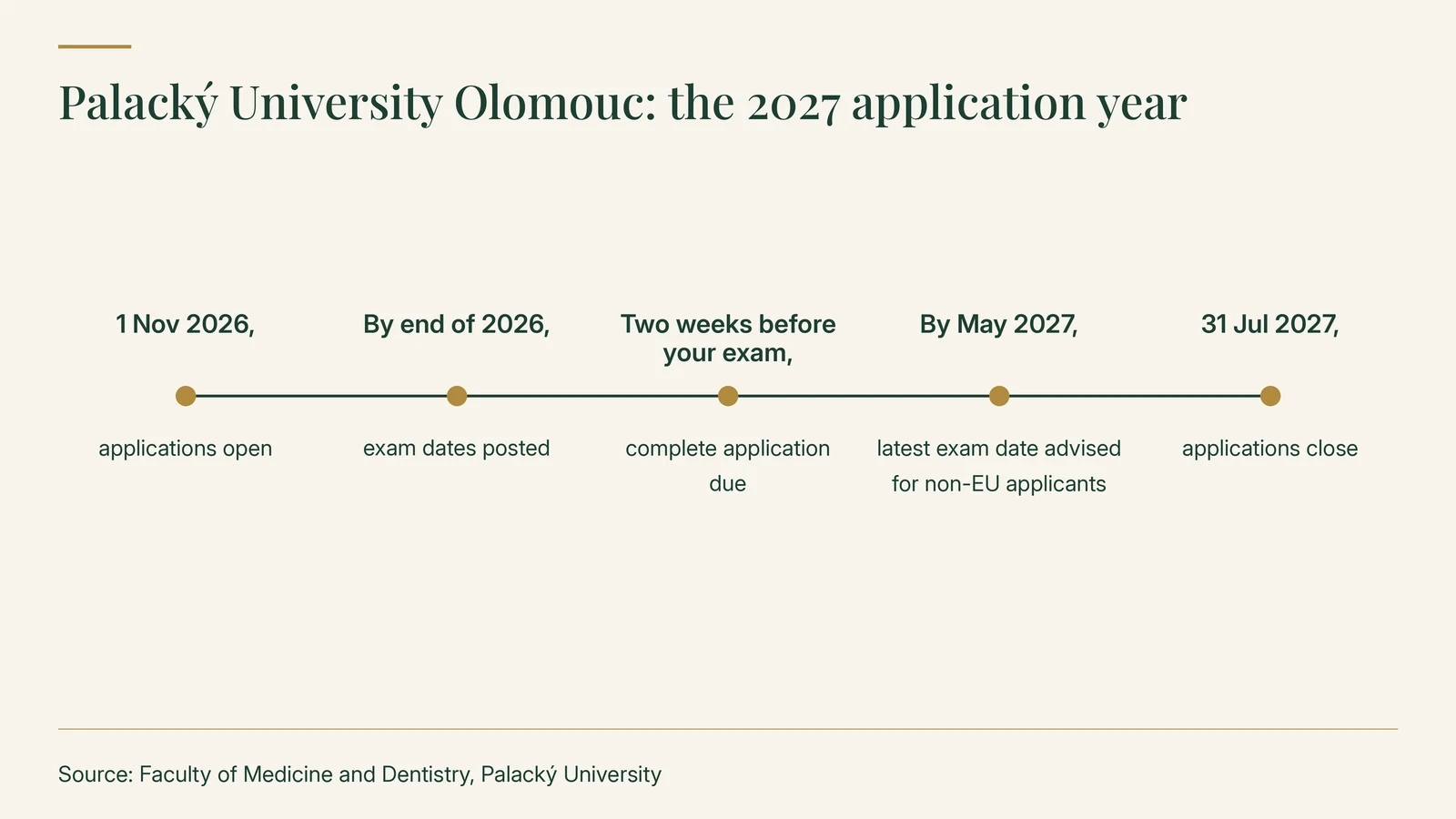
Palacký publishes topic lists and recommended literature but nothing equivalent to an Italian Call, so no single document fixes a calendar. The binding sources are the Faculty's own General Medicine and Admissions pages, its Official Notice Board and the official sample tests, re-read on 7 October 2026: applications for September 2027 are open from 1 November 2026 to 31 July 2027, and the 2027 exam dates are still to be posted. Because the deadline is tied to your chosen exam date rather than to one fixed cutoff, confirm both directly with the Faculty before applying. IvyTest re-checks lf.upol.cz and updates this guide when the 2027 dates appear.
Structure
Palacký University Olomouc Entrance Exam format
Written papers in Biology, Chemistry and Physics or Mathematics: two compulsory sciences plus one elective track. The counts below are the lengths of the university's own official sample tests, which is the best available evidence for the shape of the papers; the university does not publish the live paper's length, its duration or how it is marked. Note that the option count is not constant: it varies between papers and, in Physics, within one paper.
| Section | Questions | Weighting | Suggested time |
|---|---|---|---|
| Biology (compulsory) | 25 in the official sample test | 1see the note below the table | 1see the note below the table |
| Chemistry (compulsory) | 42 in the official sample test | 1see the note below the table | 1see the note below the table |
| Physics (elective, one track only) | 35 in the official sample test | 2see the note below the table | 2see the note below the table |
| Mathematics (elective, one track only) | 10 in the official sample test | 1see the note below the table | 1see the note below the table |
- No live-paper length, no per-paper weighting and no duration are published; the count shown is the sample paper's
- No live-paper length, no per-paper weighting and no duration are published; items 21-25 of the sample are six-option multi-select
Content
Question and subject breakdown
Two compulsory sciences and one elective track. Biology and Chemistry have genuine official syllabi published by the university; Physics has an official eight-area topic list; Mathematics has no official syllabus at all. English is not part of the written entrance examination; it is a separate, conditional proficiency requirement, described under admissions below.
Biology
No per-paper weighting is published; the sample paper runs 25 questionsCompulsory. The university's topics PDF gives a genuine sixteen-topic syllabus for this subject, running from cell structure and cell function through genetics, genetics problem solving and genetic engineering, then the full sweep of human biology (locomotor, circulatory, respiratory and digestive, energy metabolism and homeostasis, excretion and the senses, hormonal and nervous systems, reproduction and ontogenesis), plus stem cells, human diseases and healthy lifestyle, and ecology. The sample paper is mostly five-option with a few four-option items early on.
Chemistry
No per-paper weighting is published; the sample paper runs 42 questionsCompulsory, and the longest of the official sample papers at 42 questions. The topics PDF divides it into five official areas (General Chemistry, Basic Calculations in Chemistry, Inorganic Chemistry, Organic Chemistry and Biochemistry), covering atomic structure and bonding, states of matter, stoichiometry and chemical calculations, thermochemistry, rates and equilibrium, solutions and acid-base theory, redox, inorganic chemistry, the organic sequence from isomerism through functional groups to polymers and heterocycles, and the biomolecules with enzymes and metabolism. Mostly five-option.
Physics (elective)
No per-paper weighting is published; the sample paper runs 35 questionsOne of the two elective tracks, sat by only part of the cohort. Eight official areas: physical quantities and units, kinematics, dynamics with work and energy, mechanics of fluids, molecular physics and thermodynamics, wave motion and acoustics, electricity, magnetism and optics, atomic and nuclear physics, and, distinctively, physical measurement methods including refractometry, polarimetry and photocolorimetry. Its official sample paper is the one place in this catalogue where a genuine multi-select item type appears.
Mathematics (elective)
No per-paper weighting is published; the sample paper runs 10 questionsThe other elective track. The university's topics PDF lists no syllabus for it at all: one recommended text and a single line stating that general knowledge such as basic mathematical operations and unit conversions is required. The topics below are derived from the official sample test, which is ten questions of short competitive-style reasoning with little or no long calculus: arithmetic and number theory, ratios and percentages, algebraic expressions and equations, powers, roots and sequences, functions, logarithms and trigonometry, geometry, and combinatorics. Uniformly four-option.
Marks
Palacký University Olomouc Entrance Exam scoring
Palacký publishes no marking scheme, and the honest starting point is to say so plainly rather than repeat a number found elsewhere. Neither the official topics PDF nor any of the official sample tests states a point value for a correct answer, a penalty for a wrong one or a rule for blanks, and the unofficial preparation material that circulates says outright that it invents no point values, cut-offs or question counts because none exist publicly. IvyTest models the papers as +1 / 0 / 0, the neutral assumption, since a paper that really does penalise guessing still ranks candidates identically under a straight percentage, whereas inventing a penalty would change what you should do on every item you are unsure of.
- Correct answer
- Not published. IvyTest models +1 per correct answer; no official source states a point value
- Incorrect answer
- Not published. IvyTest models 0 (no negative marking) because no penalty is stated in any official source
- Unanswered question
- Not published. IvyTest models 0, which is the same as a wrong answer under the modelled rule
- Answer options
- Not constant: mostly 5 in Biology and Chemistry, 4 in Mathematics, and 4 then 6 within Physics. Confirmed by reading the official sample-test PDFs in full on 21 September 2026
- Multi-select items
- Physics items 21-25 of the official sample are headed 'Select one or more' with six options, and the answer key confirms multi-option sets such as D,E and C,F. How they are marked, and whether partial credit exists, is not published
- Maximum possible score
- Depends on the live paper's length, which is not published; the official sample tests run 25, 42, 35 and 10 items
- Minimum eligible score
- No pass mark, cut-off or minimum eligible score is published in any source checked
- Per-subject floors
- None published: there is no Czech counterpart to the per-subject 'additional learning requirement' floors used by some Italian medical schools
- Attempts
- The entrance examination may be taken only once per academic year
Worked example
Because the option count changes from paper to paper, so does the value of a guess, and that is the one piece of arithmetic here worth doing carefully. Under the modelled +1 / 0 / 0 rule a blind guess returns 1/n marks on an n-option single-answer item: +0.25 on a four-option item, +0.20 on a five-option item, and about +0.167 on a six-option item. A blank returns exactly 0 in every case, so on any single-answer item, answering beats skipping. Now the Physics multi-select block, which behaves completely differently. Items 21 to 25 offer six options under the instruction 'Select one or more', so the answer is a SET, and there are 2⁶ − 1 = 63 possible non-empty sets. A blind guess that has to match the key exactly therefore has about a 1-in-63 chance, an expected return of roughly +0.016 marks: about a fifteenth of what a four-option guess is worth. Partial knowledge fares badly too, and here the two units have to be kept apart. Model each of the six options as an independent judgement you get right with probability p. The chance of producing the exact correct set is p⁶: at p = 0.80 that is 26.2% of such items answered correctly, and at p = 0.90 it is 53.1%. Moving from 80% to 90% per-option accuracy therefore lifts your accuracy RATE on multi-select items by 26.9 percentage points, but across the five such items on the official sample paper that is worth about 1.3 RAW MARKS, not twenty-seven of anything. Those are two different measurements of the same improvement and they are not interchangeable. One caveat runs under all of this: Palacký publishes no marking rule at all, so whether those items are scored all-or-nothing or with partial credit is unknown. If partial credit exists the numbers soften considerably, but the direction does not change, and preparing as though every option in a multi-select item has to be right is the safer of the two errors.
The IvyTest simulator scores every practice paper against these exact rules.
See the Palacký University Olomouc Entrance Exam simulatorSyllabus
Palacký University medicine syllabus for the entrance exam
Biology, Chemistry and Physics all have official topic lists published by the university in its 'Topics for the Entrance Examination and Recommended Literature' PDF, and every official area of each is preserved below. Mathematics has no official syllabus at all, so that group is derived from the official sample test and is labelled as such. English is included last because non-native speakers without an exemption may have to sit the faculty's English test, but it is not part of the written entrance examination and should not be revised as though it were.
The sixteen numbered topics of the official topics PDF, which is a genuine syllabus rather than a literature list. Topic 08 is headed 'Respiratory system' but its body also covers the digestive tract, and the two are kept together as the official text has them.
- Cell structure: the chemical constitution of a cell and the importance of chemical compounds in cells, the structure and function of the biopolymers (nucleic acids, proteins, polysaccharides), phospholipids, the hierarchy of organisms according to their complexity, viruses as non-cellular organisms and virus structure, the structure of the prokaryotic cell, the structure of the eukaryotic cell, and the structure and number of chromosomes
- Cell function: cell metabolism, enzymes and enzymatic catalysis, the regulation of enzymatic reactions, membrane transport including diffusion, endocytosis, exocytosis and osmotic processes, heterotrophy, autotrophy and mixotrophy, photosynthesis, anaerobic glycolysis, oxidative phosphorylation, ATP metabolism, the synthesis of nucleic acids and of polysaccharides, the course and regulation of proteosynthesis in prokaryotes and eukaryotes, the cell cycle and its regulation, cell division, mitosis and meiosis
- Genetics: the basic genetic terms and genes, the molecular basis of heredity, genetic information and the genetic code, gene expression, Mendelian genetics and Mendel's laws, X-linked inheritance in humans, gene arrangement in chromosomes, the genetics of the prokaryotic cell including the prokaryotic chromosome and plasmids, the genetics of the eukaryotic cell including the nuclear genome and karyotype, diploid and haploid chromosome number, segregation and combination, sex determination, extranuclear DNA molecules, genetic variability, mutations and their classification, mutagenic factors and the importance of mutations, human aneuploidies, sexual and asexual reproduction, genetic crossing, the heredity of quantitative traits, inherited and non-inherited variability and heritability, the inheritance of the human blood group system, population genetics, Hardy-Weinberg equilibrium and the genetic structure of a population, the breeding of microorganisms, plants and animals, and the medical importance and ethical and social aspects of genetics
- Genetics problem solving: worked examples on Mendelian inheritance in humans, examples on blood groups, calculations using the Hardy-Weinberg law for allele and genotype frequencies, and reading inheritance patterns from a pedigree
- Genetic engineering: genetic manipulation in medicine, the basic methods of gene engineering, DNA cloning, genetically modified organisms, animal cloning and gene therapy
- Locomotor system: the locomotor system, the skeleton of the human body, the structure and function of bones, the axial skeleton, the appendicular skeleton, the structure and function of skeletal muscles, smooth muscles and connective tissue
- Circulatory system, blood and immunity: body fluids, blood and blood cells, haemostasis, blood groups and blood transfusion, the circulatory system, the function of the heart, cardiac muscle and the cardiac cycle, blood pressure and pulse, capillaries and tissue fluid, blood circulation and its regulation, vascular diseases, lymph and lymphatic circulation, and immunity
- Respiratory and digestive systems: the respiratory system, the respiration mechanism and lung ventilation, the exchange of respiratory gases in the lungs and in the tissues, the regulation of respiratory movements, defensive respiratory reflexes, diseases of the respiratory tract, the digestive system, the function of the oral cavity and oesophagus, and the function of the stomach and of the small and large intestines
- Energy metabolism and homeostasis: energy metabolism, the metabolism of individual nutrients, the importance of the liver for metabolism, homeostasis, the importance of nutrition and the composition of food, vitamins, hypoalimentation and undernutrition, and body temperature with its maintenance and regulation
- Excretion, skin and sensory organs: excretion, the structure and function of the kidney, the urinary tract, the structure and function of the skin, receptors, and the structure and function of the sense organs
- Hormonal system and metabolic regulation: the regulation of human metabolism, the endocrine glands, human hormones with their functions and sites of production, insulin, the adrenal hormones, the thyroid gland hormones, the parathyroids, the pituitary hormones and the sex hormones
- Nervous system and reflexes: the structure of the human nervous system, the functions of the nervous system, the function of the spinal cord, hindbrain, midbrain, reticular formation, diencephalon and cortex, reflexes, the regulated function of internal organs, sleep and vigilance, higher nervous activity, and conditioned and unconditioned reflexes
- Reproduction and ontogenesis: the reproductive system of woman and man, the development of an individual, human embryogenesis, intrauterine development, the uterus and placenta, pregnancy and the mother's body, the care of pregnant women and mothers, and the phases of human life
- Stem cells: the features and differentiation of stem cells, the types of stem cells, the sources of stem cells and their potential therapeutic use
- Human diseases and healthy lifestyle: human health, infectious diseases, the civilization diseases including obesity and diabetes mellitus, healthy nutrition, the work and rest regime, drug dependence, hereditary diseases and genetic predispositions, genetic counselling, and human parasitology with the main human parasites: protozoa, worms, mites and insects
- Ecology: the basic ecological terms, the relationship between organism and environment, the abiotic components of the environment (sun, atmosphere, hydrosphere, lithosphere, paedosphere), the biotic components, populations and the interrelations between them, communities, ecosystems and their changes, the biosphere, man and environment, the human population and present environmental problems, air, water and soil pollution, chemicals in the environment, increased radioactivity, noise, increased amounts of waste, and environmental protection
The five official areas of the topics PDF (General Chemistry, Basic Calculations in Chemistry, Inorganic Chemistry, Organic Chemistry and Biochemistry), with the long General and Organic paragraphs split along the semicolon-separated clusters the official text itself uses.
- Atomic structure and the periodic table: the structure of the atom, elements, atoms and the periodic table, elementary particles, atomic number and mass number, isotopes and ions, electron configuration and valence electrons, and the periodic trends in atomic and ionic radius, electronegativity, ionization energy and metallic character
- Chemical bonding and molecular structure: bonds in chemistry, the structure and properties of ionic and covalent compounds, coordinate covalent and metallic bonding, polar and nonpolar bonds and molecules, and the intermolecular forces including hydrogen bonding, dipole-dipole and dispersion forces
- States of matter: gases, liquids and solids at particle level, the ideal gas law, Avogadro's and Dalton's laws, and the pressure, volume and temperature relationships
- Stoichiometry and chemical calculations: the fundamental laws of chemistry, composition, the chemical equation and stoichiometry, the mole and molar mass, balancing equations, calculations based on chemical equations, stoichiometry involving gases, concentration in mol per cubic decimetre and in percentage by mass, dilution, mass fractions, empirical formulae, pH and pOH with the concentrations of hydrogen and hydroxide ions of strong acids and bases, and the balancing of oxidation-reduction reactions
- Thermochemistry, rates and equilibrium: the energy of chemical and biochemical processes, thermochemistry, exothermic and endothermic reactions, activation energy and catalysis, reaction rates and the factors that affect them, dynamic equilibrium and the equilibrium constant, and Le Chatelier's principle
- Solutions, acids and bases: solutions, solute and solvent, electrolytes, acids and bases, Brönsted-Lowry theory, conjugate acid-base pairs, strong and weak acids and bases, the autoionization of water, hydrolysis and buffers
- Oxidation and reduction: oxidation and reduction, oxidation numbers, oxidising and reducing agents, half-reactions and electron transfer, and balancing redox equations in acidic and basic medium
- Inorganic chemistry: the nomenclature of inorganic compounds, the trends across the periodic table, hydrogen and water, the s-block metals and their compounds, the p-block elements and their compounds, and the transition metals and their compounds
- Organic foundations and isomerism: isomerism, functional groups, the basic reaction mechanisms in organic chemistry, organic nomenclature, carbon bonding and homologous series, structural and skeletal formulae, and chain, position, functional-group and optical isomerism
- Hydrocarbons and halogen derivatives: the nomenclature, properties and reactivity of alkanes, alkenes, alkynes and aromatic hydrocarbons, and of halogenoalkanes and halogenoarenes
- Oxygen and nitrogen functional groups: alcohols, phenols and ethers, aldehydes and ketones, amines, carboxylic acids and their derivatives including halogenoacids, aminoacids and hydroxyacids, acid halogenides, esters, amides, anhydrides, and the carbonic acid derivatives
- Polymers and heterocycles: polymers, addition and condensation polymerization, monomers and repeat units, and the simple five-membered and six-membered heterocycles
- Biomolecules: saccharides including linear and cyclic formulae, monosaccharides, disaccharides and polysaccharides with their importance in biochemistry, lipids and their classification, composition, properties and biochemical importance, proteins including the basic amino acids and their formulae, peptide bonds, the composition and function of proteins, and nucleic acids including nucleosides, nucleotides, base pairing, structure and function
- Enzymes and metabolism: enzymes with their characteristics and classification, the digestive enzymes, the basic metabolic pathways of saccharides, triacylglycerols and proteins, and energy production
The eight official areas of the topics PDF, with Mechanics split into kinematics, dynamics and fluids and Electricity and Magnetism split into its three listed clusters. The official 'General Requirements' block (simple numerical calculation, basic mathematical functions, basic geometrical formulas and basic physical constants) is a competence bar that applies across every topic rather than a topic of its own.
- Physical quantities and units: the SI basic, complementary and derived units, the formation of parts and multiples, conversions of units, the determination of unit dimensions, conversion of angles, percentage work, and the basic physical constants
- Kinematics: the types of motion and their classification, uniformly rectilinear motion, uniformly accelerated and decelerated motion, uniform circular motion, displacement, distance, speed, velocity and acceleration, and motion graphs
- Dynamics, work and energy: Newton's laws of motion, the mass and weight of a body, the quantity of motion of a body, the effect of force including work, the impulse of force, the moment of force with regard to the axis, pressure and mechanical stress, energy and work, power and efficiency, and the gravitational field with Newton's gravitational law
- Mechanics of fluids: the mechanics of liquids and the term ideal liquid, pressure in a liquid induced by external force, Pascal's law and its application, hydrostatic pressure, Archimedes' law, the flow of liquids, the equation of continuity and Bernoulli's equation
- Molecular physics and thermodynamics: the quantity of compounds, interactions inside molecules and intermolecular interactions, heat and temperature with their measurement, the molecular properties of gases and events in gases, the equation of state of an ideal gas, Dalton's and Avogadro's laws, the molecular properties of liquids, surface tension and its biological importance, diffusion, osmosis, the viscosity of liquids and its importance, the molecular properties of solids, and changes of state
- Wave motion and acoustics: harmonic motion, the types of wave motion and their properties, the properties of sound with regard to sound source and propagation, sound pitch, timbre and intensity, the ear as a biological detector of sound, the sound field, and the intensity level and loudness level of sound
- Electric field and capacitance: electric charge and the electric field, the classification of the atmosphere from the electrical point of view, the potential of an electric field, voltage, capacity, the capacitor and arrangements of capacitors
- Electric current and circuits: metal conductivity, electric current and the simple circuit, the operation and output of electric current, electric resistance, Ohm's law, the branched electric circuit, Kirchhoff's laws, the assembly of resistors, semiconductors and their application, electric current in electrolytes and Faraday's law, and electric current conduction in gases and in vacuum
- Magnetism and alternating current: the magnetic field, electromagnetic induction, the induction coil, alternating current, transformers and the electric oscillating circuit
- Optics: the electromagnetic spectrum and its properties, light as electromagnetic wave motion, the wave properties of light, interference, light polarization, the quantum properties of light and the photoelectric phenomenon, geometric optics and Fermat's principle, reflection and refraction, picture formation by mirrors and lenses, optical instruments including the magnifying glass and microscope, the eye as an optical system and as a biological detector of light, eye defects, the photometric quantities and their units, and X-ray radiation with its biological importance
- Atomic and nuclear physics: the structure of the atom and its characteristics, the electron shell, the atomic nucleus, natural and artificial radioactivity, and nuclear reactions with their power utilization
- Physical measurement methods: balances and weighing, density and its measurement, temperature and thermometers, the measurement of electrical quantities including current, voltage and resistance, and optical measurement including refractometry, polarimetry and photocolorimetry
Derived, not official. The university's topics PDF lists no Mathematics syllabus at all: one recommended text and a line stating that general knowledge such as basic mathematical operations and unit conversions is required. The areas below come from analysis of the official ten-question sample test, which is short competitive-style reasoning with little or no long calculus.
- Arithmetic and number theory: integer, fraction and decimal operations, negative numbers, order of operations, scientific notation, divisibility rules, prime factorization, greatest common divisor and least common multiple, parity, unit-digit cycles and unit conversions
- Ratios, proportions and percentages: direct and combined ratios, converting separate ratios into common terms, proportional scaling, rates, percentages, percentage increase and decrease, and successive percentage change
- Algebraic expressions and equations: linear equations, rational equations and restrictions on the denominator, quadratic equations and the sum and product of their solutions, systems of equations, rearranging formulas, consecutive-integer problems, substitution and the simplification of algebraic expressions
- Powers, roots and sequences: the laws of exponents, powers of sums and products, roots and radicals, the cyclicity of powers, simplifying long power expressions, and arithmetic and geometric sequences
- Functions, logarithms and trigonometry: linear, quadratic, exponential, logarithmic and goniometric functions with their graphs, the logarithm rules including base 10 for pH work, sine, cosine and tangent with their notable values, and the physical applications of these functions
- Geometry: triangles, quadrilaterals and regular polygons, angle sums, the Pythagorean theorem, similar figures and scale factor, the perimeter and area ratios of similar figures, area and volume formulas, the circle and basic coordinate geometry
- Combinatorics and counting: the fundamental counting principle, permutations without repetition, simple combinations, forming integers under digit restrictions, odd and even conditions, and counting outcomes
Included for completeness, not as an exam paper. Non-native English speakers must provide accepted proof of English or sit the faculty's English test, unless they are exempt through English-medium secondary or tertiary education. The official 50-question sample is a general academic grammar, vocabulary, collocation and phrasal-verb paper at roughly B2 accuracy (not a medical English paper), and it is uniformly four-option.
- Verb tenses: present simple and continuous, present perfect simple and continuous, past simple, past continuous, past perfect, the future forms and future continuous, time clauses and tense consistency
- Conditionals and unreal forms: zero, first, second, third and mixed conditionals, 'if' plus past perfect with would/could/should have, 'it's time' plus past simple, 'I'd rather you' plus past simple, and 'wish' with 'would' for present and future annoyance
- Modal verbs: 'needn't have' against 'didn't need to', 'should have' and 'could have', 'mustn't' and 'can't', 'have to' and 'need to', and obligation, deduction and criticism
- Gerund and infinitive patterns: 'would mind' plus -ing, 'can't help' plus -ing, 'remember' and 'try' with -ing or the to-infinitive, 'need' plus to-infinitive, and 'would rather' with the bare infinitive or with object plus past
- Connectors and prepositions: despite and in spite of, although, however, due to, as a result of, provided that, unless, in case, on behalf of, and 'point in' plus -ing
- Vocabulary in context: common academic and general vocabulary chosen to fit a sentence, discrimination between near synonyms, and word choice in context
- Phrasal verbs and collocations: common phrasal verbs such as work out, get over, carry out, take after and get along with, and fixed collocations such as take precautions, join forces and carry out tests
- Question formation and word order: indirect questions, subject and object questions, auxiliary placement, and reported speech with tell, say, explain and suggest
Test your Palacký University Olomouc Entrance Exam knowledge
Take free diagnosticDifficulty
How difficult is the Palacký University Olomouc Entrance Exam?
Palacký's science is pitched where every Czech medical entrance paper's is: a strong final-year school student. What makes this exam awkward is how little of its machinery is published, and how much the format shifts between papers and even inside one of them.
The format is not one format
Biology and Chemistry are mostly five-option with a few four-option items early on. Mathematics is uniformly four-option. Physics is four-option for its first twenty items and six-option for its last ten. A blind guess is worth +0.25 marks on a four-option item, +0.20 on a five-option one and about +0.167 on a six-option one, so the value of answering something you do not know is not constant across the examination the way it is at every other faculty in this batch.
Physics contains a genuine multi-select block
Items 21 to 25 of the official Physics sample are headed 'Select one or more' with six options, and the answer key confirms multi-option sets. Modelling each option as an independent judgement, producing the exact right set at 80% per-option accuracy happens 26.2% of the time and at 90% accuracy 53.1% of the time, so partial knowledge that would comfortably carry a single-answer item collapses here. Nothing else in the Czech catalogue has this item type.
Nobody can tell you how long the paper is, or how long you get
The university publishes no live-paper question count, no duration and no marking scheme. The official sample tests run 25, 42, 35 and 10 items for Biology, Chemistry, Physics and Mathematics, and those are sample-paper lengths rather than a stated blueprint. A 90-minute duration and a 90-question total both circulate; neither is traceable to a university source, and the second is arithmetically an even split across five subjects, one of which is not even part of the written exam.
The elective tracks are shaped completely differently
The Physics sample is 35 items with three distinct formats inside it, including the multi-select block. The Mathematics sample is 10 items, uniformly four-option, described as short competitive-style reasoning with little or no long calculus. There is no published weighting that would let you compare them on marks, so the choice has to be made on content confidence, but knowing that one track contains an item type where partial knowledge stops paying is a real input to that decision.
Mathematics has no official syllabus at all
The topics PDF gives it one recommended text and a single line about general mathematical operations and unit conversions. Everything else known about the track comes from analysis of its ten-question official sample. A candidate choosing Mathematics is choosing the paper with the least published guidance in the entire examination, which is survivable, because the sample is short and its scope is narrow, but it should be a deliberate choice rather than a default.
Benchmarks
What is a good Palacký University Olomouc Entrance Exam score?
There is no number to aim at, and unusually there is not even a paper length to aim across. IvyTest downloaded and read the official Biology, Chemistry, Physics, Mathematics and English sample tests in full on 21 September 2026 and re-checked the official General Medicine admissions page: none of them states a duration, a marking scheme, a pass mark or the live paper's length.
That means any confident claim you find about a Palacký cutoff or a required percentage is somebody's estimate rather than a university figure, and it means the raw score you produce on a mock is not directly comparable to anything the university publishes. What you can compare it to is your own previous attempts. Score each sample paper as a percentage of the items you attempted and as a percentage of the paper, and track the two side by side: the gap between them tells you how much of your result is pacing and how much is knowledge.
One measurement discipline is worth adopting specifically because of the multi-select block. On a single-answer item, one item equals one mark under the modelled rule, so 'percentage of items right' and 'percentage of marks' are the same number. On a multi-select item they come apart: a candidate who gets five of six option judgements right on such an item may score zero for it, so per-option accuracy and per-item accuracy are different measurements and improving one by a given amount does not improve the other by the same amount. When you review a Physics mock, record both: how often you produced the exactly-correct set, and how often each individual option judgement was right, because only the second tells you whether you are actually getting better at the content.
Pending verification
- · The live paper's question count, as distinct from the official sample tests' lengths
- · The duration of the examination
- · The official marking scheme, including how multi-select Physics items are scored and whether partial credit exists
- · Any pass mark, cut-off or minimum eligible score
- · Whether a calculator is permitted, and how the online sittings are proctored
- · How the interview with the Board of Admissions is scored, and whether it is still required for 2027
- · Applicants per cycle (only an estimated number of admissions is published)
These specific numbers aren't public yet — an IvyTest simulator score is the closest benchmark you can get today.
Check your Palacký University Olomouc Entrance Exam scoreStrategy
How to prepare for the Palacký University Olomouc Entrance Exam
12+ weeks
Chemistry is the long paper: plan the calendar around it
Biology and Chemistry at depth, with the elective chosen early on evidence from both sample papers.
- Sit all four official sample tests in week one (Biology, Chemistry, Physics and Mathematics) under a self-imposed clock. They are the only artefacts that describe this examination honestly, and doing both elective papers is what makes the track choice an informed one rather than a habit.
- Weight Chemistry accordingly. Its official sample runs 42 questions against Biology's 25, and its five official areas include a full Basic Calculations block (stoichiometry, concentration, dilution, pH and pOH, redox balancing) that rewards hand-worked practice.
- Give Biology's sixteen official topics equal calendar coverage rather than clustering on cell biology and genetics. The syllabus reaches into stem cells, human parasitology, civilization diseases and a full ecology topic, all of which are genuinely listed and rarely revised.
- If you choose Physics, start the multi-select block early. Items of the 'Select one or more' type need a different habit: evaluate every one of the six options on its own merits rather than hunting for the single best, and that habit takes weeks to build.
8 weeks
Commit to a track, then stop splitting your attention
Targeted repair in Biology and Chemistry, with one elective track only.
- Diagnostic first across both compulsory sciences and both elective samples, then commit to Physics or Mathematics and stop revising the other. With no published weighting there is nothing to gain from hedging, and the two tracks share almost no content.
- Keep Biology and Chemistry on a weekly rotation rather than blocking them; the examination is sat as separate papers but in one sitting, and there is no reasoning section to reset between sciences.
- One full set of papers a week from week two, reviewed the same day, with every wrong or blank answer logged by cause: content gap, misread question, or arithmetic slip.
- Practise in the real option structures rather than a single one. A four-option habit built on Mathematics-style items transfers badly to five- and six-option Biology, Chemistry and Physics items, where elimination is worth more per option removed.
4 weeks
Full sittings at sample-paper length, and nothing left blank
Volume of timed papers, plus answer-everything discipline calibrated per item type.
- Two full sittings a week at the official sample lengths (25 Biology, 42 Chemistry and either 35 Physics or 10 Mathematics) under a fixed self-imposed time limit so your results stay comparable to each other.
- Answer every single-answer item. Under the rule IvyTest models a blind guess is worth +0.25, +0.20 or about +0.167 marks depending on the option count, and a blank is worth 0 in all three cases, so there is no single-answer item worth leaving empty.
- Treat multi-select items differently. A blind guess there has roughly a 1-in-63 chance of matching the key exactly, so the return on guessing is close to nothing; these are the items where working the physics properly is the only route to the mark.
- Drill Chemistry calculation patterns by hand: stoichiometry from equations, concentration and dilution, pH and pOH from ion concentrations, and redox balancing in acidic and basic medium. The university does not say whether a calculator is permitted, so assume it is not.
Under 4 weeks
Consolidate the two compulsory sciences, and pick your exam date deliberately
Triage across Biology and Chemistry, with the elective kept at maintenance level.
- Stop adding new content. Consolidate the highest-frequency areas of Biology and Chemistry; they are the two papers every candidate sits, and Chemistry is the longest of the official samples.
- Keep elective revision to maintenance: the standard formulas and the two or three calculation patterns its sample paper uses. A new topic in the final fortnight is unlikely to pay back.
- Sit at least two full sets of the official sample papers in the final ten days, then taper.
- Use the rolling deadline to your advantage. Palacký's cutoff is two weeks before whichever exam date you choose, so pick the sitting that gives your preparation the most useful runway rather than the earliest one, bearing in mind the examination may be taken only once per academic year.
Get your personalised Palacký University Olomouc Entrance Exam study plan
Take free diagnosticExplore the full Palacký University Olomouc Entrance Exam planPractice
Free Palacký University Olomouc Entrance Exam practice questions
Three questions in the format the exam uses. Choose an answer to see the explanation — nothing is recorded.
At 25 °C, an aqueous solution has pOH = 11. What is the hydrogen ion concentration in that solution?
A solid block of density 750 kg/m³ floats freely at rest in water of density 1000 kg/m³. What fraction of the block's volume is below the waterline?
Illustrative examples written by IvyTest to show the question style — not past Palacký University Olomouc Entrance Exam papers.
Past papers
Palacký University Olomouc Entrance Exam past papers
Palacký University publishes no past papers. Its Faculty of Medicine and Dentistry's General Medicine page links five free sample tests as PDFs instead, each with its correct answers listed at the end: Biology (25 questions), Chemistry (42), Physics (35, including a 'Select one or more' block), Mathematics (10) and English (50), plus the Topics for the Entrance Examination and Recommended Literature PDF. IvyTest's free practice paper, with every answer explained, follows the live format.
University
Palacký University Olomouc medicine admissions
The entrance examination sits inside a wider application, and Palacký's admissions process is structured differently from every other Czech faculty in this catalogue: applications run from 1 November to 31 July, but your own deadline is tied to the exam date you choose.
- Degrees
- General Medicine and Dentistry (English-taught) at the Faculty of Medicine and Dentistry
- Language of instruction
- English
- Campus
- Faculty of Medicine and Dentistry, Palacký University, Olomouc
- Tuition
- €12,500 / year for General Medicine, the lowest of the seven Czech faculties in IvyTest's catalogue
- Application fee
- €80 per application, an administrative fee payable online and non-refundable, with no further exam fee (General Medicine and Admissions pages)
- Application deadline
- Two weeks before whichever exam date you choose: applications for September 2027 enrolment are open from 1 November 2026 to 31 July 2027, and the 2027 exam dates are to be posted by the end of 2026
- Interview
- Yes, under the Faculty's 2026-2027 admissions notice: a successful interview with the Board of Admissions after the written examination, on your motivation and academic background. The General Medicine page does not mention it, and no score or weight is published
- English requirement
- Accepted proof of English at B2 level or above, the faculty English test, or an exemption: non-native speakers must provide accepted proof or sit the faculty's English test, on the day of the entrance examination, unless exempt through English-medium secondary or tertiary education; the English test is not part of the written entrance examination. Accepted certificates include Cambridge FCE or higher, IELTS 6, TOEFL 87, PTE Academic 59 and the psychometric test (PET)
- Motivation letter
- Not required
- Recommendation letters
- Not required
- Document requirements
- Depends on the issuing country, per Palacký University's legalisation specification: a verified copy, an apostille or superlegalisation. A certified translation into Czech or English is needed only for documents not issued in Czech, Slovak or English
- Czech language in clinical years
- Needed from around year 2: Czech classes are compulsory in the first three years, and the Faculty says a good grasp of Czech is required to talk to patients and to ward staff who may speak only Czech
- Cost of living
- By the university's own figures: dormitory rooms from about €95 a month and a full canteen meal about €3. The Faculty guarantees international students a place in one of its seven halls of residence for their whole studies
- Seats available
- An estimated 80 admissions to General Medicine (and 20 to Dentistry) on the Faculty's programme pages; the 2026-2027 admissions notice gave 65 and 20
IvyTest Palacký University Olomouc Entrance Exam preparation
Ready to prepare properly for the Palacký entrance exam?
Everything above is free and always will be. When you want structure (a syllabus-mapped book built on Palacký's own official topic lists, a simulator that runs the real option structures paper by paper, lessons for the gaps your results flag, and help with the application itself), that is what the IvyTest Palacký package is.
Study guide
Biology and Chemistry built on the university's own official topic lists, plus both elective tracks so you can choose on evidence.
Exam simulator
Timed mocks at the official sample lengths in the real per-paper option structures, with per-question explanations and per-paper analytics.
Video courses
Focused lessons in biology, chemistry, physics and mathematics for the topics your results flag.
Application support
MedApply: deadlines, documents, legalisation and enrolment steps carried through to a confirmed place, including Palacký's rolling, exam-date-linked cutoff.
FAQ
Palacký University Olomouc Entrance Exam frequently asked questions
It's the written entrance test Palacký University's Faculty of Medicine and Dentistry uses to select candidates for its English-taught programmes in Olomouc. It consists of written papers in Biology, Chemistry and either Physics or Mathematics: the two sciences are compulsory and the third paper is a choice between the two tracks. It may be taken only once per academic year, and the Faculty's 2026-2027 admissions notice follows it with an interview with the Board of Admissions.
None of those. There is no national Czech medical entrance test, and Palacký is a separate university from both Charles and Masaryk with its own topic lists and sample papers. Masaryk runs three equal 40-question tests with a published 60% pass mark; Charles University's Hradec Králové faculty runs one 60-point paper with published 25/25/10 weights; its Pilsen faculty runs three compulsory sciences partly in open-response form. Palacký publishes none of those numbers, which makes its own official sample tests the most informative material available.
Mostly online: the Faculty's admissions page says the entrance exam is done online, and independent applicants may join any online date. The 2026 list also had sittings in person in Olomouc and, through a partner agency, in Tel Aviv; the 2027 dates and venues are to be posted by the end of 2026. No page says whether a calculator is permitted, so prepare on the assumption that none is available: that is the conservative reading and it costs nothing if you are wrong.
No marking scheme is published anywhere. IvyTest models the papers as +1 for a correct answer and 0 for everything else, because that is the neutral assumption. On that model a blind guess is worth +0.25 marks on a four-option item, +0.20 on a five-option item and about +0.167 on a six-option item, while a blank is worth 0 in every case, so no single-answer item is worth leaving empty. The multi-select Physics items are the exception: with six options and a set to match, a blind guess has roughly a 1-in-63 chance and is worth almost nothing.
Neither is published for the live paper. The official sample tests run 25 questions in Biology, 42 in Chemistry, 35 in Physics and 10 in Mathematics, and those are sample-paper lengths rather than a stated blueprint. A 90-question total and a 90-minute duration both circulate online; neither is traceable to a university source, and the 90-question figure appears to be an even split across five subjects, one of which, English, is not part of the written entrance examination at all.
No pass mark or minimum score is published in any source checked: not the official topics PDF, not the sample tests, not the admissions pages or the notice board. The Faculty says only that the written examination must be successful, at a level corresponding to the British A-levels, and that the interview with the Board of Admissions must be too. There are also no per-subject floors; the Czech system has no counterpart to the per-subject 'additional learning requirement' thresholds used by some Italian medical schools.
On content confidence, measured rather than remembered: there is no published weighting that would let you compare them on marks. What the sample papers show is that the two are shaped very differently: the Mathematics sample is ten four-option items of short competitive-style reasoning with little or no long calculus, while the Physics sample is 35 items across three formats, including a five-item block headed 'Select one or more' with six options where partial knowledge stops paying. Sit both official samples before committing.
No. Non-native English speakers must provide accepted proof of English or sit the faculty's separate English test, unless they are exempt through English-medium secondary or tertiary education. An official 50-question English sample test exists and is a general academic grammar, vocabulary, collocation and phrasal-verb paper at roughly B2 level, but it sits alongside the entrance examination as a proficiency requirement, not inside it.
The Faculty's General Medicine page gives an estimated 80 admissions (20 for Dentistry); its 2026-2027 admissions notice gave 65 for General Medicine. It publishes no applicant numbers, so there is no official acceptance rate and any figure quoted elsewhere is an estimate. What is distinctive about Palacký's process is its shape rather than its size: a deadline tied to your chosen exam date, one attempt per academic year, and the lowest tuition of the seven Czech faculties in IvyTest's catalogue.
Within the EU, yes: automatically, as a standard Czech medical degree. There's no separate national licensing exam afterwards: the Czech state exam (státní rigorózní zkouška) is built into the MUDr degree itself, and registration with the Czech Medical Chamber (ČLK) is compulsory to practise in the country. Outside the EU recognition isn't automatic as a rule, but the UK is an exception. Under the Medical Act 1983 (section 21B, as in force on 12 October 2026), a Czech medical degree (MUDr.) is a 'relevant European qualification', so a graduate who applies to the GMC with one, whatever their nationality, is not asked to show the knowledge and skills other international graduates prove through PLAB/UKMLA; evidence of English is still required, and the rule is UK policy that can change. US-bound graduates need ECFMG certification via USMLE Step 1 and Step 2 CK, the same requirement every international medical graduate faces.
Yes. The IvyTest simulator runs Palacký-format practice at the official sample lengths, in the real per-paper option structures, across Biology, Chemistry and your chosen elective, in timed, tutor and review modes, with a free diagnostic available without payment. Because the Physics sample contains genuine multi-select items that a single-correct-answer simulator cannot fully reproduce, work those directly from the university's own sample paper alongside the simulator.
Palacký publishes no past papers, but its General Medicine page links five free sample tests as PDFs, each with its correct answers listed at the end: Biology (25 questions), Chemistry (42), Physics (35), Mathematics (10) and English (50). The same page links the Topics for the Entrance Examination and Recommended Literature PDF, the official syllabus with a reading list for each subject. The practice questions in this guide are IvyTest's own.
Applications for September 2027 enrolment are open from 1 November 2026 to 31 July 2027, through the Faculty's online application form. Your own deadline is earlier: the complete application, documents uploaded and the €80 fee paid, is due two weeks before the exam date you choose. The Faculty will post the 2027 dates and venues by the end of 2026; in 2026 sittings ran from 6 January to 28 August. Non-EU applicants should pick a date no later than May.
Completed A-levels in three subjects, or an equivalent secondary school leaving qualification, with no grade requirement; you may apply before finishing them. Then a successful written exam in Biology, Chemistry and Physics or Mathematics and, under the 2026-2027 notice, an interview. Non-native speakers need English at B2 (FCE, IELTS 6, TOEFL 87, PTE Academic 59 or the psychometric test) or the faculty's English test, unless taught in English. Non-EU students then apply for a long-term visa.
Tuition is €12,500 a year for General Medicine and €14,000 for Dentistry, agreed in a contract you sign with the Faculty before registration. Applying costs an €80 administrative fee per application, paid online and non-refundable, with no further exam fee. For living costs the university quotes dormitory rooms from about €95 a month and a canteen meal at about €3, and the Faculty guarantees international students a place in its halls of residence.
Six years in English, leading to the MUDr., with the same curriculum Czech students follow. Semesters 1 to 4 are mostly theoretical (anatomy, biology, biochemistry, biophysics, histology, physiology), 5 to 7 add pathology, microbiology and pharmacology, and clinical subjects follow. The sixth year is bedside training, and the degree ends with state exams in Paediatrics, Internal Medicine, Surgery, Gynaecology and Obstetrics, and Epidemiology, Law and Social Medicine. Czech classes are compulsory in years 1 to 3.
As Palacký reports its places: 601-650 for Medicine in the QS World University Rankings by Subject 2026, and university-wide 668th in the QS World University Rankings 2026, 1001-1200 in THE's World University Rankings 2027 and 801-900 in ShanghaiRanking's ARWU 2026. IvyTest has not checked the tables itself. The Faculty states that its General Medicine programme has AMSE accreditation, that the Faculty is accredited by a WFME-recognised authority and that its graduates are eligible for the USMLE pathway.
In Olomouc, Czech Republic, at Hněvotínská 3, where the Theoretical Institutes stand on the same campus as the teaching hospital, University Hospital Olomouc. The Faculty calls Olomouc a student city where every fifth person is a student, and Prague, Vienna, Kraków and Bratislava are a train or bus ride away. Its Open Days for applicants are on 27 November 2026 and 23 January 2027.
Verification
Official sources
- Topics for the Entrance Examination and Recommended LiteratureChecked: 7 October 2026
Palacký University Olomouc, Faculty of Medicine and Dentistry
- General Medicine (MUDr.): admissions, estimated admissions, fees, entry requirements, programmeChecked: 7 October 2026
Palacký University Olomouc, Faculty of Medicine and Dentistry
- Official sample entrance test: Biology (25 questions)Checked: 7 October 2026
Palacký University Olomouc, Faculty of Medicine and Dentistry
- Official sample entrance test: Chemistry (42 questions)Checked: 7 October 2026
Palacký University Olomouc, Faculty of Medicine and Dentistry
- Official sample entrance test: Physics (35 questions, including the multi-select block)Checked: 7 October 2026
Palacký University Olomouc, Faculty of Medicine and Dentistry
- Official sample entrance test: Mathematics (10 questions)Checked: 7 October 2026
Palacký University Olomouc, Faculty of Medicine and Dentistry
- Official sample English language test (50 questions)Checked: 7 October 2026
Palacký University Olomouc, Faculty of Medicine and Dentistry
- Admissions: September 2027 entry, online exam, application fee with no further exam feeChecked: 7 October 2026
Palacký University Olomouc, Faculty of Medicine and Dentistry
- Dentistry (MDDr.): estimated admissions and feesChecked: 7 October 2026
Palacký University Olomouc, Faculty of Medicine and Dentistry
- Official Notice Board: Admissions 2026-2027 (interview, English level, results) and the 2026-2027 academic calendarChecked: 7 October 2026
Palacký University Olomouc, Faculty of Medicine and Dentistry
- UP in International RankingsChecked: 7 October 2026
Palacký University Olomouc
- Why Palacký University (dormitory and canteen prices)Checked: 7 October 2026
Palacký University Olomouc
- Specification of legalization of documents (verified copy, apostille or superlegalisation, by issuing country)Checked: 12 October 2026
Palacký University Olomouc
- Medical Act 1983, section 21B: registration with a relevant European qualification, without the knowledge test, for applications made since IP completion day (Brexit)Checked: 12 October 2026
legislation.gov.uk (The National Archives)
- Directive 2005/36/EC on the recognition of professional qualifications, consolidated text of 29 October 2025, Annex V point 5.1.1 (Czechia: the MUDr. diploma in general medicine, no accompanying certificate)Checked: 12 October 2026
Publications Office of the European Union (EUR-Lex)
- Evidence of qualifications from the Czech RepublicChecked: 12 October 2026
General Medical Council (GMC)
Last reviewed by IvyTest editorial team: 16 October 2026. Admission rules change every cycle — always confirm against the official Palacký University Olomouc call for applications before acting on a deadline.
Find out how ready you are for the Palacký entrance exam.
The diagnostic takes one sitting and returns a paper-by-paper picture of where you stand across Biology, Chemistry and your chosen elective. No payment, no commitment.