
What is the oxidation number of manganese in the permanganate ion, MnO₄⁻?
Exam guide · Updated for 2027 admissions
Masaryk University Entrance Exam 2027: Complete Preparation Guide
Everything you need to know about the Masaryk University entrance exam for the Faculty of Medicine in Brno: three separately timed science tests, the published 60% pass mark and what it actually requires, the official sample tests and syllabus, 2027 dates and the application deadline, fees, preparation strategy and practice.
Updated for 2027 admissions · Last updated: 16 October 2026
Masaryk University Entrance Exam at a glance
Overview
What is the Masaryk University Faculty of Medicine entrance exam?
Masaryk University's Faculty of Medicine, in Brno, sets its own entrance examination for its English-taught General Medicine programme. There is no national Czech medical admission test, and Masaryk is not part of Charles University's family of faculties, so this is a distinct paper from anything sat in Prague, Pilsen, Hradec Králové or Olomouc, with its own syllabi published by the Faculty itself.
Structurally it is the largest and most conventional of the Czech medicine exams in this catalogue: three separate written tests, one per subject, each of 40 multiple-choice questions in 50 minutes. Chemistry, Biology and Physics, all compulsory, all the same size, 120 questions and 150 minutes in total. Every item offers five possible answers with exactly one correct, and in all three of the Faculty's official 2022 sample papers the fifth option is habitually a catch-all ('none of the answers is correct'). The sample papers are published without answers, so nothing marks that option as filler: weigh it like the other four.
The thing that makes Masaryk unusual in this catalogue is that it publishes a pass mark at all: the Call states that 'The acceptance pass mark in General Medicine is 60%'. Most Czech faculties publish nothing of the kind. But two qualifications matter and both come from the Call itself. First, it does not say whether that 60% is computed across all 120 questions or separately within each 40-question test, and those are materially different bars. Second, passing does not guarantee a place: the Dean sets the number of places, higher scorers take priority, and lower scorers are offered places only if higher scorers decline. 60% is a floor to clear, not a target to aim at.
Programmes that use the Masaryk University Entrance Exam
- General Medicine (English-taught, Brno): 6-year MUDr
Timeline
Masaryk University Entrance Exam 2027: dates and deadlines
When to expect your exam · 2027 start
Several dates, in Brno and abroad
Applications open 2 Jan 2027.
- Applications open2 January 2027
- Registration deadline31 July 2027
- Entrance examinationSat through the Faculty's official representatives, so sitting dates vary by location. Published so far for 2027/28: 18 January 2027 (Israel) and 30 January 2027 (India, Qatar, UAE) to 17 July 2027 (Portugal); most countries have not listed theirs yet. Non-EU applicants may sit only from January to April (exceptionally May); June and July sittings are for EU citizens only
- Results publishedNo date published; the decision on acceptance or non-acceptance appears in your e-application
- Enrolment deadlineSeptember 2027, in the week before the autumn semester, on dates given in the Letters of Acceptance
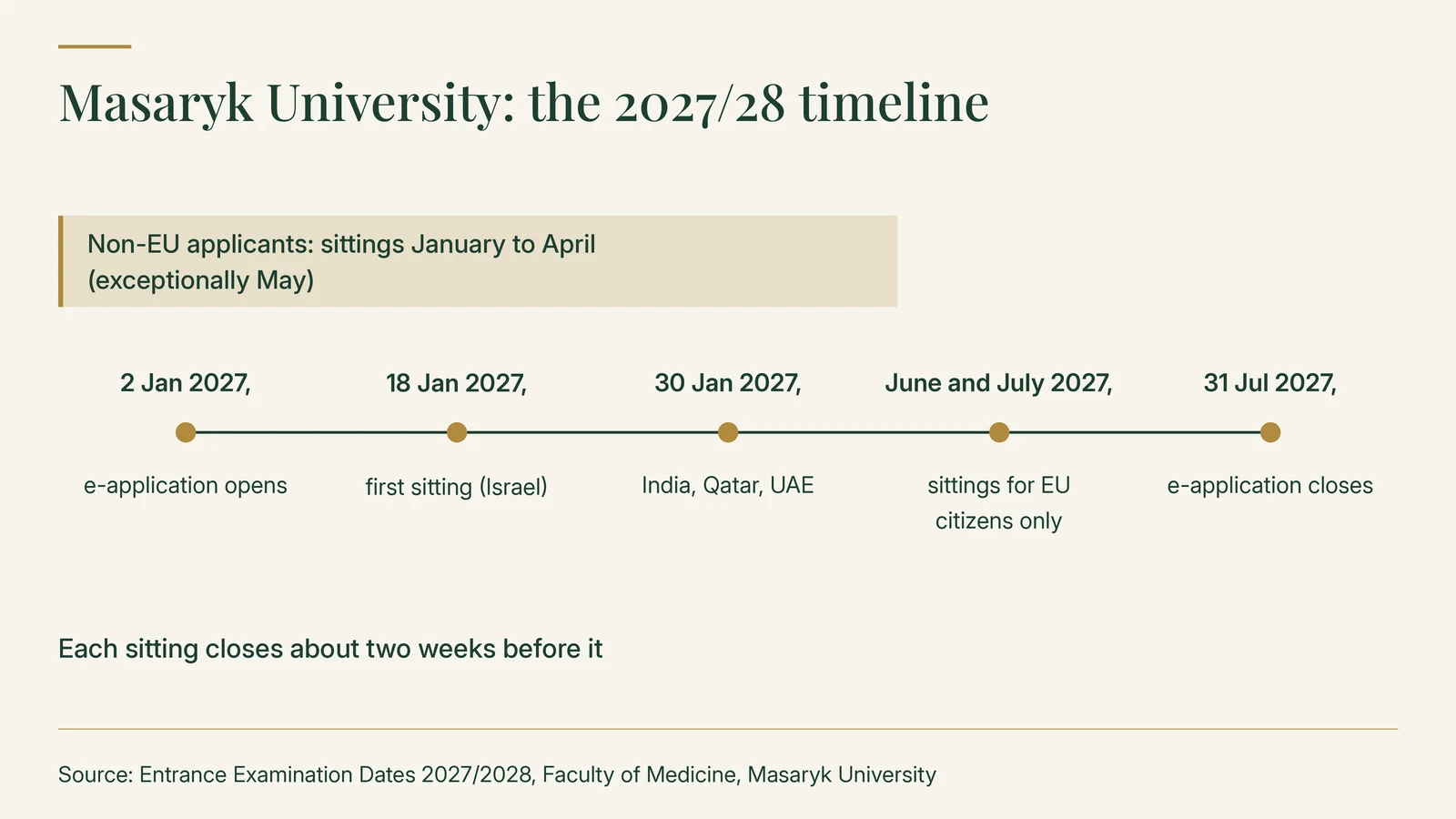
Masaryk University has published its Detailed Information for Admission 2027/2028 and the 2027/2028 entrance examination dates on the Faculty of Medicine's admissions pages, and IvyTest re-read both on 16 October 2026. The 120-question, 150-minute, five-option, 60%-pass-mark structure is unchanged from 2026/2027. Representatives add their sitting dates through the cycle, so most countries still show none: IvyTest re-checks med.muni.cz and updates this guide as they appear.
Structure
Masaryk University Entrance Exam format
Three separately timed tests of 40 questions each, all compulsory, all identical in size. Fifty minutes per test (75 seconds a question) and 150 minutes across the whole examination. The tests are not merged into one continuous paper, so time cannot be carried from a subject you find easy into one you find hard. Every item offers five possible answers with exactly one correct.
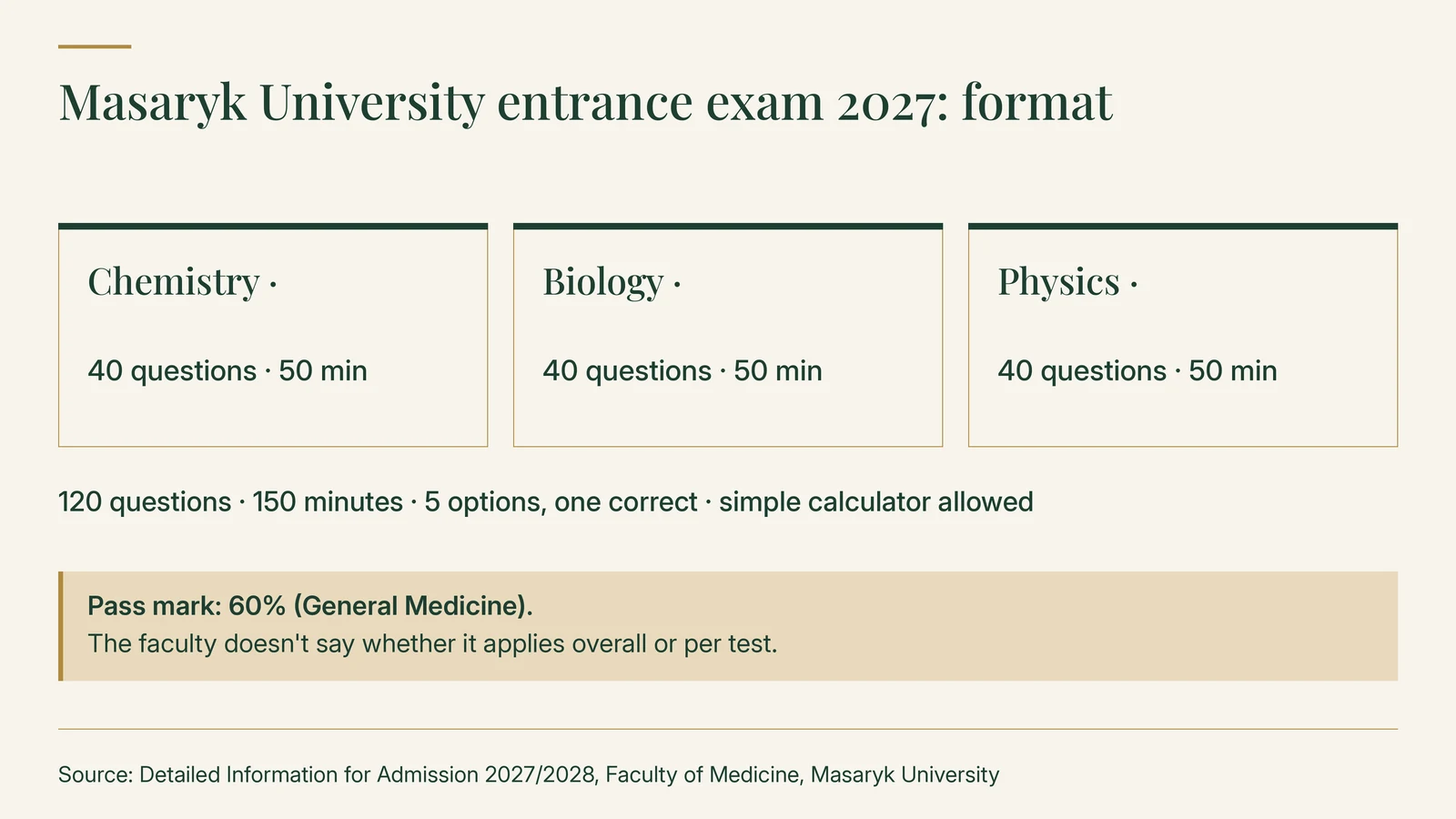
| Section | Questions | Weighting | Suggested time |
|---|---|---|---|
| Chemistry | 40 | 33% (40 of 120) | 50 minutes (its own separately timed test) |
| Biology | 40 | 33% (40 of 120) | 50 minutes (its own separately timed test) |
| Physics | 40 | 33% (40 of 120) | 50 minutes (its own separately timed test) |
Content
Question and subject breakdown
Three subjects, three equal tests, and no non-science component anywhere: no logic, no reading comprehension, no general reasoning. The Call lists them in the order Chemistry, Biology, Physics, and that order is kept below, though the Call does not state the order in which the three tests are actually sat on the day. Each subject has a full official admission syllabus published by the Faculty.
Chemistry
33% (40 of 120)Its own 50-minute test. The Faculty's official Chemistry syllabus runs from atomic structure and the periodic table through stoichiometry, bonding and molecular shape, solutions and electrolytes, acids, bases and pH, redox, thermochemistry, kinetics and equilibrium, the chemistry of the elements, then organic structure and nomenclature, hydrocarbons and functional groups, heterocycles and nucleic acids, saccharides and lipids, amino acids and proteins, and closes with enzymes, vitamins and metabolism. The 2022 sample paper front-loads calculations and closes on biomolecules and metabolism.
Biology
33% (40 of 120)Its own 50-minute test. The Faculty's official Biology syllabus has six headed sections covering classification and diversity, microorganisms and medically important species, cell biology in depth, genetics from molecular through Mendelian to mutations and karyotypes, a long human-biology stretch across every organ system, and evolution and ecology. The 2022 sample paper opens with human anatomy and physiology before moving to cell biology, molecular biology and genetics.
Physics
33% (40 of 120)Its own 50-minute test. The Faculty's official Physics syllabus is ten lettered sections A to J: units, scalars and vectors; mechanics of particles and rigid bodies; oscillations, waves and sound; mechanics of fluids; thermodynamics; electricity and circuits; magnetism and electromagnetism; optics; the theory of relativity; and quantum, atomic and nuclear physics. It requires candidates to apply each principle in simple examples and calculations, and states that knowledge of the basic SI units is unavoidable. The 2022 sample paper is dominated by short numerical items and instructs candidates to use 3.14 for π and round to three significant figures.
Marks
Masaryk University Entrance Exam scoring
Masaryk publishes a pass mark (60% for General Medicine, 65% for Dentistry), but not a marking scheme, and the gap between those two facts is where most candidates plan badly. The Call fixes the number of questions, the number of options, the timing and the threshold, and states no point value for a correct answer, no penalty for a wrong one and no rule for blanks. The official sample papers carry no marking instructions either. IvyTest models the paper as +1 / 0 / 0 because that is the neutral assumption: a paper that does penalise guessing still ranks candidates identically under a straight percentage, whereas inventing a penalty would change what you should do on every item you are unsure of.
- Correct answer
- Not published. IvyTest models +1 per correct answer; the Call states no point value
- Incorrect answer
- Not published. IvyTest models 0 (no negative marking) because no penalty is stated in the Call or on the sample papers
- Unanswered question
- Not published. IvyTest models 0, which is the same as a wrong answer under the modelled rule
- Answer options
- 5 per question, exactly one correct; option e) is habitually 'none of the answers is correct', and the sample tests come without answers, so it has to be weighed like any other option
- Pass mark (General Medicine)
- 60%
- Pass mark (Dentistry)
- 65%: Dentistry sits the same three tests; nothing else in this guide is claimed for it
- Denominator of the 60%
- Not stated. The Call does not say whether 60% is computed across all 120 questions or per 40-question test, and publishes no raw-score equivalent, so none should be back-calculated from the percentage
- Does passing guarantee a place?
- No. The Dean sets the number of places, higher scorers take priority, and lower scorers are offered places only if higher scorers decline
- Attempts
- The entrance examination may be sat only once per admission year
Worked example
Start with the ambiguity, because it decides what you should aim for. The Call says 60% and does not say 60% of what. Read it as an AGGREGATE and the bar is 72 correct items out of 120, however they are distributed. Read it PER TEST and the bar is 24 correct out of 40 in each of Chemistry, Biology and Physics separately. Those are genuinely different: 34 in Chemistry, 33 in Biology and 5 in Physics totals 72 out of 120 and clears the aggregate reading, while scoring 12.5% on Physics and failing the per-test reading outright. The useful observation is that the per-test reading is strictly stricter (any set of scores with at least 24 in every test necessarily totals at least 72), so a candidate who plans to clear 24 out of 40 in each subject satisfies both readings at once and never has to know which one the Faculty meant. Now put the guessing arithmetic on top of that, noting the unit carefully: under the modelled +1 / 0 / 0 rule one item is worth exactly one mark, so 24 out of 40 is simultaneously 24 marks, 60% of the items and 60% of the marks; those three phrasings coincide here, which is not true of every exam. With five options and no penalty, a blind guess returns (1/5 × 1) + (4/5 × 0) = +0.20 marks. Guess blind on all 40 items of a test and you expect 8; that is your floor, not your score. If you genuinely know k items and blind-guess the rest, your expected score is k + 0.20 × (40 − k) = 8 + 0.8k, which reaches 24 at k = 20. In other words, you need to actually know half the paper for blind guessing on the other half to carry you to the bar. Get better at eliminating instead of guessing and the requirement drops sharply: if you can narrow every unknown item to three plausible options, your expected score becomes k + (1/3) × (40 − k) = 13.3 + 0.667k, which reaches 24 at k ≈ 16. Learning to cut two options from an item you cannot answer outright is worth about four items of pure knowledge per test (twelve across the examination).
The IvyTest simulator scores every practice paper against these exact rules.
See the Masaryk University Entrance Exam simulatorSyllabus
Masaryk University medicine syllabus for the entrance exam
Unusually for this catalogue, all three groups below come from official Faculty of Medicine admission syllabi rather than from reverse-engineering a sample paper. The Chemistry syllabus is written as continuous paragraphs, so its grouping here is IvyTest's; the Biology syllabus's six headed sections are preserved but subdivided; the Physics syllabus's ten lettered sections A to J are reproduced one for one with no regrouping at all. Nothing has been added to or dropped from the official text. The syllabus PDFs are old files, Biology from 2019 and Chemistry and Physics from 2011, but they are the ones the Faculty's Entrance Exam Preparation page links for 2027/2028 (re-read on 16 October 2026), and IvyTest's free sample test with answers covers all three.
Grouped from the official Chemistry syllabus's continuous paragraphs. The 2022 sample paper front-loads calculation work and closes on biomolecules and metabolism.
- Atomic structure and the periodic table: subatomic particles, atomic and mass numbers, isotopes, the electron configuration of the elements, the successive filling of energy sublevels and orbitals, valence electrons, s, p and d elements, the Periodic Table and the established names of some groups, the periodicity of the properties of the elements, the positions of the representative elements, the transition d and f elements, and the locations of metals and nonmetals
- Stoichiometry and chemical equations: relative atomic mass and molecular mass, amount of substance and the mole, Avogadro's constant, the diatomic elements, molar mass, the molar volume of gases at standard temperature and pressure, the names and formulas of common inorganic ions and compounds in both directions, stoichiometric calculations from chemical formulas, mass percentage composition, chemical equations and balancing, mass relations in reactions, and calculations of reacting masses, amounts of substance and volumes of gases from equations
- Chemical bonding and molecular shape: chemical bonds and the octet rule, single and multiple covalent bonds, the coordinate covalent bond, the typical numbers of covalent bonds for nonmetals, the spatial orientation of covalent bonds, hybridization of atomic orbitals, the shapes of simple molecules, the polar covalent bond, electronegativity, polar and nonpolar molecules, the ionic bond and ionic compounds, and weak intermolecular bonding including the hydrogen bond
- Solutions and electrolytes: expressing the composition of solutions as mass fraction, amount-of-substance concentration and mass concentration with the calculations behind them, conversions involving density and parts per million, the equivalent amounts of acids and bases required for neutralization, titration of an acid with a base, solutions of nonelectrolytes and electrolytes, dissociation and ionization, strong and weak electrolytes, and the concentrations of ions in solutions of strong electrolytes
- Acids, bases and pH: the types of chemical reaction, protolytic reactions, the Brønsted definition of acids and bases, conjugate pairs, amphoteric compounds and ions, strong acids and bases, weak acids and bases with their ionization constants, the ionization of water and the ionic product of water, hydrogen ion concentration and the pH value, calculations for solutions of strong acids and bases from a given concentration or pH, the hydrolysis of ions, and the classification of aqueous salt solutions as acidic, alkaline or essentially neutral
- Redox reactions: oxidation-reduction reactions, oxidation numbers, oxidizing agents and reducing agents, recognising a redox reaction among non-redox alternatives, balancing redox equations, half equations and the numbers of electrons lost or gained, redox pairs and dehydrogenation
- Thermochemistry, kinetics and equilibrium: heats of reaction and other enthalpy changes, Hess's law, reaction rate and the factors that influence it, chemical equilibrium and equilibrium constants, the general relationship between the equilibrium concentrations of reactants and products, and the effect of changes in temperature, concentration and pressure on equilibria
- Chemistry of the elements: hydrogen and oxygen and their properties, ionic and covalent hydrides and oxides, acid-forming, basic and amphoteric oxides, water, the characteristics of chlorine, sulphur, nitrogen, phosphorus, carbon, silicon, the alkali metals, the alkaline earth metals, iron, copper, aluminium and zinc, their important compounds including oxides, hydroxides, covalent hydrides, oxyacids and salts, and the solubility of common salts
- Organic structure, isomerism and nomenclature: the bonds in organic compounds and the typical properties of organic compounds, the types of reaction in organic chemistry including addition, elimination, dehydration, condensation, hydrolysis, oxidation and reduction, the notation of structural and abbreviated (rational) formulas, structural isomerism and stereoisomerism, centres of chirality, systematic IUPAC nomenclature with functional and substitutive names, and the trivial and semisystematic names of the most common compounds
- Hydrocarbons and functional groups: hydrocarbons and the groups derived from them, saturated and unsaturated hydrocarbons, arenes and their typical reactions, organic halides, nitrocompounds, amines and their basicity, the formation of amides, alcohols and phenols with esterification, ethers, the oxidation of alcohols and quinones, aldehydes and ketones with oxidation, reduction and acetal formation, carboxylic acids and the reactivity of the carboxyl group, the common mono- and dicarboxylic, saturated and unsaturated, hydroxy- and keto-acids, and the names for acyls, acid halides, anhydrides, esters, amides, nitriles and urea
- Heterocycles and nucleic acids: the names and structures of the common types of heterocyclic compound, the purine and pyrimidine bases of nucleic acids, uric acid, the components of nucleosides and nucleotides and the bonds connecting them, phosphodiester bonds in polynucleotides, the DNA double helix, and the function of DNA and of the three major types of RNA in the transcription of the genetic code and in protein biosynthesis
- Saccharides and lipids: the classification and biological importance of saccharides, the structure of monosaccharides as acyclic oxo-forms and hemiacetal cyclic forms, anomers, the formation of glycosides, reducing and non-reducing disaccharides, polysaccharides, the fatty acids bound in lipids including the essential ones, acylglycerols, the hydrolysis of fats and oils, saponification and soap, the main constituents of phospholipids, the steroid ring system and the biological roles of the main sorts of steroid compound
- Amino acids and proteins: the structures and the common and systematic names of the twenty standard proteinogenous amino acids, the polarity and charge of the side chains at physiological pH, the peptide bond, the primary structure of proteins and the general features of secondary, tertiary and quaternary structure, disulfide cross-links, hydrogen bonds and other noncovalent stabilising interactions, the denaturation of proteins, and the two main classes of proteins
- Enzymes, vitamins and metabolism: the six main classes of enzymes, the important hydrolases of the digestive tract, the common chemical names of the vitamins, the anabolic and catabolic character of metabolic pathways, the importance of biological oxidations in the catabolism of nutrients, high-energy (macroergic) compounds and the energetic yield of metabolism, glycolysis and its intermediates, the role of the citric acid cycle and of the mitochondrial electron-transport chain, the end products of anaerobic and aerobic glucose degradation, β-oxidation of fatty acids, and the nitrogenous end products of amino acid and purine catabolism
The official syllabus's six headed sections are preserved; cell biology, genetics and human biology are each subdivided because a single pool for any of them would cover too much of a 40-question paper.
- Classification and diversity of life: a brief survey of the classification system, acellular, unicellular and multicellular organisms, the basic characteristics of vertebrata and mammals, and the milestones in biology and medicine with the scientists behind them
- Microorganisms and medically important species: bacteria and cyanobacteria, viruses and their structure, the lytic and lysogenic cycles, medically important yeasts and molds, medically important plants and protozoa, medically important worms and insects, and the causative agents of common infectious diseases with their transmission
- Chemical composition of the cell: the chemical composition of the cell, the structure and function of proteins, the structure and function of nucleic acids, and saccharides and lipids in the cell
- Cell structure and organelles: cell theory, the basic differences between prokaryotic and eukaryotic cells, biomembranes and membrane organelles with their structure and function, the secretory pathway through rough endoplasmic reticulum, Golgi apparatus and vesicles, lysosomes and ribosomes, energy transformation in mitochondria and chloroplasts, the cytoskeletal system, microtubules and microfilaments, cell movement, centrioles and basal bodies, and the structure of the cell nucleus
- Membrane transport: membrane transport, diffusion, osmosis and the behaviour of cells in hypotonic and hypertonic solutions, facilitated diffusion, active transport, endocytosis and exocytosis
- Cell cycle, mitosis and meiosis: the cell cycle and its phases, mitosis and its significance, meiosis I and II and how they differ from mitosis, the segregation and recombination of chromosomes in diploid organisms, crossing over, independent assortment, nondisjunction, stem cells, cell differentiation and the cancer cell
- Molecular genetics and gene expression: genetic information in DNA, RNA and protein, the expression of genetic information, semi-conservative DNA replication, transcription and translation, the genetic code, codons and exons, the gene and its expression, and prokaryotic and eukaryotic chromosomes and their structure
- Mendelian and human genetics: heredity and variability, the basic genetic terms, gene and genotype, allele, homozygote and heterozygote, character and phenotype, dominance and recessivity, Mendel's laws, monohybrid and dihybrid crosses, autosomal and gonosomal inheritance, reading pedigree charts, genetic tasks and probability calculations, and human genetics
- Mutations, karyotypes and DNA technology: mutations and their types including silent, missense, nonsense and frameshift, the karyotype, chromosomal aberrations, Barr bodies and the syndromes associated with abnormal sex-chromosome counts, DNA technology and the basics of the human genome
- Tissues and the musculoskeletal system: homeostasis and its maintenance, the tissues of the human body and the types of epithelium, the skeleton and its parts, the vertebral column and its regions, the classification of joints, and skeletal muscles and their action with agonists, antagonists and synergists
- Blood, circulation and immunity: body fluids, blood and its cellular and plasma components, blood groups and transfusion, the immune system and defence mechanisms, the circulatory system and its function, the chambers and valves of the heart, systole and diastole, and lymph and its circulation
- Respiration, digestion and excretion: the respiratory system and its function, lung volumes and vital capacity, the digestive system and nutrition, the digestive organs and the pH of their secretions, bile and pancreatic secretion, the urinary system and kidney function, the excretory system, the skin and its functions, and body temperature and its maintenance
- Nervous system, senses and endocrine glands: the nervous system and its central and peripheral organisation, the roots of the spinal nerves and afferent and efferent fibres, sympathetic and parasympathetic effects, the senses, the endocrine glands, and hormones and hormonal regulation including the pancreatic hormones
- Reproduction and human development: human reproduction and the male and female reproductive organs and their sequence, gametogenesis, sexual reproduction and fertilisation, human embryonic and foetal development, and the hormones of pregnancy and the placenta
- Evolution and the origin of life: the origins of life and of the cells, chemical evolution, palaeontological evidence of the earliest forms of life, the basics of evolution, Darwinian evolution, the classification of living systems, and acellular organisms
- Ecology and the biosphere: abiotic and biotic factors, the biosphere, ecosystems, population explosion, and building a sustainable society
The ten lettered sections A to J of the official Physics syllabus, reproduced one for one with no regrouping. The syllabus requires each principle to be applied in simple examples and calculations, and states that knowledge of the basic SI units is unavoidable.
- Units, scalars and vectors: the fundamental and derived SI units, the standard prefixes for multiples and submultiples, recognising dimensionless units, substituting one unit expression for another, scalars and vectors, and the addition of vectors
- Mechanics of particles and rigid bodies: uniform rectilinear motion, uniformly accelerated motion with the calculation of position, velocity and acceleration, free fall, Newton's laws of motion, force, momentum, the impulse of a force, weight, density, torque and the equilibrium of moments, static and kinetic friction, uniform circular motion with frequency, angular frequency and centripetal acceleration, work, power, efficiency, kinetic energy, the potential energy of a body in a gravitational field and the conservation of energy, elasticity with normal stress, linear strain, Hooke's law and the modulus of elasticity, Newton's principle of universal gravitation, gravitational acceleration and the potential of the gravitational field
- Oscillations, waves and sound: period, frequency and phase velocity, the instantaneous displacement, velocity and acceleration of an oscillating body, travelling and standing waves, transverse and longitudinal waves, constructive and destructive interference, the intensity of wave motion, a mass oscillating on a spring, the oscillating pendulum, audible sound and ultrasound, and sound intensity with the level of sound intensity in decibels
- Mechanics of fluids: the ideal or perfect liquid, pressure and its units, Pascal's principle, hydrostatic pressure, the hydraulic press, Archimedes' principle and the force of buoyancy, viscosity, laminar and turbulent flow, the equation of continuity, Bernoulli's equation and efflux speed, surface tension, capillary elevation and depression, and the pressure in a bubble with Laplace's formula
- Principles of thermodynamics: thermodynamic systems, states and processes, reversible and irreversible processes, thermodynamic (Kelvin) temperature, the ideal gas law and the universal gas constant, pV-diagrams, the equations for isothermal, isosteric, isobaric and adiabatic processes, the thermal expansion and contraction of solids, heat, heat capacity and specific heat capacity, the first law of thermodynamics, the equation of thermal conductivity, latent heats and boiling under changed pressure, the second law of thermodynamics and the working cycle of the ideal Carnot engine, and absolute and relative air humidity
- Electricity and circuits: electric charge and conductors, Coulomb's law, the dielectric constant, electric field intensity, potential and potential difference, the capacity of a parallel-plate capacitor, capacitors in parallel and in series, electric current, Ohm's law, resistivity, conductivity and the temperature coefficient of resistance, Kirchhoff's laws, resistors in parallel and in series, electrical power and the heating effect, the thermoelectric phenomenon, Faraday's law of electrolysis and the Faraday constant, N-type and P-type semiconductors, the properties of the P-N junction, and the principle of a transistor
- Magnetism and electromagnetism: the force acting between two magnetic poles, magnetic permeability, magnetic flux and flux density, magnetic force, the magnetic field due to a straight wire or a coil, the force on a conductor carrying a current, Fleming's rule, the force between two parallel conductors, the SI definition of the ampere, the magnetic deflection of a moving electron, electromagnetic induction, Lenz's law, the voltage induced in a straight wire, the self-inductance of a coil, alternating current, the effective values of current and voltage, the electric power of alternating current, impedance including capacitance and inductance, and the AC transformer
- Optics: the basic properties of light and of optical media, the speed of light, reflection and refraction, Snell's law, the critical angle and total internal reflection, lenses, the lens-maker's equation and the sign convention, dioptric power, converging and diverging lenses, the lens equation, linear magnification, the mirror imaging equation and magnification, the basic optical properties of the human eye, the microscope and its magnification, the light spectrum, the interference of light, polarised light, and photometry with luminous intensity, luminous flux and illumination
- Theory of relativity: the dilation of time, the contraction of length, the relativistic addition of velocities, relativistic mass, and the principle of the equivalence of energy and mass
- Quantum, atomic and nuclear physics: the electron volt, the mole and Avogadro's constant, the excitation of atoms, de Broglie matter waves, the principal, orbital and magnetic quantum numbers, Pauli's exclusion principle, emission and absorption spectra, the principle of the X-ray tube, the photoelectric effect, Compton scattering, the structure of the atomic nucleus, nuclides and isotopes, nuclear binding energy, the principle of a nuclear reactor, alpha, beta and gamma decay, neutron radiation, the fission of heavy nuclei, the law of radioactive decay and half-life, the becquerel, and the Geiger-Mueller counter
Test your Masaryk University Entrance Exam knowledge
Take free diagnosticDifficulty
How difficult is the Masaryk University Entrance Exam?
Masaryk's examination is the broadest of the Czech medicine papers in this catalogue: 120 questions across three full science syllabi, with the Physics syllabus in particular reaching further than most medical entrance tests do. What makes it hard is coverage and pace, not conceptual depth.
Three separately timed tests, so time cannot be moved between subjects
Fifty minutes for 40 Chemistry questions, fifty for 40 Biology, fifty for 40 Physics. That is 75 seconds an item, and unlike a single continuous paper there is no way to bank spare minutes from a strong subject and spend them on a weak one. A subject you run out of time in is a subject you run out of time in, regardless of how fast you were in the other two.
The Physics syllabus goes further than most medical entrance papers
Ten lettered sections that include the theory of relativity (time dilation, length contraction, relativistic addition of velocities, mass-energy equivalence), and a full quantum, atomic and nuclear section with Compton scattering, de Broglie waves, quantum numbers and the Geiger-Mueller counter. Forty questions is a third of the exam, and candidates coming from a biology-and-chemistry background routinely find this the block that decides their result.
The 60% pass mark has an unstated denominator
The Call states the acceptance pass mark for General Medicine is 60% and does not say whether that is across all 120 questions or within each 40-question test. Those are different bars: 34 + 33 + 5 clears the aggregate reading at exactly 72 of 120 while collapsing in Physics. Because any set of scores clearing 24 out of 40 in every test necessarily clears 72 of 120, planning against the per-test reading satisfies both, and removes the ambiguity from your preparation entirely.
Passing is a floor, not a place
The Call is explicit that clearing the pass mark does not guarantee admission: the Dean sets the number of places, higher scorers take priority, and lower scorers are offered places only if higher scorers decline. That makes 60% the minimum for staying in consideration, not the target, and it means the useful preparation question is how far above the bar you can get, not whether you can reach it.
Five options, a catch-all fifth, and one attempt a year
Every item offers five choices, so a blind guess is worth about +0.20 marks under the modelled rule rather than the +0.25 a four-option paper gives. In all three official sample papers the fifth option is habitually 'none of the answers is correct', and with no answers published alongside them nothing suggests it is filler, so it has to be evaluated on its merits rather than discounted. And there is no second sitting: the examination may be taken only once per admission year, which makes a weak result a full-cycle cost rather than a rehearsal.
Benchmarks
What is a good Masaryk University Entrance Exam score?
Masaryk publishes more than most Czech faculties (a 60% pass mark for General Medicine and 65% for Dentistry), but it publishes no raw-score equivalent, no marking scheme and no cutoff it explains: its admissions report for 2025 lists 76 'points for admission' for the programme without saying on what scale. IvyTest re-read the Faculty's Detailed Information for Admission 2027/2028 on 7 October 2026: the structure and pass marks are unchanged.
The pass mark is best understood as an eligibility gate rather than an admission score. The Call states that clearing it does not guarantee a place: the Dean sets how many places exist, higher scorers take priority, and lower scorers are offered places only if higher scorers decline. That is a ranking process wearing a threshold's clothing, and it means the honest answer to 'what score gets me in' is that it depends on the cohort; anyone quoting a specific admitting percentage is estimating. Note too that no raw-score equivalent of 60% is published and none should be back-calculated from the percentage, because the denominator itself is unstated.
During preparation, the measurement that matters is your score in each of the three 40-question tests separately, tracked over repeated full sittings. Under the modelled +1 / 0 / 0 rule one item equals one mark, so a per-test score doubles as a percentage without conversion: 26 out of 40 is 65%, which is two marks and five percentage points above the published bar. Watch the weakest of the three curves rather than the average of all three: because the tests are equal in size and separately timed, the lowest one is both the cheapest place to gain marks and the only one that can fail you under the stricter reading of the pass mark.
Pending verification
- · Whether the 60% pass mark is computed across all 120 questions or per 40-question test
- · The official marking scheme: points per correct answer, and whether wrong answers are penalised
- · The raw-score equivalent of the 60% threshold
- · What the 76 'points for admission' in Masaryk University's 2025 report measures, and the figure for other years
- · Seats available per cycle (the 2025 report gives applicants and admissions, not places)
These specific numbers aren't public yet — an IvyTest simulator score is the closest benchmark you can get today.
Check your Masaryk University Entrance Exam scoreStrategy
How to prepare for the Masaryk University Entrance Exam
12+ weeks
Three equal tests, with Physics treated as a first-class subject
Even coverage of Chemistry, Biology and Physics, planned against 24 out of 40 in each.
- Sit a full 120-question diagnostic in week one as three separately timed 40-question tests, 50 minutes each, and score them separately. One overall percentage hides exactly the imbalance this exam punishes.
- Give Physics equal calendar time from the start. Its official syllabus runs to ten lettered sections including relativity and a full quantum, atomic and nuclear block: it is a third of the examination and it is usually the thinnest subject for candidates arriving from a biology background.
- Work Chemistry calculations by hand and by the clock: stoichiometry, mass and volume relations from equations, concentration and dilution, pH from concentration and concentration from pH, and neutralisation equivalents. A simple calculator is permitted, but 75 seconds an item is the real constraint.
- Practise every item in the real five-option format, including sets where 'none of the answers is correct' appears: the official samples carry no answers to say how often it is right, so it needs to be a considered choice rather than a reflex either way.
8 weeks
Lift the weakest test towards 24 out of 40
Targeted repair in whichever of the three subjects is furthest from the bar.
- Diagnostic first, then put the largest share of time into the lowest-scoring test. All three are worth 40 questions, so the weakest is always where the next mark is cheapest, and under the stricter reading of the 60% pass mark it is the only one that can fail you outright.
- Keep all three subjects on a weekly rotation rather than blocking them; the examination is sat as three tests in one session and there is no non-science block to reset between them.
- One full three-test mock a week from week two, reviewed the same day, with every wrong or blank answer logged by cause: content gap, misread question, or ran out of time.
- Build elimination as a deliberate skill, not a fallback. Narrowing an unknown item from five options to three lifts its expected return from +0.20 to about +0.33 marks; across a 40-question test that habit is worth roughly four items of pure knowledge.
4 weeks
Full three-test sittings at 50 minutes each
Volume of timed tests at the real pace, plus answer-everything discipline.
- Two full 120-question mocks a week, run as three separately timed 50-minute tests rather than one continuous paper: the pacing problem this exam sets is per test, not overall.
- Practise finishing each test. At 75 seconds an item the marks most often lost late in a block are lost to pacing rather than to knowledge.
- Answer every single question. Under the rule IvyTest models a blind five-option guess is worth +0.20 marks and a blank is worth 0, so across even ten uncertain items in a test, answering rather than skipping is worth about 2 marks, five percentage points of that test's score.
- Rehearse the practical setup: in person, in English, a simple calculator permitted, and no periodic table or other reference material supplied, so anything you would want to look up has to already be in your head.
Under 4 weeks
Consolidate towards the bar in all three, and remember there is no retake
Triage across three equal tests, weighted to whichever is weakest.
- Stop adding new content. Consolidate the highest-frequency areas in all three subjects, giving the most time to whichever test your mocks put furthest from 24 out of 40.
- In Physics, prioritise the sections that carry the most items per hour of revision (units and vectors, mechanics, electricity and circuits, optics) before the relativity and nuclear sections, which are real but narrower.
- Sit at least two full, scored three-test mocks in the final ten days, then taper.
- Treat the sitting as your only one this cycle. The examination may be taken once per admission year, so there is no second session to hold anything back for.
Get your personalised Masaryk University Entrance Exam study plan
Take free diagnosticExplore the full Masaryk University Entrance Exam planPractice
Free Masaryk University Entrance Exam practice questions
Three questions in the format the exam uses. Choose an answer to see the explanation — nothing is recorded.
How many Barr bodies are present in the nucleus of a somatic cell from an individual with the karyotype 47,XXY?
The intensity of a sound is increased by a factor of 1000. By how much does its sound intensity level increase?
Illustrative examples written by IvyTest to show the question style — not past Masaryk University Entrance Exam papers.
Past papers
Masaryk University Entrance Exam past papers
Masaryk University publishes no past papers. Its Faculty of Medicine's Entrance Exam Preparation page links free PDFs instead: the official syllabus for Biology, Chemistry and Physics and one sample test per subject (Biology A, Chemistry A, Physics A, labelled 2022), each with 40 questions and five options, published without answers. The Faculty also sells e-learning preparatory courses, €100 per subject, ending in final tests similar to the real exam. IvyTest's free practice paper, with every answer explained, follows the live format.
University
Masaryk University medicine admissions
The entrance examination sits inside a wider application. The figures below describe the English-taught General Medicine programme at Masaryk University's Faculty of Medicine in Brno; Dentistry sits the same three tests but at a 65% pass mark and is not otherwise covered here.
- Degree
- General Medicine (English-taught), 6-year MUDr
- Language of instruction
- English
- Campus
- Faculty of Medicine, Masaryk University, Brno
- Tuition
- CZK 380,000 / year (about €15,300–15,700, converted at approximately 24.5 CZK to the euro)
- Application fee
- None stated in the Faculty's Detailed Information for Admission 2027/2028 or on its admissions pages; a figure of about €550 in older records could not be confirmed, so ask the Faculty or your representative. The fees it does name are CZK 990 for recognising your secondary education and CZK 25,000 kept if you pay tuition and then do not enrol
- Interview
- Not as a rule: the three written tests decide admission, but the Faculty states that in certain countries an oral interview in English can be required as part of the entrance examination
- English certificate
- Not required: none is listed among the Faculty's basic conditions of admission
- Admission without the entrance exam
- Possible for General Medicine (not Dentistry): MCAT or DAT results (US and Canadian applicants), PACES/MMOP results (France), A-levels of at least A, A, B in Chemistry, Biology and Physics, an IB Diploma of 35 points with 19 from the three sciences, an Abitur average of 1.70 or better, or a Swiss average of 5.50 or better
- Motivation letter
- Not required
- Recommendation letters
- Not required
- Document requirements
- Legalisation and certified translation required; apostille depends on the issuing country
- Czech language in clinical years
- Needed from around year 2: Czech is taught in the programme, with an exam at the end of each of years 1 to 4, so that you can talk to patients once clinical training starts
- City
- Brno, the Czech Republic's second-largest city, bigger and more international than most Czech university towns, without Prague's price premium
- Cost of living
- By the Faculty's own figures: about €200 a month for a shared room (two people) in the university halls, about €8 a day for three meals in an academic refectory, €26 for a three-month public-transport ticket
- Seats available
- No seat count published (the Dean sets the number of places each cycle); in 2025, 467 applied, 400 sat the exam and 352 were admitted
The campus
Masaryk University's Bohunice campus
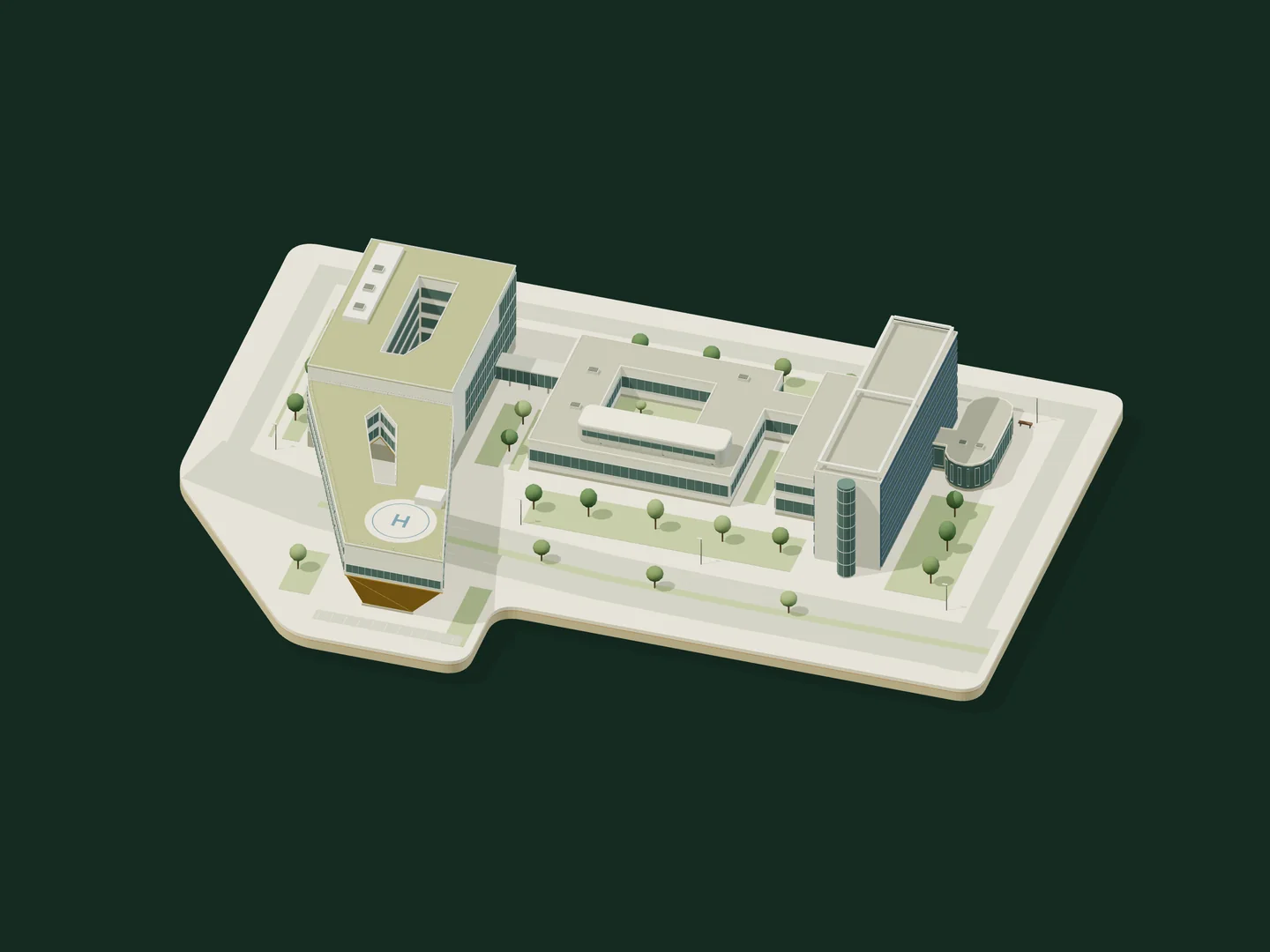
Masaryk University's Faculty of Medicine has buildings across Brno. The model shows three of them at the eastern end of the University Campus at Bohunice: SIMU, the faculty's five-storey simulation centre, open to students since autumn 2020 and planned for teaching in every year from the first to the sixth, and buildings F01B1 and F01B2, home to theoretical departments such as Anatomy. The rest of the campus and University Hospital Brno are not modelled.
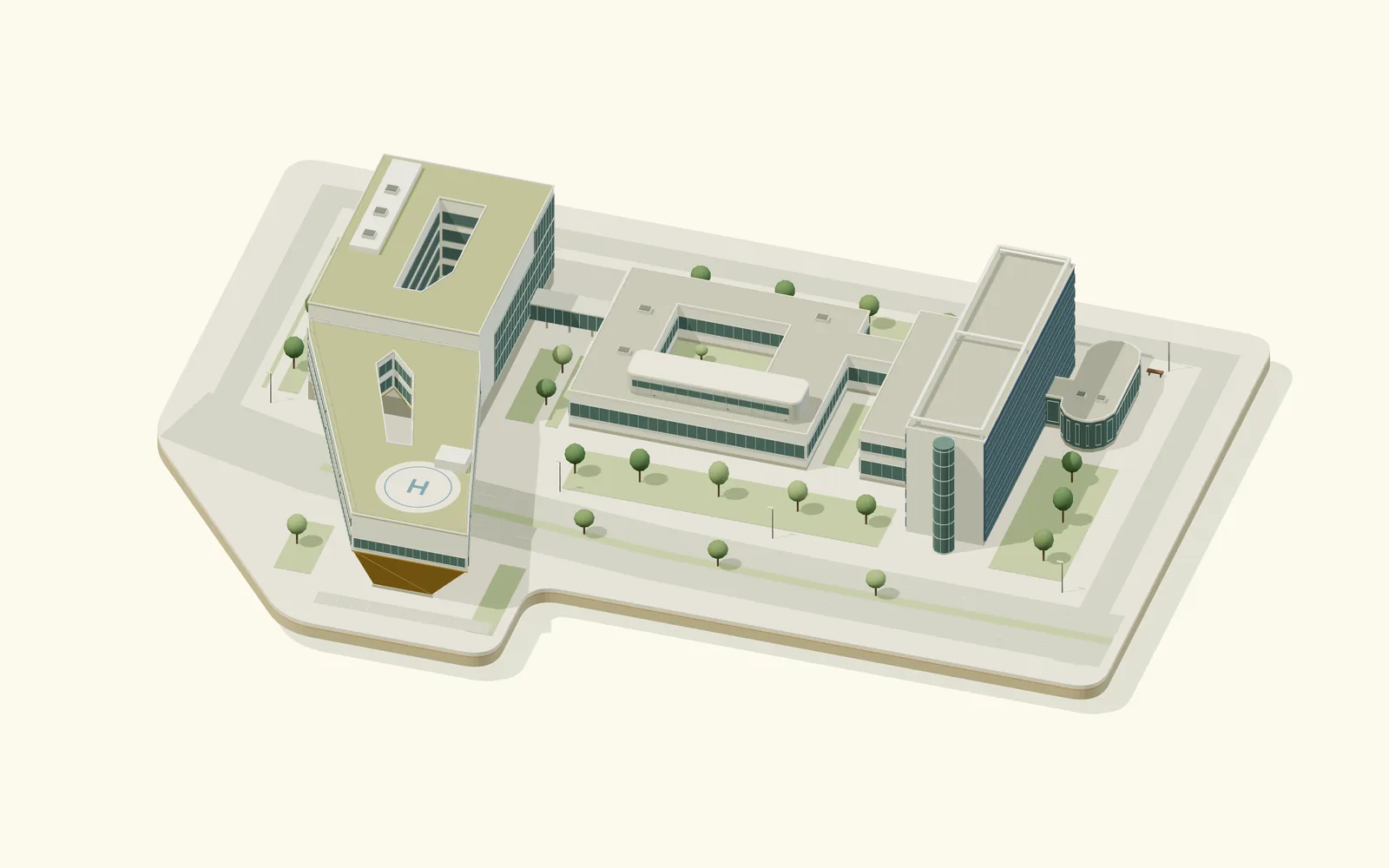
Explore the Bohunice campus.
Open it in 3D to turn it and see what each building holds.
Stylized campus illustration, not a map or to scale.
SIMU, Simulation Centre (F37)
Kamenice 126/3: the Faculty of Medicine's simulation centre, five storeys and 8,000 m² with over a thousand simulators. It holds a simulated hospital: an emergency department with an ambulance, two operating theatres, an intensive care unit, a delivery room, standard wards and a heliport on the roof. Its upper floors bridge Kamenice street, clad in gold perforated metal.
Building F01B1
Kamenice 126/3: home to several of the Faculty of Medicine's theoretical departments, among them Anatomy, Biophysics, and Histology and Embryology, as well as the Department of Health Sciences, the Institute of Medical Genetics and Genomics and the Faculty of Science's RECETOX.
Building F01B2
Kamenice 126/3: a building of the Department of Anatomy, which also works in F01B1.
Address: Kamenice 126/3, 625 00 Brno
IvyTest Masaryk University Entrance Exam preparation
Ready to prepare properly for the Masaryk entrance exam?
Everything above is free and always will be. When you want structure (a syllabus-mapped book built on the Faculty's own three official admission syllabi, a simulator that runs three separately timed 40-question tests in the real five-option format, lessons for the gaps your results flag, and help with the application itself), that is what the IvyTest Masaryk package is.
Study guide
Chemistry, Biology and Physics at equal depth, built directly on the Faculty's own official admission syllabi.
Exam simulator
Three separately timed 50-minute tests of 40 five-option questions, with per-question explanations and per-test analytics against the 60% bar.
Video courses
Focused lessons in chemistry, biology and physics, including the relativity and nuclear sections most medical entrance courses skip.
Application support
MedApply: deadlines, documents, legalisation and enrolment steps carried through to a confirmed place.
FAQ
Masaryk University Entrance Exam frequently asked questions
It's the entrance test Masaryk University's Faculty of Medicine uses to select candidates for its English-taught General Medicine programme in Brno. It is three separate written tests (Chemistry, Biology and Physics) of 40 multiple-choice questions each, 50 minutes per test, 120 questions and 150 minutes in total. Every item has five possible answers with exactly one correct.
Neither. There is no national Czech medical entrance test, and Masaryk is a separate university from Charles; its paper has nothing structurally in common with Charles University's five faculties beyond the subjects. Masaryk runs three equal 40-question tests with a published pass mark; Charles University's Hradec Králové faculty runs one 60-question paper with unequal 25/25/10 weights and an elective; its Pilsen faculty runs three compulsory sciences with part of the paper open-response; its Prague faculties run different papers again. Preparation built for one does not transfer cleanly.
In person, in English, sat through Masaryk University's official representatives in the listed countries. A simple calculator is permitted, and no periodic table or other reference material is supplied: anything you would want to look up needs to already be in your head.
The Faculty publishes a pass mark but not a marking scheme: the Call states no point value for a correct answer, no penalty and no rule for blanks, and the official sample papers carry no marking instructions either. IvyTest models the paper as +1 for a correct answer and 0 for everything else, because that is the neutral assumption. On that model a blind five-option guess is worth +0.20 marks and a blank is worth 0, so there is no item worth leaving empty, and narrowing an item to three options before guessing lifts its return to about +0.33 marks.
The Call states that the acceptance pass mark in General Medicine is 60%, and 65% for Dentistry. It does not say whether that percentage is computed across all 120 questions or separately within each 40-question test, and it publishes no raw-score equivalent. The practical resolution is that the per-test reading is strictly stricter (any set of scores with at least 24 out of 40 in every test necessarily totals at least 72 out of 120), so planning to clear 24 in each subject satisfies both readings at once.
No. The Call is explicit that passing does not guarantee a place: the Dean sets the number of places available, higher scorers take priority, and lower scorers are offered places only if higher scorers decline. The pass mark keeps you in consideration; your rank within the cohort is what actually decides the outcome.
Not within the same cycle. The Call states that an applicant may sit the entrance examination only once per admission year, so there is no second session to hold anything back for, unlike some Italian private schools, which run two sittings and count the better score.
English. The programme is English-taught and all three tests are sat in English, as are the Faculty's official sample papers. Czech is taught during the degree because clinical placements from around the second year involve Czech-speaking patients, but no Czech is required to sit the entrance examination.
The Faculty publishes no seat count for the English-taught programme: the Dean sets the number of places each cycle. Masaryk University's admissions report for 2025 gives the clearest picture: 467 applied to General Medicine in English, 400 sat the exam and 352 were admitted, about 75% of applicants and 88% of those who sat. Places go to higher scorers first, so aim for a margin above the 60% bar rather than the bar itself. Its report for 2026 is not out yet (checked 16 October 2026).
Within the EU, yes: automatically, as a standard Czech medical degree. There's no separate national licensing exam afterwards: the Czech state exam (státní rigorózní zkouška) is built into the MUDr degree itself, and registration with the Czech Medical Chamber (ČLK) is compulsory to practise in the country. Outside the EU recognition isn't automatic as a rule, but the UK is an exception. Under the Medical Act 1983 (section 21B, as in force on 12 October 2026), a Czech medical degree (MUDr.) is a 'relevant European qualification', so a graduate who applies to the GMC with one, whatever their nationality, is not asked to show the knowledge and skills other international graduates prove through PLAB/UKMLA; evidence of English is still required, and the rule is UK policy that can change. US-bound graduates need ECFMG certification via USMLE Step 1 and Step 2 CK, the same requirement every international medical graduate faces.
Yes. The IvyTest simulator runs Masaryk-format practice (three separately timed 50-minute tests of 40 five-option questions in Chemistry, Biology and Physics) in timed, tutor and review modes, with per-test analytics against the 60% bar and a free diagnostic available without payment.
Masaryk publishes no past papers, but its Entrance Exam Preparation page links free PDFs: one sample test per subject (Biology A, Chemistry A and Physics A, labelled 2022, 40 five-option questions each) and the official syllabus for each subject. The sample tests come without answers or marking instructions. The Faculty also sells e-learning preparatory courses in Biology, Chemistry and Physics, €100 each, which end in final tests similar to the real exam. Because the official samples come without answers, IvyTest has written a free full-length sample test in the same format (Chemistry, Biology and Physics, 40 five-option questions each), with every answer explained.
There is no single date: you apply through one of the Faculty's official representatives and sit the exam on one of its dates. The e-application for 2027/2028 is open from 2 January to 31 July 2027, and each sitting closes about two weeks before it. Dates published so far run from 18 January 2027 (Israel) and 30 January 2027 (India, Qatar, UAE) to 17 July 2027 (Portugal). Non-EU applicants must sit by April, exceptionally May; June and July are for EU citizens.
Completed secondary education with a final certificate or diploma (three A-levels or the IB, for example), recognised in the Czech Republic before enrolment for a CZK 990 fee, and a pass in the three entrance tests, which you may sit once per admission year. No English certificate, motivation letter or references are asked for. Strong MCAT/DAT, PACES/MMOP, A-level, IB, Abitur or Swiss results can replace the exam. Non-EU students also need a long-term visa and should apply as soon as their admission documents arrive.
Tuition for General Medicine is CZK 380,000 per academic year (about €15,300–15,700), payable in two instalments, one per semester. The Faculty lists no application fee; it names a CZK 990 fee for recognising your secondary education and keeps CZK 25,000 if you pay tuition and then do not enrol. From the third semester, students with a 1.0 grade average can win the Dean's Merit Scholarship, 50% off the next semester's tuition. Living costs: halls about €200 a month, meals about €8 a day.
Six years in English, leading to the MUDr. (equivalent to an MD). The first two years are mainly theoretical: Biology, Biophysics, Chemistry and Biochemistry, Anatomy with dissection, Histology and Physiology, with First Aid and Czech for Foreigners from the first semester. Clinical teaching follows in Brno's hospitals, including University Hospital Brno and St. Anne's, with training at the SIMU simulation centre, four blocks of summer practice, a final year of pre-graduation practice and state exams in five subjects.
Masaryk reports university-wide places, not a table for medicine alone: 454th in the QS World University Rankings published in June 2026 (third in the Czech Republic), 601-650 in the Times Higher Education World University Rankings published on 1 October 2026, and 401-500 in ShanghaiRanking's ARWU 2026, sharing first place in the Czech Republic. IvyTest has not checked the tables itself. The Faculty states that its degrees are recognised in the EU and the USA and that it is listed in the World Directory of Medical Schools.
In Brno, the Czech Republic's second-largest city. The Faculty is on the University Campus Bohunice, next to the CEITEC research centre and its SIMU simulation centre, and its International Studies Office is at Kamenice 753/5. Clinical teaching runs in Brno's hospitals, including University Hospital Brno and St. Anne's University Hospital. The entrance exam itself is sat through the Faculty's official representatives in their countries, from Georgia and India to the UK and Thailand.
No. The TSP (Test studijních předpokladů) is Masaryk University's study-aptitude test for admission at almost all of its faculties: three parts of 15 questions in numerical and analytical thinking, reasoning in English and critical thinking. The university names the Faculty of Medicine as one of the exceptions: its applicants sit subject tests instead, and for General Medicine in English that means the three science tests of 40 questions each described above.
IvyTest publishes no student reviews of its own. The Faculty lists Student Ambassadors, twelve current General Medicine students from different countries whom you can email, and points applicants to MIMSA, the Masaryk International Medical Students Association, which is run by international students from higher years and whose Education Team offers tutoring to new students.
Yes: r/MasarykUniversity, where Masaryk University applicants ask each other about the Masaryk University Entrance Exam and share how their preparation is going. It is run by the IvyTest team. Dates, rules and results come only from the university's own pages, listed under Official sources on this page.
Verification
Official sources
- Detailed Information for Admission 2027/2028 (fees, conditions, waiver, e-application, enrolment, living costs)Checked: 16 October 2026
Masaryk University, Faculty of Medicine
- Official admission syllabus: ChemistryChecked: 16 October 2026
Masaryk University, Faculty of Medicine
- Official admission syllabus: BiologyChecked: 16 October 2026
Masaryk University, Faculty of Medicine
- Official admission syllabus: PhysicsChecked: 16 October 2026
Masaryk University, Faculty of Medicine
- Entrance Exam Preparation: sample tests (Biology A, Chemistry A, Physics A, 2022) and syllabiChecked: 16 October 2026
Masaryk University, Faculty of Medicine
- The Entrance Examination Dates 2027/2028Checked: 16 October 2026
Masaryk University, Faculty of Medicine
- General Medicine: master's studies (tuition, study plan)Checked: 7 October 2026
Masaryk University
- General Medicine: admissions (instalments, hospitals, Dean's Merit Scholarship)Checked: 16 October 2026
Masaryk University, Faculty of Medicine
- Sample test: Biology A (2022)Checked: 7 October 2026
Masaryk University, Faculty of Medicine
- Sample test: Chemistry A (2022)Checked: 7 October 2026
Masaryk University, Faculty of Medicine
- Sample test: Physics A (2022)Checked: 7 October 2026
Masaryk University, Faculty of Medicine
- E-learning preparatory coursesChecked: 16 October 2026
Masaryk University, Faculty of Medicine
- Admissions report 2025, Faculty of Medicine: applicants, sat and admitted by programme (in Czech)Checked: 7 October 2026
Masaryk University
- Admission tests and the TSP (in Czech)Checked: 7 October 2026
Masaryk University
- Checked: 7 October 2026
- Masaryk University ranked 601-650 in THE World University Rankings (1 October 2026)Checked: 7 October 2026
Masaryk University
- Checked: 7 October 2026
- 10 reasons to study at MED MUNI (campus, CEITEC, SIMU)Checked: 16 October 2026
Masaryk University, Faculty of Medicine
- Student AmbassadorsChecked: 7 October 2026
Masaryk University, Faculty of Medicine
- Medical Act 1983, section 21B: registration with a relevant European qualification, without the knowledge test, for applications made since IP completion day (Brexit)Checked: 12 October 2026
legislation.gov.uk (The National Archives)
- Directive 2005/36/EC on the recognition of professional qualifications, consolidated text of 29 October 2025, Annex V point 5.1.1 (Czechia: the MUDr. diploma in general medicine, no accompanying certificate)Checked: 12 October 2026
Publications Office of the European Union (EUR-Lex)
- Evidence of qualifications from the Czech RepublicChecked: 12 October 2026
General Medical Council (GMC)
Last reviewed by IvyTest editorial team: 16 October 2026. Admission rules change every cycle — always confirm against the official Masaryk University call for applications before acting on a deadline.
Find out how ready you are for the Masaryk entrance exam.
The diagnostic takes one sitting and returns a test-by-test picture of where you stand in Chemistry, Biology and Physics against the 60% bar. No payment, no commitment.