
In a large population in Hardy-Weinberg equilibrium, 9% of individuals show the recessive phenotype for a two-allele gene. What proportion of the population is expected to be heterozygous?
Exam guide · Updated for 2027 admissions
Charles University Hradec Králové Entrance Exam 2027: Complete Preparation Guide
Everything you need to know about the Charles University Hradec Králové entrance exam, the Written Science Entrance Test of the Faculty of Medicine in Hradec Králové: the 25/25/10 point split, the Physics-or-Mathematics choice, the official sample test and topic list, scoring, the interview, the 2027 application deadline, fees, preparation strategy and practice.
Applying to more than one Charles faculty? Compare all five →
Updated for 2027 admissions · Last updated: 16 October 2026
Charles University Hradec Králové Entrance Exam at a glance
Overview
What is the Charles University Hradec Králové entrance exam?
The Faculty of Medicine in Hradec Králové is one of Charles University's five Czech medical faculties, and it sets its own Written Science Entrance Test for its English-taught General Medicine and Dentistry programmes. There is no national Czech medical admission test behind it, and the five faculties' papers are structurally different from one another, so this is a specific exam to prepare for, not a Czech equivalent of the IMAT or the UCAT.
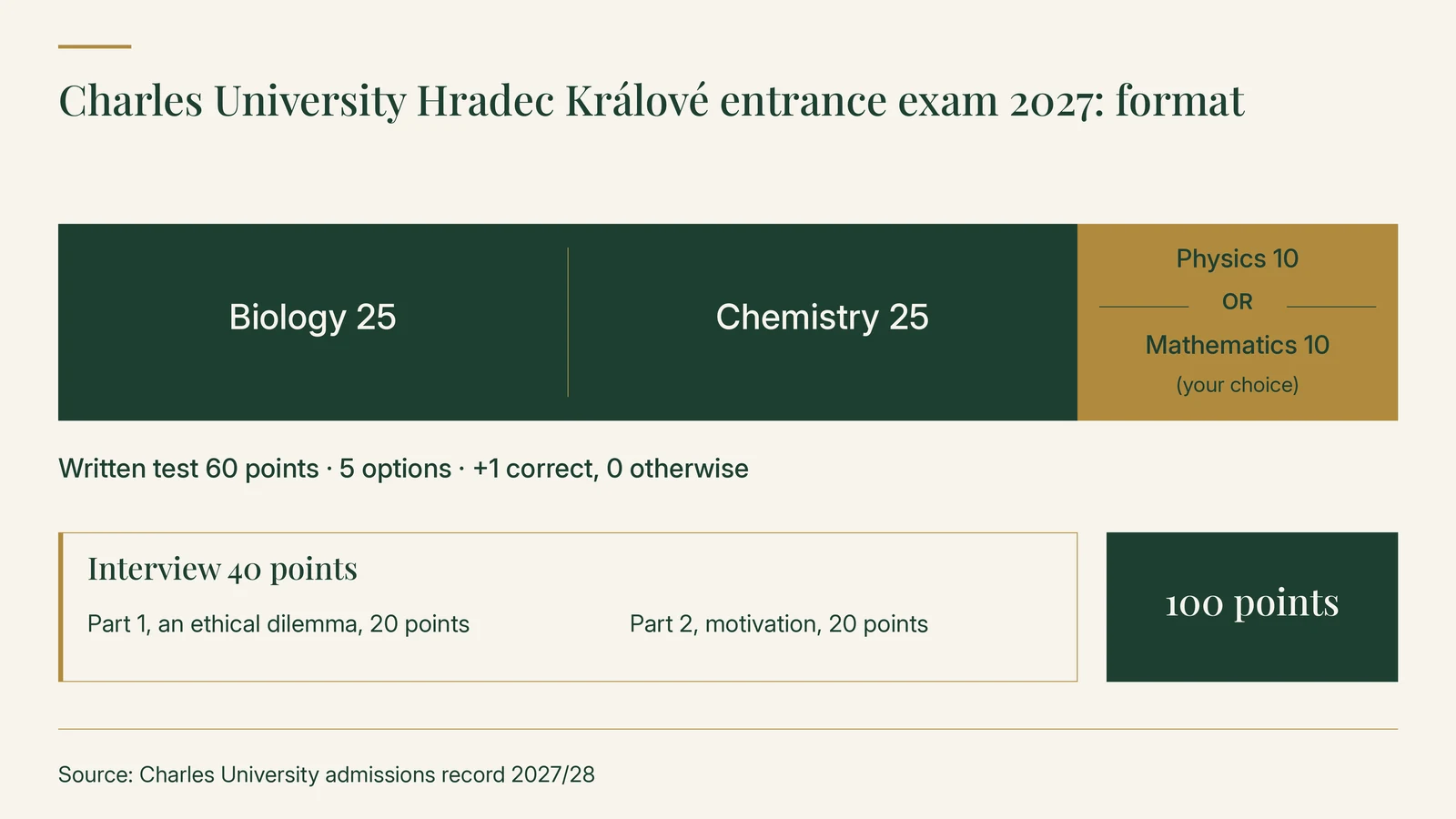
Its defining feature is a weighting that nobody guesses correctly from the outside. The faculty publishes the point split in its own words: Biology 25 points, Chemistry 25 points, Physics or Mathematics 10 points, for a maximum of 60. Biology and Chemistry are compulsory; the third block is a choice between two tracks and you sit one of them, never both. That makes this the only exam in Charles University's Czech family where the sections are explicitly not equal: the elective block is worth a sixth of the paper while each compulsory science is worth over 40% of it. The written test is also only part of the selection: an interview worth 40 points follows, and admission goes to the best combined scores out of 100.
Two practical details follow from how the official paper is printed. First, the booklet runs to seventy numbered questions (Biology 1 to 25, Chemistry 26 to 50, Physics 51 to 60, Mathematics 61 to 70), but a candidate answers only sixty of them, because the last two blocks are alternatives. Second, every item offers five choices rather than the four used at the Pilsen or Prague faculties, and several official Physics and Mathematics items use 'no answer is correct' as one of those five. A fifth option here has to be weighed like any other, which is exactly the kind of thing that costs marks the first time you meet it under time pressure.
Programmes that use the Charles University Hradec Králové Entrance Exam
- General Medicine (English-taught, Hradec Králové)
- Dentistry (English-taught, Hradec Králové): the same Written Science Entrance Test covers both Master study programmes
Timeline
Charles University Hradec Králové Entrance Exam 2027: dates and deadlines
When to expect your exam · 2027 start
- May 202713 MayBased on 2026
Predicted from this university's past sittings until it publishes its own dates. See every university on the calendar →
- Applications open2027/28 opening date not stated: on 10 October 2026 Charles University's 2027/28 admissions records were published but not yet open for applications. The faculty gives no fixed opening date, only the rule that an application must be submitted and paid at least one week before the exam term you choose
- Application deadline30 April 2027
- Written test and interview: faculty sitting2027/28 date not yet published: the faculty's page says May 2027 for applications submitted by 30 April, date 'tba'; the admissions records give an entrance-exam date range of 1 April to 30 June 2027 (alternative 4 June to 17 August 2027), and the 2026/27 faculty sitting was 13 May 2026, held online through the external provider Scio, with the interview via MS Teams
- Sittings abroad2027/28 not yet published; for 2026/27 partner agencies ran the written test and interview on the same day, on dates from 29 March to 1 July 2026
- Written test duration announcedThe faculty's admissions page, updated for 2027, still listed the written-test time as 'tba' on 12 October 2026: this is unannounced rather than unpublished elsewhere
- Enrolment deadline2027/28 not yet announced; for 2026/27, admitted applicants had 14 days after the results to confirm that they would take up their place
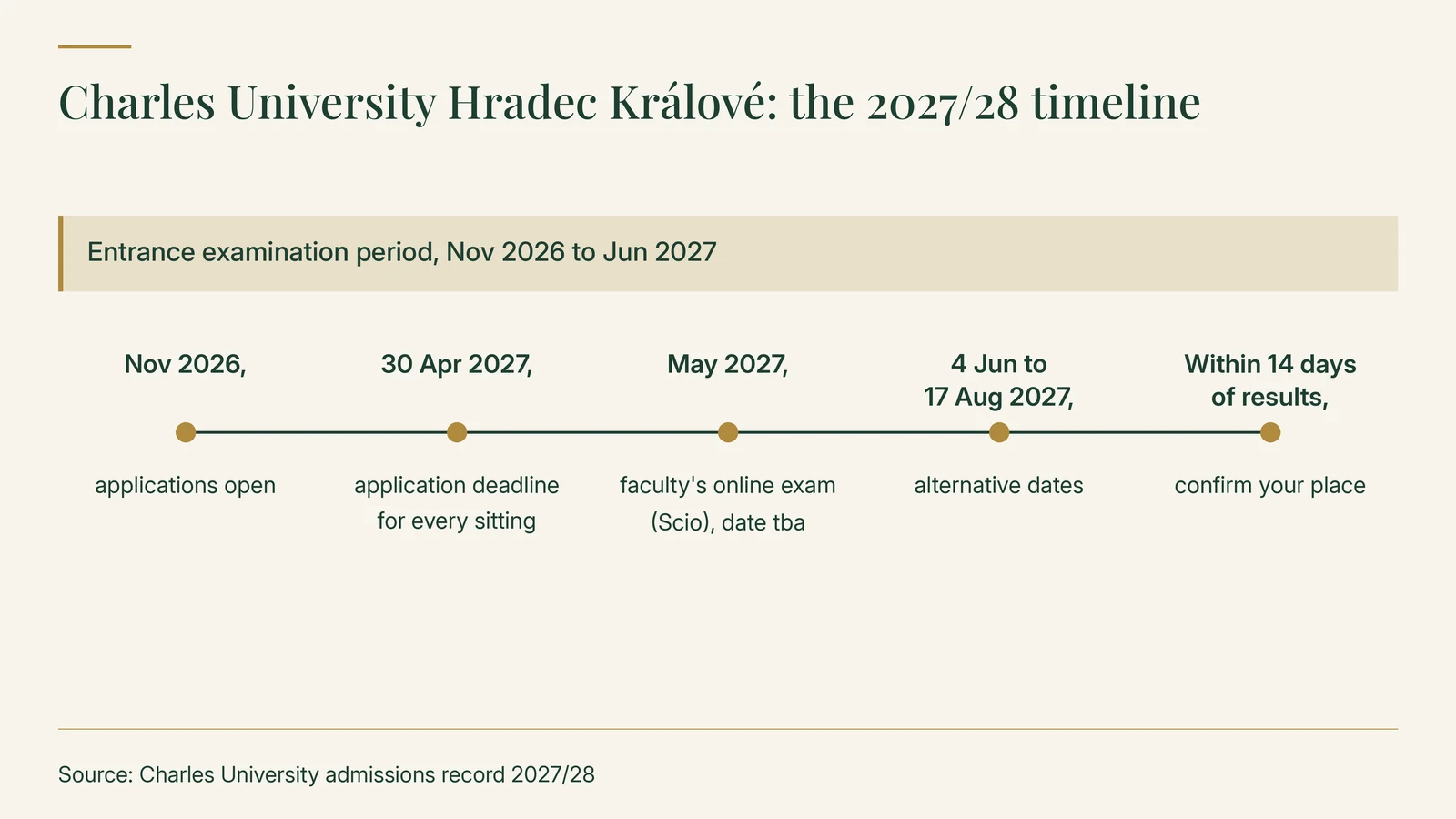
Hradec Králové publishes no single official Call PDF. The binding sources are the faculty's own admissions page at lfhk.cuni.cz/LFHKEN-181.html and the programme's admission criteria in Charles University's admissions system, both re-read on 12 October 2026. The faculty's page, updated for 2027 that day, puts its own online sitting in May 2027 for applications submitted by 30 April 2027 but gives no dates yet ('tba'); the 2027/2028 deadline, entrance-exam date range, fees and places given here come from the 2027/2028 admissions records, which give no sitting dates either. IvyTest re-checks that page and updates this guide when the next cycle's dates, and the written test's duration, appear.
Structure
Charles University Hradec Králové Entrance Exam format
Sixty answered questions across three blocks, each question worth exactly one point, for a maximum of 60. Biology and Chemistry are compulsory at 25 points apiece; the third block is Physics or Mathematics at 10 points. Every item gives five choices with exactly one correct answer. The faculty has not yet announced how long you get: its admissions page, updated for 2027, lists the written-test time as 'tba'.
| Section | Questions | Weighting | Suggested time |
|---|---|---|---|
| Biology | 25 | 25 of 60 points (42%) | *see the note below the table |
| Chemistry | 25 | 25 of 60 points (42%) | *see the note below the table |
| Physics or Mathematics (elective, one track only) | 10 | 10 of 60 points (17%) | *see the note below the table |
- The faculty lists the written-test duration as 'tba' and sets no per-block time limit
Content
Question and subject breakdown
Three blocks, but not three equal blocks. The faculty publishes the point value of each, and the compulsory sciences are worth two and a half times what the elective is worth, which should drive how your preparation time is divided far more than how interesting each subject is.
Biology
42% (25 of 60 points)Compulsory. Questions 1 to 25 of the official paper. It runs from the characteristics of life and cell structure through membrane transport and signalling, molecular biology, the cell cycle, genetics and population genetics, then a long human-physiology stretch across tissues, the musculoskeletal, cardiovascular, respiratory, digestive, urinary, nervous, endocrine and reproductive systems, closing with immunology and microbiology. The official paper contains no figures at all: every item is fully specified in text.
Chemistry
42% (25 of 60 points)Compulsory. Questions 26 to 50 of the official paper. It mixes fast recognition items with genuine numerical work: dilution ratios, pH after dilution, hydroxide concentration from hydronium, 1:1 titration and stoichiometry corrected for percentage yield all appear on the official sample. Atomic structure and bonding, the mole and solutions, acids and bases, equilibrium and enzymes, redox, inorganic chemistry, organic foundations, functional groups and biomolecules are all in scope.
Physics or Mathematics
17% (10 of 60 points)The elective third block: you sit one track, not both. The Physics track covers units and constants, mechanics, fluids and circulation, thermodynamics and gases, electricity and magnetism, waves, sound and optics, and modern physics and radiation. The Mathematics track covers algebra and factorials, functions and inverses, quadratics and parabolas, differential calculus, coordinate and solid geometry, complex numbers, and probability and sets. Several official items in both tracks offer 'no answer is correct' as one of the five choices.
Marks
Charles University Hradec Králové Entrance Exam scoring
Hradec Králové publishes both its scoring rule and its point split, which is rarer than it should be and makes this the one exam in Charles University's Czech family where you can calculate exactly what an improvement is worth. There is no negative marking: a correct answer is +1, an incorrect answer is 0, and a blank is 0. A wrong answer and an unanswered question are worth exactly the same, so leaving something empty can only cost you and can never protect you. The written test is not the whole selection, though: a 40-point interview follows, and admission goes on the combined score out of 100.
- Correct answer
- +1 point
- Incorrect answer
- 0 points (no negative marking)
- Unanswered question
- 0 points (identical to a wrong answer)
- Biology
- 25 points (compulsory)
- Chemistry
- 25 points (compulsory)
- Physics or Mathematics
- 10 points (elective, one track only)
- Maximum possible score
- 60 points on the written test; 100 with the 40-point interview
- Answer options
- 5 per question, exactly one correct, marked with a cross on a separate answer sheet; answers marked in the booklet itself do not count
- Minimum eligible score
- No pass mark is published: admission goes to the applicants ranked 1st to 105th for General Medicine (1st to 25th for Dentistry) on the combined written and interview score
- Per-subject floors
- None published: there is no Czech counterpart to the per-subject 'additional learning requirement' floors used by some Italian medical schools
Worked example
Two numbers are worth separating carefully here, because they are easy to confuse and they are not the same size. The first is PERCENTAGE POINTS OF ACCURACY: how often you get an item right within a block. The second is RAW MARKS on the 60-point scale. Because the blocks are unequal, the same accuracy gain converts into very different numbers of marks. Lift your Biology accuracy by 20 percentage points, from 60% to 80%, and you gain 20% of 25 questions = 5 marks, which is 8.3 percentage points of the 60-point total. Lift your elective-block accuracy by the same 20 percentage points, from 60% to 80%, and you gain 20% of 10 questions = 2 marks, which is 3.3 percentage points of the total. Identical effort, identical accuracy gain, two and a half times the payoff in Biology or Chemistry. Now the guessing arithmetic. With five options and no penalty, a completely blind guess returns (1/5 × 1) + (4/5 × 0) = +0.20 marks and a blank returns exactly 0. Suppose you answer 38 items confidently and get 34 of them right, can narrow 14 more to three plausible options, and have nothing at all on the last 8. The 34 score 34. The 14 three-way items return about 14 × 1/3 = 4.7 marks. The 8 blind five-way guesses return 8 × 0.20 = 1.6 marks. Expected total: about 40.3 out of 60, or 67%. Leave those 22 uncertain items blank instead and you score 34 out of 60, or 57%. That 6.3-mark gap (just over ten percentage points of the total) is bought entirely by the decision to answer, not by knowing anything more.
The IvyTest simulator scores every practice paper against these exact rules.
See the Charles University Hradec Králové Entrance Exam simulatorSyllabus
Full Charles University Hradec Králové Entrance Exam syllabus
The faculty publishes a topic list with recommended textbooks, its Requirements and Recommended Literature for Entrance Procedure (2023), covering Basic Human Anatomy and Physiology, Biology, Chemistry, Physics and Mathematics, beside one sample paper. The groups below are IvyTest's mapping of what the official 2024/2025 sample paper actually asks, so read them alongside that list rather than in place of it. The elective is split into its two tracks because you will sit one of them and can ignore the other entirely.
Derived from the official sample paper's topic range. The paper carries no figures anywhere: every item is fully specified in text.
- General biology and the characteristics of life: reproduction, evolution, response to stimuli and the regulation of internal conditions, the levels of organisation from atom to ecosystem, living versus non-living biological entities such as cells, viruses and prions, and the core vocabulary of structure, function, adaptation, feedback, stimulus and response
- Cell structure and organelles: prokaryotic versus eukaryotic cells, animal versus plant cells, the plasma membrane and the fluid mosaic model, nucleus, chromatin and nucleolus, ribosomes, rough and smooth ER, Golgi, lysosomes and peroxisomes, mitochondria including cristae, the electron transport chain and the location of cytochrome c, the cytoskeleton and the functions of microfilaments in shape, contraction, cytokinesis, cell crawling and endocytosis, and the protein synthesis and secretory pathway
- Membrane transport and cell signalling: simple diffusion of gases and small non-polar molecules, facilitated diffusion through channels and carriers, osmosis and hypertonic, hypotonic and isotonic environments, active and secondary active transport, phagocytosis, pinocytosis and receptor-mediated endocytosis, exocytosis, autocrine, paracrine, endocrine and synaptic signalling, and membrane and intracellular receptors with signal transduction
- Molecular biology and nucleic acids: the composition of DNA from deoxyribose, phosphate and the four bases, RNA with ribose and uracil, base pairing and complementary strands, semi-conservative replication, transcription into mRNA, translation with codons, tRNA and ribosomes, the central dogma, reverse transcription and retroviruses such as HIV, and substitution, insertion, deletion, frameshift, silent, missense and nonsense mutations
- Cell cycle, chromosomes and cell division: G1, S, G2 and M phases, replication in S phase, counting chromosomes, chromatids and DNA molecules at each stage, the human diploid number 2n = 46 and haploid n = 23, the stages of mitosis and cytokinesis, meiosis I and II, crossing over and independent assortment, somatic cells versus gametes, and basic segregation errors
- Genetics and population genetics: gene, allele, locus, genotype, phenotype, homozygous and heterozygous, dominance, recessiveness, codominance and incomplete dominance, monohybrid crosses and Punnett squares, autosomal versus sex-linked inheritance, X-linked recessive disease and the conditions that produce an affected daughter, human sex determination by the sperm, Hardy-Weinberg equilibrium and the conditions it requires, natural selection, genetic drift, founder effect, bottleneck effect and mutation
- Tissues, skeleton and muscle: the four basic tissue types and their roles, the distinction between tissue, organ and organ system, the diaphragm as skeletal muscle, the axial and appendicular skeleton, the regions and total number of vertebrae, bone structure and function, joints, cartilage, ligaments and tendons, skeletal muscle contraction with actin, myosin, calcium and ATP, and smooth and cardiac muscle
- Cardiovascular system and blood: the four heart chambers, the tricuspid, bicuspid, pulmonary and aortic valves, the conducting system of sinoatrial node, atrioventricular node, bundle of His and Purkinje fibres, coronary arteries and pericardium, which vessels and structures do not belong to the heart, arteries, veins and capillaries, pulmonary versus systemic circulation, plasma, erythrocytes, leukocytes and platelets, haemostasis from platelet plug through prothrombin activator, thrombin, fibrinogen and fibrin, and basic blood pressure regulation
- Respiratory system: the airways from nasal cavity to bronchioles, alveoli and gas exchange by diffusion, the transport of oxygen and carbon dioxide in blood, inspiration with diaphragm contraction and falling alveolar pressure, passive expiration by elastic recoil, and brainstem control of breathing in the medulla oblongata and pons
- Digestive system and liver: the digestive tract from mouth to anus, the order of duodenum, jejunum and ileum, the regions of the large intestine, liver functions including detoxification, plasma protein synthesis, urea production, glycogen storage, bile production and the processing of old red blood cells, the gallbladder as the store of bile rather than its source, pancreatic enzymes with insulin and glucagon, and absorption through villi and microvilli
- Urinary system and osmoregulation: kidney anatomy of cortex, medulla, renal pelvis and ureter, the nephron from glomerulus and Bowman's capsule to collecting duct, podocytes and the filtration barrier, urine formation by filtration, reabsorption, secretion and concentration, the basic roles of ADH and aldosterone, and the excretion of nitrogenous waste with the maintenance of water, salt and pH balance
- Nervous system and sensory biology: central and peripheral nervous system, sympathetic and parasympathetic divisions, cerebrum, cerebellum, diencephalon, pons and medulla oblongata, the medullary reflex centres for heartbeat, breathing and blood pressure, neurons, synapses and neurotransmitters, glial cells, the eye with retina, fovea centralis and optic nerve, and rods for low-light vision against cones for colour vision and acuity
- Endocrine and reproductive systems: hypothalamus, pituitary, thyroid, adrenal glands, pancreas and gonads, hormone action through receptor specificity and feedback control, male anatomy including testes and seminiferous tubules, female anatomy including ovaries, oviducts and uterus, spermatogenesis and oogenesis, FSH, LH, testosterone, oestrogen and progesterone, and the role of FSH in male sperm production
- Immunology, microbiology and infectious agents: innate versus adaptive immunity, the leukocyte types including lymphocytes, macrophages, neutrophils, eosinophils, basophils and NK cells, B cells, T cells, antibodies, antigens and memory cells, matching named cells to their system such as Kupffer cells, Purkinje cells, podocytes and glial cells, bacterial structure and binary fission, the temperature and salt classes including psychrophiles, thermophiles and halophiles, DNA viruses, RNA viruses and retroviruses, prions and prion disease, and the differences between bacteria, viruses, protozoa, fungi and prions
Derived from the official sample paper's topic range. Calculation items are well represented: the sample includes dilution, pH after dilution, hydroxide from hydronium, 1:1 titration and yield-corrected stoichiometry.
- Atomic structure, the periodic table and bonding: protons, neutrons and electrons, atomic number, mass number, isotopes and relative atomic mass, electron shells, valence electrons and basic electron configuration, groups and periods with alkali metals, alkaline earth metals, halogens, noble gases and transition metals, trends in atomic radius, electronegativity, ionisation energy and metallic character, ionic, covalent, polar covalent, coordinate and metallic bonding, hydrogen bonding, dipole-dipole and dispersion forces, polarity and water solubility including why tetrachloromethane dissolves poorly, and the recognition of ionic compounds such as potassium bromide
- The mole, solutions and stoichiometry: the mole, molar mass and the Avogadro constant, balancing equations and stoichiometric coefficients, mass-to-mole and mole-to-mass conversion, limiting and excess reactant, theoretical, actual and percentage yield, concentration in mol per litre and in mass percent, dilution factors, mixing a concentrated solution with water in a stated ratio to reach a target percentage, and thermal decomposition calculations corrected for reaction yield
- Acids, bases, pH and salts: the Arrhenius and Brønsted-Lowry definitions, conjugate acid-base pairs and the strength of a conjugate base, strong and weak acids and bases, pH and pOH, the ion product of water and calculating hydroxide from hydronium concentration, pH after dilution of a strong acid, titration calculations for 1:1 stoichiometry, salt hydrolysis, and which salts give acidic, basic or neutral solutions
- Equilibrium, kinetics and enzymes: reaction rate and the factors that change it, activation energy and catalysis, chemical equilibrium and the equilibrium constant at conceptual level, the fact that catalysts and enzymes change the rate but not the equilibrium constant, the enzyme-substrate complex, active site, specificity, saturation and denaturation, and the effect of temperature and pH on enzyme activity
- Redox chemistry: oxidation numbers and the rules for assigning them, oxidation as loss and reduction as gain of electrons, identifying oxidising and reducing agents, common oxidants such as permanganate and bromate and common reductants such as carbon monoxide and iron(II), balancing redox equations in acidic medium, and reading electron transfer in reactions such as iron(II) to iron(III) and permanganate to manganese(II)
- Inorganic chemistry: the main-group chemistry of alkali metals, alkaline earth metals, halogens, oxygen, sulphur, nitrogen and phosphorus, common oxidation states including magnesium at plus two, transition elements with variable oxidation states, coloured compounds and complex formation, mercury with its symbol, toxicity and oxidation states, the common oxides, hydroxides, carbonates, sulphates, nitrates, chlorides, chromates, cyanides and ammonium salts, counting atoms in a formula, and the solubility and acid-base behaviour of common salts
- Organic chemistry foundations: carbon tetravalence, sp3, sp2 and sp hybridisation, single, double and triple bonds, molecular, condensed and structural formulas, chain, position, functional and cis-trans isomerism, chirality and the chiral carbon with four different substituents, alkanes, alkenes, alkynes and aromatic compounds, addition and polymerisation of alkenes such as ethenyl chloride, benzene derivatives and basic aromatic nomenclature, and counting carbon atoms in a named compound
- Functional groups and organic reactions: alcohols and their primary, secondary and tertiary classes, ethers, aldehydes and ketones, carboxylic acids, esterification of an acid with an alcohol and examples such as methyl acetate, amides distinguished from amines, primary, secondary and tertiary amines including diphenylamine, hemiacetals and glycosides for contrast, acid derivatives at recognition level, and the reduction, polymerisation and toxicity of medically relevant compounds such as propenamide
- Biomolecules and biochemistry: monosaccharides, disaccharides and polysaccharides, the aldose and ketose classification of glucose and fructose, sucrose as glucose and fructose and starch as a glucose polymer, fatty acids, triglycerides, phospholipids and steroids, saturated and unsaturated fatty acids including the carbon count of oleic acid, amino acids, peptide bonds and the levels of protein structure, enzymes as proteins, nucleotides and nucleosides, and the recognition of heterocycles such as pyridine, pyrrole, pyrimidine and purine
One of the two elective tracks. You sit Physics or Mathematics, not both. The official paper supplies its own constants list and permits a simple calculator, so use the printed constants rather than remembered values.
- Units, constants and calculation discipline: the SI base and derived units including newton, joule, watt, pascal, coulomb, volt, ohm and hertz, conversion of kilometres per hour to metres per second and of metric prefixes from pico to kilo, Celsius to Kelvin conversion, scientific notation and powers of ten, significant figures with rounding of the final result only, and substituting the constants printed on the paper rather than remembered ones
- Mechanics, work and energy: uniform motion, uniformly accelerated motion and the three kinematic equations, braking distance and stopping time under constant deceleration, Newton's laws at basic level, weight and gravitational force, work, kinetic and gravitational potential energy, and power including the average power developed when running up stairs
- Fluids and circulation: density, mass and volume, pressure and its units including normal atmospheric pressure, the continuity equation for incompressible fluids, the cross-sectional area of a circular vessel, and blood-vessel branching problems relating total area, velocity and the diameter of the daughter vessels
- Thermodynamics and gases: the Celsius to Kelvin conversion, the ideal gas law, the constant-volume gas law relating pressure and absolute temperature, heat capacity and specific heat, latent heat of fusion and of vaporisation, and finding a final temperature from a percentage change in pressure at fixed volume
- Electricity and magnetism: charge and the elementary charge, Coulomb's law and how the force scales when the charges are replaced, the charge of an alpha particle, Ohm's law and resistance at basic level, alternating current and frequency, inductance and inductive reactance, and the conversion of millihenry to henry with the result expressed in ohms
- Waves, sound and optics: wave speed, frequency and wavelength, sound intensity and the decibel scale, intensity ratios for a ten- and a twenty-decibel rise, refractive index and Snell's law, total internal reflection and the critical angle with answers sometimes requested in radians, and the relationship between the speed of light, wavelength and frequency
- Modern physics and radiation: the Planck relation and photon energy from frequency or wavelength, conversion between joules and electronvolts, X-ray photon energy, the de Broglie wavelength of a moving electron, electron mass and speed conversion, and half-life and exponential decay at basic level
The other elective track. Ten items, and the official sample reaches further than most medical entrance papers: differential calculus and complex numbers both appear.
- Algebra, powers and factorials: simplification, expansion and factorisation, linear and quadratic equations, powers, roots and the exponent laws, logarithms and the logarithm laws, factorial expressions such as the ratio of consecutive factorials and their cancellation, manipulation of expressions in a parameter such as n, and rounding to the precision the question specifies
- Functions, graphs and inverses: linear, quadratic, exponential and logarithmic functions, domain and range at basic level, composite functions, finding an inverse by swapping the variables and solving, the inverse relationship between exponentials and logarithms, and reading graphs and turning points
- Quadratics and parabolas: the general form of a quadratic, vertex form, the vertex abscissa from −b/2a, completing the square, locating the turning point of a parabola given in implicit form, and combining the vertex coordinates as a sum or in an evaluation
- Differential calculus: the derivative as the slope of a tangent, derivatives of powers, the exponential and the natural logarithm, the product rule and the simple chain rule, differentiating products such as x² eˣ and x ln x, evaluating a tangent slope at a point, and the acute angle between two tangents from their slopes
- Coordinate geometry in the plane: the Cartesian plane and point coordinates, lines written as a constant abscissa or ordinate, in slope-intercept form and in general form, slope and intercepts, the intersection of two lines, distance between points, and the area of a triangle bounded by two axis-parallel lines and one oblique line
- Solid geometry and the sphere: three-dimensional coordinates, the equation of a sphere in standard and expanded form, completing the square in three variables, extracting the centre and radius, and the surface area and volume of a sphere
- Complex numbers: the imaginary unit and the fact that its square is minus one, real and imaginary parts, addition, subtraction and multiplication, simplifying powers of the imaginary unit before dividing, and division by multiplying through by the conjugate
- Probability and sets: basic probability and the complement rule, union and intersection of sets, the inclusion-exclusion principle applied to overlapping groups, independent events and repeated trials, binomial probability for at-least and at-most wording such as the number of boys in a family, and rounding a probability to the requested number of significant digits
Test your Charles University Hradec Králové Entrance Exam knowledge
Take free diagnosticDifficulty
How difficult is the Charles University Hradec Králové Entrance Exam?
The science in this paper is pitched at a strong final-year school student, not at a first-year medic. What makes it awkward is the shape: an unequal point split most candidates misread, a fifth option that is sometimes the answer, a choice of elective track made before you know what is on it, and a duration the faculty has not announced.
The blocks are not equal, and most preparation plans assume they are
Biology and Chemistry are worth 25 points each; the elective is worth 10. That is 42% of the paper each against 17%. A candidate who splits study time evenly across three subjects is spending a third of their effort on a sixth of the marks. Expressed the other way: twenty percentage points of accuracy gained in Biology is worth 5 marks, while the same twenty percentage points gained in the elective is worth 2.
Five options, and 'no answer is correct' is a real option
Every item offers five choices rather than four, which drops the blind-guess return from +0.25 to +0.20 marks and makes elimination worth more per option removed. Five items of the official sample (four in Physics, one in Mathematics) also use 'no answer is correct' as one of the five. The sample marks its correct answers in bold and none of those five is the bold one, but nothing says it never will be: treating it as filler, or reflexively picking it when stuck, both cost marks.
No negative marking, so a blank is a pure loss
The faculty states it explicitly: correct +1, no answer 0, incorrect 0. A wrong answer costs exactly what a blank costs. That makes every unanswered item a decision to accept the worse of two outcomes, because a blind guess is worth +0.20 marks and a blank is worth exactly 0. There is no question on this paper worth leaving empty.
You choose your elective track, so choose it on evidence
Physics or Mathematics, one or the other, ten items either way. The stakes are capped: going from 50% to 90% accuracy in the better track is worth 4 marks out of 60, or about seven percentage points of the total, but four marks is four marks, and the choice is free. Sit both official sample blocks before deciding rather than picking the subject you preferred at school.
The clock is unannounced
The faculty's admissions page, updated for 2027, lists the written-test duration as 'tba', and the official 2024/2025 sample paper states no limit. The 120-minute figure that circulates comes from an unofficial syllabus quoting a screenshot. Practise to a fixed self-imposed limit so your results stay comparable, and check the faculty's page yourself before the exam: this is a number that will appear there when it exists.
Benchmarks
What is a good Charles University Hradec Králové Entrance Exam score?
The faculty publishes its scoring rule and its point split but not a pass mark. IvyTest re-read lfhk.cuni.cz/LFHKEN-181.html and the programme's admission criteria, including the 2027/28 records, directly on 10 October 2026: they state the marking structure in full, add a 40-point interview, and state no minimum eligible score or fixed cut-off anywhere.
What is published instead is the seat structure, which tells you more than a threshold would. General Medicine admits the applicants ranked 1st to 105th on the combined written and interview score out of 100, and everyone tied with the last admitted applicant is admitted too; Dentistry does the same for 25 places. Charles University's admissions records give 208 of 377 General Medicine applicants admitted in the past academic year. Because the faculty sets no published floor, a score is competitive relative to that year's cohort rather than against a fixed bar.
For preparation, the useful target is a score out of 60 that you can hold across repeated full mocks, broken down by block rather than reduced to one number. Watch the two compulsory sciences separately: because Biology and Chemistry carry 25 marks each, a five-mark swing in either is worth 8.3 percentage points of your total, while the elective is worth only ten marks in all, so it can move your total by at most 16.7 percentage points. Track raw marks per block, not just an overall percentage, and you will see where the next mark is cheapest.
Pending verification
- · Any pass mark, cut-off or minimum eligible score
- · The written test's duration, which the faculty currently lists as 'tba'
- · Historical competitive score ranges by year
- · Applicant numbers for 2027/28
These specific numbers aren't public yet — an IvyTest simulator score is the closest benchmark you can get today.
Check your Charles University Hradec Králové Entrance Exam scoreStrategy
How to prepare for the Charles University Hradec Králové Entrance Exam
12+ weeks
Weight the plan 25/25/10, not a third each
Biology and Chemistry carry 50 of 60 marks; the elective gets proportionate time, not equal time.
- Sit a full 60-question diagnostic in week one under the real +1/0/0 rule and score each block out of its own maximum (25, 25 and 10) rather than as one percentage. The whole point of this exam's published split is that it lets you see where a mark is cheapest.
- Try both elective tracks early. Sit the official Physics block and the official Mathematics block, compare, and commit to one. The Mathematics track reaches into differential calculus and complex numbers; the Physics track leans on constants and unit discipline. Pick on evidence, then stop revising the other.
- Build Chemistry calculation fluency deliberately: dilution, pH after dilution, hydroxide from hydronium, 1:1 titration, and stoichiometry corrected for percentage yield. These are the sample paper's own numerical patterns, and Chemistry is worth 25 marks.
- Practise in the real five-option format from the start, including items where 'no answer is correct' is one of the five, so that option stops being a surprise.
8 weeks
Close the gap in whichever compulsory science is weaker
Targeted repair in Biology and Chemistry, with the elective kept warm rather than grown.
- Diagnostic first, then put the largest share of time into the weaker of Biology and Chemistry. Each is worth 25 marks, so the weaker of the two is always where the next mark is cheapest.
- Keep the elective on a light weekly rotation: enough to stay fluent in ten items' worth of material. Its ceiling is 10 marks, and hours spent past fluency there have nowhere to go.
- One full 60-question mock a week from week two, reviewed the same day, with every wrong or blank answer logged by cause: content gap, misread question, or arithmetic slip.
- Rehearse the answer sheet. The official paper is marked with a cross on a separate sheet and answers marked in the booklet itself do not count: a mechanical failure that scores zero however well you knew the item.
4 weeks
Full 60-question sittings, and nothing left blank
Volume of timed mocks at the real five-option pace, plus answer-everything discipline.
- Two full 60-question mocks a week under a fixed self-imposed time limit, scored 25/25/10 with +1 for correct and 0 for everything else.
- Build the habit of answering every item. A blind five-option guess is worth +0.20 marks and a blank is worth 0, so across even ten uncertain items answering rather than skipping is worth about 2 marks, over three percentage points of the 60-point total.
- Drill elimination specifically. With five options, removing two before guessing lifts your return from +0.20 to about +0.33 marks on that item, and eliminating options is a skill that improves with practice in a way that recall does not.
- Confirm your elective track and stop hedging. Ten items is not enough to split preparation across two subjects in the final month.
Under 4 weeks
Protect the 50 marks that matter most
Triage weighted to the published point split.
- Stop adding new content. Consolidate the highest-frequency Biology and Chemistry areas: between them they carry 50 of the 60 available marks.
- Keep elective revision to maintenance only: the standard formulas, the unit conversions, the two or three calculation patterns the sample paper uses. Ten marks do not justify a new topic in the final fortnight.
- Sit at least two full, scored 60-question mocks in the final ten days, then taper, and rehearse the 40-point interview: arguing for and against the proposed solution to an ethical dilemma, then your motivation and experience.
- Check lfhk.cuni.cz yourself before the exam for the announced duration and the confirmed sitting dates: the faculty's page listed the written-test time as 'tba' as of 12 October 2026, and it is the page where that will change.
Get your personalised Charles University Hradec Králové Entrance Exam study plan
Take free diagnosticExplore the full Charles University Hradec Králové Entrance Exam planPractice
Free Charles University Hradec Králové Entrance Exam practice questions
Three questions in the format the exam uses. Choose an answer to see the explanation — nothing is recorded.
A 0.010 mol/L solution of hydrochloric acid is diluted tenfold with water. What is the pH of the diluted solution?
Blood flows at speed v through an artery of cross-sectional area A. The artery divides into five identical branches, each of cross-sectional area A/10. Assuming incompressible flow, what is the speed of blood in each branch?
Illustrative examples written by IvyTest to show the question style — not past Charles University Hradec Králové Entrance Exam papers.
Past papers
Charles University Hradec Králové Entrance Exam past papers
The Faculty of Medicine in Hradec Králové publishes no archive of past papers. Its Admission Process page links two free PDFs under Example test and recommended literature: the 2024/2025 sample test for General Medicine and Dentistry (70 numbered questions, Biology 1-25, Chemistry 26-50, Physics 51-60 and Mathematics 61-70, of which you answer 60, five options each, with the correct answers in bold and a list of constants for Physics) and the Requirements and Recommended Literature for Entrance Procedure, a topic list with textbooks for each subject. IvyTest's free practice paper, with every answer explained, follows the live format.
University
Charles University, Faculty of Medicine in Hradec Králové medicine admissions
The written test sits inside a wider application, and the figures below describe the English-taught Master study programmes at the Faculty of Medicine in Hradec Králové. Charles University's other four Czech medical faculties set their own fees, calendars and exams entirely independently.
- Degrees
- General Medicine and Dentistry (English-taught): both Master study programmes
- Language of instruction
- English
- Campus
- Faculty of Medicine in Hradec Králové, Czech Republic
- Tuition
- CZK 400,000 / year for General Medicine (about €16,200–16,400, converted at approximately 24.5 CZK to the euro) and CZK 410,000 for Dentistry, unchanged in the 2027/28 admissions records; each Charles University faculty sets its own fee independently
- Application fee
- CZK 2,500 (about €100)
- Interview
- Yes: 40 points in two 20-point parts. For 2027/28 the first part is an ethical dilemma, on which you argue for and against the proposed solution; the second covers your motivation, your interest in the field and any experience caring for chronically ill patients. Each part is marked 0 to 20 in four published bands, from 0-5 (the task not understood, or motivation presented incoherently) to 16-20 (fluent, logical and convincing)
- English certificate
- Not required: none is listed among the faculty's conditions of admission
- Motivation letter
- Not required
- Recommendation letters
- Not required
- Seats available
- 105 in General Medicine and 25 in Dentistry for 2027/28; the admissions records give 208 of 377 General Medicine applicants and 33 of 80 Dentistry applicants admitted in the past academic year
- Document requirements
- Legalisation and certified translation required; apostille depends on the issuing country
- Czech language in clinical years
- Czech is a compulsory course in years 1 and 2, to prepare you for talking with patients in clinical lessons; all other classes are taught in English, and an elective Czech course is open to later years
- Cost of living
- No confirmed city-specific figure yet. Hradec Králové is smaller than Prague or Brno and generally more affordable, but IvyTest has no verified number to quote
Read the full Charles University Hradec Králové admissions guide →
IvyTest Charles University Hradec Králové Entrance Exam preparation
Ready to prepare properly for the Charles Hradec entrance exam?
Everything above is free and always will be. When you want structure (a syllabus-mapped book weighted the way the paper actually is, a simulator that runs the real 60-question, five-option, +1/0/0 format with the elective track you have chosen, lessons for the gaps your results flag, and help with the application itself), that is what the IvyTest Charles Hradec package is.
Study guide
Biology and Chemistry at the depth 25 marks each deserves, plus both elective tracks so you can choose on evidence.
Exam simulator
Timed 60-question mocks in the real five-option, +1/0/0 format, scored 25/25/10 with per-block analytics.
Video courses
Focused lessons in biology, chemistry, physics and mathematics for the topics your results flag.
Application support
MedApply: deadlines, documents, legalisation and enrolment steps carried through to a confirmed place.
FAQ
Charles University Hradec Králové Entrance Exam frequently asked questions
It's the Written Science Entrance Test the Faculty of Medicine in Hradec Králové uses to select candidates for its English-taught General Medicine and Dentistry programmes. You answer 60 questions worth one point each: Biology for 25 points, Chemistry for 25 points, and either Physics or Mathematics for 10 points. An interview worth 40 more points follows, and admission goes to the best combined scores out of 100.
Neither. There is no national Czech medical entrance test, and Charles University's five medical faculties run structurally different papers. Hradec Králové is the only one that offers an elective third subject and the only one that publishes unequal block weights. The Pilsen faculty runs Biology, Chemistry and compulsory Physics with no elective; the First Faculty in Prague has no Physics paper at all; the Second Faculty runs four sections including Logic and scores its science items all-or-nothing; the Third Faculty runs only Biology and Chemistry. Preparation built for one does not transfer cleanly to another.
Both formats are used. For 2026/27 the faculty's own sitting on 13 May 2026 was held online through the external provider Scio, with the interview via MS Teams, while partner agencies abroad ran the written test and interview in person on the same day. The official 2024/2025 sample paper is pen-and-paper, marked with a cross on a separate answer sheet. The faculty's page allows a scientific calculator and no dictionaries or tables. The test is delivered entirely in English.
The faculty states it explicitly: +1 for a correct answer, 0 for no answer, 0 for an incorrect answer. There is no negative marking, so a wrong answer costs exactly what a blank costs. With five options, a blind guess returns +0.20 marks on average against a blank's 0, which means there is no question on this paper worth leaving empty. Eliminating even two options before guessing lifts the return on that item to about +0.33 marks.
No pass mark is published. IvyTest re-read the faculty's official admissions page and the programme's admission criteria, including the 2027/28 records, directly on 10 October 2026: they state the full marking structure and admit the best-ranked applicants up to capacity, with no fixed threshold. There are also no per-subject floors: the Czech system has no counterpart to the per-subject 'additional learning requirement' thresholds used by some Italian medical schools.
Whichever you score better on, measured rather than remembered. The block is only worth 10 of the 60 marks, so the choice is capped: moving from 50% to 90% accuracy in the better track is worth 4 marks, about seven percentage points of your total, but it is free, so it should be made on evidence. Sit both official sample blocks before you commit. Mathematics reaches into differential calculus and complex numbers; Physics leans on constants, units and calculation discipline.
Because the booklet prints both elective tracks. Biology runs 1 to 25, Chemistry 26 to 50, Physics 51 to 60 and Mathematics 61 to 70. You answer your two compulsory blocks plus one elective block: sixty items, sixty points. The ten questions in the track you did not choose are not yours to answer and carry no marks for you.
Not yet announced. The faculty's admissions page, updated for 2027, still listed the written test's time as 'tba' when IvyTest re-read it on 12 October 2026, and the official 2024/2025 sample paper states no limit anywhere. A 120-minute figure circulates from an unofficial syllabus quoting a screenshot; treat it as unconfirmed and check the faculty's page yourself before your sitting.
105 places in General Medicine and 25 in Dentistry, filled in rank order on the combined written and interview score. Charles University's admissions records give 208 of 377 General Medicine applicants and 33 of 80 Dentistry applicants admitted in the past academic year, about 55% and 41%. The places are the same for 2027/28.
Within the EU, yes: automatically, as a standard Czech medical degree. There's no separate national licensing exam afterwards: the Czech state exam (státní rigorózní zkouška) is built into the MUDr degree itself, and registration with the Czech Medical Chamber (ČLK) is compulsory to practise in the country. Outside the EU recognition isn't automatic as a rule, but the UK is an exception. Under the Medical Act 1983 (section 21B, as in force on 12 October 2026), a Czech medical degree (MUDr.) is a 'relevant European qualification', so a graduate who applies to the GMC with one, whatever their nationality, is not asked to show the knowledge and skills other international graduates prove through PLAB/UKMLA; evidence of English is still required, and the rule is UK policy that can change. US-bound graduates need ECFMG certification via USMLE Step 1 and Step 2 CK, the same requirement every international medical graduate faces.
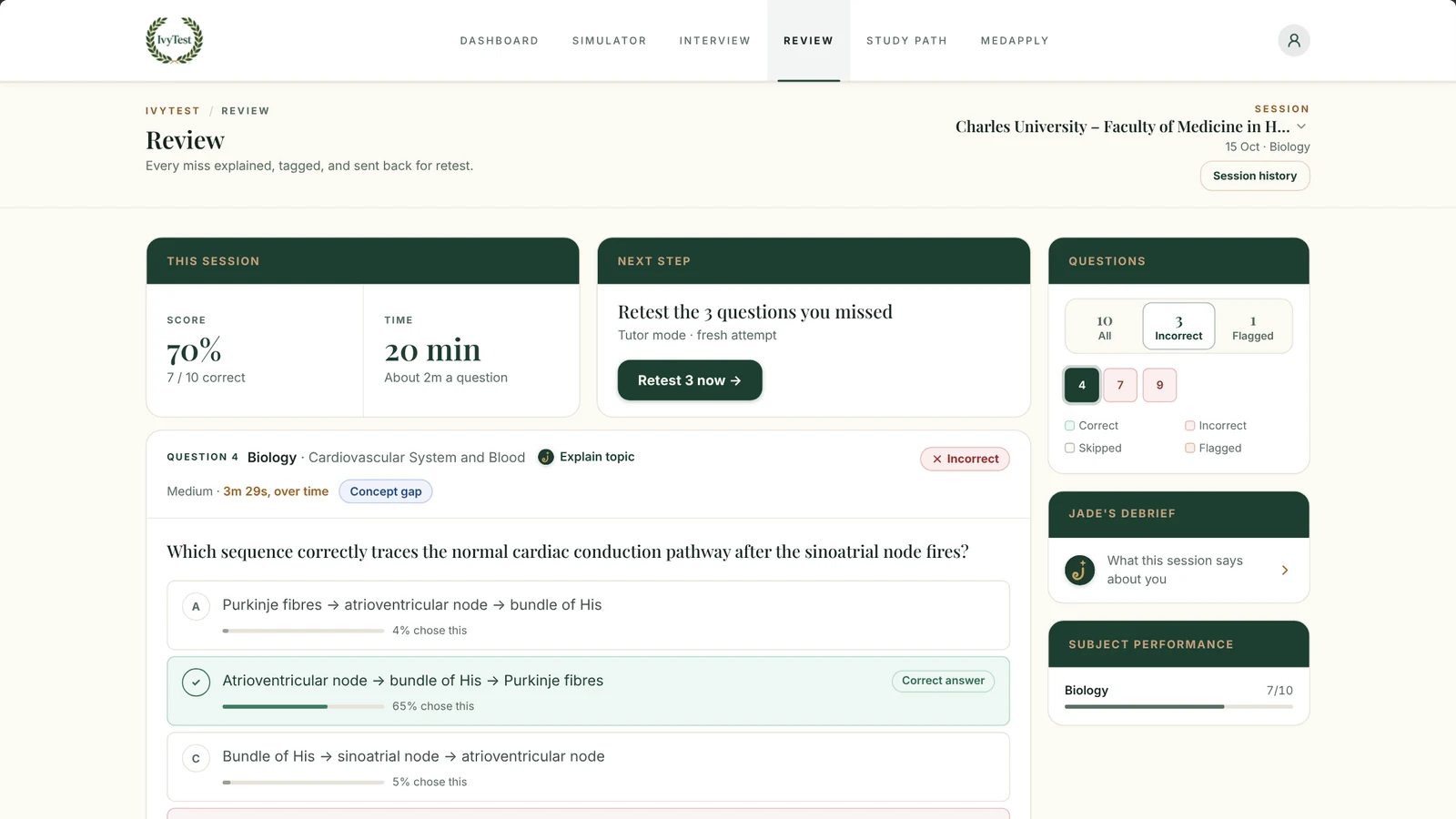
Yes. The IvyTest simulator runs Hradec-format practice (60 questions, five options, the real +1/0/0 rule scored 25/25/10 across Biology, Chemistry and your chosen elective) in timed, tutor and review modes, with a free diagnostic available without payment.
There is no archive of past papers. The faculty publishes one official sample paper as a PDF, its 2024/2025 test for General Medicine and Dentistry: 70 numbered questions (you answer 60), five options each, with the correct answers marked in bold. It also publishes a PDF of Requirements and Recommended Literature, a topic list with textbooks for each subject. Both are linked from its Admission Process page.
Charles University's 2027/28 admissions records give 30 April 2027 as the application deadline for General Medicine and Dentistry in English, and an entrance-exam date range of 1 April to 30 June 2027 (alternative 4 June to 17 August 2027). The faculty's page, updated for 2027, puts its own online sitting in May 2027 for applications submitted by 30 April 2027, but the exact date and the partner agencies' dates abroad are still 'tba'. For 2026/27 its online sitting was on 13 May 2026, and sittings abroad ran from 29 March to 1 July 2026.
A completed secondary education with a school-leaving certificate, of a kind that would admit you to the same programme in your home country. You apply online, pay the CZK 2,500 fee and sit the entrance exam, which is compulsory: the written test, then the 40-point interview. One attempt is allowed per academic year, and the faculty lists no English certificate among its conditions. Applying for both General Medicine and Dentistry, you sit the exam once.
Tuition for the English-taught programmes is CZK 400,000 a year for General Medicine and CZK 410,000 a year for Dentistry, the same in the 2027/28 admissions records as for 2026/27. The online application costs CZK 2,500, paid by bank transfer quoting the application number. The faculty also teaches General Medicine in Czech, free of charge, with a separate entrance procedure.
Six years, leading to the MUDr degree. Years 1 and 2 cover the structure and function of the body (anatomy, histology, biophysics, biochemistry, physiology) with compulsory Czech; years 3 and 4 the preclinical subjects and the first clinical ones; year 5 is wholly clinical, and year 6 is bedside practice ending in state exams in Internal Medicine, Surgery, Gynaecology and Obstetrics, Paediatrics and Preventive Medicine. Clinical lessons run in groups of 5 to 7 students at the University Hospital, which has 37 clinics and departments and 1,500 beds.
The faculty publishes no ranking of its own. It describes itself as among the best educational, scientific and research institutions in medicine in the Czech Republic, and as the oldest university in East Bohemia, the first medical faculty founded after the Second World War. For Charles University as a whole it cites the QS World University Rankings 2024, which placed Charles as the only Czech university in the world's top 250.
Charles University. The faculty is one of its 17 faculties, two of which are in Hradec Králové (the other is the Faculty of Pharmacy), and Charles University's Constitution makes Charles University a public higher education institution, in existence since 1348. The degree is a Charles University degree, and graduates of the English-taught programmes receive it at the Karolinum in Prague.
IvyTest publishes no student reviews of its own. The faculty's Stories of our students page carries accounts from its international students: a fifth-year student presenting research at the EHRA 2026 congress in Paris, and electives at Liverpool Heart and Chest Hospital, Galway University Hospital and the University of Alabama at Birmingham. Its Open Day for international applicants, in person or online, is announced for February 2027, and the 2026 session's recording is on its Open Day page.
The science is at a strong school-leaver's level, but the format has traps: five options per item, a 25/25/10 point split that makes Biology and Chemistry worth 50 of the 60 marks, and an elective block you choose yourself. No cut-off is published, and the ranking is on the combined score out of 100, interview included. The admissions records give 208 of 377 General Medicine applicants admitted in the past academic year.
Yes: r/CharlesHradec, where Charles University, Faculty of Medicine in Hradec Králové applicants ask each other about the Charles University Hradec Králové Entrance Exam and share how their preparation is going. It is run by the IvyTest team. Dates, rules and results come only from the university's own pages, listed under Official sources on this page.
Verification
Official sources
- Admission procedure for the academic year 2026/2027, Faculty of Medicine in Hradec KrálovéChecked: 12 October 2026
Charles University, Faculty of Medicine in Hradec Králové
- Official entrance examination sample test, academic year 2024/2025 (General Medicine and Dentistry), correct answers in boldChecked: 10 October 2026
Charles University, Faculty of Medicine in Hradec Králové
- Faculty of Medicine in Hradec Králové: admissions for international applicantsChecked: 10 October 2026
Charles University, Faculty of Medicine in Hradec Králové
- General Medicine (English), admission criteria 2026/2027Checked: 12 October 2026
Charles University admissions system
- Dentistry (English), admission criteria 2026/2027Checked: 10 October 2026
Charles University admissions system
- General Medicine (English), admission criteria 2027/2028Checked: 12 October 2026
Charles University admissions system
- Dentistry (English), admission criteria 2027/2028Checked: 12 October 2026
Charles University admissions system
- Requirements and Recommended Literature for Entrance Procedure (2023)Checked: 10 October 2026
Charles University, Faculty of Medicine in Hradec Králové
- General Medicine, with the Study curriculum for academic year 2026/2027Checked: 10 October 2026
Charles University, Faculty of Medicine in Hradec Králové
- Undergraduate studies (language of the courses, University Hospital)Checked: 10 October 2026
Charles University, Faculty of Medicine in Hradec Králové
- About facultyChecked: 10 October 2026
Charles University, Faculty of Medicine in Hradec Králové
- Top 10 for Hradec (rankings cited for Charles University)Checked: 10 October 2026
Charles University, Faculty of Medicine in Hradec Králové
- Stories of our studentsChecked: 10 October 2026
Charles University, Faculty of Medicine in Hradec Králové
- Open DayChecked: 10 October 2026
Charles University, Faculty of Medicine in Hradec Králové
- Faculties & Structure (the 17 faculties)Checked: 10 October 2026
Charles University
- Constitution of Charles University, Article 1Checked: 10 October 2026
Charles University
- Medical Act 1983, section 21B: registration with a relevant European qualification, without the knowledge test, for applications made since IP completion day (Brexit)Checked: 12 October 2026
legislation.gov.uk (The National Archives)
- Directive 2005/36/EC on the recognition of professional qualifications, consolidated text of 29 October 2025, Annex V point 5.1.1 (Czechia: the MUDr. diploma in general medicine, no accompanying certificate)Checked: 12 October 2026
Publications Office of the European Union (EUR-Lex)
- Evidence of qualifications from the Czech RepublicChecked: 12 October 2026
General Medical Council (GMC)
Last reviewed by IvyTest editorial team: 16 October 2026. Admission rules change every cycle — always confirm against the official Charles University, Faculty of Medicine in Hradec Králové call for applications before acting on a deadline.
Find out how ready you are for the Charles Hradec entrance exam.
The diagnostic takes one sitting and returns a block-by-block picture of where you stand across Biology, Chemistry and your elective. No payment, no commitment.