
A human somatic cell is observed at metaphase of mitosis. How many chromatids are present in that single cell?
Exam guide · Updated for 2027 admissions
Charles University Pilsen Entrance Exam 2027: Complete Preparation Guide
Everything you need to know about the Charles University Pilsen entrance exam, the medicine and dentistry entrance test of the Faculty of Medicine in Pilsen: the 60-question, three-subject paper of 2027/28, the syllabus and what the official sample tests actually show, the 9-point minimum in each subject, the 2027 dates and application deadline, fees, preparation strategy and practice.
Applying to more than one Charles faculty? Compare all five →
Updated for 2027 admissions · Last updated: 16 October 2026
Charles University Pilsen Entrance Exam at a glance
Overview
What is the Charles University Pilsen medicine entrance exam?
The Faculty of Medicine in Pilsen is one of Charles University's five Czech medical faculties, and like each of the others it sets its own entrance examination rather than sharing one with Prague. There is no national Czech medical admission test behind it. What Pilsen tests is stated in the examination's own title: Biology, Chemistry and Physics, three compulsory science papers with no reasoning, logic or reading-comprehension component anywhere in the paper.
That three-subject shape is the thing to internalise, because it is exactly where Pilsen parts company with its sister faculty in Prague. Charles University's First Faculty has no Physics section at all: it examines physics-style reasoning inside a General Science block alongside statistics and graph reading. Pilsen runs Physics as a full third subject with its own syllabus, its own sample paper and, on the 2027/28 paper, exactly the same 20 questions as Biology and Chemistry, with the same 9-point minimum. Preparation built from LF1 material arrives at Pilsen with the physics in the wrong proportion and the rest of the General Science content irrelevant.
The second thing to know is that the official sample papers are not purely multiple choice. Most items give four lettered options A to D with one correct answer, but a substantial minority across all three subjects are open-response: write a short definition, balance an equation, name a compound from its formula, carry out a calculation and state the result. In the Chemistry sample roughly half the items are calculations or open-response tasks of that kind. A candidate who has only ever practised picking between four printed options has practised the easier half of those samples. The official admission criteria, though, describe every live question as having one correct answer worth one point, so use the open-response items as recall training rather than as a promise about the live format.
Programmes that use the Charles University Pilsen Entrance Exam
- General Medicine (English-taught, Pilsen)
- Dentistry (English-taught, Pilsen), admitted through the same examination
Timeline
Charles University Pilsen Entrance Exam 2027: dates and deadlines
When to expect your exam · 2027 start
- May 202726 MayPublished
- June 202728 JunPublished
Applications open 1 Nov 2026.
Dates the university has published for this cycle. See every university on the calendar →
- Applications open1 November 2026
- Application deadline30 April 2027
- Entrance examination (first sitting)26 May 2027
- Entrance examination (second sitting)28 June 2027
- Results publishedNo calendar date: the 2027/28 admission criteria say the result appears in your application in Charles University's student information system (SIS) within one week of the exam
- EnrolmentNo single date: first-year students enrol in Pilsen during July and September 2027, on the day given in an invitation letter sent about a month before. Legalised school documents are due by 31 August 2027
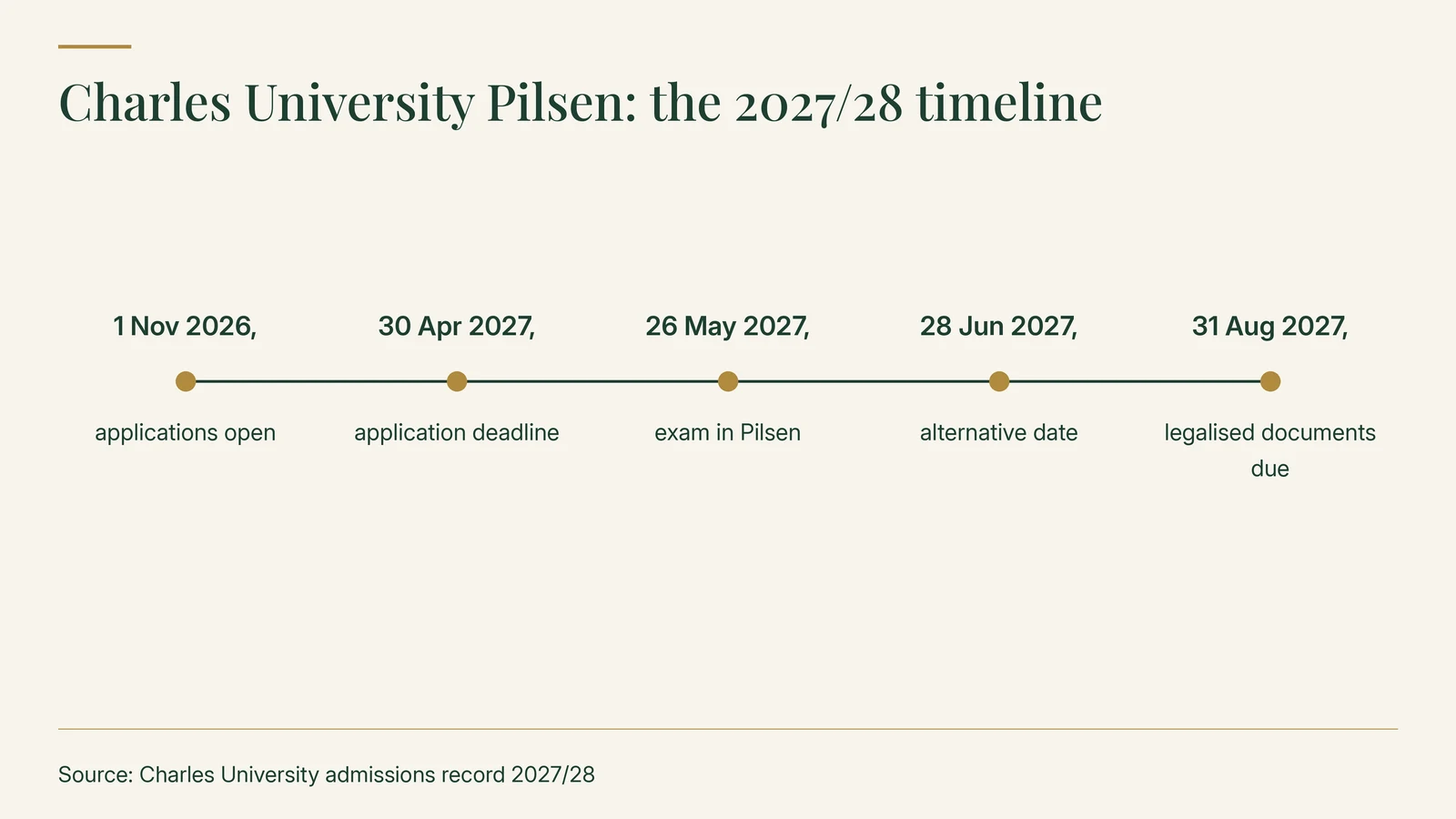
Pilsen publishes no single official Call document. The binding sources are the faculty's own admission page and the programme's 2027/2028 admission criteria in Charles University's admissions system (records 36043 and 36042), both read on 11 October 2026: they give the application period, both Pilsen sittings, the 60-question paper, the 9-point minimum and the fees stated here. The cooperating agencies' dates abroad were still marked TBA. IvyTest re-checks lfp.cuni.cz and updates this guide when they appear.
Structure
Charles University Pilsen Entrance Exam format
Three science subjects (Biology, Chemistry and Physics), 20 questions each and 60 in total for 2027/28, as the faculty's admission page and the programme's 2027/28 admission criteria state (the 2026/27 criteria gave 25 each, 75 in all). Every subject is compulsory: there is no optional track and nothing to choose between. Every live question has exactly one correct answer worth one point, and you need at least 9 points in each subject. The official sample tests are the same length, 20 questions each, but also include open-response items. The one thing the faculty does not publish is how long you get.
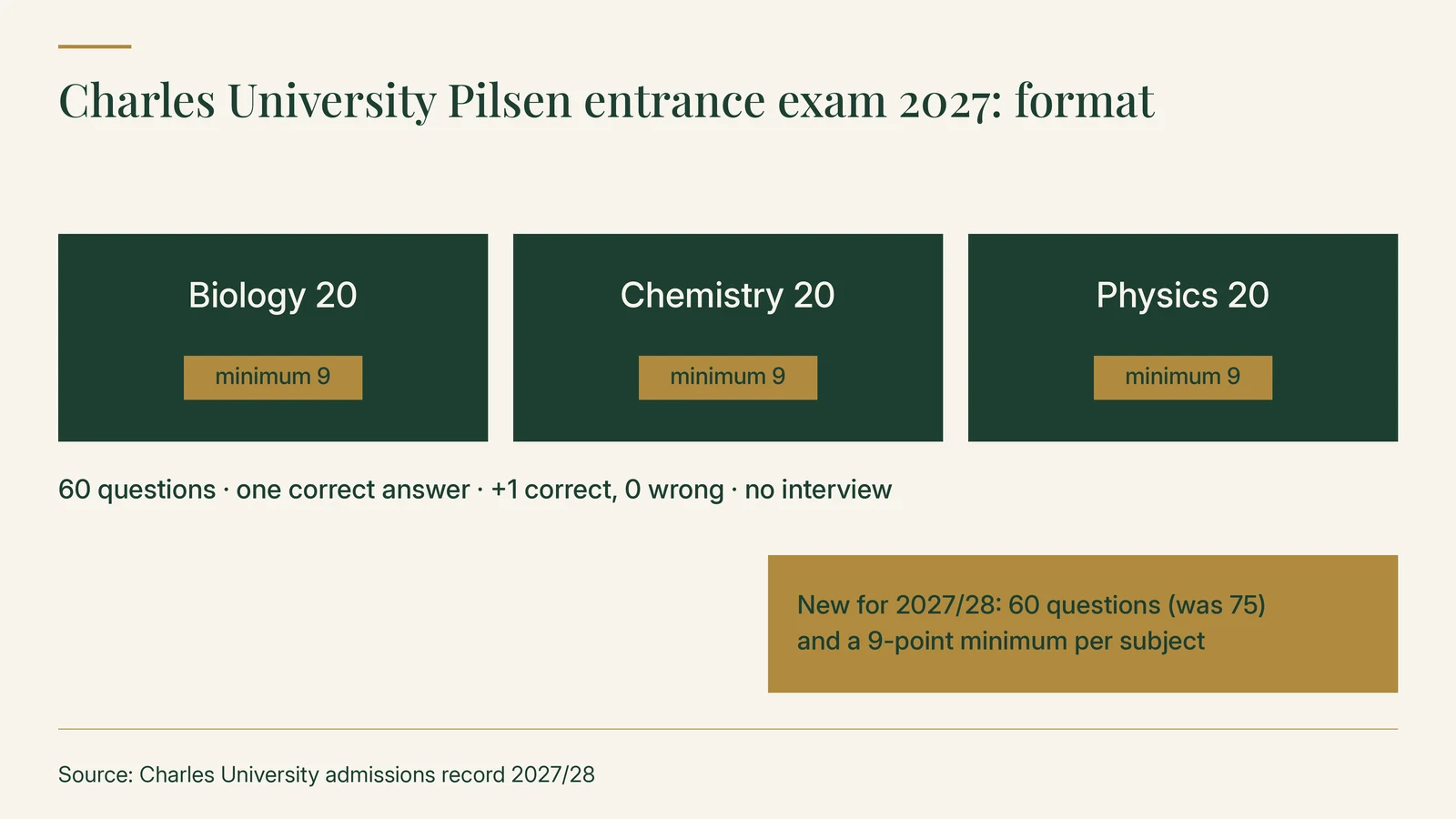
| Section | Questions | Weighting | Suggested time |
|---|---|---|---|
| Biology | 20 | One third (20 of 60) | *see the note below the table |
| Chemistry | 20 | One third (20 of 60) | *see the note below the table |
| Physics | 20 | One third (20 of 60) | *see the note below the table |
- No duration is published for the examination as a whole, and no per-subject time limit is stated anywhere
Content
Question and subject breakdown
Three subjects of 20 questions each, and no non-science component at all. The faculty's own syllabus page divides each subject into a handful of named areas (four in Biology, two in Chemistry, five in Physics), and those official divisions are preserved in the syllabus below even where the finer grouping is IvyTest's own.
Biology
One third (20 of 60 questions)Officially divided by the faculty into General and Cell Biology, Genetics and Heredity, Human Biology, and Ecology. In practice that runs from landmark figures and classification through cell structure, transport and energetics, the cell cycle, gene expression and medical genetics, then a long stretch of human anatomy and physiology across the musculoskeletal, circulatory, respiratory, digestive, excretory, endocrine, nervous and sensory systems, closing with ecology. The sample paper is entirely text-based with no figures, and rewards terminology precision as much as recall.
Chemistry
One third (20 of 60 questions)Officially divided into General and Inorganic Chemistry, and Organic Chemistry and Biochemistry. Atomic structure and radioactivity, the mole and stoichiometry, bonding and intermolecular forces, the periodic table and main groups, inorganic nomenclature and oxidation states, solutions and concentration, reaction types and redox, acids and pH, then organic structure and isomerism, functional groups, heterocycles and amines, and the biomolecules. Roughly half the sample items are calculations or open-response tasks: balancing an equation, naming a compound, drawing a structural formula.
Physics
One third (20 of 60 questions)Officially divided into Units and Quantities, Mechanics, Thermodynamics, Electricity and Magnetism, and Optics and Acoustics. Unit awareness and dimensional analysis run through the whole paper rather than sitting only in the first area. Gravitation is examined alongside forces and rotation. The sample supplies its own table of physical constants for calculation items, which is a strong hint about how much of this subject is numerical rather than descriptive.
Marks
Charles University Pilsen Entrance Exam scoring
The official sample answer keys list correct answers and nothing more, but the faculty's admission page and the programme's 2027/28 admission criteria in Charles University's admissions system settle the rule: there is always only one correct answer, it is worth one point, and there are no penalties for mistakes. A wrong answer and a blank are therefore worth the same, nothing, so leaving a question empty can only cost you. New in the 2027/28 criteria, admission also needs at least 9 points in each of Physics, Chemistry and Biology. What stays unpublished is the time limit and the total needed for admission, which the Dean sets according to the anticipated number of admitted students.
- Correct answer
- +1 point
- Incorrect answer
- 0 points (no penalties in case of mistakes)
- Unanswered question
- 0 points, the same as a wrong answer
- Open-response items
- Present in all three sample papers: definitions, calculations, balancing and naming tasks. The admission criteria describe every live question as having one correct answer, so how such items would be marked is not published
- Maximum possible score
- 60 points (20 per subject)
- Minimum eligible score
- No fixed total is published: the Dean sets the number of points required for admission according to the anticipated number of admitted students
- Per-subject floors
- At least 9 points in each of the three subjects, out of 20, under the 2027/28 admission criteria: admission is conditional on reaching that floor in every subject and the Dean's total
Worked example
Work the numbers under the published +1 / 0 / 0 rule and one unit point matters: a mark and a question are the same thing, so 'six more marks' and 'six more items right' are identical statements, which is not true of every exam in this catalogue and is worth not assuming elsewhere. Take the 2027/28 paper: 60 questions, 20 per subject. Suppose you answer 41 correctly, get 10 wrong and leave 9 untouched. You score 41 out of 60, about 68%, and the nine blanks cost you exactly what the ten wrong answers cost you, nothing extra. Now look at those nine blanks. If they are four-option items, a completely blind guess returns (1/4 × 1) + (3/4 × 0) = +0.25 marks each, so answering all nine adds about 2 marks in expectation and takes you to roughly 43 out of 60, about 72%: four percentage points of the total, bought with no extra knowledge. The 9-point floor makes the same arithmetic count per subject: a subject left at 8 of 20 keeps you out however strong the other two are. If instead they are open-response items (name this compound, balance this equation), there is nothing to guess between and the expected return of scribbling is genuinely zero. That asymmetry is why the open-response practice in the samples is worth doing: the guessing floor that protects you on the multiple-choice half does not exist on the other half, which is precisely why the open-response topics are the ones worth learning properly rather than recognising.
The IvyTest simulator scores every practice paper against these exact rules.
See the Charles University Pilsen Entrance Exam simulatorSyllabus
Full Charles University Pilsen Entrance Exam syllabus
The faculty publishes a syllabus page naming the official areas of each subject, and every one of those areas is preserved below. The finer breakdown within them comes from an unofficial compilation of that page together with the three official sample tests, so treat the boundaries between topics as IvyTest's mapping rather than as faculty headings. Nothing here has been added to what the official areas cover.
The faculty's own four areas are General and Cell Biology, Genetics and Heredity, Human Biology and Ecology. The sample paper is entirely text-based, with no figures anywhere.
- Foundations and classification: the landmark figures and what each is attached to: Hooke, van Leeuwenhoek, Schleiden, Purkyně, Harvey, Vesalius, Malpighi, Mendel, Darwin, Pasteur, Koch, Fleming, Morgan, Watson and Crick, Röntgen; taxonomy and the biological species, taxonomy of vertebrates and of humans, the hierarchy of living systems, acellular, unicellular and multicellular organisation, Darwinian evolution, variability, mutation, selection, genetic drift, gene flow, prebiotic and cellular evolution, the milestones of human evolution
- Cell structure: cell theory and cell size, prokaryotic versus eukaryotic cells, plant versus animal cells, the chemical composition of the cell including proteins, nucleic acids, saccharides and lipids, nucleus, mitochondria, endoplasmic reticulum, Golgi apparatus, lysosomes, ribosomes, centrioles, cytoskeleton, chloroplasts and other plastids, biomembranes, and surface specialisations such as microvilli
- Transport and cell energetics: diffusion, osmosis, active transport, endocytosis, pinocytosis and phagocytosis, photosynthesis, cellular respiration, glycolysis and oxidative phosphorylation, and why photosynthesis and respiration are complementary at both cellular and ecosystem level
- Cell cycle, mitosis and meiosis: the phases of the cell cycle and their regulation, the phases of mitosis, regulation and errors of mitosis, the phases and biological significance of meiosis, and the comparison of mitosis with meiosis by purpose, number of divisions, daughter cells and genetic variation
- Chromosomes and gene expression: the human karyotype, chromosome structure and classification, gamete maturation and sex determination, the structure and function of nucleic acids, intranuclear and extranuclear DNA, the RNA types and where RNA is synthesised, DNA replication, transcription, translation, the genetic code, genome, chromosome and gene structure, and the regulation of gene expression
- Inheritance and medical genetics: genotype and phenotype, dominant and recessive alleles, homozygous and heterozygous states, complete and incomplete dominance, codominance, Mendel's laws, linkage and gene interactions, gene, chromosomal and genomic mutations with their causes and consequences, autosomal dominant and recessive traits, sex-linked inheritance and pedigree logic, multifactorial traits, medically important chromosomal abnormalities, and the links to hereditary disease and cancer
- Tissues, blood and immunity: epithelial, connective, muscular and nervous tissue, ectoderm, endoderm and mesoderm differentiation, total body water, extracellular and intracellular fluid, plasma composition, erythrocytes, leukocytes and thrombocytes with their functions and counts, blood volume, haematocrit, the ABO and Rh systems, agglutination, agglutinogens and agglutinins, transfusion and the universal donor and recipient, and B lymphocytes and antibody defence
- Musculoskeletal and integumentary systems: the axial and appendicular skeleton, bone structure and development, osteoblasts and periosteum, joints and articulations, cartilage and chondrocytes, skeletal muscle structure and fasciae, motor units and the contraction mechanism, and the skin with its sebaceous, sweat and ceruminous glands
- Circulation and respiration: the location of the heart, its chambers, valves and conduction system, heart rate and its control centre, the pulmonary and systemic circulations and where each begins and ends, arteries, veins and capillaries, blood pressure, the lymphatic system, lymph nodes and spleen, the conducting passages and lungs, ventilation, gas transport, and external and internal respiration and gas exchange
- Digestive, excretory and endocrine systems: the organs and glands of the digestive tract, the liver and bile, nutrients and vitamins, the digestion and absorption of carbohydrates, proteins and fats, the functions of the urinary system, urine production and composition, kidneys, ureters, bladder and urethra, the classification of glands and the nature of hormones, adenohypophysis and neurohypophysis, thyroid, parathyroids, pancreas, adrenals and gonads with their principal hormones
- Nervous and sensory systems: neurons and neuroglia, peripheral nerves, the somatic and autonomic divisions, spinal cord, brainstem, pons, midbrain, medulla oblongata, cerebellum, diencephalon and cerebral hemispheres, reflexes, excitability, resting and action potentials, synapses, and smell, taste, skin perception, the eye, the vestibular apparatus and hearing
- Ecology: the scope and definition of ecology, the hierarchy from organism through species, populations, communities, ecosystems and biomes to the biosphere, biodiversity, habitat, biotope and niche, biotic and abiotic factors, population, community and ecosystem ecology, food chains and food webs, trophic levels, producers, consumers and decomposers, and atmospheric composition and terminology
The faculty's two official areas are General and Inorganic Chemistry, and Organic Chemistry and Biochemistry. Roughly half the sample items are calculations or open-response tasks, and one item shows a ring structure as a figure.
- Atomic structure and radioactivity: the definition of the atom, atomic number and mass number, protons, neutrons and electrons with their charges, masses and locations, electron configurations, isotopes and isotones, radioactivity and radioactive decay, and atomic, molecular, molar and relative mass
- Amount of substance and stoichiometry: molar mass, the mole, the Avogadro constant, particle counting, the relationships among mass, molar mass, amount and number of particles, unit conversions, stoichiometric calculation, and balancing equations by conservation of atoms
- Chemical bonding and intermolecular forces: the strong bonds (covalent, ionic and metallic) and the weak interactions (hydrogen bonds, Van der Waals forces and hydrophobic interactions); intermolecular forces in solids, liquids and gases, and hydrogen bonding in biological molecules
- The periodic table and main groups: the arrangement of the table, periods and groups, element symbols, electron configurations and periodic properties, hydrogen and the alkali metals, the alkaline-earth metals, the boron and carbon groups, the nitrogen family, chalcogens, halogens and noble gases, valence electrons, the important compounds of each group and the biological relevance of key elements
- Inorganic nomenclature and oxidation states: oxides, hydroxides, inorganic acids, halides, sulphides, cyanides, nitrates, sulphates, hydrogen carbonates, phosphates and hydrides, naming compounds from formulas and writing formulas from names, assigning oxidation states in neutral compounds and in ions, and building ionic formulas by balancing cation and anion charge
- Mixtures, solutions and concentration: solute and solvent, solubility, mass fraction, molarity and mass concentration, dilution, dissociation, electrolytes and nonelectrolytes, suspensions and emulsions, sedimentation and stability, and density, mass and volume relationships including conversions between g/cm³ and kg/m³
- Chemical reactions, kinetics and redox: synthesis, decomposition, single and double replacement, condensation and hydrolysis reactions, the factors affecting reaction rate, catalysts, the equilibrium constant, redox reactions, oxidising and reducing agents, and balancing redox equations
- Acids, bases and pH: protolytic reactions, acids, bases and amphoteric compounds, hydrogen ion concentration and pH, strong versus weak acids and bases, pH calculation for strong monoprotic acids, neutralisation, titration and dissociation constants
- Organic structure and isomerism: molecular, empirical and structural formulas, the valence of carbon, hydrogen, oxygen, nitrogen and the halogens, saturated and unsaturated hydrocarbons, aliphatic and aromatic compounds, single and multiple bonds, isomerism, optical activity with levorotary and dextrorotary rotation and the R/S and D/L terminology, and the common halogen derivatives
- Functional groups and derivatives: thiols, alcohols, phenols, ethers, aldehydes, ketones and quinones, mono-, di- and tricarboxylic acids, salts, esters, amides, anhydrides, acid halides and nitriles, fatty acids such as palmitic, stearic and oleic acid, and naming and recognising each group with its typical reactions
- Heterocycles, amines and amino acids: furan, imidazole, indole, purine, pyridine, pyrimidine, pyran and pyrrole and their relevance to nucleic acids and biomolecules, amine nomenclature and the primary, secondary and tertiary classification, choline, epinephrine, norepinephrine, dopamine, serotonin and histamine, and amino acid formulas, classification, properties and reactions
- Biomolecules: saccharides and their D and L enantiomers, reactivity and the key mono-, di- and polysaccharides, lipids, triacylglycerols, phospholipids, steroids, cholesterol, lecithin and sphingomyelin, proteins and their primary, secondary, tertiary and quaternary structure, nucleic acids with bases, nucleosides, nucleotides and complementary base pairing, DNA and RNA, and the vitamins
The faculty's five official areas are Units and Quantities, Mechanics, Thermodynamics, Electricity and Magnetism, and Optics and Acoustics. Gravitation is folded in with forces and rotation, and the sample paper supplies its own table of constants for calculation items.
- Units, quantities and dimensions: the SI, CGS and MKS systems, base and derived SI units, the common prefixes, conversions of length, area, volume and density, the density of water, expressing derived units such as Pa, N, J, W, C, V and the ohm in base units, scalar and vector quantities, and checking a formula through its dimensions
- Linear motion: uniform linear motion, distance, time and velocity, the distinction between speed and velocity, accelerated motion, free fall, acceleration and gravitational acceleration, the conversion of km/h to m/s, and position, velocity and acceleration calculations
- Forces, rotation and gravitation: Newton's laws, force as a vector, momentum and impulse, mass and weight, torque, uniform circular motion, frequency and angular frequency, centripetal acceleration, Newton's law of universal gravitation, gravitational force, the gravitational constant and the dependence on distance
- Work, power and energy: work and energy with their SI units, mechanical work calculations, power in mechanical and electrical form, mechanical efficiency, mechanical energy, kinetic energy, gravitational potential energy and changes in it
- Fluids: the ideal liquid, pressure and hydrostatic pressure, Pascal's principle, atmospheric pressure, Archimedes' principle and buoyant force, volume, mass and density, flow and the continuity equation, Bernoulli's law, viscosity, laminar and turbulent flow, and surface tension
- Thermodynamics and heat: thermodynamic systems, states and processes, the Celsius and Kelvin scales, absolute zero, normal body temperature, the first and second laws of thermodynamics, the ideal gas law and the gas constant, isobaric, isothermal and isochoric processes, the laws of Boyle, Charles, Avogadro and Gay-Lussac, thermal expansion and contraction, heat, heat capacity, specific heat capacity and its units, and calorimetry
- Electrostatics and capacitance: electric charge and its units including the ampere-hour, electrostatic attraction and repulsion, the electron and proton charge, Coulomb's law, electric field intensity, potential and potential difference, capacitance, parallel-plate capacitors, and capacitors in series and parallel
- Current electricity and circuits: electric current and its SI unit, Ohm's law, current, voltage and resistance, resistors in series and in parallel, cells connected in series and in parallel, electric power and the relation between power, current and voltage, and everyday appliance calculations
- Magnetism, induction and alternating current: Faraday's law of electrolysis and the Faraday constant, magnetic force, permeability, magnetic flux and flux density, the magnetic field and Ampère's rule, electromagnetic induction, Faraday's and Lenz's laws, Fleming's rule, alternating current, effective current and voltage, AC power, impedance, inductance and transformers
- Light, optics and photons: the properties of light, speed, wavelength, spectrum and frequency, visible, ultraviolet and infrared light, photon energy from frequency, the photoelectric effect and the particle theory of light, reflection, refraction, refractive index, Snell's law and the critical angle, mirrors and lenses, refractive power, the lens and imaging equations, magnification, interference, polarisation, luminous intensity, luminous flux, illumination and the optics of the eye
- Sound and acoustics: the production, control, transmission, reception and effects of sound, frequency, wavelength and the speed of sound, sound pressure and sound pressure level, intensity and intensity level, the human hearing range, noise, pitch, loudness, timbre, sonic texture and spatial location, and ultrasound above 20 kHz and infrasound below 20 Hz
Test your Charles University Pilsen Entrance Exam knowledge
Take free diagnosticDifficulty
How difficult is the Charles University Pilsen Entrance Exam?
Pilsen's examination is not built to trick anyone. What makes it demanding is that it is three full science syllabi rather than one, that part of it cannot be answered by recognition, and that the faculty publishes so little about its mechanics that candidates routinely prepare against numbers nobody has confirmed.
Three science subjects, no reasoning component to fall back on
Biology, Chemistry and Physics are all compulsory and all the same size, 20 questions each, each with its own 9-point minimum. There is no logic, reading-comprehension or general-reasoning block anywhere in this paper, which means there is nothing on it that rewards being generally quick rather than specifically prepared. Every mark on offer has a syllabus behind it.
Part of the paper cannot be guessed at all
A substantial minority of items across all three sample papers are open-response: write the definition, balance the equation, name the compound, do the calculation and state the answer. In the Chemistry sample that is 6 of its 20 items (about 30%). On a four-option multiple-choice item a blind guess is worth about +0.25 marks under the published no-penalty rule; on an open-response item it is worth nothing. The admission criteria describe every live question as having one correct answer, but the samples are the best official guide to the recall the faculty expects.
Physics here is a subject, not a flavour
Charles University's First Faculty in Prague has no Physics section and folds physics-style reasoning into a General Science block. Pilsen runs Physics as a full third subject with its own five-area syllabus, its own sample paper and its own table of constants: mechanics, fluids, thermodynamics, electricity, magnetism, optics and acoustics. A candidate who prepared from an LF1 syllabus would arrive with a third of this exam essentially unrevised.
Nobody can tell you how long you get
The faculty states no time limit. IvyTest re-read its admission page, the three official sample-test PDFs and the 2027/28 admission criteria on 11 October 2026 and found no duration anywhere; the 90-minute figure circulating online has no traceable source behind it. Practising to a self-imposed clock is still the right call, but treat any specific timing advice you find elsewhere, including the pacing implied by a 90-minute assumption, as somebody's guess.
A floor in every subject, but no published total
The 2027/28 admission criteria set a floor of 9 points out of 20 in each subject, so one weak science can cost you the place on its own. Beyond that there is no published cut-off: the criteria leave the total needed to the Dean, according to the anticipated number of admitted students. That makes the only sensible target a comfortable margin across all three subjects rather than a number, and it makes any specific percentage quoted elsewhere somebody's estimate rather than a faculty statement.
Benchmarks
What is a good Charles University Pilsen Entrance Exam score?
There is a floor but no total to aim at. IvyTest re-read the faculty's admission page and the programme's 2027/28 admission criteria directly on 11 October 2026: the criteria state the scoring rule (one point per correct answer, no penalties) and a minimum of 9 points in each subject, but no time limit and no total pass mark, because the Dean sets the points needed for admission according to the anticipated number of admitted students.
The published rule settles the one question that matters on the day: wrong answers are not penalised, so every question should be answered. The admission line itself moves with capacity: for 2027/28 the faculty expects to admit 105 General Medicine students, and in the past academic year 99 of 298 applicants were admitted, as Charles University's admissions records give them. Treat any specific percentage quoted elsewhere as somebody's estimate rather than a faculty figure.
What you can do instead is make your own results comparable. Score full three-subject mocks as a raw count out of the total attempted and as a percentage per subject, and watch the three curves separately. Because the live paper weights Biology, Chemistry and Physics equally, an imbalance in any one of them costs the same as an imbalance in either of the others, so the useful preparation target is the weakest of your three subject percentages climbing, not your overall average.
Pending verification
- · Historical admission thresholds by year
- · The duration of the examination
- · The total number of points needed for admission, which the Dean sets each year
- · How open-response items, if any appear on the live paper, would be marked
These specific numbers aren't public yet — an IvyTest simulator score is the closest benchmark you can get today.
Check your Charles University Pilsen Entrance Exam scoreStrategy
How to prepare for the Charles University Pilsen Entrance Exam
12+ weeks
Three sciences at equal depth, and practice that includes writing answers out
Even coverage of Biology, Chemistry and Physics, with open-response work built in from the start.
- Sit a full three-subject diagnostic in week one and score each subject separately. The 2027/28 paper is 20 questions per subject with a 9-point minimum in each, so a weakness in Physics costs exactly what a weakness in Biology costs: there is no subject here that can be traded off against another.
- Give Physics real calendar time from the beginning. It is a full third of this examination with its own five-area syllabus, and candidates arriving from a Prague-faculty syllabus most often have it as their thinnest subject.
- Practise producing answers, not selecting them. At least once a week, work a set of items closed-book with no options visible (balance the equation, name the compound, state the definition), because a substantial minority of the official sample items are exactly that.
- Build Chemistry calculation fluency by hand: stoichiometry, dilution, pH of a strong monoprotic acid, density conversions. Roughly half the Chemistry sample is calculation or open-response, and the samples supply constants rather than assuming a calculator.
8 weeks
Repair the weakest science while the other two stay warm
Targeted repair across three equal subjects, with the open-response format practised weekly.
- Diagnostic first, then put the largest share of your time into whichever of the three subjects scores lowest, not into the one you enjoy most. All three carry the same weight on the live paper.
- Keep all three subjects on a weekly rotation rather than blocking them one at a time; the real paper mixes them and there is no reading or reasoning section to give you a mental reset between sciences.
- One full three-subject mock a week from week two, reviewed the same day, with every wrong or blank answer logged by cause: content gap, misread question, or arithmetic slip.
- Set your own clock and keep it constant. The faculty publishes no duration, so pick a working time limit, write it down, and hold every mock to the same one so your results are comparable to each other even if not to the real paper.
4 weeks
Full three-subject sittings, with nothing left blank on the multiple-choice half
Volume of timed mocks across all three sciences, plus closed-book recall drills.
- Two full three-subject mocks a week, scored as a raw count and as three separate subject percentages.
- Drill the high-frequency open-response tasks specifically: inorganic naming both ways, balancing by conservation of atoms, oxidation-state assignment, unit conversion and dimensional checks. These are learnable in days and they appear throughout the Chemistry and Physics papers.
- Answer every four-option item. With no penalty for mistakes a blind guess is worth about +0.25 marks and a blank is worth 0, so a blank on a multiple-choice item is a decision to accept the worse outcome.
- Rehearse the practical setup: in person, in English, working from the printed table of constants rather than a remembered one.
Under 4 weeks
Consolidate what produces answers, not what produces recognition
Triage across three equal sciences, weighted to whatever your mocks show weakest.
- Stop adding new content. Consolidate the highest-frequency areas in all three subjects, giving the most time to whichever is currently weakest: they carry identical weight.
- Spend the recall time on things you must be able to write from blank: nomenclature, equation balancing, the standard formulas of mechanics and optics, the definitions the Biology sample keeps asking for.
- Sit at least two full three-subject mocks in the final ten days, then taper.
- Check the faculty's admission-procedure page yourself before the exam. It is where the sample tests and the sitting dates live, and it is the page that will carry a duration if one is ever published.
Get your personalised Charles University Pilsen Entrance Exam study plan
Take free diagnosticExplore the full Charles University Pilsen Entrance Exam planPractice
Free Charles University Pilsen Entrance Exam practice questions
Three questions in the format the exam uses. Choose an answer to see the explanation — nothing is recorded.
150 mL of a 0.40 mol/L sodium hydroxide solution is diluted with water to a final volume of 600 mL. What is the concentration of the diluted solution?
A 6.0 Ω resistor and a 3.0 Ω resistor are connected in parallel. What is the equivalent resistance of the combination?
Illustrative examples written by IvyTest to show the question style — not past Charles University Pilsen Entrance Exam papers.
Past papers
Charles University Pilsen Entrance Exam past papers
The Faculty of Medicine in Pilsen publishes no past papers. Its admission page links three free sample tests as PDFs, one each for Biology, Chemistry and Physics: 20 questions apiece, the same length as each subject on the 2027/28 paper, most with four options A to D and some open-response (a definition, a balanced equation, a compound name), with the solutions at the end of each file. The same page gives the full syllabus of each subject and a short list of A-level study guides. IvyTest's free practice paper, with every answer explained, follows the live format.
University
Charles University, Faculty of Medicine in Pilsen medicine admissions
The entrance examination sits inside a wider application, and the figures below describe the English-taught programmes at the Faculty of Medicine in Pilsen. Charles University's other four Czech medical faculties set their own fees, calendars and exams entirely independently: nothing here transfers to Prague or Hradec Králové.
- Degree
- General Medicine (English-taught), 6-year MUDr
- Dentistry
- English-taught too, five years to the MDDr. degree, and admitted through the same 60-question examination: 28 places for 2027/28
- Language of instruction
- English
- Campus
- Faculty of Medicine in Pilsen, Czech Republic: a new campus beside University Hospital Pilsen in Lochotín, completed in 2022
- Tuition
- CZK 390,000 / year for 2027/28 (about €15,800–16,000, converted at approximately 24.5 CZK to the euro); Dentistry CZK 410,000. First-year students pay in full by bank transfer before enrolment, with no instalments
- Application fee
- CZK 1,000 online (about €41) in Charles University's 2027/28 admissions records; the faculty's page gives CZK 990
- Interview
- Not required; the written examination is the whole of the selection
- English certificate
- Not required: the faculty's four listed requirements are the online application, the entrance examination, proof of secondary education and tuition
- Motivation letter
- Not required
- Recommendation letters
- Not required
- Document requirements
- A notarised copy of your school-leaving certificate, legalised (apostille or superlegalisation) where your country requires it, with an official translation into Czech or English unless it is in Czech, English or Slovak; hard copies only, by post or in person, by 31 August 2027
- Czech language in clinical years
- Not stated on the pages IvyTest read: practical training in hospitals and GP offices runs from year 2, and besides Latin every student must pass an examination in English and one more foreign language
- Cost of living
- No monthly total published; the faculty's Life in Pilsen page lists a university dorm at €160 a month, a private dorm at €500, a university meal at €4 and a public-transport card at €12 a month
- Seats available
- 105 in General Medicine for 2027/28; in the past academic year 99 of 298 applicants were admitted
- High-school document assessment fee
- CZK 1,050 for 2027/28 (CZK 990 on the faculty's older High School Documents page), paid only once you have passed the entrance examination and decide to study at the Faculty, and only if an assessment is needed: not for a nostrification, the IB, the European Baccalaureate or a school-leaving certificate automatically equivalent in Czechia (Slovakia, Poland, Hungary, Slovenia)
- Medical certificate
- At enrolment: a certificate of medical fitness to study and of vaccination against hepatitis B and measles on the form in Dean's Measure No. 5/2026; the fitness certificate must be no more than six months old at enrolment
IvyTest Charles University Pilsen Entrance Exam preparation
Ready to prepare properly for the Charles Pilsen entrance exam?
Everything above is free and always will be. When you want structure (a syllabus-mapped book covering Biology, Chemistry and Physics at the depth this faculty's own topic list implies, a simulator that runs the real four-option format, lessons for the gaps your results flag, and help with the application itself), that is what the IvyTest Charles Pilsen package is.
Study guide
All three sciences at equal depth, built on the faculty's own official subject areas.
Exam simulator
Timed mocks in the real four-option format across Biology, Chemistry and Physics, with per-question explanations and per-subject analytics.
Video courses
Focused lessons in biology, chemistry and physics for the topics your results flag, including the calculation work the Chemistry and Physics papers lean on.
Application support
MedApply: deadlines, documents, legalisation and enrolment steps carried through to a confirmed place.
FAQ
Charles University Pilsen Entrance Exam frequently asked questions
Three compulsory science subjects, Biology, Chemistry and Physics, 20 questions each and 60 in total for 2027/28, every one with a single correct answer worth one point. It is the written test the Faculty of Medicine in Pilsen uses for its English-taught General Medicine and Dentistry. The faculty's syllabus splits Biology into four areas, Chemistry into two and Physics into five; there is no logic or reading section.
Neither. There is no national Czech medical entrance test, and Charles University's five medical faculties run structurally different papers. Pilsen runs Biology, Chemistry and Physics; the First Faculty in Prague has no Physics section at all and examines Biology, Chemistry and General Science; the Second Faculty runs four sections including Logic; the Third Faculty runs only Biology and Chemistry. Hradec Králové is closest to Pilsen in subject matter but lets candidates choose Mathematics instead of Physics and weights that third subject at only 10 of 60 marks. Preparation built for one faculty does not transfer cleanly to another.
In person, in English: in Pilsen or at a sitting run by one of the faculty's cooperating agencies abroad. The 2027/28 admission criteria allow an online test only with the Dean's approval, in cases of force majeure or a serious medical condition, requested through your application in the SIS. The official sample papers supply their own table of physical constants for calculation items, which is a fair indication of what you can expect to be given on the day.
One point for each correct answer, and no penalties in case of mistakes: that is stated on the faculty's admission page and in the programme's 2027/28 admission criteria, even though the sample answer keys list correct answers only. A blind four-option guess is therefore worth about +0.25 marks while a blank is worth 0, so there is no question worth leaving empty, least of all in a subject close to the 9-point minimum.
Unknown. IvyTest re-checked the faculty's admission page, the three official sample-test PDFs and the programme's 2027/28 admission criteria in full on 11 October 2026 and none of them states a time limit. A 90-minute figure circulates online with no traceable source behind it, so it should not be treated as a faculty figure. Practise to a self-imposed limit and keep it constant so your own results stay comparable.
At least 9 of the 20 points in each of Biology, Chemistry and Physics, a minimum new in the 2027/28 admission criteria, and then the total the Dean sets according to the anticipated number of admitted students. That total is not published in advance and no figure appears on the faculty's own site, so aim for a comfortable margin in all three subjects rather than a number.
The live paper is: the admission criteria say there is always only one correct answer, worth one point. The official sample papers are not, though. Most sample items give four options A to D, but a substantial minority are open-response (short definitions, calculations, balancing equations and naming compounds), including 6 of the Chemistry sample's 20 items (about 30%). They are worth working as recall practice, because producing an answer is a stronger test of knowledge than picking one.
English. The programme is English-taught and the official sample tests are in English throughout. No Czech is required to sit the entrance examination. During the degree, practical training in hospitals and GP offices runs from the second year, and besides Latin every student must pass an examination in English and one more foreign language.
For 2027/28 Charles University's admissions records list 105 General Medicine places and 28 in Dentistry. In the past academic year 99 of 298 General Medicine applicants and 27 of 87 Dentistry applicants were admitted, about 33% and 31%. For 2026/27 the records had listed about 90 General Medicine places (at most 105) and 14 in Dentistry (at most 24).
Within the EU, yes: automatically, as a standard Czech medical degree. There's no separate national licensing exam afterwards: the Czech state exam (státní rigorózní zkouška) is built into the MUDr degree itself, and registration with the Czech Medical Chamber (ČLK) is compulsory to practise in the country. Outside the EU recognition isn't automatic as a rule, but the UK is an exception. Under the Medical Act 1983 (section 21B, as in force on 12 October 2026), a Czech medical degree (MUDr.) is a 'relevant European qualification', so a graduate who applies to the GMC with one, whatever their nationality, is not asked to show the knowledge and skills other international graduates prove through PLAB/UKMLA; evidence of English is still required, and the rule is UK policy that can change. US-bound graduates need ECFMG certification via USMLE Step 1 and Step 2 CK, the same requirement every international medical graduate faces.
Yes. The IvyTest simulator runs Pilsen-format practice across Biology, Chemistry and Physics in the real four-option format, in timed, tutor and review modes, with a free diagnostic available without payment. Because part of the official sample papers is open-response, use the simulator alongside closed-book recall work rather than instead of it.
The faculty publishes no past papers. Its admission page links three free sample tests as PDFs, one each for Biology, Chemistry and Physics, 20 questions apiece with the solutions at the end: most items have four options A to D, some are open-response. The same page sets out the full syllabus of each subject and a short list of A-level study guides as recommended books.
Applications for 2027/28 run from 1 November 2026 to 30 April 2027, online with the application fee, and later applications are not accepted. The exam is held in Pilsen on 26 May 2027, with an alternative date on 28 June 2027; the cooperating agencies' sittings abroad run from May to August, dates still to be announced. Results follow within a week, and enrolment is in July and September 2027.
The faculty lists four: an online application by the deadline, the entrance exam, proof of secondary education with a school-leaving examination, and the tuition fee. The faculty's list of requirements includes no English certificate, interview or motivation letter. Admitted students send their legalised and translated school documents by 31 August 2027 and, at enrolment, a medical certificate with proof of hepatitis B and measles vaccination. You may apply once per academic year, and transfers are not accepted.
Tuition for 2027/28 is CZK 390,000 a year for General Medicine and CZK 410,000 for Dentistry, paid in full before enrolment, with no instalments for first-year students. The application fee is CZK 1,000 in Charles University's admissions records (CZK 990 on the faculty's page), and the school-document assessment CZK 1,050. It is not an MBBS: General Medicine leads to the MUDr. degree after six years, Dentistry to the MDDr. after five.
Six years. The first two cover theoretical subjects such as Anatomy, Histology, Embryology, Biophysics, Biochemistry and Physiology; years 3 and 4 the preclinical ones, among them Pathological Anatomy, Pathological Physiology, Microbiology, Immunology and Pharmacology, with bedside teaching from year 3; the last two years are wholly clinical. Practical training in hospitals and GP offices runs from year 2, and the campus beside University Hospital Pilsen has a Simulation Center.
The faculty quotes no QS or other ranking position for itself, and IvyTest has not checked any ranking table. Its own pages say it is one of Charles University's five medical faculties, that Charles University is among the top 1.5% of universities in the world and one of the oldest in Europe, and that it moved in 2022 to the most modern medical campus in the country. It was founded in 1945 and has around 2,000 students, 500 of them from abroad.
IvyTest publishes no student reviews of its own. What the faculty publishes about student life is on its Life in Pilsen page: a city 50 minutes from Prague and from Germany, a university dorm at €160 a month, a private dorm at €500, a university meal at €4 and a public-transport card at €12 a month. Its Facebook, Instagram and YouTube channels and its student associations are linked from every page of its site.
The science is at school-leaver level (the faculty recommends A-level study guides), but three full subjects with no logic or reading section to lean on, a 9-point minimum in each 20-question subject, open-response items in the official samples and an unpublished time limit make it demanding. In the past academic year 99 of 298 General Medicine applicants were admitted, about one in three.
Yes: r/CharlesPilsen, where Charles University, Faculty of Medicine in Pilsen applicants ask each other about the Charles University Pilsen Entrance Exam and share how their preparation is going. It is run by the IvyTest team. Dates, rules and results come only from the university's own pages, listed under Official sources on this page.
Verification
Official sources
- All you need to know to apply (admission procedure, 2027/2028)Checked: 12 October 2026
Charles University, Faculty of Medicine in Pilsen
- Official entrance examination sample test: BiologyChecked: 11 October 2026
Charles University, Faculty of Medicine in Pilsen
- Official entrance examination sample test: ChemistryChecked: 11 October 2026
Charles University, Faculty of Medicine in Pilsen
- Official entrance examination sample test: PhysicsChecked: 11 October 2026
Charles University, Faculty of Medicine in Pilsen
- Admission-procedure syllabus page (Biology, Chemistry and Physics subject areas)Checked: 12 October 2026
Charles University, Faculty of Medicine in Pilsen
- General Medicine (English), admission criteria 2027/2028Checked: 12 October 2026
Charles University admissions system
- Dentistry (English), admission criteria 2027/2028Checked: 12 October 2026
Charles University admissions system
- General Medicine (English), admission criteria 2026/2027Checked: 11 October 2026
Charles University admissions system
- Dentistry (English), admission criteria 2026/2027Checked: 11 October 2026
Charles University admissions system
- Types of High School Documents and their assessmentChecked: 12 October 2026
Charles University, Faculty of Medicine in Pilsen
- Courses in English (General Medicine and Dentistry, concept of study)Checked: 11 October 2026
Charles University, Faculty of Medicine in Pilsen
- Why Faculty of Medicine in PilsenChecked: 11 October 2026
Charles University, Faculty of Medicine in Pilsen
- About faculty (history, students, campus)Checked: 11 October 2026
Charles University, Faculty of Medicine in Pilsen
- Life in Pilsen (student costs)Checked: 11 October 2026
Charles University, Faculty of Medicine in Pilsen
- Medical Act 1983, section 21B: registration with a relevant European qualification, without the knowledge test, for applications made since IP completion day (Brexit)Checked: 12 October 2026
legislation.gov.uk (The National Archives)
- Directive 2005/36/EC on the recognition of professional qualifications, consolidated text of 29 October 2025, Annex V point 5.1.1 (Czechia: the MUDr. diploma in general medicine, no accompanying certificate)Checked: 12 October 2026
Publications Office of the European Union (EUR-Lex)
- Evidence of qualifications from the Czech RepublicChecked: 12 October 2026
General Medical Council (GMC)
Last reviewed by IvyTest editorial team: 16 October 2026. Admission rules change every cycle — always confirm against the official Charles University, Faculty of Medicine in Pilsen call for applications before acting on a deadline.
Find out how ready you are for the Charles Pilsen entrance exam.
The diagnostic takes one sitting and returns a subject-by-subject picture of where you stand across Biology, Chemistry and Physics, no payment, no commitment.