
In a healthy person, glucose that has been filtered at the glomerulus is almost entirely returned to the blood. Where does this happen, and by what mechanism?
Exam guide · Updated for 2027 admissions
Charles University Third Faculty of Medicine Entrance Exam 2027: Complete Preparation Guide
Everything you need to know about the Third Faculty of Medicine, Charles University entrance exam (LF3, the 3rd Faculty of Medicine in Prague): the two-part structure, the official syllabus and sample test, scoring, the interview, the 2027 dates and application deadline, fees, preparation strategy and practice.
Applying to more than one Charles faculty? Compare all five →
Updated for 2027 admissions · Last updated: 16 October 2026
Charles University LF3 Entrance Exam at a glance
Overview
What is the Charles University Third Faculty of Medicine entrance exam?
The Third Faculty of Medicine (LF3) sets its own entrance examination for its English-taught General Medicine programme in Prague. There is no shared national Czech admission test behind it, and Charles University's five medical faculties each write their own paper; LF3's is the narrowest of the three Prague faculties by subject list and the only one that tests just two subjects.
The written part is 60 questions: 30 Biology and 30 Chemistry, weighted exactly equally, with four options per question and exactly one correct answer. Each question is worth one point, so the written part scores between 0 and 60. There is no Physics section, no logic or reasoning block, and no general-knowledge component. The expected level corresponds to the Czech grammar-school framework, and the test is taken electronically on the applicant's own laptop or other device.
Admission runs in two parts. The written test does not admit anyone on its own: the Dean sets the minimum number of points needed to proceed to the second part on the basis of that year's first-part results, and the second part is a separately scored interview worth 12 to 62 points, covering interpretation of a popular-scientific text, general overview, independent judgement, communication skills, motivation and an evaluator recommendation. Two consequences follow, and they shape everything below: the number you need is not published because it does not exist until the cohort has sat the paper, and roughly half of what LF3 assesses is never touched by the written test at all.
Programmes that use the Charles University LF3 Entrance Exam
- General Medicine (English-taught, Prague)
Timeline
Charles University LF3 Entrance Exam 2027: dates and deadlines
When to expect your exam · 2027 start
- May 202728 MayPublished
- July 20271 JulPublished
Applications open 1 Nov 2026.
Dates the university has published for this cycle. See every university on the calendar →
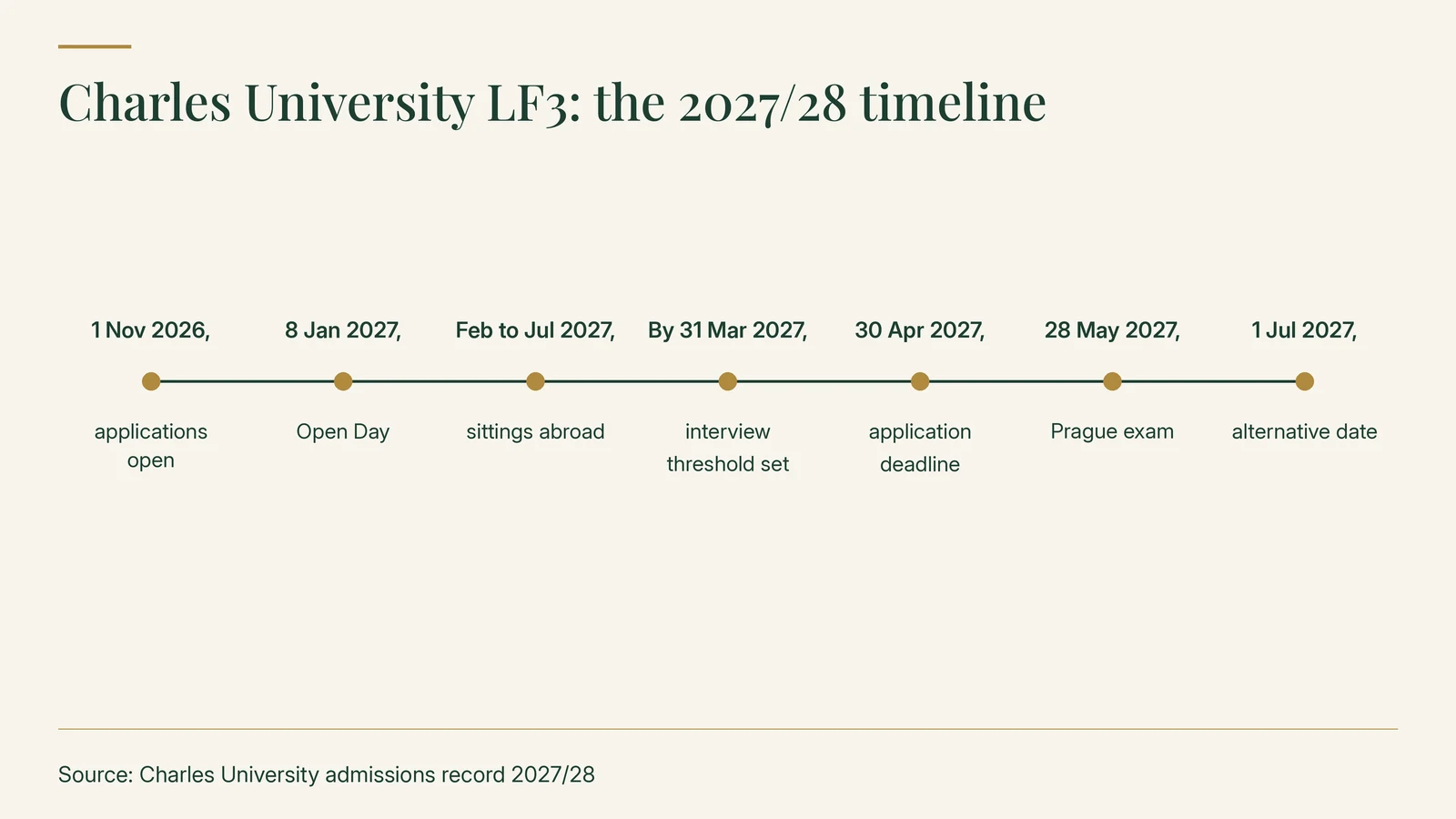
- Applications open1 November 2026
- Registration deadline30 April 2027
- Written test: Prague28 May 2027
- Written test: alternative date1 July 2027
- Interview (second part)Interview dates not yet announced; invitations follow the Dean's threshold decision on the first part, which the 2027/28 admissions record says the Dean sets no later than 31 March 2027, from the sittings held by then
- Enrolment deadline30 October 2027
LF3's official admissions pages were updated for the 2027/2028 cycle on 12 October 2026 and now give the same deadline, Prague dates, application fee and tuition as Charles University's admissions record for the programme, published in its admissions system, which also confirms the written test's structure, option count and 0–60 point range. Note also that LF3 publishes a separate Czech-language document for its Czech-medium programme describing a 90-question Biology, Physics and Chemistry paper; that is a different exam, and none of its figures apply to the English-taught test described here. IvyTest re-checks lf3.cuni.cz/3LFEN-819.html and the admissions record, and updates this guide when either changes.
Structure
Charles University LF3 Entrance Exam format
Two parts of 30 questions each, 60 in total, every question worth one point. Each carries four options, A to D, with exactly one correct answer, confirmed across all 60 items of LF3's official 2025 sample test. The one thing the table cannot give you is a time column: LF3 publishes no duration anywhere, so pacing per question cannot be derived from official material.
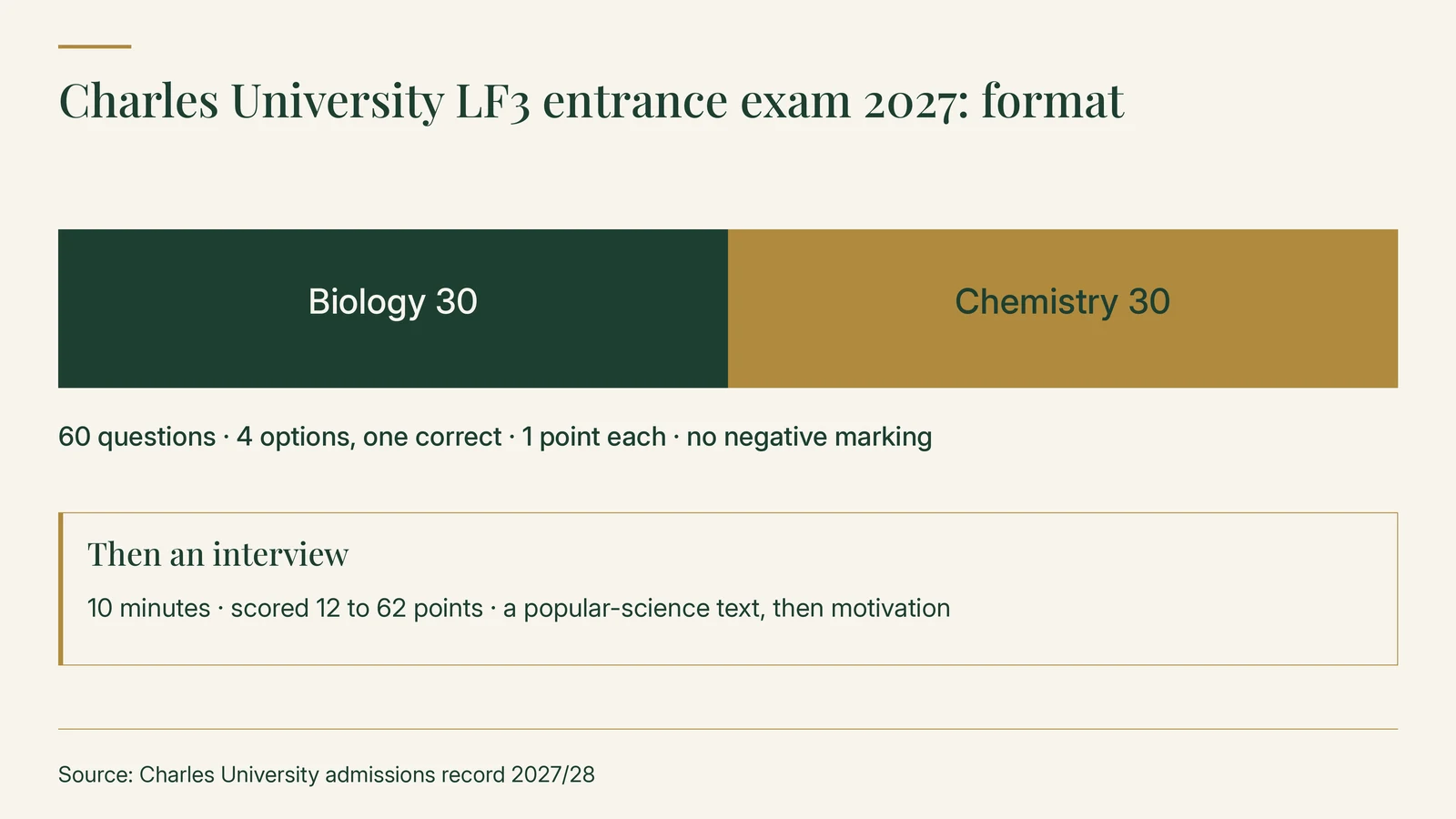
| Section | Questions | Weighting | Suggested time |
|---|---|---|---|
| Biology | 30 | 50% (30 of 60) | *see the note below the table |
| Chemistry | 30 | 50% (30 of 60) | *see the note below the table |
- LF3 publishes no time limit for the written test at all: not per section and not overall
Content
Question and subject breakdown
Two subjects, thirty questions each, exactly equal in weight. With no Physics, no reasoning section and no general-knowledge block, there is nowhere on this paper to offset a weak subject with a strong one: an even performance across both is worth more here than on any other Charles faculty's test.
Biology
50%LF3's official premedical Biology syllabus runs to forty numbered headings with no higher-level grouping, spanning living systems and bioenergetics, prokaryotes, viruses, eukaryotic cells, DNA and gene expression, the cell cycle, meiosis, classical and human genetics, genetic disorders and DNA technology, evolution, and then a long run of human anatomy and physiology system by system. In the official 2025 sample, human anatomy, physiology, development and nutrition was the single heaviest area, followed by genetics and the cell cycle.
Chemistry
50%The official syllabus splits into Part I General Chemistry (sixteen headings) and Part II Organic Chemistry and Biochemistry (twenty-three), covering atomic structure through bonding, states of matter, solutions, stoichiometry, kinetics, acids and bases, redox, then the full organic sequence and the biomolecules. Calculation items are frequent in the sample and every one of them has to be solvable without a calculator.
Marks
Charles University LF3 Entrance Exam scoring
Two things about LF3's scoring are published and one is not, and it is worth being precise about which is which. Published: every question is worth one point, and the written part scores from 0 to 60. Not published: whether a wrong answer carries a penalty. LF3 has never stated a marking rule for incorrect answers in any document IvyTest has been able to read, so what follows is flagged rather than asserted.
- Correct answer
- +1 point
- Written part score range
- 0 to 60 points (stated by LF3)
- Incorrect answer
- Not explicitly published. A stated floor of exactly 0, rather than a negative figure, across 60 one-point questions is what a no-penalty scheme produces, and a negative-marking scheme would need a floor rule LF3 has never issued. IvyTest assesses 0 points for a wrong answer as likely, not confirmed.
- Unanswered question
- Not explicitly published; assessed as 0 points on the same reasoning as an incorrect answer
- Answer format
- Single best answer: exactly one of the four options is correct, confirmed across all 60 items of the official 2025 sample
- Minimum eligible score
- No fixed value exists: LF3 states the Dean sets the minimum points to proceed to the second part on the basis of that year's first-part results
- Per-subject floors
- None. LF3 publishes no per-section minimum, and there is no Czech equivalent of the Italian per-subject OFA floors
- Interview (second part)
- 12 to 62 points, scored separately from the written test
- How the two parts combine
- Not published: LF3 describes the written test as the gate to the second part and the interview as separately scored, but states no rule for combining them into a final ranking
Worked example
Start with the part that is published: 60 questions at one point each. Suppose you answer 44 correctly. Your written score is 44 out of 60, or 73%. Now the part that is not published: whether the 16 you got wrong cost you anything. If the scheme is the no-penalty one IvyTest assesses as likely, a blind guess across four options is worth (1/4 × 1) + (3/4 × 0) = +0.25 points and a blank is worth exactly 0, so answering every question is strictly better than leaving any of them empty; on ten blind guesses you would expect about 2.5 free marks. Because that rule is inferred from LF3's stated 0–60 range rather than published, confirm it with the faculty before building a strategy on it. What the 44 actually buys you is the harder question. LF3 sets no fixed pass mark: the Dean fixes the threshold after the first part, from that year's results. If the faculty interviews roughly the top N candidates, the cut lands wherever the Nth-best score happens to fall, so the same 44 is comfortably through in a weak year and short in a strong one, on an identical paper. There is no number to aim at, only a position, and the position is not knowable until after you have sat the exam.
The IvyTest simulator scores every practice paper against these exact rules.
See the Charles University LF3 Entrance Exam simulatorSyllabus
Charles University Third Faculty entrance exam syllabus (LF3)
Both subjects have an official LF3 premedical syllabus and the content below is the syllabus's own; only the grouping into readable blocks is IvyTest's. One note on the source: the syllabus PDF's filename contains the word 'physics', but the document body and LF3's admissions page both describe the written test as Biology and Chemistry only, so no Physics section appears here.
Forty official headings, grouped below in the syllabus's own order. Human anatomy and physiology was the heaviest area of the official 2025 sample by some distance.
- Living systems and bioenergetics: characteristics of living systems (organisation, homeostasis, metabolism, growth, adaptation, response to stimuli, reproduction), the second law of thermodynamics, parthenogenesis and sexual reproduction, photosynthesis, cell respiration, glycolysis, the Krebs cycle, the electron transport chain, oxidative phosphorylation and fermentation
- Prokaryotes and bacteria: phylogenetic division and archaebacteria, genome organisation, bacterial shapes, cell wall composition including Gram-positive peptidoglycan, movement, growth of populations, transformation and conjugation, endospores, nutritional and metabolic diversity, nitrogen fixation, symbiosis, pathogenicity and bacteria in technology
- Viruses and non-cellular agents: division according to host, icosahedral models and capsid configuration, bacteriophage structure, virus classification and evolution, reverse transcription, reproduction, lytic and lysogenic cycles, latent viruses, tumour viruses, prions, heredity, disease and HIV infection
- Eukaryotic cells and membranes: nucleus, plasma membrane, endomembrane system and lysosomes, mitochondria and chloroplasts, centrosomes, cytoskeleton, flagella, actin filaments, muscle, cell surfaces and intracellular junctions, the fluid mosaic model, membrane proteins and carbohydrates, transport and osmosis
- DNA, chromosomes and replication: bacterial transformation, informational polymers, purines and pyrimidines, pentose, nucleotides and nucleosides, bonds between nucleotides, replication and DNA polymerase, euchromatin and heterochromatin, chromosome ultrastructure and condensation, sister and non-sister chromatids, karyotypes
- Gene expression and protein synthesis: transcription and translation, RNA structure and types, processing of the primary transcript, the genetic code, ribosomes and polyribosomes, aminoacyl-tRNA synthetases, protein structure and synthesis, regulation of gene expression and the differences between prokaryotes and eukaryotes
- Cell cycle and mitosis: the cell cycle and its phases, proliferating and resting cells, chromatid counts at each stage, the phases of mitosis, centrosomes and kinetochores, checkpoints, cyclins and CDKs, proto-oncogenes, tumour suppressor genes, carcinogenesis, signal molecules and signal transduction, ageing, apoptosis and necrosis
- Meiosis and gametogenesis: asexual and sexual reproduction, alternation of haploid and diploid phases, meiosis-mitosis differences, prophase I, synapsis, the synaptonemal complex, crossing over, the phases of both meiotic divisions, spermatogenesis and oogenesis, fertilisation, nondisjunction and anaphase lag, errors of fertilisation, gynogenesis and androgenesis
- Classical and bacterial genetics: the bacterial chromosome, transformation, transduction, conjugation, F and R plasmids, transposons, operons and positive and negative gene regulation, eukaryotic chromosomes and mitochondrial DNA, Mendel's pea characters, character and trait, monohybrid and dihybrid crosses, testcross, parental and filial generations, the laws of uniformity, segregation and independent assortment, Morgan's gene linkage and gene order from recombination frequencies
- Human genetics and cytogenetics: gene, allele and gene expression, heredity and variability, homozygous and heterozygous, genome and gene pool, genotype and phenotype, complete and incomplete dominance, codominance, ABO and Rh blood groups, structure and classification of chromosomes, the human karyotype, gamete maturation, sex determination in different species and Barr bodies
- Genetic disorders and DNA technology: gene mutations (substitution, deletion, insertion), autosomal and X-linked dominant and recessive traits, chromosome mutations (deletion, duplication, inversion, translocation), genome mutations (aneuploidy, trisomy, monosomy, polyploidy), genetic counselling and testing, carrier recognition, amniocentesis and chorionic villus sampling, newborn screening, PCR, sequencing, restriction digestion, reverse transcription, blotting and cloning
- Evolution and population genetics: conditions on early Earth, abiotic synthesis, the primordial soup and the Miller-Urey experiment, microspheres, liposomes and protobionts, the RNA world, evolution of prokaryotic metabolism, endosymbiotic theory and the phylogenetic tree, macro- and microevolution, Lamarck, Darwin and de Vries, mutation, recombination, gene duplication, horizontal transfer, natural and artificial selection, genetic drift, species and gene pools, the geological time scale, radiometric dating, taxonomy and cladistics, Hardy-Weinberg equilibrium, the five causes of microevolution, hominid evolution from Australopithecus to Homo sapiens, multiregional and monogenesis models and cultural evolution
- Human development and tissues: human specification, diblastic and triblastic organisation, protostomes and deuterostomes, types of coelom, vertebrates and mammals, genetic bases of development, morphogen gradients, ontogenesis, ectoderm, endoderm and mesoderm and the organs derived from each, differentiation, epithelial tissue, connective tissue (loose, fibrous, cartilage, bone, adipose, blood), muscle tissue (skeletal, cardiac, smooth) and nervous tissue (neurons and glia)
- Skeletal and muscular systems: structure and function of the skeleton, shapes of joints, the trunk framework and ribs, skeleton of the limbs and pelvis, skeleton of the head, bone cells and synthesis of the extracellular matrix, structure and function of muscle, muscles of the arm, leg, trunk and back, and frequent diseases of both systems
- Circulatory and respiratory systems: body fluids and the intracellular and extracellular compartments, vessels and heart, blood circulation and the origin of the great vessels, heart activity, blood pressure, the lymphatic system, spleen and nodes, external and internal respiration, gas exchange, larynx, vocal cords, trachea, bronchi, lungs, bronchioles and alveoli, positive and negative pressure breathing, tidal volume, vital capacity and residual volume, and frequent diseases
- Digestive system and nutrition: oral cavity, tongue, salivary glands and teeth, pharynx, oesophagus, stomach, small and large intestine, rectum and anus, pancreas, liver and gallbladder, digestion and absorption of carbohydrates, proteins and fats, hepatitis and other frequent diseases, nutritional requirements and essential nutrients, leptin and homeostatic mechanisms, overnourishment, undernourishment and malnourishment as distinct terms, metabolism of carbohydrates, proteins and fats, vitamins and minerals
- Excretory system and the internal environment: filtration, reabsorption and secretion, kidney, nephron, collecting duct and renal pelvis, ureter, urinary bladder and urethra, frequent diseases, thermoregulation by conduction, convection, radiation and evaporation, water and mineral balance, diffusion and osmosis, homeostasis of blood osmolarity, pressure and volume, and the nitrogenous wastes ammonia, urea and uric acid
- Skin and reproductive systems: epidermis and dermis, nerve endings, pain and touch receptors, sweat glands, body defence and thermoregulation, male reproductive anatomy (testis, epididymis, vas deferens, seminal vesicle, prostate), female reproductive anatomy (ovary, oviduct, uterus, vagina), embryonic and fetal development and frequent diseases
- Endocrine control: the endocrine glands and their hormones, chemical classes of hormones, hormone action and regulation, positive and negative feedback loops such as oxytocin and milk release, and homeostasis of blood calcium and blood glucose
- Nervous control and sense organs: central and peripheral nervous systems, somatic and autonomic divisions with sympathetic and parasympathetic branches, neuron structure and supporting cells including the glia lining the ventricles, sensory and motor neurons, reflexes, ganglia and nuclei, membrane and action potentials and ion permeability, electrical and chemical synapses, medulla oblongata, pons, cerebellum, midbrain, diencephalon, thalamus and hypothalamus, cerebral hemispheres, cortex, white matter, basal nuclei, corpus callosum, limbic system and the structural and functional areas of the cortex, mechanoreceptors, nociceptors, thermoreceptors, gustatory and olfactory chemoreceptors, and photoreceptors including accommodation of the lens
- Blood and the immune system: plasma and cellular elements (erythrocytes, leucocytes, thrombocytes), haematocrit and serum, haematopoiesis and its regulation by erythropoietin, blood clotting and haemophilia, the organs of the immune system, classification of leucocytes, non-specific and specific defence, and the cellular and humoral components
- Man and the environment: agricultural effects on nutrient cycling, accelerated eutrophication of lakes, biological magnification of toxins, carbon dioxide emissions and the greenhouse effect, depletion of atmospheric ozone, plus the broader ecosystem facts the official sample draws on at this point such as the composition of the atmosphere and the order of an ecological energy pyramid
Part I General Chemistry (sixteen headings) and Part II Organic Chemistry and Biochemistry (twenty-three), in the syllabus's own order. Calculations are frequent and must be solvable without a calculator.
- Atomic structure and the periodic table: atoms, atomic number, mass number, protons and neutrons, electron configuration, orbitals, the Pauli exclusion principle, Hund's rule, the Aufbau principle, the periodic law, representative, transition and inner transition elements, metals and non-metals, biologically important elements (macroelements, inorganic ions, trace elements), ionic compounds, the shapes, sizes and radii of ions, and the octet rule
- Chemical bonding and inorganic nomenclature: molecules and chemical bonds, covalent, polar covalent and ionic bonding, bond polarity and electronegativity, intermolecular attractive forces, naming and writing formulas of oxides, acids, bases and salts, charge balance in ionic formulas, oxidation states of common biological ions such as Fe(II) and Fe(III), and acid nomenclature families including the hypohalous acids
- States of matter and energy: physical quantities (mass, volume, temperature, time, amount of substance), density and specific gravity, kinetic and potential energy, chemical energy and conservation of energy, heat, specific heat and heat capacity, melting and boiling points, exothermic and endothermic reactions, the gaseous state, the pressure-volume-temperature relationship, the general gas law, Avogadro's principle, Dalton's law of partial pressures, the liquid state, dynamic equilibrium, vapour pressure, water and hydrogen bonds, surface tension, surfactants, the solid state and sublimation
- Mixtures, solutions and transport: heterogeneous and homogeneous mixtures, solutions, colloidal dispersions and suspensions, aqueous solutions, the product of solubility, solubility of gases, Henry's law, gas tension, diffusion, osmosis and dialysis
- Stoichiometry and concentration: quantitative relationships in chemical reactions, the mole concept, percentage concentration, molar concentration, conversion between concentration units, preparing dilute solutions from concentrated ones, balanced equations and stoichiometry, grams of solute required for a given volume and molarity, the concentration of a particular ion in solution, and conversions between micromoles, millimoles and moles per litre
- Equilibrium and reaction kinetics: chemical equilibrium and the shifting of equilibrium, Le Chatelier's principle, reaction kinetics, the Guldberg-Waage law, catalysts and their effect on activation energy as distinct from the equilibrium constant, and rate of reaction
- Acids, bases and pH: electrolytes, the Arrhenius and Brönsted theories, strong and weak acids and bases, conjugate acid-base pairs, salts and the product of solubility, the pH concept, the ionic product of water and the ion concentrations at neutrality, acid ionisation constants, buffers, acid-base titration, neutralisation products, the pH change on dilution, and the effect of dissolved carbon dioxide on the pH of water
- Redox reactions: oxidation-reduction equilibria, the oxidation number, identifying which species is oxidised and which is reduced, balancing redox equations, and reduction potentials
- Foundations of organic chemistry: classification into hydrocarbons and their derivatives, valence of carbon, oxygen, hydrogen, nitrogen, sulfur and the halogens, alkyl, aryl and aromatic compound, constitution, conformation and configuration, saturated and unsaturated hydrocarbons, functional groups, cyclic hydrocarbons, single and multiple bonds, sigma and pi electrons, primary, secondary and tertiary carbon, molecular, empirical and structural formulas, structural isomerism and stereoisomerism (optical and geometrical cis-trans), reaction types (substitution, addition, elimination, rearrangement), nomenclature with its prefixes and suffixes, systematic and common names, and the priority of functional groups
- Hydrocarbons and arenes: alkanes, alkenes and alkynes, their physical and biological properties, occurrence and reactivity (oxidation, halogenation, reduction, addition, polymerisation), common names such as ethylene, acetylene, chloroform and vinyl chloride, and arenes: planar rings, delocalised pi electrons, aromaticity and reactivity compared with alkenes, plus the common names benzene, phenyl-, toluene, benzyl-, the o-, m- and p-xylenes, naphthalene, anthracene, phenanthrene, pyrene, biphenyl and styrene
- Alcohols, carbonyls and sulfur compounds: alcohols and phenols (naming, primary, secondary and tertiary, monofunctional and polyfunctional, dehydration, oxidation, esterification, and the common names glycerol, phenol, cresols, hydroquinone, pyrocatechol and benzyl alcohol), ethers and epoxides, thiols, sulfides and disulfides including formation of a disulfide bond on oxidation, aldehydes and ketones (oxidation, reduction, addition of water, alcohols and nitrogen compounds, keto-enol tautomerism, aldol condensation, and the common names formaldehyde, acetaldehyde, benzaldehyde, glyceraldehyde, acetone, dihydroxyacetone, quinones and phenones), and the effect of these groups on water solubility
- Carboxylic acids and derivatives: naming, structure and classification as saturated, unsaturated, monocarboxylic and dicarboxylic, the terms acyl, anion, alpha-carbon and omega-carbon, common names of the C1-C4, C16 and C18 monocarboxylic acids and the C2-C5 dicarboxylic acids, fumaric, maleic, oleic, linoleic, linolenic, arachidonic and benzoic acid, substitutional derivatives (lactic, malic, pyruvic, oxaloacetic, 2-oxoglutaric, citric and salicylic acid), functional derivatives (salts, anhydrides, esters, amides, halides and nitriles), sulfonic acids and carbonic acid derivatives (urea, phosgene, guanidine)
- Amines, nitro compounds and heterocycles: heterocyclic compounds and their structures (pyrrole, indole, pyridine, pyrimidine, purine, imidazole, furan, pyran), amines (naming, classification as primary, secondary and tertiary amines and quaternary ammonium, physical and biological properties, diazotation, and the common names aniline and choline), and nitro compounds
- Biomolecules: nucleic acids (purine and pyrimidine bases, nucleosides and nucleotides, keto-enol tautomerism, complementary base pairing, hydrogen, N-glycosidic, phosphoester and phosphodiester bonds, the structure of DNA and RNA and the types of RNA), proteins (proteinogenic amino acids and their classification and properties, isoelectric point, chiral carbon and functional-group count, primary to quaternary structure, the peptide -CO-NH- arrangement, denaturation, classification and functions), lipids and terpenes (fatty acids, triacylglycerols, phospholipids, sphingolipids, steroids and cholesterol, transport of poorly soluble molecules by protein carriers, isoprene), saccharides (mono-, oligo- and polysaccharides, Fischer, Tollens and Haworth projections, oxidation, reduction, esterification and glycosylation, ketose-aldose and pyran-furan isomerism, alpha and beta anomers, epimers, D and L enantiomers, glucose, fructose, galactose, mannose, ribose, deoxyribose, sucrose, lactose, maltose, starch, glycogen and cellulose), and the anhydride bond hydrolysed when ATP becomes ADP and phosphate
Test your Charles University LF3 Entrance Exam knowledge
Take free diagnosticDifficulty
How difficult is the Charles University LF3 Entrance Exam?
The content of LF3's written test is ordinary school biology and chemistry at Czech grammar-school level. What makes the exam awkward to prepare for is how much about it is unstated, and how much of the admission decision sits outside the paper entirely.
There is no published time limit
IvyTest read LF3's official admissions page in full on 21 September 2026 and it states no duration (not per section, not overall), and a 'three hours' figure circulating elsewhere could not be corroborated in either PDF linked from the faculty's own pages. You therefore cannot derive a per-question pace from official material, which is a real preparation problem: the only sensible response is to practise the same 60-question paper at more than one pace rather than train a single rhythm that may not match the day.
The pass mark is generated after you sit the paper
LF3 states that the Dean sets the minimum number of points needed to proceed to the second part on the basis of that year's first-part results. That is not an unpublished number; it is a number that does not exist in advance. The threshold is whatever that cohort produces, so a score that comfortably qualified one year can fall short the next on an identical paper.
Everything is plain text, including the chemistry
The official 2025 sample test contains no figures at all (no diagrams, no graphs, no reaction schemes), and even organic structures are written inline as text, in the form CH3-CH2-NH-CH3 or HOOC-CH(NH2)-CH2-SH. Anatomical and structural questions are posed in words too. Reading a molecule off a line of characters, quickly and without sketching it, is a specific skill this paper demands and most textbook practice never builds.
Chemistry calculations, by hand, at a third of the block
Calculation items are frequent in the official sample and every one of them has to be solvable without a calculator: molarity, dilution, mass of solute for a given volume, unit conversions between micromoles, millimoles and moles per litre, pH, and balancing redox equations. Acids, bases, pH, redox, kinetics and calculations together made up roughly a third of the sample's chemistry questions.
Half the assessment is not on the paper
The written test is a gate; the second part is a separately scored interview worth 12 to 62 points, assessing interpretation of a popular-scientific text, general overview, independent judgement, communication skills, motivation and an evaluator recommendation. Almost none of that is examined by 60 biology and chemistry multiple-choice questions, and LF3 does not publish how the two scores combine into a final ranking.
Benchmarks
What is a good Charles University LF3 Entrance Exam score?
LF3 publishes no cutoff, and on a full re-read of its official admissions page on 21 September 2026 it explains exactly why: the Dean sets the minimum number of points to proceed to the second part on the basis of the results of the first part. The number is cohort-relative and retrospective by design.
This makes LF3 different from an exam that simply has not released its threshold yet. There is no figure being withheld. If the faculty invites roughly the top N written scores to interview, the cut settles wherever the Nth-ranked candidate lands, which depends entirely on who else applied that year and how they performed. Any specific pass mark quoted elsewhere is somebody's reconstruction of a past cohort, not a rule you can prepare against.
The more useful signal during preparation is your own trajectory on full 60-question mocks, tracked separately for Biology and Chemistry, since the two are exactly equal in weight and there is no third section to compensate. One further caution when comparing figures found elsewhere: LF3 also publishes a Czech-language document for its Czech-medium programme describing a 90-question Biology, Physics and Chemistry paper with its own Dean-set threshold. That is a different exam from the English-taught 60-question test, and its numbers do not transfer.
Pending verification
- · The Dean's threshold to proceed to the second part, by year
- · How many first-part candidates are invited to the interview
- · Whether the written and interview scores are combined in the final ranking, and how
- · How many candidates apply for the 90 places of 2027/28
These specific numbers aren't public yet — an IvyTest simulator score is the closest benchmark you can get today.
Check your Charles University LF3 Entrance Exam scoreStrategy
How to prepare for the Charles University LF3 Entrance Exam

12+ weeks
Two subjects, equal weight, no weak half
Biology and Chemistry in parallel at 30 questions each, with no third section to hide behind.
- Sit a full 60-question diagnostic in week one and score Biology and Chemistry separately. They are worth exactly the same, so whichever is weaker is the one that decides your total.
- Work Biology against LF3's own syllabus order: it runs from living systems and bioenergetics through microbiology, cell and molecular biology, genetics and evolution, and then system by system through human anatomy and physiology, which was the heaviest area in the official 2025 sample.
- Build calculator-free chemistry arithmetic from the first week: molarity and dilution, mass of solute for a given volume, micromole-to-millimole conversions, pH, and balancing redox equations. These recur throughout the sample and none of them may be done with a calculator.
- Practise reading organic structures written inline as text, in the sample's own style (CH3-CH2-NH-CH3 rather than a drawn skeleton), because that is how every structural question is posed.
8 weeks
Repair the weaker subject before polishing the stronger
Balanced coverage, with the official sample's weightings as a guide to emphasis.
- Diagnostic first, then put the larger share of the next four weeks into whichever of the two subjects scores lower: a 60-point paper split evenly has no way to carry an imbalance.
- In Biology, prioritise human anatomy and physiology and then genetics and the cell cycle; in Chemistry, prioritise the acids, bases, pH, redox, kinetics and calculations cluster alongside organic chemistry and functional groups. Those were the heaviest areas of the official 2025 sample.
- One full 60-question mock a week from week two, reviewed the same day, with every miss logged as a content gap, a misread question or an arithmetic slip.
- Because no time limit is published, run your mocks at two different paces (a comfortable one and a deliberately tight one), so neither comes as a surprise.
4 weeks
Full 60-question sittings, plain text throughout
Volume of timed papers in the real format.
- Two full 60-question mocks a week, with no diagrams, no calculator, and organic structures written inline exactly as the official sample writes them.
- Drill the chemistry calculation types by hand until they are automatic rather than derived: concentration, dilution, stoichiometric mass, unit conversion, pH.
- Review each mock against both halves separately. A 44 built from 26 Biology and 18 Chemistry is a very different result from a balanced 22 and 22, and only one of them tells you where to spend the next week.
- Answer every question. If LF3's scheme is the no-penalty one IvyTest assesses as likely, a blind four-option guess is worth +0.25 and a blank is worth 0, but confirm the marking rule with the faculty, since it has never been explicitly published.
Under 4 weeks
Shore up the weaker subject, then prepare the interview
Triage across two equal halves, plus the second part.
- Stop adding new topics. Consolidate the highest-frequency areas in whichever subject your mocks show weaker; with only two subjects, that is where the marks are.
- Spend a session purely on calculator-free chemistry arithmetic; it is the most recoverable category of mark on this paper in a short window.
- Sit at least two full, scored 60-question mocks in the final ten days, then taper.
- Reserve real time for the second part. The interview is worth 12 to 62 points and assesses interpretation of a popular-scientific text, general overview, independent judgement, communication and motivation, none of which the written paper rehearses.
Get your personalised Charles University LF3 Entrance Exam study plan
Take free diagnosticExplore the full Charles University LF3 Entrance Exam planPractice
Free Charles University LF3 Entrance Exam practice questions
Three questions in the format the exam uses. Choose an answer to see the explanation — nothing is recorded.
A 0.01 mol/L solution of hydrochloric acid is diluted with water to ten times its original volume. What is the pH of the diluted solution?
LF3's sample papers write organic structures inline as text. To which class does the compound CH3-CH2-NH-CH3 belong?
Illustrative examples written by IvyTest to show the question style — not past Charles University LF3 Entrance Exam papers.
Past papers
Charles University LF3 Entrance Exam past papers
LF3 publishes no archive of past papers. Its Entrance exam page links three free PDFs under Sample questions: the premedical syllabus of Chemistry and Biology, last year's sample test (the 2025 paper: 30 Biology and 30 Chemistry questions, four options and one correct answer each, all in plain text) and its key, a one-page scanned answer grid. Its Prospects and documents page also points to the premedical course's study materials, lecture handouts from 2016. IvyTest's free practice paper, with every answer explained, follows the live format.
University
Charles University, Third Faculty of Medicine medicine admissions
The written test is the first of two parts, and the second carries a 50-point range of its own. The figures below describe the English-taught General Medicine programme at the Third Faculty of Medicine; Charles University's other four Czech medical faculties set their own fees, calendars and exams independently.
- Degree
- General Medicine (English-taught)
- Language of instruction
- English
- Campus
- Prague Campus, Third Faculty of Medicine
- Tuition
- CZK 440,000 / year (about €18,000) for 2027/28 entrants, in Charles University's admissions record and on LF3's own pages (it was CZK 420,000 for 2026/27). Due by 30 October; students in a difficult financial situation can ask to pay in several instalments on a repayment schedule
- Application fee
- CZK 2,000 (about €82) for 2027/28; it was CZK 940 for 2026/27
- Interview
- Yes: a separately scored second part worth 12 to 62 points
- Expected level
- Corresponds to the Czech grammar-school framework
- English certificate
- Not required: LF3 asks first-year applicants for the school-leaving certificate, a transcript and a passport copy; a C1 English certificate is required only of transfer applicants
- Motivation letter
- Not required as a document, but motivation is one of the criteria scored at interview
- Recommendation letters
- Not required as a document, but an evaluator recommendation is one of the criteria scored at interview
- Document requirements
- Legalisation and certified translation required; apostille depends on the issuing country
- Cost of living
- No verified Prague cost-of-living figure yet; IvyTest's Czech city research has not reached Prague
- Seats available
- 90 for 2027/28, as for 2026/27; in the past academic year 92 of 548 applicants were admitted, about 17%
- Application process
- Apply through the LF3 admissions portal; sit the written test, then attend the second-part interview if the Dean's first-part threshold is met
- Admission without the entrance exam
- Possible: LF3 admits at most the best 25 applicants on qualifying A-level, IB, SAT-type or German school-leaving results, or a science or health bachelor's degree. For 2027/28 the request must be posted by 30 April 2027
IvyTest Charles University LF3 Entrance Exam preparation
Ready to prepare properly for the Charles LF3 entrance exam?
Everything above is free and always will be. When you want structure (a book mapped to LF3's own premedical Biology and Chemistry syllabuses, a simulator that runs the real 60-question, four-option, plain-text format, lessons for the gaps your results flag, and help with the application itself), that is what the IvyTest Charles LF3 package is.
Study guide
Both subjects at equal depth, organised against LF3's own premedical syllabus headings.
Exam simulator
Timed 60-question mocks in the real 4-option, plain-text format (organic structures inline, no diagrams, no calculator) with per-subject analytics.
Video courses
Focused lessons in biology and chemistry, including the calculator-free calculation types the sample leans on.
Application support
MedApply: deadlines, documents, legalisation, interview preparation and enrolment steps carried through to a confirmed place.
FAQ
Charles University LF3 Entrance Exam frequently asked questions
It's the two-part admission process the Third Faculty of Medicine uses for its English-taught General Medicine programme in Prague. The first part is a 60-question written test: 30 Biology and 30 Chemistry, four options each, one point per question, scored 0 to 60. The second part is a separately scored interview worth 12 to 62 points.
Neither. There is no shared national medical entrance test in the Czech Republic, and Charles University's five medical faculties run structurally different papers. LF3 is the only one of the three Prague faculties that tests just two subjects: the First Faculty runs Biology, Chemistry and General Science across 75 questions, and the Second Faculty runs four sections including Physics and Logic. Preparation built for one does not transfer cleanly to another.
No. The English-taught written test is Biology and Chemistry only. This is worth checking carefully against anything you read elsewhere, because LF3's syllabus PDF has the word 'physics' in its filename while the document body and the admissions page both describe a two-subject test, and because LF3 publishes a separate Czech-language document for its Czech-medium programme that does describe a 90-question paper including Physics. That is a different exam.
LF3 does not say. IvyTest re-read the faculty's official admissions page in full on 7 October 2026, with Charles University's 2027/28 admissions record and the 2025 sample test, and none of them gives a time limit for the written test (the only duration LF3 states is the interview's 10 minutes), and a '3 hours' figure that circulates on third-party sites could not be corroborated in either PDF linked from LF3's own pages. Rather than print a number the university has never published, we leave it unverified, and recommend practising the same 60-question paper at more than one pace.
It is an electronic test taken on the applicant's own laptop or other device, in Prague or at a partner agency's sitting abroad. For 2027/28, Charles University's admissions record adds that sittings abroad may be online, with the first round then run by the testing company Scio on questions the faculty supplies, and the faculty itself running the second round. Practically, that means your equipment is part of your preparation. The expected level of knowledge corresponds to the Czech grammar-school framework.
Each question is worth one point and the written part scores from 0 to 60; that much LF3 states directly. Whether a wrong answer carries a penalty is not stated anywhere. IvyTest assesses a no-penalty scheme as likely rather than confirmed, on the reasoning that a stated floor of exactly 0 across 60 one-point questions is what a no-penalty scheme produces, while a negative-marking scheme would need a floor rule the faculty has never issued. If that assessment is right, a blind four-option guess is worth +0.25 points and there is no reason to leave anything blank, but confirm the rule with the faculty rather than taking it as settled.
There is no fixed pass mark, and this is a design choice rather than an omission. LF3 states that the Dean sets the minimum number of points needed to proceed to the second part on the basis of that year's first-part results, and the points required for admission according to the expected number of admissions, so the threshold is produced by the cohort after the exam, not published before it. There are also no per-subject floors; LF3 has no equivalent of the per-subject minimums used by some Italian medical schools.
An interview scored from 12 to 62 points, covering interpretation of a popular-scientific text, general overview, independent judgement, communication skills, motivation and an evaluator recommendation. It lasts 10 minutes in all: five criteria in a text round and six in an interview round, each scored 1 to 5, plus each evaluator's recommendation scored 1 to 7. It is scored separately from the written test. LF3 does not publish how the two scores are combined in the final ranking, so we leave that unverified rather than assuming they are summed.
None at all. The official 2025 sample test contains no figures: every item, including anatomical and structural questions, is posed as plain text, and organic structures are written inline in the form CH3-CH2-NH-CH3 or HOOC-CH(NH2)-CH2-SH. Practising from diagram-heavy material leaves that specific reading skill untrained.
LF3 expects to admit 90 students for 2027/28, as for 2026/27. Charles University's 2027/28 admissions record reports that 92 of 548 applicants were admitted in the past academic year, an acceptance rate of about 17%; the 2026/27 record gave 90 of 436, about 21%. Up to 25 places can go to applicants admitted without the exam, and the threshold to reach the interview is set from that year's results, which makes the competition explicitly relative to the cohort.
Within the EU, yes: automatically, as a standard Czech medical degree. There is no separate national licensing exam afterwards: the Czech state exam is built into the MUDr degree itself, and registration with the Czech Medical Chamber (ČLK) is compulsory to practise in the country. Outside the EU recognition isn't automatic as a rule, but the UK is an exception. Under the Medical Act 1983 (section 21B, as in force on 12 October 2026), a Czech medical degree (MUDr.) is a 'relevant European qualification', so a graduate who applies to the GMC with one, whatever their nationality, is not asked to show the knowledge and skills other international graduates prove through PLAB/UKMLA; evidence of English is still required, and the rule is UK policy that can change. US-bound graduates need ECFMG certification via USMLE Step 1 and Step 2 CK, the same requirement every international medical graduate faces.
Yes. The IvyTest simulator runs LF3-format practice (60 questions, 30 Biology and 30 Chemistry, four options with one correct answer, in the plain-text style of the official sample) in timed, tutor and review modes, with a free diagnostic available without payment.
LF3 publishes no archive of past papers, but its Entrance exam page links three free PDFs: the premedical syllabus for Chemistry and Biology, last year's sample test (the 2025 paper: 30 Biology and 30 Chemistry questions, four options each) and its key, a one-page scanned answer grid. Its Prospects and documents page also points to the premedical course's study materials, lecture handouts from 2016.
Charles University's admissions record for 2027/28 sets the application deadline at 30 April 2027, also the day by which a request to waive the exam must be posted. The written test is in Prague on 28 May 2027, with an alternative date on 1 July 2027, and sittings abroad, some possibly online, run from February to July 2027. Applications open on 1 November 2026, according to LF3's How to apply page; the interview dates are not yet published.
Secondary education completed with a school-leaving examination, an online application with its fee (CZK 2,000 for 2027/28), and the entrance exam unless you qualify for the waiver: A-levels of A, A, B in English, Chemistry and Biology, 19 points in Higher Level IB Chemistry, Biology and English, or similar results taken in 2025/26 or later. Once admitted you post an authenticated, translated school-leaving certificate, a transcript and a passport copy, and pay CZK 990 for its recognition. No English certificate is asked of first-year applicants.
Tuition is CZK 440,000 a year (about €18,000) for students starting in 2027/28, according to Charles University's admissions record and LF3's own pages; it was CZK 420,000 for 2026/27. It is due by 30 October, and students in a difficult financial situation can ask to pay in instalments. The application fee is CZK 2,000 for 2027/28 and the recognition of a foreign school certificate CZK 1,050. LF3 publishes no living-cost estimate; its optional Premedical Course costs CZK 125,000.
Six years, taught in English since 1991/92 alongside the Czech programme and leading to the MUDr. (M.D.) degree. LF3's integrated curriculum runs in three cycles: basic biomedical sciences in years 1 and 2, principles of clinical medicine in years 3 and 4, and clinical preparation in years 5 and 6, with an emphasis on preventive care. Students must be able to use Czech by the end of year 2. The main clinical base is the University Hospital Královské Vinohrady in Prague 10.
LF3 traces its roots to the medical faculty founded with Charles University in 1348; it became the Faculty of Hygiene in 1953 and the Third Faculty of Medicine in 1990. It calls its integrated curriculum the only such reform at a medical school in Central and Eastern Europe, and is accredited by the U.S. Department of Education for U.S. students. LF3's pages cite no world ranking; Charles University's preparatory institute cites the QS World University Rankings 2025 (top 250) and 151-200 in QS Medicine and ShanghaiRanking's Clinical Medicine, for the whole university.
IvyTest publishes no student reviews of its own. LF3's Students and graduates to applicants page carries accounts from four graduates, three of them now in residencies in the USA and Sweden, describing a demanding programme with problem-based learning, and one mentions the language barrier on clinical placements. Its students' association TRIMED has a podcast for applicants, and LF3 offers visits guided by a current student (its Open Day page last listed 9 January 2026).
The content is school Biology and Chemistry at Czech grammar-school level, 30 questions each with one correct answer and every item posed in plain text. What makes it hard is the competition: about 17% of applicants were admitted in the past academic year, the threshold to reach the interview is set from that year's results, and there is no third section to make up for a weak subject.
Yes: r/CharlesThirdFaculty, where Charles University, Third Faculty of Medicine applicants ask each other about the Charles University LF3 Entrance Exam and share how their preparation is going. It is run by the IvyTest team. Dates, rules and results come only from the university's own pages, listed under Official sources on this page.
Verification
Official sources
- General Medicine: admission procedure, Third Faculty of Medicine (2027/2028)Checked: 12 October 2026
Charles University, Third Faculty of Medicine
- General Medicine: how to apply (admission fee), Third Faculty of MedicineChecked: 12 October 2026
Charles University, Third Faculty of Medicine
- General Medicine: tuition fee for the English-taught programme, Third Faculty of MedicineChecked: 12 October 2026
Charles University, Third Faculty of Medicine
- Syllabus of Biology for Premedical Course (Entrance exam requirements)Checked: 7 October 2026
Charles University, Third Faculty of Medicine
- Syllabus of Chemistry for Premedical Course (entrance exam requirements)Checked: 7 October 2026
Charles University, Third Faculty of Medicine
- Official 2025 sample entrance test (Questions from Biology and Chemistry)Checked: 7 October 2026
Charles University, Third Faculty of Medicine
- How to apply: admission process, fee and deadlines, Third Faculty of MedicineChecked: 12 October 2026
Charles University, Third Faculty of Medicine
- Regulations and fees (tuition instalments), Third Faculty of MedicineChecked: 12 October 2026
Charles University, Third Faculty of Medicine
- General Medicine (English), admission criteria 2026/2027Checked: 12 October 2026
Charles University admissions system
- General Medicine (English), admission criteria 2027/2028 (deadline, dates, fee, tuition)Checked: 12 October 2026
Charles University admissions system
- Official 2025 sample test: keyChecked: 7 October 2026
Charles University, Third Faculty of Medicine
- When admitted (documents, recognition fee, enrolment, tuition deadline)Checked: 12 October 2026
Charles University, Third Faculty of Medicine
- Prospects and documents (study materials from the premedical course)Checked: 7 October 2026
Charles University, Third Faculty of Medicine
- Premedical course: general information and tuition feeChecked: 7 October 2026
Charles University, Third Faculty of Medicine
- History of Third Faculty of MedicineChecked: 7 October 2026
Charles University, Third Faculty of Medicine
- Students and graduates to applicantsChecked: 7 October 2026
Charles University, Third Faculty of Medicine
- Open Day for Applicants 2026 (visits guided by a student)Checked: 7 October 2026
Charles University, Third Faculty of Medicine
- Podcast "Welcome at the Third" (TRIMED)Checked: 7 October 2026
Charles University, Third Faculty of Medicine
- Increase your chances for admission (rankings cited for Charles University)Checked: 7 October 2026
Charles University, Institute for Language and Preparatory Studies
- Medical Act 1983, section 21B: registration with a relevant European qualification, without the knowledge test, for applications made since IP completion day (Brexit)Checked: 12 October 2026
legislation.gov.uk (The National Archives)
- Directive 2005/36/EC on the recognition of professional qualifications, consolidated text of 29 October 2025, Annex V point 5.1.1 (Czechia: the MUDr. diploma in general medicine, no accompanying certificate)Checked: 12 October 2026
Publications Office of the European Union (EUR-Lex)
- Evidence of qualifications from the Czech RepublicChecked: 12 October 2026
General Medical Council (GMC)
Last reviewed by IvyTest editorial team: 16 October 2026. Admission rules change every cycle — always confirm against the official Charles University, Third Faculty of Medicine call for applications before acting on a deadline.
Find out how ready you are for the Charles LF3 entrance exam.
The diagnostic takes one sitting and returns a separate picture of your Biology and your Chemistry: the two halves that decide a score out of 60. No payment, no commitment.