
University of Debrecen Admissions Guide
Everything you need to apply to University of Debrecen: entrance requirements, application deadlines, tuition and cost of living, and the Debrecen Entrance Exam.
At a glance
University of Debrecen in brief
- Entrance exam
- Debrecen Entrance Exam
- Language of instruction
- English
- Interview required
- Yes
- Tuition
- €15,500 / year
- Cost of living
- Around 24% lower than Budapest — a small apartment outside the centre runs roughly €386 / month versus Budapest's €467
- Application deadline
- 2027/28: deadline 15 May 2027 for the September 2027 intake; no opening date is published. Exam dates are set by email with you or your representative. Medicine closed early to September 2026 applications because of demand, so apply early.
- Subjects tested
- Biology, Chemistry or Physics
Source: University of Debrecen Admissions · Verified 28 Sep 2026
Admission test
Debrecen Entrance Exam
University of Debrecen requires the Debrecen Entrance Exam for admission. Here are the essential figures.
- Total Questions
- 40
- Test Duration
- 90 min
- Main Sections
- 2
- Maximum Score
- 40
Not sure you'd clear the cutoff?
Take the free University of Debrecen diagnostic: real questions from its own question bank, scored against its cutoff. No account needed.
What the exam tests
- Biology
- Chemistry or Physics
2 tested areas · Debrecen Entrance Exam
Application
Application requirements
- Entrance exam
- Required
- Biology, Chemistry, Physics
- Online or In-person
- Interview
- Required
- Scholarship
- Separate application required
- Application fee
- €460
Intakes
January/February or September: the two intakes
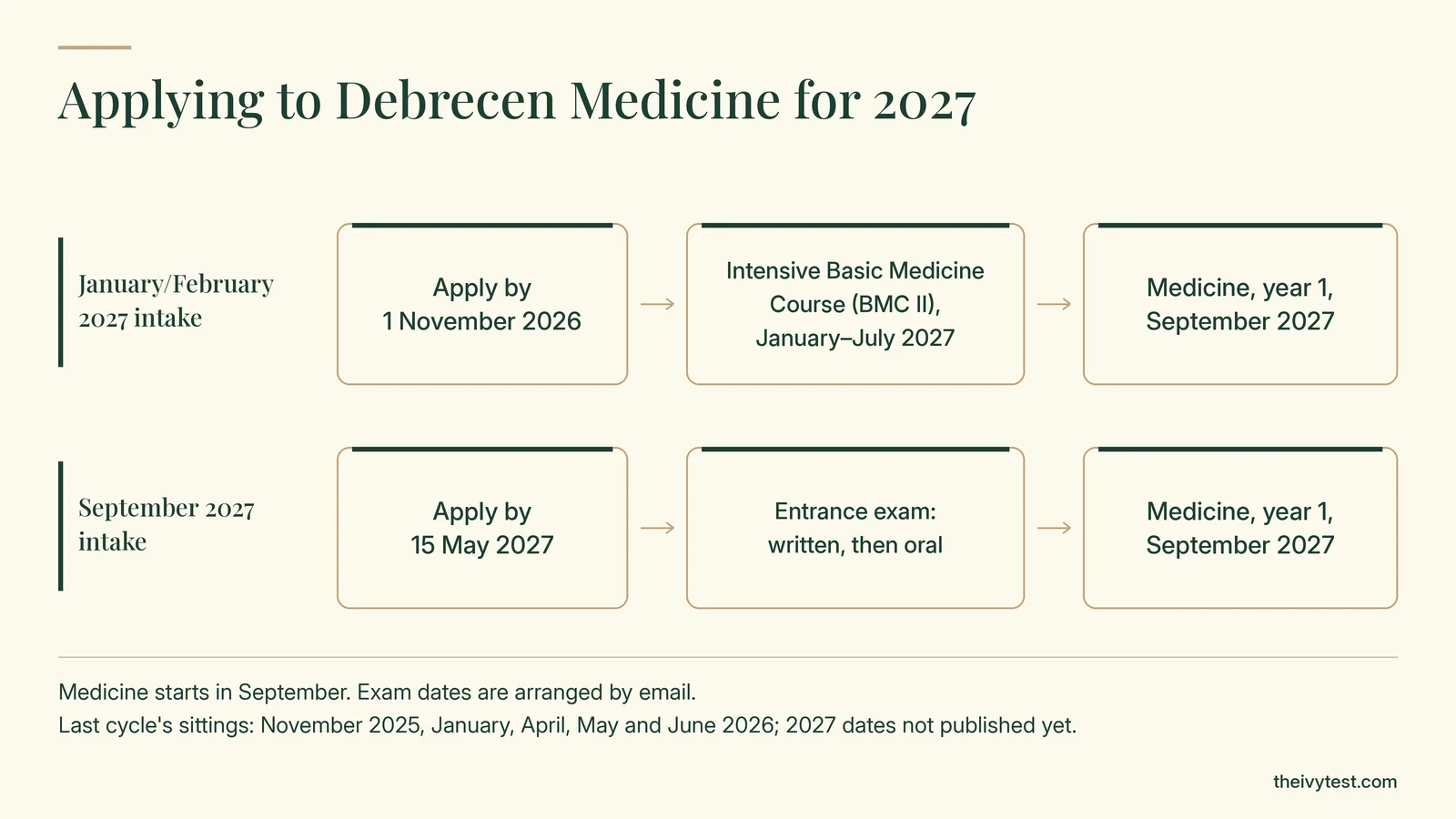
Debrecen's application page gives two deadlines for 2027, for all programmes: 1 November 2026 for the January/February 2027 intake, and 15 May 2027 for the September 2027 intake. Medicine itself starts in September (its programme page gives no other starting date).
For a medical applicant, the January intake is the Intensive Basic Medicine Course (BMC II, January to July): a preparatory course in biology, biophysics and medical chemistry, with Hungarian, that leads into the first year of Medicine. The longer Basic Medicine Course I runs from September to June.
The entrance exam decides where you start. Its possible results are admission to the first year, admission to the Basic Medicine Course, or rejection. The exam date is set by email with you or Debrecen's local representative, an online exam is possible if you cannot travel, and the decision is given right after the oral. No 2027 sittings are published yet: the official exam calendar's last date is 5 June 2026.
Fees
Fees for international students
Debrecen charges international students in US dollars. These are the fees for students admitted for 2026/27, the latest the university has published; the 2027/28 fees are not out yet.
University of Debrecen fees, 2026/27 (English programmes)
| Fee | Amount |
|---|---|
| Medicine (MD, 12 semesters) | 16,900 USD a year |
| Basic Medicine Course I (September to June) | 7,500 USD |
| Application fee | 150 USD |
| Entrance exam fee | 350 USD |
Tuition includes health insurance, the medical check-up and the student card, not housing or living costs. Fees are paid by bank transfer; cheques and cash are not accepted. The application fee is not refunded, and the entrance exam fee only if you cancel at least a week before the exam; the seat reservation fee and any tuition paid in advance are refunded if your visa (residence permit) is rejected.
From the second year, full-time students with a 4.0 grade average or higher in each of the two previous semesters, and at least 20 credits a semester, may be eligible for a tuition fee reduction (Debrecen's FAQ).
Entry requirements
Entry requirements for international students
You apply online, and an application missing any of these documents is not considered:
- Your school-leaving certificate in English or translated, or, in your final year, transcripts of the last two or three years with predicted grades.
- A passport or other proof of citizenship, a short CV, a medical certificate on the university's template, and the receipt for the 150 USD application fee.
- English at B2 or above from a proctored standardised test, unless English is your first language or you studied in English (then a medium-of-instruction certificate).
- A study gap of no more than six years since your last studies, for the medical programmes (shorter limits apply to citizens of six named countries).
- The entrance exam: a written test in Biology and in Chemistry or Physics, then an oral, or completing the Basic Medicine Course.
Rankings
Is the University of Debrecen good for medicine?
Times Higher Education (THE) places the University of Debrecen in the 801–1000 band of its World University Rankings 2027, published in October 2026. In THE's Clinical and Health table, which covers medicine, it has been in the 501–600 band in every edition from 2023 to 2026; the 2027 subject tables are not out yet. Both rank the whole university, a large one with many faculties.
What the degree leads to matters more than the band: Debrecen's Medicine page says its graduates do not need to take the PLAB exam to practise in the UK. And a ranking says nothing about your chances of getting in, which rest on the entrance exam and the oral.
The University of Debrecen in THE's World University Rankings
| Edition | World | Clinical and Health |
|---|---|---|
| THE 2027 | 801–1000 | not out yet |
| THE 2026 | 801–1000 | 501–600 |
| THE 2025 | 801–1000 | 501–600 |
| THE 2024 | 601–800 | 501–600 |
| THE 2023 | 1001–1200 | 501–600 |
Curriculum
The Medicine curriculum and the bulletin
Medicine is 12 semesters and 360 ECTS, taught in English, and leads to the Doctor of Medicine (dr. med., M.D.). You learn basic Hungarian to talk with patients from the third year, and the sixth year is clinical work in internal medicine, surgery, gynaecology, neurology, psychiatry and paediatrics.
Main subjects by year, as the Medicine page lists them (indicative)
| Year | Main subjects |
|---|---|
| 1 | Behavioural sciences, biophysics, biostatistics, communication skills, first aid, Hungarian, medical chemistry, anatomy, histology, embryology, cell biology, medical genetics, molecular biology |
| 2 | Anatomy, histology, embryology, biochemistry, Hungarian, physiology, neurobiology |
| 3 | Oncology, basic surgical techniques, clinical biochemistry, Hungarian, immunology, medical anthropology, microbiology, pathology, internal medicine, clinical physiology, medical psychology and sociology |
| 4 | Internal medicine, obstetrics and gynaecology, orthopaedics, pharmacology, public health, pulmonology, radiology, surgery, traumatology, behavioural medicine, bioethics, clinical genetics, stomatology, urology |
| 5 | Dermatology, emergency medicine, family medicine, forensic medicine, infectology, internal medicine, neurology, paediatrics, psychiatry, anaesthesiology, clinical oncology, ophthalmology, otolaryngology, thesis |
| 6 | Internal medicine, neurology, obstetrics and gynaecology, paediatrics, psychiatry, surgery |
The full curriculum, the credit rules, the calendar and the required electives are in the Faculty of Medicine's English Program Bulletin 2026/2027, a free PDF on Debrecen's Bulletins page.
Sources, read on 14 October 2026: Application and admission · Tuition Fee, Application + Entrance fee · Entrance Examination/Interview · FAQ · Medicine, Full-time Graduate Program · Basic Medicine Course · Bulletins · Times Higher Education: University of Debrecen
Student life
Living in Debrecen as a medical student
Debrecen is Hungary's second-largest city and runs one of the country's most internationally diverse student bodies — around 7,800 international students from over 140 countries university-wide, with particularly large cohorts from South Asia. Debrecen's Medicine and Dentistry programmes have filled to capacity ahead of the standard deadline in past cycles — a real demand signal, though confirm current-cycle application status directly rather than assuming it repeats every year.
FAQ
University of Debrecen admissions FAQ
Yes. University of Debrecen delivers Medicine in English and runs its admission process in the same language.
Yes, at all four Hungarian schools in our catalogue. At Semmelweis, Debrecen and Szeged it re-tests science orally in English (at Debrecen, biology and the second subject you chose). At Pécs it is a 20 to 30 minute personal interview with a professor on motivation and medicine-related questions, which per Pécs's own FAQ includes two biology and two chemistry questions.
At three of the four Hungarian schools in our catalogue, yes. Semmelweis, Pécs and Szeged score English as a separate written subject, split into general and medical English. Debrecen doesn't: its written papers are biology plus chemistry or physics, although the whole exam and the oral are held in English.
Not a separate one. Hungary's final exam (záróvizsga) is built into the sixth year of the degree itself, and registration afterwards with the national healthcare register is automatic. A separate specialist exam (szakvizsga) applies only later, for those pursuing specialty practice.
Yes, it's the 2027 edition, built from the latest admission rules University of Debrecen has published. Where a 2027 date or detail isn't published yet, confirm it with the university before you rely on it.
Yes. University of Debrecen-format practice sessions are available inside the simulator and align with the guide section by section.
Ready to prepare for the Debrecen Entrance Exam?
The University of Debrecen Complete Admissions System — study guide, exam simulator, video courses and application help, built from University of Debrecen's own syllabus.