Free practice paper · 2027 format

MU-Plovdiv Entrance Exam Practice Paper 1: Biology & Chemistry, with Answers

A full paper in the format of the Medical University of Plovdiv's 2026 entrance exam: Biology in all six of its task types, 30 four-option Chemistry questions and the 40-item English Diagnostic Test. MU-Plovdiv publishes question books with the answers marked but no explanations; this paper explains every answer. Written by IvyTest; it is not an official MU-Plovdiv paper.

Before you start

How to sit this paper

Questions
100
Time
45 minutes + 45 minutes + 45 minutes
Options per question
4 (A to D)
Sections
3, each timed separately
SectionQuestionsTimeMarks (Admission Examination for International Students)
Biology3045 min+1 correct, 0 wrong, 0 blank
Chemistry3045 min+1 correct, 0 wrong, 0 blank
English Diagnostic Test4045 min+1 correct, 0 wrong, 0 blank

Sit Biology and Chemistry back to back, 45 minutes each, Biology first, without a calculator, periodic table, paper or pen, as the Admission Guide's exam instructions require (do the written tasks on paper here, since you cannot type them on this page); then the English test in 45 minutes if you will sit it. Each test's points convert to a grade from 2.00 to 6.00, and the competition score is 3 × Biology + 3 × Chemistry + English, out of 42: a grade below 3.00 in any of them keeps you out of the ranking. MU-Plovdiv does not publish how points become grades, so judge yourself by the share of points you score in each test.

Section 1 of 3

Biology

30 questions · 45 minutes

Question 1

Biology · Cell Structure and Organisation · Foundation

Which organelle is the site of the Krebs cycle and oxidative phosphorylation?

Show answer and explanation

Answer: B

Aerobic respiration after glycolysis happens in the mitochondrion: the Krebs cycle in the matrix and oxidative phosphorylation on the inner membrane (the cristae), which is where most of the cell's ATP is made. The Golgi apparatus modifies and packages proteins, lysosomes digest material with hydrolytic enzymes, and the smooth endoplasmic reticulum makes lipids and detoxifies.

Question 2

Biology · Biological Molecules and Enzymes · Foundation

Which bond joins two monosaccharides in a disaccharide such as sucrose?

Show answer and explanation

Answer: C

Monosaccharides are joined by a glycosidic bond, formed by condensation (a molecule of water is released): glucose and fructose make sucrose. Peptide bonds join amino acids, phosphodiester bonds join nucleotides in DNA and RNA, and ester bonds join glycerol to fatty acids in lipids.

Question 3

Biology · Biological Molecules and Enzymes · Standard

An enzyme speeds up a chemical reaction by:

Show answer and explanation

Answer: B

Enzymes are biological catalysts: they bind the substrate at the active site and provide a pathway with a lower activation energy, so the reaction runs faster at body temperature. A catalyst does not change the position of equilibrium or supply energy; it reaches the same equilibrium sooner.

Question 4

Biology · Genetic Processes · Standard

In which direction does DNA polymerase extend a new DNA strand during replication?

Show answer and explanation

Answer: A

DNA polymerase can only add nucleotides to the free 3' end of a growing strand, so every new strand grows 5' → 3'. That is why the lagging strand is made in short Okazaki fragments, later joined by DNA ligase. Replication starts at origins of replication, not at the centromere.

Question 5

Biology · Genetic Processes · Foundation

The anticodon is a sequence of three bases found on:

Show answer and explanation

Answer: C

Each transfer RNA carries one amino acid and an anticodon that pairs with a complementary codon on the messenger RNA during translation. The codon is on the mRNA; rRNA forms the ribosome together with proteins; the DNA template strand is read during transcription, not translation.

Question 6

Biology · Cell Division and Differentiation · Foundation

In which phase of mitosis do the sister chromatids separate and move to opposite poles?

Show answer and explanation

Answer: C

In anaphase the centromeres split and the spindle fibres pull the sister chromatids, now separate chromosomes, to opposite poles. In prophase chromatin condenses, in metaphase the chromosomes line up on the equatorial plate, and in telophase the nuclear envelopes re-form around the two sets.

Question 7

Biology · Cell Division and Differentiation · Challenging

A human cell has just completed meiosis I. Each of the two new cells contains:

Show answer and explanation

Answer: B

Meiosis I separates the homologous chromosomes, not the chromatids, so each cell receives one of each pair: 23 chromosomes, each still made of two sister chromatids. The chromatids separate only in meiosis II, which gives 23 single-chromatid chromosomes per cell.

Question 8

Biology · Viruses and Immunity · Foundation

Which cells secrete antibodies?

Show answer and explanation

Answer: D

Antibodies (immunoglobulins) are secreted by plasma cells, which develop from B lymphocytes after they meet their antigen. T helper cells coordinate the response with cytokines, macrophages engulf and present antigens, and erythrocytes carry oxygen.

Question 9

Biology · Viruses and Immunity · Standard

Which statement about viruses is correct?

Show answer and explanation

Answer: C

A virus particle has a single type of nucleic acid, DNA or RNA, inside a protein coat (the capsid), sometimes with a lipid envelope. It has no ribosomes and no cell wall, which is why it can multiply only inside a host cell, using the host's machinery.

Question 10

Biology · Tissues and the Organism · Standard

Which epithelium lines the alveoli of the lungs?

Show answer and explanation

Answer: B

Gas exchange needs the shortest possible distance, so the alveoli are lined by a single layer of flat cells, a simple squamous epithelium. Stratified squamous epithelium protects surfaces under friction (skin, oesophagus), simple columnar lines the stomach and intestine, and transitional epithelium lines the urinary bladder.

Question 11

Biology · Digestive System and Nutrition · Foundation

Which enzyme begins the digestion of proteins in the stomach?

Show answer and explanation

Answer: A

Pepsin, secreted as inactive pepsinogen and activated by hydrochloric acid, starts protein digestion in the stomach. Salivary amylase digests starch in the mouth, lipase digests fats (mainly in the small intestine), and trypsin continues protein digestion in the small intestine, from the pancreas.

Question 12

Biology · Respiratory System · Standard

During a quiet inspiration, the diaphragm:

Show answer and explanation

Answer: B

The diaphragm is dome-shaped at rest; when it contracts it flattens and moves down, enlarging the chest cavity, so the pressure in the lungs falls and air flows in. In quiet expiration it relaxes and rises back into its dome.

Question 13

Biology · Excretory System · Standard

Where in the nephron is the blood filtered?

Show answer and explanation

Answer: C

Filtration happens in the renal corpuscle: blood pressure in the glomerular capillaries pushes plasma into Bowman's capsule, forming the primary urine. The tubules and the loop of Henle then reabsorb and secrete, and the collecting duct concentrates the urine.

Question 14

Biology · Cardiovascular System and Blood · Foundation

Which valve lies between the left atrium and the left ventricle?

Show answer and explanation

Answer: D

The left atrioventricular valve has two cusps and is called the mitral or bicuspid valve. The tricuspid valve is the right atrioventricular valve; the pulmonary and aortic valves are the semilunar valves at the exits of the right and left ventricles.

Question 15

Biology · Cardiovascular System and Blood · Foundation

Which mature human blood cells have no nucleus?

Show answer and explanation

Answer: A

Mature red blood cells lose their nucleus (and their organelles) while they develop in the bone marrow, which leaves more room for haemoglobin and gives them their biconcave shape. Lymphocytes, neutrophils and monocytes are white blood cells and keep their nuclei.

Question 16

Biology · Musculoskeletal System · Foundation

How many vertebrae make up the human cervical spine?

Show answer and explanation

Answer: C

The vertebral column has 7 cervical, 12 thoracic and 5 lumbar vertebrae, then the sacrum (5 fused) and the coccyx (about 4 fused). The first two cervical vertebrae, the atlas and the axis, allow the head to nod and turn.

Question 17

Biology · Reproductive System and Development · Foundation

Where does fertilisation normally take place in humans?

Show answer and explanation

Answer: C

The secondary oocyte is released into the uterine tube, and fertilisation normally happens in its widest part, the ampulla. The zygote then divides as it travels to the uterus, where the blastocyst implants about a week later.

Question 18

Biology · Nervous System · Foundation

Which part of the brain coordinates balance and the precision of movement?

Show answer and explanation

Answer: D

The cerebellum coordinates posture, balance and smooth, accurate movement. The medulla oblongata holds the breathing and cardiovascular centres, the hypothalamus regulates temperature, hunger and the pituitary, and the thalamus relays sensory signals to the cortex.

Question 19

Biology · Endocrine System · Standard

Which hormone, made by the parafollicular (C) cells of the thyroid gland, lowers the calcium level in the blood?

Show answer and explanation

Answer: B

Calcitonin lowers blood calcium, mainly by slowing bone resorption. Parathyroid hormone does the opposite and raises it; thyroxine, from the thyroid follicles, raises the metabolic rate; aldosterone, from the adrenal cortex, increases sodium reabsorption in the kidney.

Question 20

Biology · Sensory Systems and Skin · Foundation

Which photoreceptors of the retina are responsible for colour vision?

Show answer and explanation

Answer: A

Cones work in bright light and, with three types sensitive to different wavelengths, give colour vision; they are concentrated in the fovea. Rods are more sensitive and serve vision in dim light, without colour. Bipolar and ganglion cells are neurons that carry the signal on, not photoreceptors.

Question 21

Biology · Endocrine System · Standard

Task III · Match the definition with its term: the hormone released by the posterior pituitary that increases water reabsorption in the kidneys.

Show answer and explanation

Answer: B

Antidiuretic hormone, made in the hypothalamus and released by the posterior pituitary, makes the collecting ducts more permeable to water, so less urine is produced. Oxytocin is also released by the posterior pituitary but acts on the uterus and breast; aldosterone (adrenal cortex) acts on sodium; prolactin (anterior pituitary) on milk production.

Question 22

Biology · Cell Division and Differentiation · Foundation

Task III · Match the definition with its term: the phase of interphase in which DNA is replicated.

Show answer and explanation

Answer: C

S stands for synthesis: the DNA is copied, so each chromosome comes to consist of two sister chromatids. G1 is growth before replication, G2 is preparation for division after it, and M is mitosis itself.

Question 23

Biology · Musculoskeletal System · Foundation

Task III · Match the definition with its term: the dense connective tissue cord that attaches a skeletal muscle to a bone.

Show answer and explanation

Answer: D

A tendon connects muscle to bone and transmits the muscle's pull. A ligament connects bone to bone at a joint, cartilage covers joint surfaces and forms flexible supports, and fascia wraps muscles and groups of muscles.

Question 24

Biology · Respiratory System · Foundation

Task III · Match the definition with its term: the serous membrane that covers the lungs and lines the chest cavity.

Show answer and explanation

Answer: B

The pleura has two layers, the visceral pleura on the lung and the parietal pleura lining the thoracic wall, with a thin film of fluid between them. The peritoneum lines the abdominal cavity, the pericardium surrounds the heart and the meninges cover the brain and spinal cord.

Question 25

Biology · Viruses and Immunity · Foundation

Task III · Match the definition with its term: white blood cells that engulf and digest bacteria and cell debris, and present antigens to lymphocytes.

Show answer and explanation

Answer: C

Macrophages, which develop from monocytes, are phagocytes: they engulf and digest microbes and debris and show pieces of the antigens to T lymphocytes. Lymphocytes carry out specific immunity, plasma cells secrete antibodies, and platelets take part in clotting.

Question 26

Biology · Digestive System and Nutrition · Standard

Task III · Match the definition with its term: the flap of elastic cartilage that closes the entrance to the larynx during swallowing.

Show answer and explanation

Answer: A

The epiglottis folds over the entrance to the larynx when we swallow, so food goes into the oesophagus and not the airway. The uvula hangs from the soft palate and helps close the nasopharynx, the glottis is the opening between the vocal folds, and the palatine tonsils are lymphoid tissue.

Question 27

Biology · Excretory System · Standard

Task VI · Sentence (1) contains a wrong word. Which correction is right?

Show answer and explanation

Answer: B

The kidneys lie against the posterior abdominal wall, behind the peritoneum (retroperitoneally), on either side of the vertebral column. They are paired organs, and they are in the abdomen, not the thorax.

Question 28

Biology · Excretory System · Challenging
Show the passage · Task VI · The kidneys (find and correct 4 wrong words)

(1) The kidneys are paired organs that lie against the anterior wall of the abdomen. (2) Each kidney contains about one million nephrons, the structural and functional units of the kidney. (3) In the glomerulus, blood plasma is filtered into Bowman's capsule, forming the primary urine. (4) Most of the water, glucose and amino acids in the filtrate are reabsorbed in the distal convoluted tubule. (5) Urine passes from the renal pelvis to the urinary bladder through the urethra. (6) Antidiuretic hormone decreases the reabsorption of water in the collecting ducts.

Task VI · Sentence (4) contains a wrong word. Which correction is right?

Show answer and explanation

Answer: D

Most reabsorption, including about two thirds of the water and sodium and, normally, all of the glucose and amino acids, happens in the proximal convoluted tubule. The distal tubule and collecting duct fine-tune what is left under hormonal control. Urea is not mostly reabsorbed, and plasma proteins are not filtered in the first place.

Question 29

Biology · Excretory System · Standard
Show the passage · Task VI · The kidneys (find and correct 4 wrong words)

(1) The kidneys are paired organs that lie against the anterior wall of the abdomen. (2) Each kidney contains about one million nephrons, the structural and functional units of the kidney. (3) In the glomerulus, blood plasma is filtered into Bowman's capsule, forming the primary urine. (4) Most of the water, glucose and amino acids in the filtrate are reabsorbed in the distal convoluted tubule. (5) Urine passes from the renal pelvis to the urinary bladder through the urethra. (6) Antidiuretic hormone decreases the reabsorption of water in the collecting ducts.

Task VI · Sentence (5) contains a wrong word. Which correction is right?

Show answer and explanation

Answer: A

Each kidney drains through its own ureter into the urinary bladder; the urethra carries urine from the bladder out of the body. The renal pelvis is where the urine collects before it enters the ureter, so 'pelvis' is right.

Question 30

Biology · Excretory System · Standard
Show the passage · Task VI · The kidneys (find and correct 4 wrong words)

(1) The kidneys are paired organs that lie against the anterior wall of the abdomen. (2) Each kidney contains about one million nephrons, the structural and functional units of the kidney. (3) In the glomerulus, blood plasma is filtered into Bowman's capsule, forming the primary urine. (4) Most of the water, glucose and amino acids in the filtrate are reabsorbed in the distal convoluted tubule. (5) Urine passes from the renal pelvis to the urinary bladder through the urethra. (6) Antidiuretic hormone decreases the reabsorption of water in the collecting ducts.

Task VI · Sentence (6) contains a wrong word. Which correction is right?

Show answer and explanation

Answer: C

Antidiuretic hormone increases water reabsorption in the collecting ducts by inserting water channels (aquaporins) into their cells; the name itself means 'against urine production'. Sentences (2) and (3) are correct: each kidney has about a million nephrons, and filtration happens from the glomerulus into Bowman's capsule.

The Biology test: the six task types, the syllabus and practice

Written tasks

Answer on paper, then mark your work against the model answer.

1. Task II · Mark the 10 correct statements

10 points · Cell Structure and Organisation

Exactly 10 of these 20 statements are correct. Write down the numbers of the correct ones (1 point each).

1. Ribosomes are found free in the cytoplasm and on the rough endoplasmic reticulum. 2. Lysosomes are surrounded by a double membrane. 3. Mitochondria contain their own circular DNA. 4. Insulin lowers the concentration of glucose in the blood. 5. In DNA, adenine pairs with uracil. 6. Red blood cells are produced mainly in the liver in adults. 7. The right ventricle pumps blood into the pulmonary trunk. 8. Bile is produced by the gallbladder. 9. Meiosis produces four genetically different cells from one cell. 10. Enzymes are mostly proteins. 11. Arteries always carry oxygenated blood. 12. The cerebellum contains the centre that controls breathing. 13. Memory cells allow a faster response to a second infection by the same antigen. 14. Skeletal muscle contracts involuntarily. 15. The cornea is the transparent front part of the outer layer of the eye. 16. Melanin is produced by keratinocytes. 17. Glucagon is produced by the beta cells of the pancreas. 18. The spinal cord has grey matter in its centre and white matter around it. 19. Neurons conduct impulses from the dendrites towards the axon. 20. Spermatozoa mature in the seminal vesicles.

Show the model answer

Correct: 1, 3, 4, 7, 9, 10, 13, 15, 18, 19.

Why the others are wrong: 2, lysosomes have a single membrane (mitochondria, chloroplasts and the nucleus have two). 5, in DNA adenine pairs with thymine; uracil replaces thymine only in RNA. 6, in adults red blood cells are made in the red bone marrow; the liver makes them only in the fetus. 8, bile is made by the liver and only stored and concentrated in the gallbladder. 11, the pulmonary arteries carry deoxygenated blood to the lungs. 12, the breathing centres are in the medulla oblongata and pons; the cerebellum coordinates movement. 14, skeletal muscle is voluntary; smooth and cardiac muscle are involuntary. 16, melanin is made by melanocytes and passed to keratinocytes. 17, glucagon comes from the alpha cells; the beta cells make insulin. 20, spermatozoa mature in the epididymis; the seminal vesicles add fluid to the semen.

2. Task IV · Label the diagram

6 points · Cell Structure and Organisation

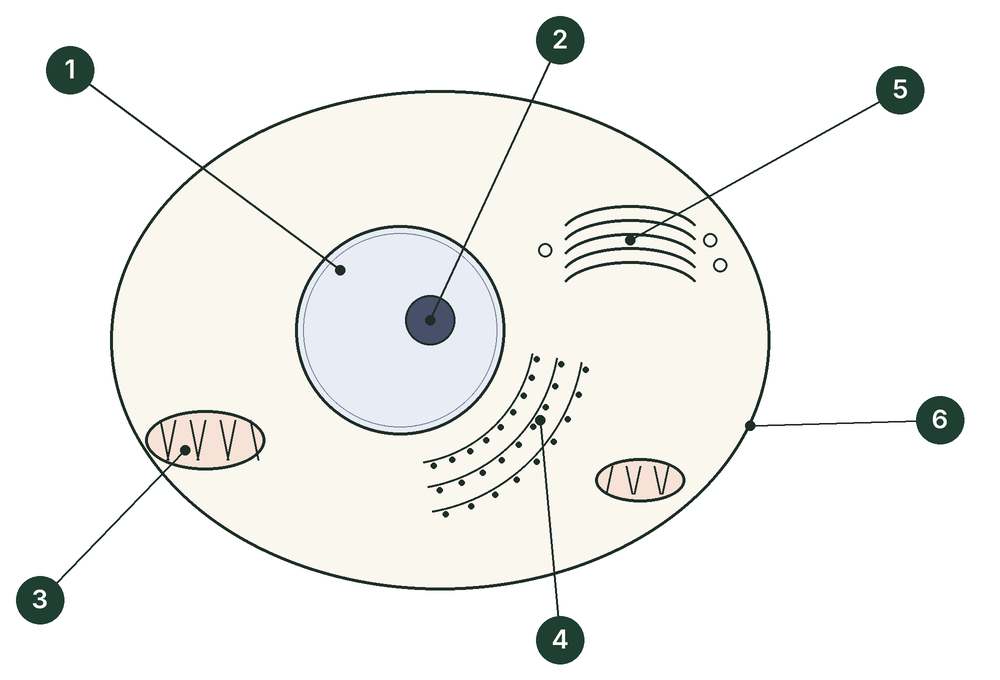
Label the numbered parts 1 to 6 with terms from this list (1 point each): A. lysosome; B. nucleolus; C. Golgi apparatus; D. centriole; E. plasma membrane; F. mitochondrion; G. smooth endoplasmic reticulum; H. nucleus; I. vacuole; J. rough endoplasmic reticulum.

Then answer, without points here (the sample test marks only the labels): which numbered structure makes most of the cell's ATP, and on which are proteins for export made?

Schematic drawing of an animal cell with six numbered labels. 1 points to the large round body in the middle of the cell. 2 points to the small dark body inside it. 3 points to an oval structure with folded inner lines at the lower left. 4 points to curved parallel membranes studded with dots, beside the large round body. 5 points to a stack of flattened curved sacs with small round vesicles at the upper right. 6 points to the outer boundary of the cell.
Show the model answer

1 H, nucleus; 2 B, nucleolus; 3 F, mitochondrion; 4 J, rough endoplasmic reticulum; 5 C, Golgi apparatus; 6 E, plasma membrane.

ATP: 3, the mitochondrion, by aerobic respiration (the Krebs cycle and oxidative phosphorylation on the cristae). Proteins for export: 4, the rough endoplasmic reticulum, whose ribosomes make them; they then pass to 5, the Golgi apparatus, to be modified and packed into vesicles. What gives each away: the nucleolus is the dark body inside the nucleus; the mitochondrion's inner membrane is folded into cristae; the rough ER is studded with ribosomes, the smooth ER is not.

3. Task V · Complete the comparison table

8 points · Cell Division and Differentiation

Compare mitosis and meiosis by filling in the eight empty cells (1 point each).

Feature | Mitosis | Meiosis Number of divisions | … | … Number of cells produced from one cell | … | … Chromosome number of the new cells (human) | … | … Crossing-over between homologous chromosomes | … | …

Show the model answer

Number of divisions: mitosis 1, meiosis 2 (meiosis I and II). Cells produced: mitosis 2, meiosis 4. Chromosome number: mitosis 46, the same as the parent cell (diploid); meiosis 23, half (haploid). Crossing-over: mitosis no; meiosis yes, in prophase I.

Mark each cell on its own: the real task gives a point per correct cell, so a half-right row still earns one point. 'Diploid' and 'haploid' count as well as the numbers.

Section 2 of 3

Chemistry

30 questions · 45 minutes

Question 31

Chemistry · Atomic Structure and Periodicity · Foundation

How many neutrons are there in the nucleus of potassium-39 (Z = 19)?

Show answer and explanation

Answer: B

The mass number (39) counts protons and neutrons; the atomic number (19) counts protons. Neutrons = 39 − 19 = 20. 19 is the number of protons (and electrons in the neutral atom); 58 adds the two numbers instead of subtracting.

Question 32

Chemistry · Atomic Structure and Periodicity · Foundation

Which element of the second period has the highest electronegativity?

Show answer and explanation

Answer: D

Electronegativity increases across a period, as the nuclear charge grows while the electrons stay in the same shell, and decreases down a group. Fluorine, at the end of period 2 (before the noble gas neon), is the most electronegative element of all.

Question 33

Chemistry · Atomic Structure and Periodicity · Standard

How many unpaired electrons does a nitrogen atom (Z = 7) have in its ground state?

Show answer and explanation

Answer: C

Nitrogen is 1s² 2s² 2p³. By Hund's rule the three 2p electrons occupy the three p orbitals singly, with parallel spins, so there are 3 unpaired electrons. 5 is the number of valence electrons (2s² 2p³), not of unpaired ones.

Question 34

Chemistry · Chemical Bonding · Standard

The molecules of which substance form hydrogen bonds with one another?

Show answer and explanation

Answer: A

A hydrogen bond needs hydrogen attached to a small, very electronegative atom with a lone pair (N, O or F). Ammonia has N–H bonds and a lone pair on nitrogen, so its molecules hydrogen-bond. In CH₄ hydrogen is bonded to carbon; sulfur is too large and not electronegative enough; CO₂ has no hydrogen.

Question 35

Chemistry · Chemical Bonding · Standard

In the ammonium ion, NH₄⁺, the bond formed when NH₃ accepts H⁺ is:

Show answer and explanation

Answer: B

The nitrogen of NH₃ donates its lone pair to the H⁺ ion, which has no electrons: a covalent bond in which both electrons come from one atom is a coordinate (dative) bond. Once formed, the four N–H bonds are identical.

Question 36

Chemistry · Reaction Rate and Catalysis · Standard

For a reaction with the rate equation v = k[A][B]², what happens to the rate if [B] is doubled and [A] is kept constant?

Show answer and explanation

Answer: C

The rate depends on the square of [B]: doubling [B] multiplies the rate by 2² = 4. Doubling [A] alone would only double it, because [A] appears to the first power.

Question 37

Chemistry · Reaction Rate and Catalysis · Foundation

Which statement about a catalyst is correct?

Show answer and explanation

Answer: D

A catalyst offers a reaction pathway with a lower activation energy and comes out of the reaction unchanged. It does not change the enthalpy of the reaction or the position of equilibrium: it speeds up the forward and the reverse reaction equally, so equilibrium is reached sooner.

Question 38

Chemistry · Chemical Equilibrium · Standard

N₂(g) + 3H₂(g) ⇌ 2NH₃(g) is exothermic. Which change shifts the equilibrium towards ammonia?

Show answer and explanation

Answer: B

By Le Chatelier's principle, raising the pressure favours the side with fewer gas molecules: 4 on the left, 2 on the right, so more ammonia forms. Raising the temperature favours the endothermic (reverse) reaction, a catalyst does not shift the equilibrium, and removing nitrogen shifts it to the left.

Question 39

Chemistry · Chemical Equilibrium · Foundation

What is the equilibrium constant expression, Kc, for H₂(g) + I₂(g) ⇌ 2HI(g)?

Show answer and explanation

Answer: A

Kc is the product of the products' concentrations over the product of the reactants', each raised to the power of its coefficient: [HI]² over [H₂][I₂]. The coefficient becomes an exponent, never a multiplier, and the products go on top.

Question 40

Chemistry · Solutions · Standard

How many grams of NaOH (M = 40 g/mol) are needed to make 500 mL of a 0.2 mol/L solution?

Show answer and explanation

Answer: B

Moles = concentration × volume = 0.2 mol/L × 0.5 L = 0.1 mol. Mass = 0.1 mol × 40 g/mol = 4 g. 8 g is the answer for a whole litre; 40 g is one mole.

Question 41

Chemistry · Solutions · Challenging

Which of these has the lowest freezing point?

Show answer and explanation

Answer: C

Freezing-point depression depends on the number of dissolved particles, not their identity. Glucose stays as 0.1 mol/kg of molecules, NaCl gives 0.2 mol/kg of ions (Na⁺ and Cl⁻), CaCl₂ gives 0.3 mol/kg (Ca²⁺ and two Cl⁻). The most particles lower the freezing point most; pure water freezes highest, at 0 °C.

Question 42

Chemistry · Electrolytes, Acids and Bases · Standard

What is the pH of a 0.01 mol/L NaOH solution at 25 °C?

Show answer and explanation

Answer: D

NaOH is a strong base, fully dissociated: [OH⁻] = 0.01 = 10⁻² mol/L, so pOH = 2 and pH = 14 − 2 = 12. 2 is the pOH, the usual slip when pH is computed from [OH⁻] directly.

Question 43

Chemistry · Electrolytes, Acids and Bases · Standard

In the reaction NH₃ + H₂O ⇌ NH₄⁺ + OH⁻, water acts as:

Show answer and explanation

Answer: A

In the Brønsted-Lowry theory an acid donates a proton. Water gives H⁺ to ammonia and becomes OH⁻, so here it is the acid and ammonia the base. Water is amphiprotic: with HCl it would act as a base instead.

Question 44

Chemistry · Electrolytes, Acids and Bases · Standard

An aqueous solution of which salt is acidic?

Show answer and explanation

Answer: C

NH₄Cl is the salt of a weak base (NH₃) and a strong acid (HCl): NH₄⁺ hydrolyses, NH₄⁺ + H₂O ⇌ NH₃ + H₃O⁺, so the solution is acidic. NaCl (strong acid, strong base) is neutral; Na₂CO₃ and CH₃COONa are salts of weak acids and give basic solutions.

Question 45

Chemistry · Oxidation-Reduction Reactions · Standard

What is the oxidation number of chromium in K₂Cr₂O₇?

Show answer and explanation

Answer: B

The compound is neutral: 2(+1) for potassium + 2x for chromium + 7(−2) for oxygen = 0, so 2x = 12 and x = +6. Dichromate is a strong oxidising agent and is usually reduced to Cr³⁺ (+3).

Question 46

Chemistry · Oxidation-Reduction Reactions · Standard

In the reaction Zn + CuSO₄ → ZnSO₄ + Cu, the oxidising agent is:

Show answer and explanation

Answer: D

Cu²⁺ gains two electrons and is reduced to copper metal, so it is the oxidising agent; zinc loses two electrons, is oxidised to Zn²⁺ and is the reducing agent. The sulfate ion is a spectator and does not change.

Question 47

Chemistry · Properties of Metals and Nonmetals · Foundation

Which metal does not react with dilute hydrochloric acid to release hydrogen?

Show answer and explanation

Answer: A

Only metals above hydrogen in the reactivity series displace hydrogen from dilute acids. Magnesium, zinc and iron are above hydrogen; copper is below it, so it does not react with dilute HCl.

Question 48

Chemistry · Oxides, Oxyacids and Bases · Foundation

Sulfur trioxide reacts with water to form:

Show answer and explanation

Answer: B

SO₃ + H₂O → H₂SO₄: an acidic oxide reacts with water to give its oxyacid, with sulfur keeping its oxidation number (+6). H₂SO₃ comes from SO₂ (+4), and H₂S is a hydride, not an oxyacid.

Question 49

Chemistry · Oxides, Oxyacids and Bases · Standard

What is formed when calcium oxide reacts with carbon dioxide?

Show answer and explanation

Answer: C

A basic oxide reacts with an acidic oxide to give a salt: CaO + CO₂ → CaCO₃. Ca(OH)₂ would form with water, not with CO₂.

Question 50

Chemistry · Amphoteric Oxides and Hydroxides · Standard

Which hydroxide is amphoteric?

Show answer and explanation

Answer: B

Aluminium hydroxide reacts with acids (Al(OH)₃ + 3HCl → AlCl₃ + 3H₂O) and with strong bases (Al(OH)₃ + NaOH → Na[Al(OH)₄]), so it is amphoteric; zinc hydroxide behaves the same way. The hydroxides of sodium, magnesium and calcium are bases only.

Question 51

Chemistry · Organic Basics and Nomenclature · Foundation

What is the hybridisation of the carbon atoms in ethene, CH₂=CH₂?

Show answer and explanation

Answer: C

Each carbon in ethene forms three σ bonds (two to H, one to C) and one π bond, so it uses three hybrid orbitals: sp², with a trigonal planar arrangement at 120°. Single-bonded carbon (alkanes) is sp³; triple-bonded carbon (alkynes) is sp.

Question 52

Chemistry · Organic Basics and Nomenclature · Challenging

Which compound shows cis-trans (geometric) isomerism?

Show answer and explanation

Answer: D

Cis-trans isomerism needs a C=C double bond with two different groups on each carbon. In but-2-ene, CH₃–CH=CH–CH₃, each double-bonded carbon carries H and CH₃. But-1-ene has two H atoms on the first carbon, 2-methylpropene two CH₃ groups on one carbon, and ethene only H atoms, so none of them has cis and trans forms.

Question 53

Chemistry · Hydrocarbons · Foundation

Ethene decolourises bromine water. What type of reaction is this, and what forms?

Show answer and explanation

Answer: B

Alkenes undergo addition across the double bond: CH₂=CH₂ + Br₂ → CH₂Br–CH₂Br, 1,2-dibromoethane. The orange bromine is used up, which is the classic test for a C=C bond. Substitution is typical of alkanes (with light) and of benzene.

Question 54

Chemistry · Hydrocarbons · Standard

Benzene reacts with a mixture of concentrated nitric and sulfuric acids. The reaction and its main product are:

Show answer and explanation

Answer: A

Sulfuric acid helps form the nitronium ion, NO₂⁺, which replaces a hydrogen on the ring: nitration is an electrophilic substitution, and the aromatic ring is kept. Benzene resists addition because addition would destroy its stable delocalised π system.

Question 55

Chemistry · Alcohols and Phenols · Foundation

The oxidation of a secondary alcohol, such as propan-2-ol, gives:

Show answer and explanation

Answer: B

A secondary alcohol is oxidised to a ketone (propan-2-ol → propanone) and goes no further under normal conditions. A primary alcohol gives an aldehyde and then a carboxylic acid; a tertiary alcohol resists oxidation.

Question 56

Chemistry · Alcohols and Phenols · Standard

Which of these compounds reacts with aqueous sodium hydroxide to form a salt?

Show answer and explanation

Answer: D

Phenol is a weak acid, much stronger than alcohols, because its anion (phenoxide) is stabilised by the benzene ring: C₆H₅OH + NaOH → C₆H₅ONa + H₂O. Alcohols are too weakly acidic to react with NaOH; they react with sodium metal instead.

Question 57

Chemistry · Carbonyl Compounds · Standard

Which compound gives a silver mirror with Tollens' reagent?

Show answer and explanation

Answer: C

Aldehydes are easily oxidised to carboxylic acids, and they reduce the Ag⁺ of Tollens' reagent to metallic silver. Ethanal is an aldehyde; propanone is a ketone and is not oxidised; ethanol and ethanoic acid do not give the test.

Question 58

Chemistry · Carbohydrates · Foundation

Sucrose is a disaccharide made of:

Show answer and explanation

Answer: C

Sucrose is glucose joined to fructose by a glycosidic bond between their anomeric carbons, which is why it is a non-reducing sugar. Maltose is two glucose units and lactose is glucose plus galactose.

Question 59

Chemistry · Carboxylic Acids and Derivatives · Standard

Ethanoic acid is heated with ethanol and a little concentrated sulfuric acid. The products are:

Show answer and explanation

Answer: A

This is esterification: CH₃COOH + C₂H₅OH ⇌ CH₃COOC₂H₅ + H₂O, catalysed by acid and reversible. Sodium ethanoate and hydrogen would come from the acid and sodium metal.

Question 60

Chemistry · Amines and Amino Acids · Standard

At its isoelectric point, an α-amino acid such as glycine exists mainly as:

Show answer and explanation

Answer: D

At the isoelectric point the amino group is protonated (–NH₃⁺) and the carboxyl group deprotonated (–COO⁻): a zwitterion, with no net charge, so it does not move in an electric field. At lower pH the cation dominates, at higher pH the anion.

The Chemistry test: the syllabus, practice questions and tips

Section 3 of 3

English Diagnostic Test

40 questions · 45 minutes

Question 61

Diagnostic Test of English · Reading Comprehension · Foundation

In the past, sleep was mainly thought of as

Show answer and explanation

Answer: B

The first paragraph says sleep 'was seen simply as rest: a period in which the body and the brain switched off to save energy'. The active brain is the newer view, not the old one.

Question 62

Diagnostic Test of English · Reading Comprehension · Foundation
Show the passage · Part 1 · Why we sleep

For a long time, sleep was seen simply as rest: a period in which the body and the brain switched off to save energy. Research over the last few decades has changed that view. We now know that the brain is remarkably active during sleep, and that several processes essential to health take place mainly, or only, while we are asleep.

One of the best understood is the consolidation of memory. During deep sleep, the brain appears to replay the experiences of the day and to transfer important information from short-term to long-term storage. Students who sleep after learning remember more than those who stay awake for the same length of time, which is why an all-night revision session before an exam can do more harm than good.

Sleep also seems to help the brain clean itself. Studies in mice have shown that the space between brain cells widens during sleep, allowing fluid to wash away waste products that build up during the day. Some scientists believe that poor sleep over many years may contribute to diseases such as Alzheimer's, although this has not yet been proved in humans.

Most adults need between seven and nine hours of sleep a night, but many get far less. Shift workers, new parents and people who use screens late in the evening are particularly at risk. The light from phones and laptops delays the release of melatonin, the hormone that tells the body it is time to sleep. Doctors therefore recommend keeping a regular bedtime and switching off screens at least an hour before going to bed.

According to the text, memory consolidation happens mainly during

Show answer and explanation

Answer: A

The second paragraph: 'During deep sleep, the brain appears to replay the experiences of the day'. Waking and naps are not mentioned.

Question 63

Diagnostic Test of English · Reading Comprehension · Standard
Show the passage · Part 1 · Why we sleep

For a long time, sleep was seen simply as rest: a period in which the body and the brain switched off to save energy. Research over the last few decades has changed that view. We now know that the brain is remarkably active during sleep, and that several processes essential to health take place mainly, or only, while we are asleep.

One of the best understood is the consolidation of memory. During deep sleep, the brain appears to replay the experiences of the day and to transfer important information from short-term to long-term storage. Students who sleep after learning remember more than those who stay awake for the same length of time, which is why an all-night revision session before an exam can do more harm than good.

Sleep also seems to help the brain clean itself. Studies in mice have shown that the space between brain cells widens during sleep, allowing fluid to wash away waste products that build up during the day. Some scientists believe that poor sleep over many years may contribute to diseases such as Alzheimer's, although this has not yet been proved in humans.

Most adults need between seven and nine hours of sleep a night, but many get far less. Shift workers, new parents and people who use screens late in the evening are particularly at risk. The light from phones and laptops delays the release of melatonin, the hormone that tells the body it is time to sleep. Doctors therefore recommend keeping a regular bedtime and switching off screens at least an hour before going to bed.

Why can an all-night revision session 'do more harm than good'?

Show answer and explanation

Answer: B

The text links it to the previous sentence: people who sleep after learning remember more, so staying awake costs the memory consolidation that sleep provides.

Question 64

Diagnostic Test of English · Reading Comprehension · Standard
Show the passage · Part 1 · Why we sleep

For a long time, sleep was seen simply as rest: a period in which the body and the brain switched off to save energy. Research over the last few decades has changed that view. We now know that the brain is remarkably active during sleep, and that several processes essential to health take place mainly, or only, while we are asleep.

One of the best understood is the consolidation of memory. During deep sleep, the brain appears to replay the experiences of the day and to transfer important information from short-term to long-term storage. Students who sleep after learning remember more than those who stay awake for the same length of time, which is why an all-night revision session before an exam can do more harm than good.

Sleep also seems to help the brain clean itself. Studies in mice have shown that the space between brain cells widens during sleep, allowing fluid to wash away waste products that build up during the day. Some scientists believe that poor sleep over many years may contribute to diseases such as Alzheimer's, although this has not yet been proved in humans.

Most adults need between seven and nine hours of sleep a night, but many get far less. Shift workers, new parents and people who use screens late in the evening are particularly at risk. The light from phones and laptops delays the release of melatonin, the hormone that tells the body it is time to sleep. Doctors therefore recommend keeping a regular bedtime and switching off screens at least an hour before going to bed.

The studies on mice showed that during sleep

Show answer and explanation

Answer: B

'The space between brain cells widens during sleep, allowing fluid to wash away waste products'. Waste builds up during the day, not during sleep.

Question 65

Diagnostic Test of English · Reading Comprehension · Challenging
Show the passage · Part 1 · Why we sleep

For a long time, sleep was seen simply as rest: a period in which the body and the brain switched off to save energy. Research over the last few decades has changed that view. We now know that the brain is remarkably active during sleep, and that several processes essential to health take place mainly, or only, while we are asleep.

One of the best understood is the consolidation of memory. During deep sleep, the brain appears to replay the experiences of the day and to transfer important information from short-term to long-term storage. Students who sleep after learning remember more than those who stay awake for the same length of time, which is why an all-night revision session before an exam can do more harm than good.

Sleep also seems to help the brain clean itself. Studies in mice have shown that the space between brain cells widens during sleep, allowing fluid to wash away waste products that build up during the day. Some scientists believe that poor sleep over many years may contribute to diseases such as Alzheimer's, although this has not yet been proved in humans.

Most adults need between seven and nine hours of sleep a night, but many get far less. Shift workers, new parents and people who use screens late in the evening are particularly at risk. The light from phones and laptops delays the release of melatonin, the hormone that tells the body it is time to sleep. Doctors therefore recommend keeping a regular bedtime and switching off screens at least an hour before going to bed.

What does the text say about the link between poor sleep and Alzheimer's disease?

Show answer and explanation

Answer: B

'Some scientists believe ... although this has not yet been proved in humans.' The careful wording ('may contribute') signals a hypothesis, not a fact.

Question 66

Diagnostic Test of English · Reading Comprehension · Foundation
Show the passage · Part 1 · Why we sleep

For a long time, sleep was seen simply as rest: a period in which the body and the brain switched off to save energy. Research over the last few decades has changed that view. We now know that the brain is remarkably active during sleep, and that several processes essential to health take place mainly, or only, while we are asleep.

One of the best understood is the consolidation of memory. During deep sleep, the brain appears to replay the experiences of the day and to transfer important information from short-term to long-term storage. Students who sleep after learning remember more than those who stay awake for the same length of time, which is why an all-night revision session before an exam can do more harm than good.

Sleep also seems to help the brain clean itself. Studies in mice have shown that the space between brain cells widens during sleep, allowing fluid to wash away waste products that build up during the day. Some scientists believe that poor sleep over many years may contribute to diseases such as Alzheimer's, although this has not yet been proved in humans.

Most adults need between seven and nine hours of sleep a night, but many get far less. Shift workers, new parents and people who use screens late in the evening are particularly at risk. The light from phones and laptops delays the release of melatonin, the hormone that tells the body it is time to sleep. Doctors therefore recommend keeping a regular bedtime and switching off screens at least an hour before going to bed.

How much sleep do most adults need, according to the text?

Show answer and explanation

Answer: B

The last paragraph: 'Most adults need between seven and nine hours of sleep a night'.

Question 67

Diagnostic Test of English · Reading Comprehension · Foundation
Show the passage · Part 1 · Why we sleep

For a long time, sleep was seen simply as rest: a period in which the body and the brain switched off to save energy. Research over the last few decades has changed that view. We now know that the brain is remarkably active during sleep, and that several processes essential to health take place mainly, or only, while we are asleep.

One of the best understood is the consolidation of memory. During deep sleep, the brain appears to replay the experiences of the day and to transfer important information from short-term to long-term storage. Students who sleep after learning remember more than those who stay awake for the same length of time, which is why an all-night revision session before an exam can do more harm than good.

Sleep also seems to help the brain clean itself. Studies in mice have shown that the space between brain cells widens during sleep, allowing fluid to wash away waste products that build up during the day. Some scientists believe that poor sleep over many years may contribute to diseases such as Alzheimer's, although this has not yet been proved in humans.

Most adults need between seven and nine hours of sleep a night, but many get far less. Shift workers, new parents and people who use screens late in the evening are particularly at risk. The light from phones and laptops delays the release of melatonin, the hormone that tells the body it is time to sleep. Doctors therefore recommend keeping a regular bedtime and switching off screens at least an hour before going to bed.

Which group is NOT mentioned as being particularly at risk of too little sleep?

Show answer and explanation

Answer: B

The text names shift workers, new parents and people who use screens late in the evening. Athletes are not mentioned.

Question 68

Diagnostic Test of English · Reading Comprehension · Standard
Show the passage · Part 1 · Why we sleep

For a long time, sleep was seen simply as rest: a period in which the body and the brain switched off to save energy. Research over the last few decades has changed that view. We now know that the brain is remarkably active during sleep, and that several processes essential to health take place mainly, or only, while we are asleep.

One of the best understood is the consolidation of memory. During deep sleep, the brain appears to replay the experiences of the day and to transfer important information from short-term to long-term storage. Students who sleep after learning remember more than those who stay awake for the same length of time, which is why an all-night revision session before an exam can do more harm than good.

Sleep also seems to help the brain clean itself. Studies in mice have shown that the space between brain cells widens during sleep, allowing fluid to wash away waste products that build up during the day. Some scientists believe that poor sleep over many years may contribute to diseases such as Alzheimer's, although this has not yet been proved in humans.

Most adults need between seven and nine hours of sleep a night, but many get far less. Shift workers, new parents and people who use screens late in the evening are particularly at risk. The light from phones and laptops delays the release of melatonin, the hormone that tells the body it is time to sleep. Doctors therefore recommend keeping a regular bedtime and switching off screens at least an hour before going to bed.

In the last paragraph, the word 'delays' is closest in meaning to

Show answer and explanation

Answer: B

To delay is to make something happen later: screen light postpones the release of melatonin. It does not stop it altogether or make it stronger.

Question 69

Diagnostic Test of English · Reading Comprehension · Standard
Show the passage · Part 1 · Why we sleep

For a long time, sleep was seen simply as rest: a period in which the body and the brain switched off to save energy. Research over the last few decades has changed that view. We now know that the brain is remarkably active during sleep, and that several processes essential to health take place mainly, or only, while we are asleep.

One of the best understood is the consolidation of memory. During deep sleep, the brain appears to replay the experiences of the day and to transfer important information from short-term to long-term storage. Students who sleep after learning remember more than those who stay awake for the same length of time, which is why an all-night revision session before an exam can do more harm than good.

Sleep also seems to help the brain clean itself. Studies in mice have shown that the space between brain cells widens during sleep, allowing fluid to wash away waste products that build up during the day. Some scientists believe that poor sleep over many years may contribute to diseases such as Alzheimer's, although this has not yet been proved in humans.

Most adults need between seven and nine hours of sleep a night, but many get far less. Shift workers, new parents and people who use screens late in the evening are particularly at risk. The light from phones and laptops delays the release of melatonin, the hormone that tells the body it is time to sleep. Doctors therefore recommend keeping a regular bedtime and switching off screens at least an hour before going to bed.

Melatonin is described as a hormone that

Show answer and explanation

Answer: A

'Melatonin, the hormone that tells the body it is time to sleep.' The devices produce light, which delays its release; they do not produce the hormone.

Question 70

Diagnostic Test of English · Reading Comprehension · Standard
Show the passage · Part 1 · Why we sleep

For a long time, sleep was seen simply as rest: a period in which the body and the brain switched off to save energy. Research over the last few decades has changed that view. We now know that the brain is remarkably active during sleep, and that several processes essential to health take place mainly, or only, while we are asleep.

One of the best understood is the consolidation of memory. During deep sleep, the brain appears to replay the experiences of the day and to transfer important information from short-term to long-term storage. Students who sleep after learning remember more than those who stay awake for the same length of time, which is why an all-night revision session before an exam can do more harm than good.

Sleep also seems to help the brain clean itself. Studies in mice have shown that the space between brain cells widens during sleep, allowing fluid to wash away waste products that build up during the day. Some scientists believe that poor sleep over many years may contribute to diseases such as Alzheimer's, although this has not yet been proved in humans.

Most adults need between seven and nine hours of sleep a night, but many get far less. Shift workers, new parents and people who use screens late in the evening are particularly at risk. The light from phones and laptops delays the release of melatonin, the hormone that tells the body it is time to sleep. Doctors therefore recommend keeping a regular bedtime and switching off screens at least an hour before going to bed.

What is the main purpose of the text?

Show answer and explanation

Answer: A

It moves from the old view of sleep to what sleep does (memory, cleaning the brain) and ends with practical advice. It sells nothing, and the mice are one example among several.

Question 71

Diagnostic Test of English · Verb Tenses and Forms · Foundation

The patient ______ in hospital since Monday.

Show answer and explanation

Answer: C

'Since Monday' with a situation that continues to the present takes the present perfect: 'has been'.

Question 72

Diagnostic Test of English · Verb Tenses and Forms · Standard

When the ambulance arrived, the doctor ______ the patient for twenty minutes.

Show answer and explanation

Answer: C

An action in progress up to a past moment, with its duration ('for twenty minutes'), takes the past perfect continuous.

Question 73

Diagnostic Test of English · Verb Tenses and Forms · Foundation

By the time she graduates, she ______ six years at medical school.

Show answer and explanation

Answer: B

An action completed before a point in the future takes the future perfect: 'will have spent'.

Question 74

Diagnostic Test of English · Verb Tenses and Forms · Foundation

Penicillin ______ by Alexander Fleming in 1928.

Show answer and explanation

Answer: B

A finished past event in the passive, with a past date: past simple passive, 'was discovered'.

Question 75

Diagnostic Test of English · Verb Tenses and Forms · Standard

I'm used to ______ early, because I work night shifts.

Show answer and explanation

Answer: B

'Be used to' means 'be accustomed to' and is followed by the -ing form; 'used to + infinitive' is a different structure, for past habits.

Question 76

Diagnostic Test of English · Question Forms and Reported Speech · Foundation

______ have you been feeling like this?

Show answer and explanation

Answer: A

With a present perfect continuous and a duration in mind, the question word is 'how long'.

Question 77

Diagnostic Test of English · Question Forms and Reported Speech · Standard

The nurse asked me where ______.

Show answer and explanation

Answer: C

Reported questions take statement word order and, after a past reporting verb, the tense moves back: 'where I lived'.

Question 78

Diagnostic Test of English · Question Forms and Reported Speech · Standard

You haven't taken your medicine yet, ______?

Show answer and explanation

Answer: B

A negative statement takes a positive question tag with the same auxiliary: 'have you'.

Question 79

Diagnostic Test of English · Question Forms and Reported Speech · Standard

She told me she ______ the results the following day.

Show answer and explanation

Answer: B

In reported speech 'will' becomes 'would' after a past reporting verb, and 'tomorrow' becomes 'the following day'.

Question 80

Diagnostic Test of English · Modal Verbs and Conditionals · Foundation

You ______ smoke in the hospital. It is strictly forbidden.

Show answer and explanation

Answer: A

Prohibition is 'mustn't'. 'Don't have to' and 'needn't' mean that something is not necessary, which is different.

Question 81

Diagnostic Test of English · Modal Verbs and Conditionals · Standard

If I ______ harder, I would have passed the exam.

Show answer and explanation

Answer: B

A third conditional, about an unreal past: 'if + past perfect', 'would have + past participle'.

Question 82

Diagnostic Test of English · Modal Verbs and Conditionals · Standard

He ______ have left already: his coat is still here.

Show answer and explanation

Answer: B

A logical deduction that something is impossible, about the past, is 'can't have + past participle'.

Question 83

Diagnostic Test of English · Modal Verbs and Conditionals · Foundation

If you heat ice, it ______.

Show answer and explanation

Answer: A

A general truth takes the zero conditional: present simple in both clauses.

Question 84

Diagnostic Test of English · Determiners, Pronouns and Comparison · Foundation

There isn't ______ information about the side effects of this drug.

Show answer and explanation

Answer: B

'Information' is uncountable, so it takes 'much' in negative sentences; 'many', 'a few' and 'several' go with countable nouns.

Question 85

Diagnostic Test of English · Determiners, Pronouns and Comparison · Foundation

This is ______ hospital in the city.

Show answer and explanation

Answer: C

A one-syllable adjective forms its superlative with -est and 'the': 'the largest'.

Question 86

Diagnostic Test of English · Determiners, Pronouns and Comparison · Standard

The students prepared the presentation ______; nobody helped them.

Show answer and explanation

Answer: A

The reflexive pronoun for 'the students' is 'themselves'; 'theirselves' does not exist, and 'each other' would mean they helped one another.

Question 87

Diagnostic Test of English · Determiners, Pronouns and Comparison · Standard

The more you practise, ______ you become.

Show answer and explanation

Answer: A

The double comparative is 'the + comparative ..., the + comparative'.

Question 88

Diagnostic Test of English · Prepositions and Phrasal Verbs · Foundation

The doctor is responsible ______ the patients on this ward.

Show answer and explanation

Answer: B

The fixed preposition after 'responsible' is 'for'.

Question 89

Diagnostic Test of English · Prepositions and Phrasal Verbs · Standard

The meeting has been ______ until next week because the director is ill.

Show answer and explanation

Answer: A

'Put off' means postpone. 'Put on' is to dress or to switch on, 'put up' to raise or to host, 'put out' to extinguish.

Question 90

Diagnostic Test of English · Prepositions and Phrasal Verbs · Standard

It took him months to ______ the flu completely.

Show answer and explanation

Answer: A

'Get over' an illness means to recover from it. 'Get by' is to manage, 'get on' to make progress or have a good relationship, 'get through to' to reach someone by phone.

Question 91

Diagnostic Test of English · Prepositions and Phrasal Verbs · Foundation

She was born ______ 12 May 2008.

Show answer and explanation

Answer: C

Dates and days take 'on'; months and years alone take 'in'; times take 'at'.

Question 92

Diagnostic Test of English · Prepositions and Phrasal Verbs · Standard

Several patients complained ______ the long waiting times.

Show answer and explanation

Answer: B

One complains 'about' something and 'to' someone.

Question 93

Diagnostic Test of English · Collocations and Set Phrases · Foundation

Before the operation, the patient must ______ a consent form.

Show answer and explanation

Answer: C

The collocation is 'sign a form'.

Question 94

Diagnostic Test of English · Collocations and Set Phrases · Standard

Regular exercise can ______ the risk of heart disease.

Show answer and explanation

Answer: A

The usual collocation is 'reduce the risk'. 'Decline' is intransitive here, and 'lower down' is not used this way.

Question 95

Diagnostic Test of English · Collocations and Set Phrases · Standard

I'll do my ______ to finish the report on time.

Show answer and explanation

Answer: A

The set phrase is 'do my best'.

Question 96

Diagnostic Test of English · Collocations and Set Phrases · Standard

The new treatment has ______ a big difference to her quality of life.

Show answer and explanation

Answer: B

The collocation is 'make a difference'.

Question 97

Diagnostic Test of English · Medical and Everyday Vocabulary · Foundation

A doctor who specialises in children's health is a ______.

Show answer and explanation

Answer: A

Paediatrics is the medicine of children. A geriatrician treats older people, a dermatologist the skin, a radiologist reads images.

Question 98

Diagnostic Test of English · Medical and Everyday Vocabulary · Foundation

The nurse took his ______ to check whether he had a fever.

Show answer and explanation

Answer: B

A fever is a raised body temperature, so the nurse takes his temperature.

Question 99

Diagnostic Test of English · Medical and Everyday Vocabulary · Standard

The doctor wrote a ______ for antibiotics, which he took to the pharmacy.

Show answer and explanation

Answer: B

A prescription is the doctor's written order for a medicine. A 'recipe' is for cooking (a common false friend), and a receipt proves payment.

Question 100

Diagnostic Test of English · Medical and Everyday Vocabulary · Standard

After the accident she was taken to the ______ department.

Show answer and explanation

Answer: A

The hospital department is called the emergency department (also accident and emergency, A&E, in British English).

About this paper

MU-Plovdiv Entrance Exam past papers

The Medical University of Plovdiv publishes no past papers. The Entrance Exams section of its admission page offers free PDFs instead: for Biology, Chemistry and English, the official programme and a sample test with its answers, and for the two sciences a book of tests: Biology Entrance Exam Questions (2026), in the exam's six task types with the right answers in bold, and Chemistry Admission Test Practice, six parts of four-option questions with an answer key. The authors say they may revise both. Neither explains its answers. The practice paper on this page is IvyTest's own: Biology in all six task types, 30 Chemistry questions and the English test, each answer explained.

This paper keeps the format MU-Plovdiv publishes: Chemistry's 30 four-answer questions, the English test's 10 three-answer reading items and 30 four-answer Use of English items, and Biology's six task types. The Biology programme counts only three of them (20 multiple-choice questions, 10 correct statements out of 20, 6 matches), so the other three follow the Admission Guide's sample test: a diagram with 6 labels, a table of 8 cells and a text with 4 wrong words (the programme's count; the sample has 5). The matches and corrections are asked one by one with four options so the page can mark them; on the real test you choose from one list. Every question is new, and every one has its answer explained.

Next step

How did you do?

One paper shows where you are today. Take the free diagnostic next, or read the MU-Plovdiv Entrance Exam guide for the syllabus, dates and scoring in full.