
A patient with a deep wound is given an injection of preformed antibodies against tetanus toxin. Which type of immunity has the patient acquired?
Exam guide · Updated for 2027 admissions
CEU Fernando III Medicine Admission Test 2027: Complete Preparation Guide
Everything you need to know about the CEU Fernando III Medicine admission test, Universidad CEU Fernando III's own exam for its Spanish-taught Medicine degree at the Bormujos campus outside Seville: the four tested blocks and what each is worth under the new 2027/28 formula, the confirmed no-penalty scoring, the two sittings, places, fees and the study plan, and how to prepare for a programme that only launched in 2025/2026.
Updated for 2027 admissions · Last updated: 17 October 2026
CEU Fernando III Medicine Admission Test at a glance
Overview
What is the CEU Fernando III Medicine Admission Test?
Universidad CEU Fernando III runs its own admission test for its Spanish-taught Grado en Medicina at the Campus de Bormujos, a suburb west of Seville. It is sat in person and, for 2027/28, covers four blocks: Biología, Química, English at B1 level and Razonamiento y ética (reasoning and ethics), which UF3's brochure groups as the "Prueba de conocimientos: biología, química, inglés B1 y razonamiento y ética". The degree is taught in Spanish; UF3 does not state the tests' language, though their contents are Bachillerato subjects and they include a B1 English block. The IvyTest study guide and simulator questions for it are in Spanish; this page summarises the content in English.
UF3 publishes two of the exam's most important properties directly: every question offers four options with exactly one correct answer, and wrong answers carry no penalty. Between them those two facts settle guessing strategy completely, which is more than most papers in this set allow. It also publishes how the tests count. From 2027/28 your admission mark is 60% your 1º de Bachillerato (or CFGS) average and 40% the tests, and the 40% is split Biología 35%, Química 25%, Inglés B1 20% and Razonamiento y ética 20%. That replaces the 2026/27 formula, in which the English paper counted for 5% and reasoning was a 5% sliver of the content.
What UF3 does not publish is almost as striking, and it has been checked rather than assumed: both official documents were read in full, and neither states a total question count, a duration in minutes, a calculator policy or a cut-off score, nor any topic list for English or for reasoning and ethics. The 75-question, 90-minute figures that circulate are estimates from third-party reports, not UF3 statements, and this guide renders them as unknown rather than dress them up. One further caution worth knowing before you plan around anything: Medicine at CEU Fernando III only launched in 2025/2026, so there is no admissions track record: no historical cutoffs, no published applicant volume, and no graduates yet.
Programmes that use the CEU Fernando III Medicine Admission Test
- Grado en Medicina: Campus de Bormujos, Sevilla (Spanish-taught, launched 2025/2026)
Timeline
CEU Fernando III Medicine Admission Test 2027: dates and deadlines
When to expect your exam · 2027 start
- February 20276 FebPublished
- April 20273 AprPublished
Applications are open until 28 Mar 2027.
Dates the university has published for this cycle. See every university on the calendar →
- Applications open15 October 2026
- First sitting6 February 2027
- Second sitting3 April 2027
- Registration deadline for each sitting31 January 2027 · 28 March 2027
- Results published11 February 2027 · 8 April 2027
- Enrolment deadlineNot published; UF3's brochure asks preadmitted candidates to reserve their place within 5 days of preadmission
| Step | 1ª convocatoria | 2ª convocatoria |
|---|---|---|
| Applications | 15 October to 31 January | 15 February to 28 March |
| Exam, in person at Bormujos | 6 February 2027 | 3 April 2027 |
| Documents due by | 6 February | 3 April |
| Results | 11 February | 8 April |
| Preadmissions | 12 February | 9 April |
Read on UF3's admission brochure for 2027/28 (created 15 October 2026) and its programme page on 17 October 2026. The brochure prints the days without a year; they belong to the 2027/28 cycle, which opened on 15 October 2026, and both fall on a Saturday in 2027, as the 2026/27 sittings (7 February and 11 April 2026) did. This is a programme in only its third admissions cycle, so re-check the brochure before you book.
Structure
CEU Fernando III Medicine Admission Test format
Four blocks, four options per item, and no published length. UF3's contents PDF gives each block's weight but states no total question count and no duration in minutes, a confirmed absence rather than a research gap, since both official documents were read end to end. The weighting column below carries UF3's published weights and what each is worth in admission points; the question column is left unknown, because filling it would mean inventing a figure the university has never issued.
| Section | Questions | Weighting | Suggested time |
|---|---|---|---|
| Biología (Biology) | 1see the note below the table | 35% of the tests: 14 of 100 admission points | 1see the note below the table |
| Química (Chemistry) | 2see the note below the table | 25% of the tests: 10 of 100 admission points | 2see the note below the table |
| Inglés B1 (English, B1 level) | 3see the note below the table | 20% of the tests: 8 of 100 admission points | 3see the note below the table |
| Razonamiento y ética (reasoning and ethics) | 4see the note below the table | 20% of the tests: 8 of 100 admission points | 4see the note below the table |
- UF3 publishes no item count and no duration for any block. The largest block
- UF3 publishes no item count and no duration for any block
- UF3 publishes no item count, no duration and no topic list beyond the level (B1 on the Common European Framework)
- UF3 publishes no item count, no duration and no topic list. New for 2027/28: in 2026/27 the block was scientific reasoning, at 5%
Content
Question and subject breakdown
Four blocks, whose weights UF3 publishes exactly as shares of the tests, which are themselves 40% of the admission mark. Multiply by 0.4 to read them as admission points: Biología 14, Química 10, English 8 and reasoning and ethics 8, out of 100. They are not question counts, which UF3 does not publish.
Biology
35% of the testsSix official modules of the Spanish 2º de Bachillerato Biología syllabus (LOMLOE), covering all 37 published epígrafes: biomolecules, molecular genetics, cell biology, metabolism, biotechnology and immunology. The largest block, worth 14 of the 100 admission points.
Chemistry
25% of the testsTen areas drawn from three official bloques: chemical bonding and the structure of matter, chemical reactions, and organic chemistry. One absence is deliberate and worth knowing: the mole, concentration and stoichiometry are not an official unidad of their own, even though the acid-base and redox volumetrías and the electrolysis calculations that are official presuppose them. Expect that arithmetic inside the acid-base and redox questions rather than as standalone items.
English (B1 Level)
20% of the testsA generic English block at B1 level on the Common European Framework. UF3 publishes the level and nothing else (no grammar inventory, no lexical list), so the areas below are derived from the Council of Europe B1 descriptors. Worth 8 of the 100 admission points for 2027/28, up from 5 in 2026/27, so it is no longer a block to leave to chance.
Reasoning and Ethics
20% of the testsNew for 2027/28 under the name "Razonamiento y Ética", and four times its old weight: in 2026/27 the block was scientific reasoning at 5% of the content, described in one line as "capacidad de razonamiento y comprensión de textos científicos". UF3's 2027/28 contents PDF gives the block's name and weight and no topic list at all, so the areas below are derived. IvyTest's simulator still files this block under its previous label, Razonamiento Científico (Scientific Reasoning), and has no ethics questions yet.
Marks
CEU Fernando III Medicine Admission Test scoring
Two rules are confirmed in UF3's own documents and they are the two that matter most: four options with exactly one correct, and no penalty for a wrong answer. After that comes the 2027/28 formula: 60% your school record and 40% the tests, with the 40% split across the four blocks. Keep the two layers apart: a block's percentage is its share of the tests, not of your admission mark.
- Correct answer
- +1 point; UF3 confirms only that incorrect answers do not subtract, not the absolute mark a correct answer carries, so 1 is the neutral unit used here
- Incorrect answer
- 0 points: no negative marking. UF3's brochure FAQ: wrong answers do not subtract
- Unanswered question
- 0 points
- Answer format
- Four options, exactly one correct, not multiple-select. UF3's contents PDF states this directly
- Admission weighting
- 60% average of 1º de Bachillerato (or CFGS) + 40% tests, plus up to 2 additional points
- Weights inside the tests' 40%
- Biología 35% · Química 25% · Inglés B1 20% · Razonamiento y ética 20%, that is 14, 10, 8 and 8 of 100 admission points
- Minimum eligible score
- None published. Neither the official contents PDF nor the official admissions brochure sets a pass mark (the brochure publishes only the ranking formula), and uf3ceu.es/admision/ and /admision/nacional/ give no Medicine scoring at all
- Per-subject floors
- None: UF3 sets no per-subject minimum, and the OFA mechanism has no Spanish counterpart
- Maximum possible score
- Cannot be stated: UF3 publishes no total question count in any source
- Two sittings
- 6 February and 3 April 2027; take both and the higher mark counts, paying €80 for each
- Calculator policy
- Not published in either official document; plan to work the chemistry calculations by hand
Worked example
Start with the part that is fully confirmed, because it is rare: four options and no penalty are both official UF3 facts, so the expected value of a blind guess is (1/4 × 1) + (3/4 × 0) = +0.25 marks, exactly. There is no scenario on this paper where a blank beats a guess, and eliminating one option raises a guess to +0.33 and two options to +0.50. Now the formula. Your admission mark is 60% your 1º de Bachillerato average and 40% the tests, and UF3 splits the 40% Biología 35%, Química 25%, Inglés B1 20% and Razonamiento y ética 20%. Multiply each by 0.4 and the blocks are worth 14, 10, 8 and 8 of the 100 admission points. A worked case, reading each block as a percentage of its own items: score 70% in Biología, 70% in Química, 85% in English and 60% in reasoning and ethics, and the tests give you (0.70 × 14) + (0.70 × 10) + (0.85 × 8) + (0.60 × 8) = 9.8 + 7 + 6.8 + 4.8 = 28.4 of the 40 points available, with your record supplying the other 60 and up to 2 additional points on top. Ten more percentage points is worth 1.4 admission points in Biología, 1 in Química, and 0.8 in English or in reasoning and ethics. The change from 2026/27 is in those last two: the English paper used to be worth 5 points and reasoning a sliver of the content; together they are now worth 16, more than Biología alone. One last note on units, and it is a real limitation rather than a flourish: on this paper you cannot convert a percentage-point gain into raw marks at all, because UF3 publishes no item count. Anyone quoting you a number of marks for this exam is working from an estimate.
Admission grade calculator
How much does the test count? Work out your admission grade
out of 10
out of 10
out of 10
out of 10
out of 10
Your admission grade
0.00
0.00 out of 10 from the formula, plus 0.00 additional points
The tests are worth 40% of the grade, split 35/25/20/20 across their four blocks. The university does not publish how each block is marked; here each is entered out of 10.
No CEU university publishes a cut-off: this is your grade under the official formula, not a chance of admission.
The IvyTest simulator scores every practice paper against these exact rules.
See the CEU Fernando III Medicine Admission Test simulatorSyllabus
Full CEU Fernando III Medicine Admission Test syllabus
The Biología and Química groups below are official: they are the modules and unidades temáticas of the Spanish 2º de Bachillerato syllabi that UF3's own contents PDF names, translated into English for this page. The English and Reasoning and Ethics groups are derived: UF3 publishes the English level (B1 on the Common European Framework) and nothing beneath it, and gives the reasoning and ethics block a name and a weight with no topic list at all.
The six official modules of the Biología syllabus, in the official A-F order, covering all 37 published epígrafes. 35% of the tests, the largest block.
- Biomoléculas (biomolecules): organic and inorganic biomolecules; water and mineral salts; monosaccharides: pentoses and hexoses, linear and cyclic forms, isomerism, bonds and functions; the disaccharides and polysaccharides of greatest biological relevance; saponifiable and non-saponifiable lipids; proteins and their biocatalytic role; vitamins and mineral salts as enzyme cofactors and their dietary intake; nucleic acids; and the relationship between bioelements, biomolecules and health
- Genética molecular (molecular genetics): DNA replication in the prokaryotic model; the stages of gene expression in the prokaryotic model; the genetic code and solving translation problems; mutations and their relationship to replication, evolution and biodiversity; regulation of gene expression and cell differentiation; and prokaryotic and eukaryotic genomes
- Biología celular (cell biology): cell theory and its biological implications; optical and electron microscopy, resolving power and sample preparation; the ultrastructure and properties of the plasma membrane; the osmotic process in animal, plant and prokaryotic cells; transport mechanisms and the types of molecule each carries; eukaryotic and prokaryotic organelles and their basic functions; the cell cycle, its phases and regulatory mechanisms; mitosis and meiosis, their phases and biological function; and cancer, mutations, disruption of the cell cycle and harmful habits
- Metabolismo (metabolism): the concept of metabolism; anabolism and catabolism; anaerobic and aerobic cellular respiration; comparative calculation of energy yields; heterotrophic anabolism covering amino acids, proteins and fatty acids; and autotrophic anabolism covering photosynthesis and chemosynthesis
- Biotecnología (biotechnology): genetic-engineering techniques and their applications: PCR, restriction enzymes, molecular cloning and CRISPR-Cas9; the importance and repercussions of biotechnology in health, agriculture, the environment, new materials and the food industry; and the prominent role of microorganisms
- Inmunología (immunology): the concept of immunity; external barriers; innate and specific immunity; humoral and cellular immunity; natural and artificial, active and passive immunity; the phases of infectious disease; and the principal pathologies of the immune system
Ten areas from the three official bloques: A (chemical bonding and the structure of matter), B (chemical reactions) and C (organic chemistry), covering all 42 published epígrafes. 25% of the tests.
- Espectros atómicos (atomic spectra): atomic spectra as the reason the atomic model was revised, and their historical significance; interpreting emission and absorption spectra and relating them to electronic structure; and the relationship between wavelength, frequency and energy
- Principios cuánticos de la estructura atómica (quantum principles of atomic structure): quantisation of energy; from the Bohr model to quantum-mechanical models; Heisenberg's uncertainty principle and wave-particle duality; the probabilistic nature of the orbital; quantum numbers and the Pauli exclusion principle; and using the Moeller diagram to write electron configurations of atoms and ions
- Tabla periódica y tendencias (the periodic table and periodic trends): the experimental origin of the periodic table; locating an element from its electron configuration; trends in atomic and ionic radius, ionisation energy, electron affinity, electronegativity and metallic character; and predicting property values from position
- Enlace químico y fuerzas intermoleculares (bonding and intermolecular forces): types of bond according to the characteristics of the elements; the energy involved in forming molecules and crystals; the properties of substances; Lewis, VSEPR and hybridisation models; the Born-Haber cycle; the electron-cloud model and band theory; and intermolecular forces and their relationship to macroscopic properties
- Termodinámica química (chemical thermodynamics): the first principle and energy exchange as heat and work; thermochemical equations and enthalpy of reaction; endothermic and exothermic processes; Hess's law applied from enthalpies of formation or bond energies; the second principle and entropy; and calculating Gibbs energy and spontaneity as a function of temperature
- Cinética química (chemical kinetics): collision theory as the microscopic model; reaction rate and activation energy; the influence of reaction conditions on rate, catalysts included; and the differential rate law and reaction orders from experimental data
- Equilibrio químico (chemical equilibrium): equilibrium as a dynamic process; expressing the constant through the law of mass action; the constant for reactions with reactants in different physical states; the relationship between Kc and Kp; the solubility product in heterogeneous equilibria; and Le Châtelier's principle and the reaction quotient
- Reacciones ácido-base (acid-base reactions): the Arrhenius and Brønsted-Lowry theories; strong and weak acids and bases and the degree of dissociation; pH and the constants Ka and Kb; conjugate pairs and salt hydrolysis; neutralisation and acid-base volumetric analysis; and acids and bases of relevance to industry, consumption and environmental conservation
- Reacciones redox y electroquímica (redox and electrochemistry): oxidation state and identifying the species oxidised and reduced; the ion-electron method in acidic and basic media; stoichiometric calculations and redox volumetric analysis; standard potential and spontaneity; Faraday's laws and calculations for electrolytic cells; and batteries, electrolytic cells, fuel cells and corrosion prevention
- Química orgánica (organic chemistry): molecular and structural formulas and types of structural isomerism; molecular models, 3D representation and spatial isomers; the chemical properties of the organic functions; the principal types of organic reaction and their products; the formation of polymers from monomers, their structure and properties; and the classification of polymers and their environmental risks
Derived, not official. UF3 publishes only the level ("Inglés nivel B1 (MCER)"), with no grammar or lexical inventory, so these four areas follow the Council of Europe B1 descriptors. Everything is tested in multiple-choice form, so treat the content as recognition rather than production.
- Reading comprehension: the main idea and purpose of clear B1-level texts on familiar, school, health or science topics; locating specific information; distinguishing a stated fact from a reasonable inference; working out word meaning from context; and reference words, connectors and paragraph logic
- Tenses, modals and conditionals: present simple and continuous; past simple and continuous; present perfect; future with will, going to and the present continuous for plans; modals of permission, obligation, advice and probability; the zero, first and basic second conditionals; and unless and when in simple contexts
- The passive and sentence structures: the passive voice in present and past; basic reported speech; question formation and word order; defining and non-defining relative clauses; comparatives and superlatives; quantifiers, articles and prepositions of time, place and movement; and connectors of cause, contrast and consequence
- Vocabulary and exam technique: everyday B1 lexis for education, family, travel, work, technology, environment and health; basic health and science vocabulary; word formation with prefixes and suffixes; false friends for Spanish speakers; synonyms and definition in context; and eliminating options by tense, agreement or an illogical connector
Derived, not official. UF3's 2027/28 contents PDF heads this block "Razonamiento y Ética (20%)" and lists nothing under it. The first two areas below carry over from the 2026/27 description of the old reasoning block ("capacidad de razonamiento y comprensión de textos científicos"); the third, ethics, is IvyTest's own assumption about what a Medicine school's ethics questions ask, not a UF3 list.
- Scientific texts and experiments: identifying the research question, hypothesis, method, results and conclusion in a short text; separating what the text asserts, what can be inferred from it, and what it does not support; independent, dependent and controlled variables; control and experimental groups; correlation against causation; and sample size, repeatability, limitations and confounding factors
- Data and graphs: reading axes, units, legends and trends; calculating ratios, percentages and percentage change; comparing rates; and deciding whether a graph or a table supports, contradicts or is insufficient for a stated conclusion
- Ethical reasoning (IvyTest's assumption, not a UF3 list): the four principles of biomedical ethics (autonomy, beneficence, non-maleficence and justice); informed consent and confidentiality; telling a factual claim from a value judgement; and weighing the arguments for and against a course of action in a short case
Test your CEU Fernando III Medicine Admission Test knowledge
Take free diagnosticDifficulty
How difficult is the CEU Fernando III Medicine Admission Test?
This is the least documented exam in this set, and that is its defining difficulty. The content is standard Spanish 2º de Bachillerato material; what is missing is almost everything about the shape of the paper you will sit.
No published length, duration or calculator policy
Both official UF3 documents were read in full and neither states a total question count, a duration in minutes or whether a calculator is permitted. Nor do its admission pages. That means you cannot rehearse the real pacing, because nobody outside UF3 knows what it is. The practical response is to train at a deliberately uncomfortable pace and to work all chemistry arithmetic by hand.
Percentages inside percentages
UF3's weights come in two layers: 60% record and 40% tests, then 35/25/20/20 inside the tests. A block's admission value is its weight times 0.4: Biología is worth 14 of the 100 admission points, not 35, and English and reasoning and ethics 8 each. Last cycle's formula really did give the knowledge paper 35 points, so advice written for 2026/27 reads the new 35% the wrong way.
A fifth of the tests with no syllabus
Razonamiento y ética is 20% of the tests for 2027/28, four times the old reasoning block, and UF3 lists no content for it. Ethics is new, there are no past papers ("No, no tenemos exámenes de años anteriores"), and nobody outside UF3 has seen a question. Prepare reasoning on scientific texts and data, which the old block covered, and the basic principles of biomedical ethics, and accept that this block carries the most uncertainty on the paper.
The academic record outweighs the tests
Your 1º de Bachillerato (or CFGS) average is 60% of the admission score against 40% for the tests. UF3 also awards up to 2 additional points on top. A strong test cannot substitute for a weak record, though at the margin, in a small early-cohort field, a few points may go a long way.
An unusual Chemistry omission with a real consequence
The mole, concentration and stoichiometry are not an official unidad of the Química syllabus, yet the acid-base volumetrías, redox volumetrías and electrolysis calculations that are official all presuppose them. You will not see a heading telling you to revise stoichiometry; you will see questions that cannot be answered without it. Prepare it inside the acid-base and redox topics rather than waiting to be told.
A programme with no track record
Medicine at CEU Fernando III launched in 2025/2026. There are no historical cutoffs, no published applicant volume, no released past papers and no graduates. That also raises the practical uncertainty around recognition compared with an established school, and it means anything you read about "the usual score" at UF3 is describing at most two prior cycles, both under a different formula.
Benchmarks
What is a good CEU Fernando III Medicine Admission Test score?
There is no cutoff to aim at, and this time the absence has been verified twice over: both official UF3 documents were read in full and neither sets a pass mark, and uf3ceu.es/admision/ and /admision/nacional/ were fetched directly and give no Medicine scoring at all. What exists is the brochure's formula, not a threshold.
That formula is worth working backwards from, because it is unusually explicit for a Spanish private school: 60% your 1º de Bachillerato (or CFGS) average and 40% the tests, split Biología 35%, Química 25%, Inglés B1 20% and Razonamiento y ética 20%, plus up to 2 additional points. With your school record fixed by the time you apply, the tests supply at most 40 points: 14 from Biología, 10 from Química and 8 each from English and from reasoning and ethics. Ten percentage points of accuracy is worth 1.4 admission points in Biología, 1 in Química and 0.8 in each of the other two.
Because Medicine only launched in 2025/2026, there is no historical data of any kind to calibrate against: no cutoffs, no applicant counts, no released papers, and the 2027/28 formula is new on top. That cuts both ways. There is no published bar to be intimidated by, but there is also nothing to tell you how competitive a given score is, and an early-cohort field can behave very differently from a settled one. Two sittings a cycle help: the higher mark counts, so sitting on 6 February costs nothing but the €80 fee and gives you the only calibration that exists before 3 April. Your own trajectory on full timed mocks, scored +1/0/0 with four options and no blanks permitted, is the signal to trust.
Pending verification
- · Any cut-off or minimum score: confirmed absent from both official UF3 documents and its admission pages
- · Total question count and per-block item counts
- · The exam duration in minutes
- · Whether a calculator is permitted
- · Any topic list for English or for Razonamiento y ética, and what the ethics questions look like
- · Whether the four blocks are sat as one paper or several, and on paper or by computer
- · Applicants per cycle against the 120 places: no track record exists for a programme launched in 2025/2026
These specific numbers aren't public yet — an IvyTest simulator score is the closest benchmark you can get today.
Check your CEU Fernando III Medicine Admission Test scoreStrategy
How to prepare for the CEU Fernando III Medicine Admission Test
12+ weeks
Cover all four blocks, in proportion to their points
Full Biología and Química coverage, with real weekly time for English and for reasoning and ethics, which are 20% of the tests each from 2027/28.
- Sit a full diagnostic in week one scored +1/0/0 with four options, report it block by block, and convert it: Biología × 14, Química × 10, English × 8, reasoning and ethics × 8. That is how the 2027/28 formula weights them.
- Work through all six official Biología modules in their published A-F order (biomolecules, molecular genetics, cell biology, metabolism, biotechnology, immunology), which between them cover all 37 official epígrafes.
- Cover the ten Química areas, and build the mole, concentration and stoichiometry inside the acid-base and redox work: the syllabus has no unidad for them but the official volumetrías and electrolysis calculations require them.
- Give English and reasoning and ethics a fixed weekly slot each, about a fifth of your hours apiece to mirror their 20% weights: B1 tenses, modals, conditionals, the passive and reading for inference; scientific texts, data and graphs; and the basic principles of biomedical ethics.
8 weeks
Hours by points, then by weakness
Targeted depth where your diagnostic is weakest, inside the published weights.
- Diagnostic first, then start from the published split, roughly 35% of your weekly hours on Biología, 25% on Química, 20% on English and 20% on reasoning and ethics, and move time towards whichever block your diagnostic shows furthest behind.
- In Biología, prioritise immunology and molecular genetics: both are full official modules and both are heavily definitional, which is where accuracy converts to marks fastest.
- One full timed mock a week from week two, four options, no blanks permitted, reviewed the same day block by block.
- Add a weekly reasoning drill on data and graphs (ratios, percentages and percentage change against a starting value) and a short ethics case, since that block has no published content and cannot be revised any other way.
4 weeks
Train at an uncomfortable pace, because the real one is unpublished
Volume of timed practice under deliberately tight conditions.
- Two full timed mocks a week. Since UF3 publishes no duration, practise at the tighter end of the reported estimate (around 90 minutes for a paper of roughly 75 items, about 72 seconds a question) so that the real sitting cannot be faster than your training.
- Work every Química calculation by hand. The calculator policy is unpublished in both official documents, so assume you will not have one.
- Review each mock by block, then convert it into admission points: Biología percentage × 14, Química × 10, English × 8, reasoning and ethics × 8. Getting used to that conversion stops you over-reading or under-reading one block's improvement.
- Book the 6 February sitting. The higher mark counts, so a first attempt costs only the €80 fee and returns the only real calibration available before the 3 April sitting.
Under 4 weeks
Consolidate the science, answer every question
Triage by admission points.
- Stop adding topics. Consolidate the Biología modules you already half-know: at 35% of the tests, 14 admission points, that is still where a marginal hour returns most.
- Spend your second-priority hours on the Química areas the official syllabus names but rarely flags: the stoichiometry hidden inside acid-base and redox volumetrías, and Gibbs energy and spontaneity as a function of temperature.
- Sit at least two full, scored mocks in the final ten days, then taper.
- On the day, answer everything. Four options and no penalty are both confirmed UF3 facts, so a blind guess is worth exactly +0.25 marks and a blank is worth zero; there is no version of this paper where leaving an item empty is right.
Get your personalised CEU Fernando III Medicine Admission Test study plan
Take free diagnosticExplore the full CEU Fernando III Medicine Admission Test planPractice
Free CEU Fernando III Medicine Admission Test practice questions
Three questions in the format the exam uses. Choose an answer to see the explanation — nothing is recorded.
A reaction has ΔH = +30 kJ/mol and ΔS = +100 J/(mol·K), both taken as temperature-independent. At which of these temperatures is the reaction spontaneous?
A study reports that the incidence of a condition fell from 40 cases per 100,000 people to 30 cases per 100,000. By what percentage did the incidence fall?
Illustrative examples written by IvyTest to show the question style — not past CEU Fernando III Medicine Admission Test papers.
Past papers
CEU Fernando III Medicine Admission Test past papers
CEU Fernando III publishes no past papers and no sample test: its 2027/28 admission brochure's FAQ says "No, no tenemos exámenes de años anteriores. El temario se encuentra publicado en la web." That syllabus is a contents PDF, linked from its Medicine page, with the four blocks and their weights (Biología 35%, Química 25%, Inglés B1 20%, Razonamiento y Ética 20%) and the Biology and Chemistry topics. IvyTest's free practice paper is a complete paper for it, written by IvyTest, with every answer explained.
University
Universidad CEU Fernando III medicine admissions
The tests supply 40 of the 100 admission points (Biología 14, Química 10, English 8, reasoning and ethics 8), plus up to 2 additional points; your 1º de Bachillerato (or CFGS) average supplies the other 60. The figures below describe the Bormujos campus Medicine degree, which launched in 2025/2026.
- Degree
- Grado en Medicina: Campus de Bormujos, Sevilla (launched 2025/2026)
- Language
- The degree is taught in Spanish; UF3 does not state the tests' language, and the English block is at B1 level
- Campus
- Bormujos, a suburb west of Seville, not the historic city centre
- Tuition
- €15,500 for the first year (2026/27)
- Exam fee
- €80 per sitting
- Sittings
- Two per academic year: 6 February and 3 April 2027, with the higher mark counting if both are taken
- Scholarships
- Six scholarships worth €12,900 each, through the Fundación Nemesio Díez
- Interview
- Not part of the selection for school leavers
- English certificate
- Not required; English is tested by the admission tests themselves
- Cost of living
- IvyTest's own estimate, not a UF3 figure: €600–1,000 / month in Seville
- Seats available
- 120
- Application process
- Online, through UF3's Portal del Futuro Alumno (admision.uf3ceu.es), with your ID or passport and a certificate of your 1º de Bachillerato average
IvyTest CEU Fernando III Medicine Admission Test preparation
Ready to prepare properly for the CEU Fernando III test?
Everything above is free and always will be. When you want structure (a study guide mapped to the official 2º de Bachillerato Biología and Química syllabi UF3 actually names, a four-option simulator that reports each block separately, lessons for the gaps your results flag, and help with the application itself), that is what the IvyTest CEU Fernando III package is.
Study guide
All six official Biología modules and all ten Química areas, including the stoichiometry the syllabus assumes but never lists, plus B1 English and reasoning.
Exam simulator
Timed four-option, +1/0/0 mocks that report each block separately, so you can weight them the way UF3's 2027/28 formula does. The reasoning block still runs under its 2026/27 label, Razonamiento Científico.
Application support
MedApply: deadlines, documents, the two sittings, legalisation and enrolment steps carried through to a confirmed place.
FAQ
CEU Fernando III Medicine Admission Test frequently asked questions
It is Universidad CEU Fernando III's own admission test for its Spanish-taught Grado en Medicina at the Campus de Bormujos outside Seville, sat in person. For 2027/28 it tests four blocks: Biología 35%, Química 25%, English at B1 level 20% and Razonamiento y ética (reasoning and ethics) 20%, which together make up 40% of the admission mark; your 1º de Bachillerato average makes up the other 60%.
No. Spain's private medical schools each write and grade their own paper: there is no shared national format. That includes the other CEU institutions: CEU Cardenal Herrera in Valencia and CEU San Pablo in Madrid belong to the same network but run genuinely different exams, with different subject blocks, different published detail and different weightings. A result from one is not transferable to another.
In person, on the Bormujos campus in Seville. Whether the paper is answered on paper or by computer is not published, and neither is the calculator policy: both official UF3 documents were read in full and neither says.
Every question offers four options with exactly one correct answer, and wrong answers carry no penalty, both stated directly in UF3's own documents. So guessing always helps: a blind four-option guess is worth (1/4 × 1) = +0.25 marks in expectation, rising to +0.33 with one option eliminated and +0.50 with two. A blank is worth exactly zero and is never the better choice.
No. Neither the official contents PDF nor the official admissions brochure sets a pass mark, and uf3ceu.es/admision/ and /admision/nacional/ were checked directly and set none either. What the brochure publishes is how your score is weighted: 60% your 1º de Bachillerato (or CFGS) average and 40% the tests (Biología 35%, Química 25%, Inglés B1 20%, Razonamiento y ética 20%), plus up to 2 additional points.
The tests are 40% of the admission mark, and UF3 splits that 40% into Biología 35%, Química 25%, Inglés B1 20% and Razonamiento y ética 20%. Out of 100 admission points that is 14 for Biología, 10 for Química, 8 for English and 8 for reasoning and ethics; your 1º de Bachillerato average supplies the other 60, plus up to 2 extra points. In 2026/27 the English paper counted for only 5 points and reasoning was 5% of the content; for 2027/28 those two blocks are worth 16 points between them, more than Biología alone.
UF3 does not publish either figure, and that has been verified rather than assumed: both official documents were read in full and its admission pages checked directly. A figure of roughly 75 questions in roughly 90 minutes circulates from third-party reports, but it is an estimate from before the 2027/28 weights, and this guide treats it as one. Any per-block question split you see quoted for this exam is likewise not a UF3 figure.
The degree is taught in Spanish; UF3 does not state the tests' language, though their contents are Bachillerato subjects and they include an English block at B1 level on the Common European Framework. The IvyTest study guide and simulator questions for CEU Fernando III are in Spanish; only the subject content on this page is translated into English.
UF3's Medicine page gives 120 places, but UF3 publishes no acceptance rate and no historical cutoffs, and there is genuinely no track record to draw on, because Medicine only launched in 2025/2026. Two sittings a cycle mitigate the uncertainty a little: the higher mark counts, so an earlier attempt costs only the €80 fee and produces the only calibration that exists. ACCUA's verification report of May 2025 gave 60 new places a year; the Ministry's register of the degree (RUCT) records 120 under a modification in effect from 18 June 2026, the figure on the programme page.
UF3's Medicine page names it the official Grado en Medicina, giving access to the regulated profession of doctor (Médico), and Andalusia's quality agency ACCUA gave its study plan a favourable verification report, with points to be monitored, in May 2025. The caveat specific to UF3 is programme age: Medicine started in 2025 and has no graduates yet, so IvyTest records a higher recognition uncertainty here than for an established Spanish school; confirm the current status with UF3 before you commit. As IvyTest's general guidance rather than a UF3 statement: a Spanish medical degree falls under the EU rules on recognising doctors' qualifications, practising as a specialist in Spain additionally requires the MIR, Spain's national residency-entry exam, and US-bound graduates need ECFMG certification via USMLE Step 1 and Step 2 CK. For the UK, the law itself answers: under the Medical Act 1983 (section 21B, as in force on 12 October 2026), a Spanish medical degree is a 'relevant European qualification', so a graduate who applies to the GMC with one, whatever their nationality, is not asked to show the knowledge and skills other international graduates prove through PLAB/UKMLA; evidence of English is still required, and the rule is UK policy that can change.
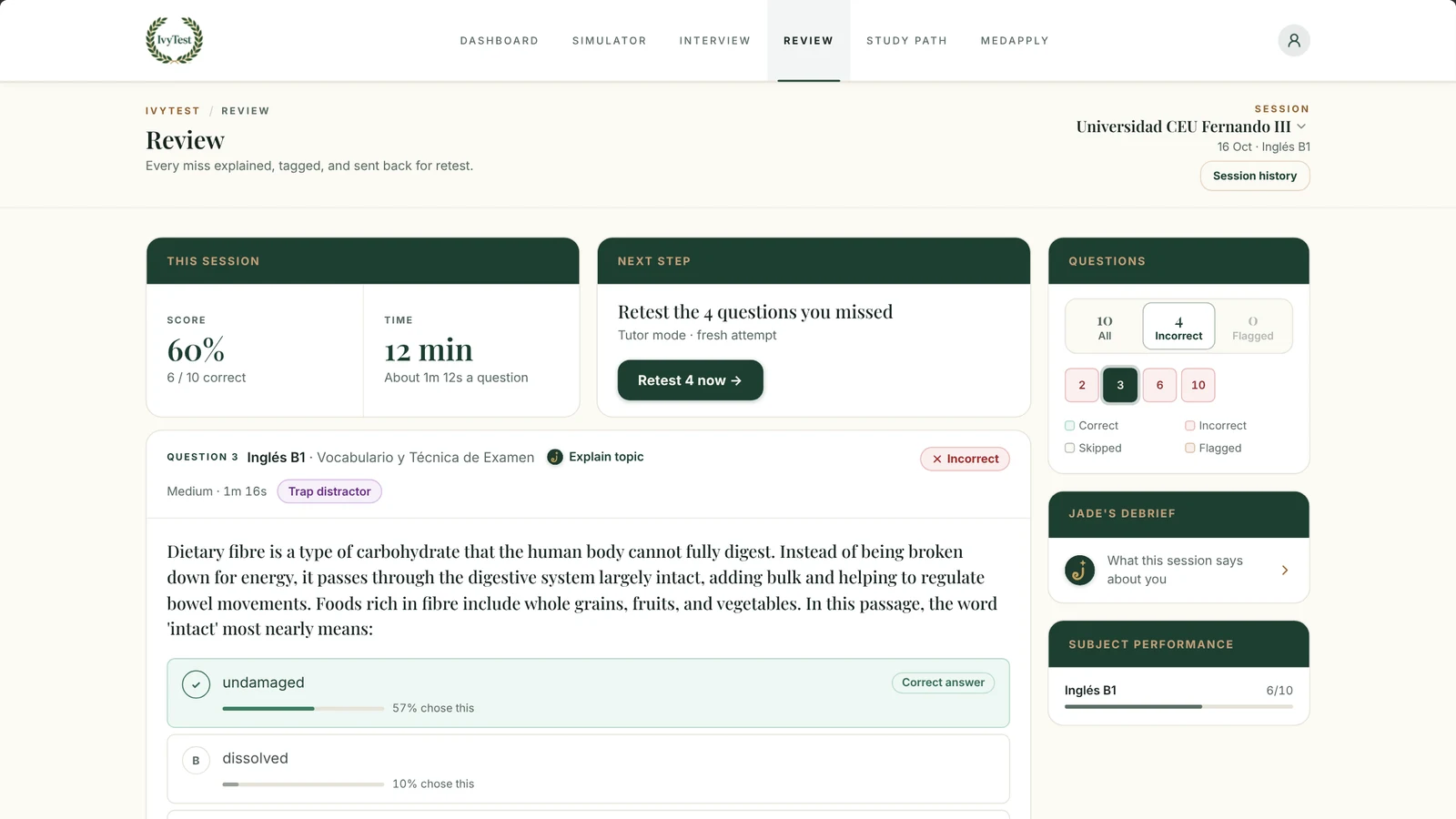
Yes. The IvyTest simulator runs practice in UF3's confirmed format (four options, exactly one correct, +1/0/0 marking) with each block reported separately, in timed, tutor and review modes, and a free diagnostic available without payment. It still files the fourth block under its 2026/27 label, Razonamiento Científico, and does not yet include ethics questions. Where UF3 publishes no figure, such as the paper length or the duration, the simulator states which value it is assuming rather than presenting it as fact.
There are two sittings for 2027/28, both on the Bormujos campus: applications from 15 October 2026 to 31 January for the exam on 6 February 2027 (results on 11 February, preadmissions on 12 February), and from 15 February to 28 March for the exam on 3 April 2027 (results on 8 April, preadmissions on 9 April). UF3's brochure prints the days without the year. The first sitting gives up to 70% of the preadmissions; take both and the higher mark counts. Each sitting costs €80.
UF3's 2027/28 contents PDF lists four blocks, all multiple choice with four options and one correct answer: Biología of 2º de Bachillerato (LOMLOE), 35%; Química of 2º de Bachillerato (LOMLOE), 25%; English at B1 level of the Common European Framework, 20%; and Razonamiento y Ética, 20%. Together they are 40% of the admission mark. The Biología and Química modules are listed in the syllabus section above; UF3 gives no topic list for English or for reasoning and ethics.
UF3 publishes no nota de corte for Medicine, and with its first students admitted for 2025/2026 there is no history to infer one from. Candidates are ranked for the 120 places on the admission mark: 60% your 1º de Bachillerato average and 40% the tests, plus up to 2 extra points. PEvAU (selectividad) marks do not count towards the ranking, although candidates in the Spanish system must still pass its general phase.
No. UF3's 2027/28 admission brochure answers the question itself: "No, no tenemos exámenes de años anteriores. El temario se encuentra publicado en la web." The temario it means is the contents PDF linked from its Medicine page, which lists the blocks, their weights and the Biología and Química topics; there is still no sample test or past paper. The practice questions on this page and in the IvyTest simulator are IvyTest's own, written to UF3's published format.
Six years and 360 ECTS: 91.5 credits of basic training, 181.5 compulsory, 9 optional, 69 of external placements and a 6-credit final project, as UF3's plan de estudios page lists them. The first year includes Bioquímica, Biología Molecular y Biología Celular I and II, the structure and function of the human body and of its locomotor, urinary and reproductive, respiratory and cardiovascular systems, Claves de Historia Contemporánea, and Psicología, Ética y Comunicación Asistencial. The programme page counts 1,665 hours of clinical practice and a Simulation Hospital.
€15,500 for the first year in 2026/27, on UF3's prices page: a €1,950 place reservation, €650 enrolment and 60 credits at €215 (€12,900), which the page says can be split into up to 9 instalments. The admission test costs €80 per sitting. For 2026/27, UF3 also offered six Fundación Nemesio Díez scholarships of €12,900 and 10 CEU Merit Medicina scholarships of 35% off tuition for an access mark of at least 9. The 2027/28 prices are not yet published.
School leavers apply with Bachillerato, a higher vocational qualification (CFGS) or an equivalent foreign qualification, upload their ID and 1º de Bachillerato average, and sit the admission test. In the Spanish system you must also pass the PEvAU; from another system you need the Credencial de Homologación and an equivalence report giving your penultimate-year average on the Spanish 1 to 10 scale. Biosanitary graduates (3 places, an average of at least 7) and transfer students (3 places, between 30 and 180 ECTS recognised) do not sit the exam.
UF3's 2027/28 brochure gives two dates for each sitting, one for the exam results and one for the preadmissions: results on 11 February and preadmissions on 12 February for the 6 February exam, results on 8 April and preadmissions on 9 April for the 3 April exam. Candidates follow the process in their 'futuro alumno' portal. A preadmitted candidate has at most 5 days to pay the place reservation, or the place goes to the next on the waiting list; a candidate on the first sitting's waiting list may sit the second, and the higher mark counts. Preadmitted candidates in the Spanish system must also show they have passed the general phase of the PEvAU.
Verification
Official sources
- Contenido del examen de admisión al Grado en Medicina (official contents PDF for 2027/28, created 15 October 2026): four-option items with one correct, and the blocks Biología 35%, Química 25%, Inglés B1 20% and Razonamiento y Ética 20%Checked: 17 October 2026
Universidad CEU Fernando III
- Checked: 17 October 2026
- Grado en Medicina programme page: 120 places, Spanish, "Admisión Abierta para el curso 2027/2028"Checked: 17 October 2026
Universidad CEU Fernando III
- Precios curso 26-27: Grado en Medicina €1,950 reservation, €650 enrolment, €215 per credit, €15,500 first yearChecked: 17 October 2026
Universidad CEU Fernando III
- Currículo de Biología y de Química, 2º de Bachillerato (LOMLOE): the official syllabi UF3's contents PDF namesChecked: 5 October 2026
Boletín Oficial del Estado
- Grado en Medicina, Plan de Estudios: 360 ECTS over six years (91.5 basic, 181.5 compulsory, 9 optional, 69 external placements, 6 final project) and the subjects of each yearChecked: 12 October 2026
Universidad CEU Fernando III
- Grado en Medicina, Calidad y Normativa: academic year of implantation 2025, and ACCUA's verification report (favourable, May 2025)Checked: 12 October 2026
Universidad CEU Fernando III
- Becas y Ayudas: Fundación Nemesio Díez scholarships (six of €12,900 for first-year Medicine) and the CEU Merit Medicina scholarshipsChecked: 12 October 2026
Universidad CEU Fernando III
- Bases de las Becas CEU Merit Program Medicina 2026-2027: 10 scholarships of 35% off tuition for an access mark of at least 9 out of 10Checked: 12 October 2026
Universidad CEU Fernando III
- Bases de las Becas Fundación Nemesio Díez & CEU UF3 2026-2027: six scholarships of €12,900 for first-year Medicine, on academic record and financial and family circumstances, with two compulsory interviewsChecked: 12 October 2026
Universidad CEU Fernando III
- Portal del Futuro Alumno: the documents for an application to Medicine (ID or passport, 1º de Bachillerato average, an equivalence report for a foreign system)Checked: 12 October 2026
Universidad CEU Fernando III
- RUCT, Graduado o Graduada en Medicina por la Universidad CEU Fernando III (code 1500370): substantial modification in effect from 18 June 2026; 120 first-year places, taught in SpanishChecked: 12 October 2026
Ministerio de Ciencia, Innovación y Universidades
- Medical Act 1983, section 21B: registration with a relevant European qualification, without the knowledge test, for applications made since IP completion day (Brexit)Checked: 12 October 2026
legislation.gov.uk (The National Archives)
- Directive 2005/36/EC on the recognition of professional qualifications, consolidated text of 29 October 2025, Annex V point 5.1.1 (Spain: Título de Licenciado en Medicina y Cirugía, Licenciado en Medicina or Graduado/a en Medicina, no accompanying certificate)Checked: 12 October 2026
Publications Office of the European Union (EUR-Lex)
- Evidence of qualifications from SpainChecked: 12 October 2026
General Medical Council (GMC)
Last reviewed by IvyTest editorial team: 17 October 2026. Admission rules change every cycle — always confirm against the official Universidad CEU Fernando III call for applications before acting on a deadline.
Find out how ready you are for the CEU Fernando III test.
The diagnostic takes one sitting, reports each block separately, and lets you weight them the way UF3's 2027/28 formula does. No payment, no commitment.