Ethics and religious culture · 2027/28 reading list

Dignitas Personae for the Cattolica Medicine Test

Dignitas Personae, the 2008 Instruction of the Congregation for the Doctrine of the Faith on certain bioethical questions, is one of the three texts Università Cattolica recommends for the ethics and religious culture questions of the 2027/28 Medicine and Surgery test. It was on the 2026/27 list and stays on it unchanged, while Magnifica Humanitas has replaced Laudato Si'. This page summarises it part by part from the official text, with the paragraph numbers behind every point, says what the test can ask of it, and ends with ten practice questions in the exam's format.

Dignitas Personae

What it is

Issued by
The Congregation for the Doctrine of the Faith, signed by William Card. Levada, Prefect, and Luis F. Ladaria, S.I., Secretary
Full title
Instruction Dignitas Personae on Certain Bioethical Questions
Date and approval
Approved by Pope Benedict XVI in an audience on 20 June 2008, who ordered its publication; dated Rome, 8 September 2008, Feast of the Nativity of the Blessed Virgin Mary
Structure
An introduction, three parts and a conclusion: 37 numbered paragraphs (§3)
Addressed to
The Catholic faithful and all who seek the truth (§3); it brings the 1987 Instruction Donum vitae up to date (§1)
On the test
One of three recommended texts for the 5 ethics and religious culture questions of 65

Read the full text on vatican.va

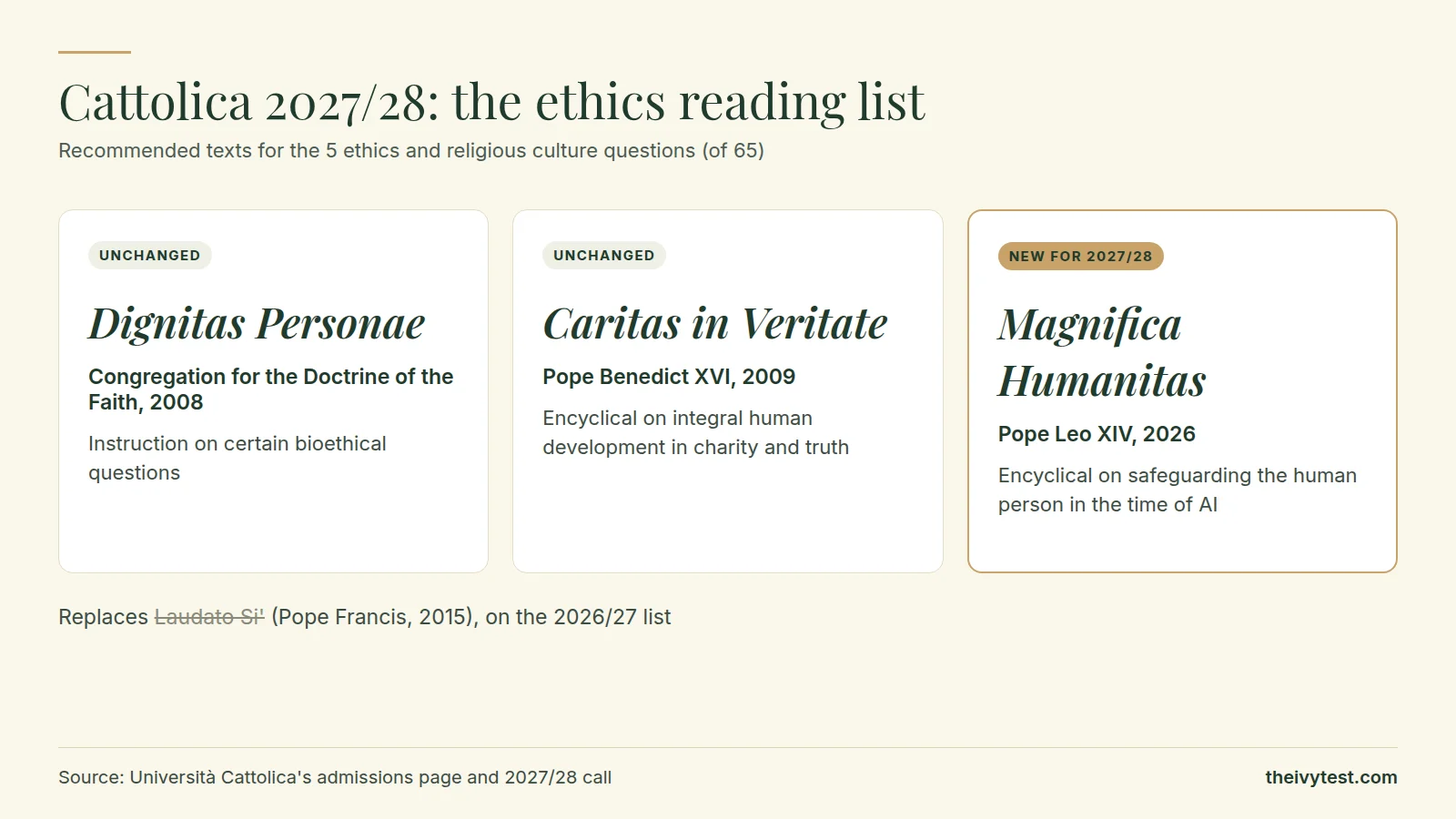
Cattolica's 2027/28 ethics and religious culture reading list, for 5 of the 65 questions: Dignitas Personae (Congregation for the Doctrine of the Faith, 2008), Caritas in Veritate (Benedict XVI, 2009) and, new, Magnifica Humanitas (Leo XIV, 2026), which replaces Laudato Si' (Francis, 2015) from the 2026/27 list.

Ethics and religious culture · 2027/28 reading list

The Instruction, part by part

Each section follows the Instruction's own order; the numbers in brackets are its paragraphs, so you can check every point against the text.

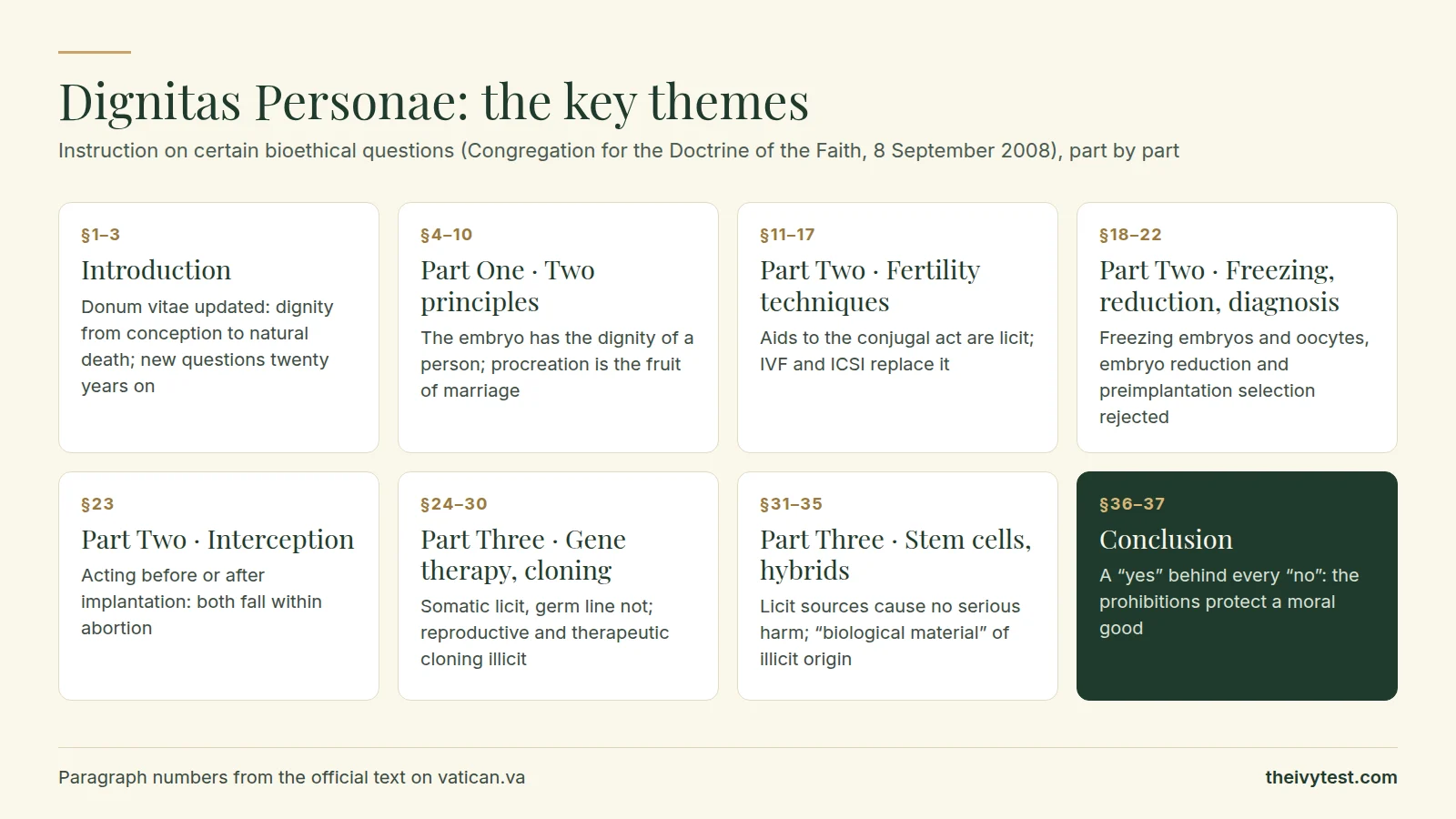
Dignitas Personae, key themes by part: Introduction (§1–3), bringing Donum vitae up to date; Part One (§4–10), the two principles, the dignity of the person from conception and procreation as the fruit of marriage; Part Two on fertility techniques (§11–17), aids to the conjugal act, IVF and ICSI, on frozen embryos and oocytes, embryo reduction and preimplantation diagnosis (§18–22), and on interception and contragestation (§23); Part Three on gene therapy and cloning (§24–30), somatic and germ line, reproductive and therapeutic, and on stem cells, hybrids and biological material of illicit origin (§31–35); Conclusion (§36–37), a great yes behind every no.

Introduction: bringing Donum vitae up to date §1–3

The Instruction opens with its fundamental principle: "The dignity of a person must be recognized in every human being from conception to natural death" (§1). Twenty years after Donum vitae (1987), whose teaching "remains completely valid", the Congregation addresses the questions raised by new biomedical technologies, above all research on human embryos, the use of stem cells for therapy and other areas of experimental medicine (§1). It drew on the Pontifical Academy for Life, on scientific experts and on John Paul II's Veritatis splendor and Evangelium vitae (§2), and it notes both those who see medicine as a service to human fragility "in the spirit of the Hippocratic Oath" and those who view biomedical advances from "an essentially eugenic perspective" (§2).

The Church draws on "the light both of reason and of faith" (§3). She "views scientific research with hope", hopes that its results will reach poor regions afflicted by disease, and seeks to bring comfort, light and hope to those who suffer (§3). The Instruction is addressed to "the Catholic faithful and to all who seek the truth" and has three parts: anthropological, theological and ethical elements; new problems regarding procreation; and new procedures involving the manipulation of embryos and the human genetic patrimony (§3).

Part One: anthropological, theological and ethical aspects of human life and procreation §4–10

Advances in medicine are positive when they "serve to overcome or correct pathologies" and negative when they destroy human beings or use means contrary to the dignity of the person (§4); the human body, from its first stages, "can never be reduced merely to a group of cells" (§4). The first principle is Donum vitae's criterion: the fruit of human generation, "from the moment the zygote has formed, demands the unconditional respect that is morally due to the human being in his bodily and spiritual totality" (§4). Reason can recognise it as part of the natural moral law, and it "should be the basis for all legislation in this area" (§5). Donum vitae did not define the embryo as a person, but the human being's reality excludes "either a change in nature or a gradation in moral value": "The human embryo has, therefore, from the very beginning, the dignity proper to a person" (§5).

The second principle concerns the origin of life, which "has its authentic context in marriage and in the family": responsible procreation "must be the fruit of marriage" (§6). Faith receives what is human and also "purified, elevated and perfected" it; in the Incarnation the Son of God confirmed the dignity of body and soul, so there is "no contradiction between the affirmation of the dignity and the affirmation of the sacredness of human life" (§7). "This value belongs to all without distinction", and discrimination based on "biological, psychological, or educational development, or based on health-related criteria, must be excluded" (§8). The acts by which a man and a woman give themselves to each other are a reflection of trinitarian love (§9).

The Church "does not intervene in the area proper to medical science itself" but recalls that the ethical value of biomedical science "is gauged in reference to both the unconditional respect owed to every human being at every moment of his or her existence, and the defense of the specific character of the personal act which transmits life" (§10).

Part Two: new problems concerning procreation §11–23

Infertility treatments must respect three goods: the right to life and physical integrity of every human being from conception to natural death, the unity of marriage, and the specifically human values of sexuality (§12). They "are not to be rejected on the grounds that they are artificial", but all heterologous techniques, and homologous ones "which substitute for the conjugal act, are to be excluded", while techniques that aid the conjugal act are permitted (§12). Treatments "aimed at removing obstacles to natural fertilization" (hormonal treatment, surgery for endometriosis, unblocking the fallopian tubes) are licit; adoption and the prevention of sterility should be encouraged (§13).

Experience has shown that "all techniques of in vitro fertilization proceed as if the human embryo were simply a mass of cells to be used, selected and discarded": about a third of women have a baby, but the number of embryos sacrificed "is extremely high" (§14). Many losses are "foreseen and willed", and multiple embryo transfer "implies a purely utilitarian treatment of embryos" (§15). The Church "recognizes the legitimacy of the desire for a child", but it "cannot justify the 'production' of offspring" (§16). ICSI, a variety of IVF, is "intrinsically illicit" because it separates procreation completely from the conjugal act (§17). Freezing embryos "is incompatible with the respect owed to human embryos" (§18). For those already frozen, the Instruction rejects research, treatment, donation to infertile couples and, despite its good intention, "prenatal adoption": they are "a situation of injustice which in fact cannot be resolved" (§19). Freezing oocytes for artificial procreation is "morally unacceptable" (§20).

Embryo reduction is "an intentional selective abortion", and neither analogies with disasters nor the principles of the lesser evil or double effect justify it: "the end does not justify the means" (§21). Preimplantation diagnosis "is directed toward the qualitative selection and consequent destruction of embryos" and is "the expression of a eugenic mentality" (§22); "sick and disabled people are not some separate category of humanity" (§22). Interceptive methods act on the embryo before implantation and contragestative ones eliminate it once implanted; both "fall within the sin of abortion and are gravely immoral" (§23).

Part Three: new treatments which involve the manipulation of the embryo or the human genetic patrimony §24–35

Research on embryonic stem cells has so far produced no effective results, "as distinct from research on adult stem cells" (§24). In gene therapy, "Procedures used on somatic cells for strictly therapeutic purposes are in principle morally licit", with proportionate risks and informed consent (§26); germ line changes pass to offspring with risks not yet controllable, so "in its current state, germ line cell therapy in all its forms is morally illicit" (§26). Genetic engineering to improve the gene pool "would promote a eugenic mentality", and in it "man tries to take the place of his Creator" (§27).

Human cloning, the "asexual or agametic reproduction of the entire human organism", is "intrinsically illicit" because it gives rise to a new human being without any link to the spouses' self-giving or to sexuality (§28). Reproductive cloning would impose "a form of biological slavery" (§29); "so-called therapeutic cloning is even more serious", because "To create embryos with the intention of destroying them, even with the intention of helping the sick, is completely incompatible with human dignity" (§30). For alternative techniques whose product's status is in doubt, the Instruction recalls Evangelium vitae: "the mere probability that a human person is involved would suffice to justify an absolutely clear prohibition of any intervention aimed at killing a human embryo" (§30).

"Methods which do not cause serious harm to the subject from whom the stem cells are taken are to be considered licit": adult tissues, cord blood at birth, fetuses who died of natural causes; taking them from a living embryo is "gravely illicit", and research on adult stem cells "should be encouraged and supported" (§32). Hybrid cloning with animal oocytes is "an offense against the dignity of human beings" (§33). On "biological material" of illicit origin, the criterion of independence "is necessary, but may be ethically insufficient"; there are "differing degrees of responsibility", and "danger to the health of children could permit parents to use a vaccine which was developed using cell lines of illicit origin", while making their disagreement known (§34–35).

Conclusion: a great "yes" behind every "no" §36–37

To those who say the Church's moral teaching contains "too many prohibitions", the Instruction answers that it rests on "the recognition and promotion of all the gifts which the Creator has bestowed on man: such as life, knowledge, freedom and love", and that "the legitimacy of every prohibition is based on the need to protect an authentic moral good" (§36). As a century ago for the working classes, the Church speaks "on behalf of those who have no voice" (§37). "Behind every 'no' in the difficult task of discerning between good and evil, there shines a great 'yes'" to the dignity of every human being; the faithful are asked to receive the Instruction "with the religious assent of their spirit" and to promote "a new culture of life" (§37).

Cattolica Medicine Test

What the test can ask of it

The 2027/28 call sets 5 ethics and religious culture questions out of 65, each with five options and one correct answer, at +1 for a correct answer, −0.25 for a wrong one and 0 for a blank, and it sends candidates to the texts the university recommends. Nobody knows what will be asked of this Instruction. From the format alone, a candidate should be able to:

  • say what the Instruction is, who issued it and when, how it relates to Donum vitae, and tell it apart from Caritas in Veritate and Magnifica Humanitas;
  • state its two fundamental principles: the dignity of the person from conception, and procreation as the fruit of marriage and of the conjugal act;
  • recognise its evaluations of fertility techniques: treatments that remove obstacles to natural fertility, and IVF, ICSI, the freezing of embryos and oocytes, embryo reduction, preimplantation diagnosis, interception and contragestation;
  • apply the distinctions of its third part: somatic and germ line gene therapy, reproductive and therapeutic cloning, licit and illicit sources of stem cells, hybrids and the use of "biological material" of illicit origin.

Ethics and Religious Culture

10 practice questions

In the Cattolica format: five options, one correct. Each answer cites the paragraphs it rests on. They were written for this page; they are not past exam questions.

Question 1

Ethics and Religious Culture · Bioethics and the Dignity of the Person · Standard

According to Dignitas Personae, the ethical value of biomedical science is gauged in reference to:

Show answer and explanation

Answer: C

The ethical value of biomedical science "is gauged in reference to both the unconditional respect owed to every human being at every moment of his or her existence, and the defense of the specific character of the personal act which transmits life" (§10). These are the two principles of the first part: the embryo "demands the unconditional respect that is morally due to the human being" from the zygote on (§4), and procreation "must be the fruit of marriage" (§6). Informed consent and proportionate risk (A) are conditions the Instruction sets for somatic gene therapy (§26), not the measure of biomedicine as a whole, and the Church says it "does not intervene in the area proper to medical science itself" (§10).

Question 2

Ethics and Religious Culture · Bioethics and the Dignity of the Person · Standard

Which statement about the human embryo matches the teaching of Dignitas Personae?

Show answer and explanation

Answer: A

"The human embryo has, therefore, from the very beginning, the dignity proper to a person" (§5). The reality of the human being before and after birth "does not allow us to posit either a change in nature or a gradation in moral value" (§5), which rules out B and D. Donum vitae, "in order to avoid a statement of an explicitly philosophical nature, did not define the embryo as a person" (C), and "the presence of the spiritual soul cannot be observed experimentally" (E), although science gives "a valuable indication" of a personal presence (§5).

Question 3

Ethics and Religious Culture · Bioethics and the Dignity of the Person · Standard

Which of these fertility treatments does Dignitas Personae consider licit?

Show answer and explanation

Answer: E

Techniques "aimed at removing obstacles to natural fertilization", such as hormonal treatments, surgery for endometriosis and the "unblocking of fallopian tubes or their surgical repair, are licit", because none of them "replaces the conjugal act" (§13). All heterologous techniques, and homologous ones "which substitute for the conjugal act, are to be excluded" (§12), which rules out A and B. ICSI is "intrinsically illicit" like the IVF of which it is a variety (§17), and freezing oocytes for artificial procreation "is to be considered morally unacceptable" (§20).

Question 4

Ethics and Religious Culture · Bioethics and the Dignity of the Person · Standard

What, according to Dignitas Personae, has subsequent experience shown about in vitro fertilisation?

Show answer and explanation

Answer: B

Some held that the destruction of embryos was due to imperfect techniques, but "Subsequent experience has shown, however, that all techniques of in vitro fertilization proceed as if the human embryo were simply a mass of cells to be used, selected and discarded" (§14), which rules out A. About "a third of women" succeed in having a baby (§14), not most (D). To the objection that the risks are those of natural procreation, the Instruction answers that "in many cases the abandonment, destruction and loss of embryos are foreseen and willed" (§15), and "The desire for a child cannot justify the 'production' of offspring" (§16).

Question 5

Ethics and Religious Culture · Bioethics and the Dignity of the Person · Standard

What does Dignitas Personae conclude about the thousands of frozen embryos already in existence?

Show answer and explanation

Answer: D

The Instruction concludes that "the thousands of abandoned embryos represent a situation of injustice which in fact cannot be resolved", which is why John Paul II appealed for "the production of human embryos" to be halted (§19). Using them for research or treatment is "obviously unacceptable" because it treats them as "biological material" (A), and thawing them for research "as if they were normal cadavers, is also unacceptable" (B); giving them to infertile couples is "not ethically acceptable" (C); prenatal adoption is "praiseworthy with regard to the intention" but "presents however various problems" (E) (§19).

Question 6

Ethics and Religious Culture · Bioethics and the Dignity of the Person · Standard

Which of the following does Dignitas Personae judge to be, in principle, morally licit?

Show answer and explanation

Answer: A

"Procedures used on somatic cells for strictly therapeutic purposes are in principle morally licit", provided the risks are not disproportionate and there is informed consent (§26). Embryo reduction "is an intentional selective abortion" (§21); preimplantation diagnosis "is directed toward the qualitative selection and consequent destruction of embryos, which constitutes an act of abortion" (§22); interception and contragestation "fall within the sin of abortion and are gravely immoral" (§23).
Question 7

Ethics and Religious Culture · Bioethics and the Dignity of the Person · Standard

Why does Dignitas Personae hold that germ line cell therapy, in its current state, is morally illicit?

Show answer and explanation

Answer: D

Modifications to germ cells "will be transmitted to any potential offspring", and because the risks "are considerable and as yet not fully controllable" it is not permissible to risk harm to the progeny; on the embryo it would also need IVF. So "in its current state, germ line cell therapy in all its forms is morally illicit" (§26). Somatic gene therapy is in principle licit (§26), so A is wrong. Germ line therapy aims at "correcting genetic defects" (§25); improving the gene pool is the separate question of §27 (C). Gene therapy can be done "on a fetus before his or her birth" as well as after (§25), so E is wrong, and its use for cancer concerns non-inherited disease (§25).

Question 8

Ethics and Religious Culture · Bioethics and the Dignity of the Person · Standard

Why does Dignitas Personae judge so-called therapeutic cloning to be even more serious than reproductive cloning?

Show answer and explanation

Answer: E

In the Instruction's words, "so-called therapeutic cloning is even more serious": "To create embryos with the intention of destroying them, even with the intention of helping the sick, is completely incompatible with human dignity" (§30). The "predetermined genetic identity", "a form of biological slavery", is the Instruction's objection to reproductive cloning (§29), so D describes the other kind. Mixing human and animal genetic elements is hybrid cloning (§33). The bans in "the great majority of nations" (§28) are noted, but they are not the reason given, and success rates are not discussed.

Question 9

Ethics and Religious Culture · Bioethics and the Dignity of the Person · Standard

According to Dignitas Personae, a method of obtaining stem cells is licit when:

Show answer and explanation

Answer: C

"Methods which do not cause serious harm to the subject from whom the stem cells are taken are to be considered licit": tissues from an adult organism, umbilical cord blood at birth and fetuses who died of natural causes; taking them from a living embryo is "gravely illicit" (§32). Embryonic cells were thought more versatile, but the Instruction reports that adult cells "give more positive results" (§31), so capacity (A) is not the test. Embryonic cells obtained from others or "commercially available" still raise "cooperation in evil and scandal" (§32) (B); the criterion of independence is "ethically insufficient" (§35) (D); hybrid cloning with animal oocytes is "an offense against the dignity of human beings" (§33) (E).

Question 10

Ethics and Religious Culture · Bioethics and the Dignity of the Person · Standard

On the use of "biological material" of illicit origin, such as certain cell lines, what does Dignitas Personae hold?

Show answer and explanation

Answer: B

"Grave reasons may be morally proportionate to justify the use of such 'biological material'": "danger to the health of children could permit parents to use a vaccine which was developed using cell lines of illicit origin", while everyone has the duty to make known their disagreement (§35). The criterion of independence "is necessary, but may be ethically insufficient" (A), and there is a duty to refuse such material "even when there is no close connection" with those who produced it (C). The duty concerns researchers' "ordinary professional activities", not opposing every illicit act (D), and "there exist differing degrees of responsibility" (E) (§35).

Ethics and religious culture · 2027/28 reading list

The other two texts on the list

Dignitas Personae and Caritas in Veritate stay on the 2027/28 list; Magnifica Humanitas is new, in place of Laudato Si'.