Ethics and religious culture · 2027/28 reading list

Caritas in Veritate for the Cattolica Medicine Test

Caritas in Veritate is Pope Benedict XVI's 2009 encyclical on integral human development in charity and truth, written more than forty years after Paul VI's Populorum Progressio. It is on Università Cattolica's reading list for the ethics and religious culture questions of the 2027/28 Medicine and Surgery test, unchanged from 2026/27, while Magnifica Humanitas has replaced Laudato Si'. This page summarises it chapter by chapter from the official text, with the paragraph numbers behind every point, says what the test can ask of it, and ends with ten practice questions in the exam's format.

Caritas in Veritate

What it is

Author
Pope Benedict XVI
Full title
Encyclical Letter Caritas in Veritate on Integral Human Development in Charity and Truth
Signed
Rome, at Saint Peter's, 29 June 2009, the Solemnity of the Holy Apostles Peter and Paul, in the fifth year of his pontificate
Structure
An introduction, six chapters and a conclusion: 79 numbered paragraphs
Addressed to
The bishops, priests and deacons, men and women religious, the lay faithful and all people of good will
On the test
One of three recommended texts for the 5 ethics and religious culture questions of 65, on the list since 2026/27

Read the full text on vatican.va

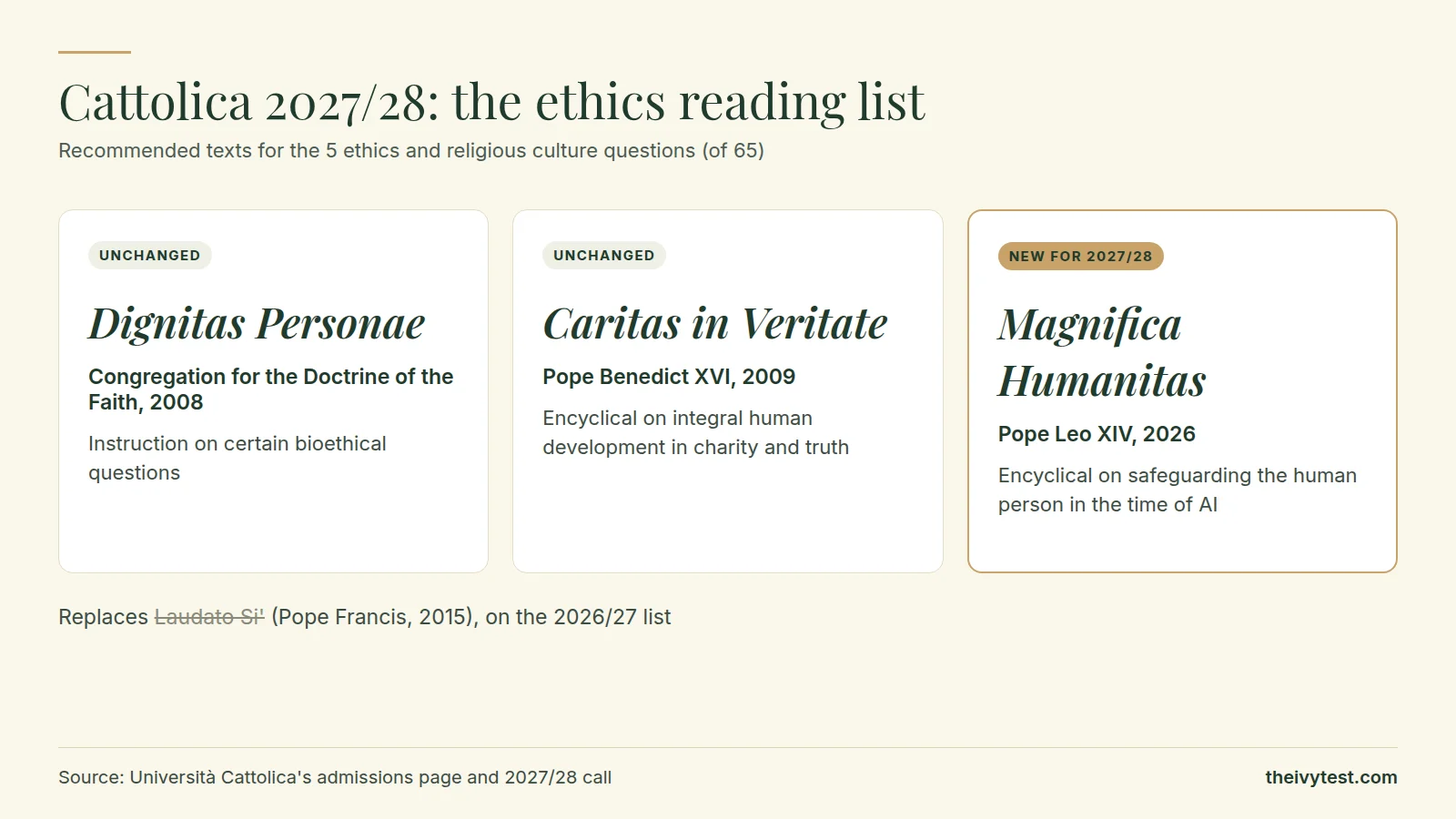
Cattolica's 2027/28 ethics and religious culture reading list, for 5 of the 65 questions: Dignitas Personae (Congregation for the Doctrine of the Faith, 2008), Caritas in Veritate (Benedict XVI, 2009) and, new, Magnifica Humanitas (Leo XIV, 2026), which replaces Laudato Si' (Francis, 2015) from the 2026/27 list.

Ethics and religious culture · 2027/28 reading list

The encyclical, chapter by chapter

Each section follows the encyclical's own order; the numbers in brackets are its paragraphs, so you can check every point against the text.

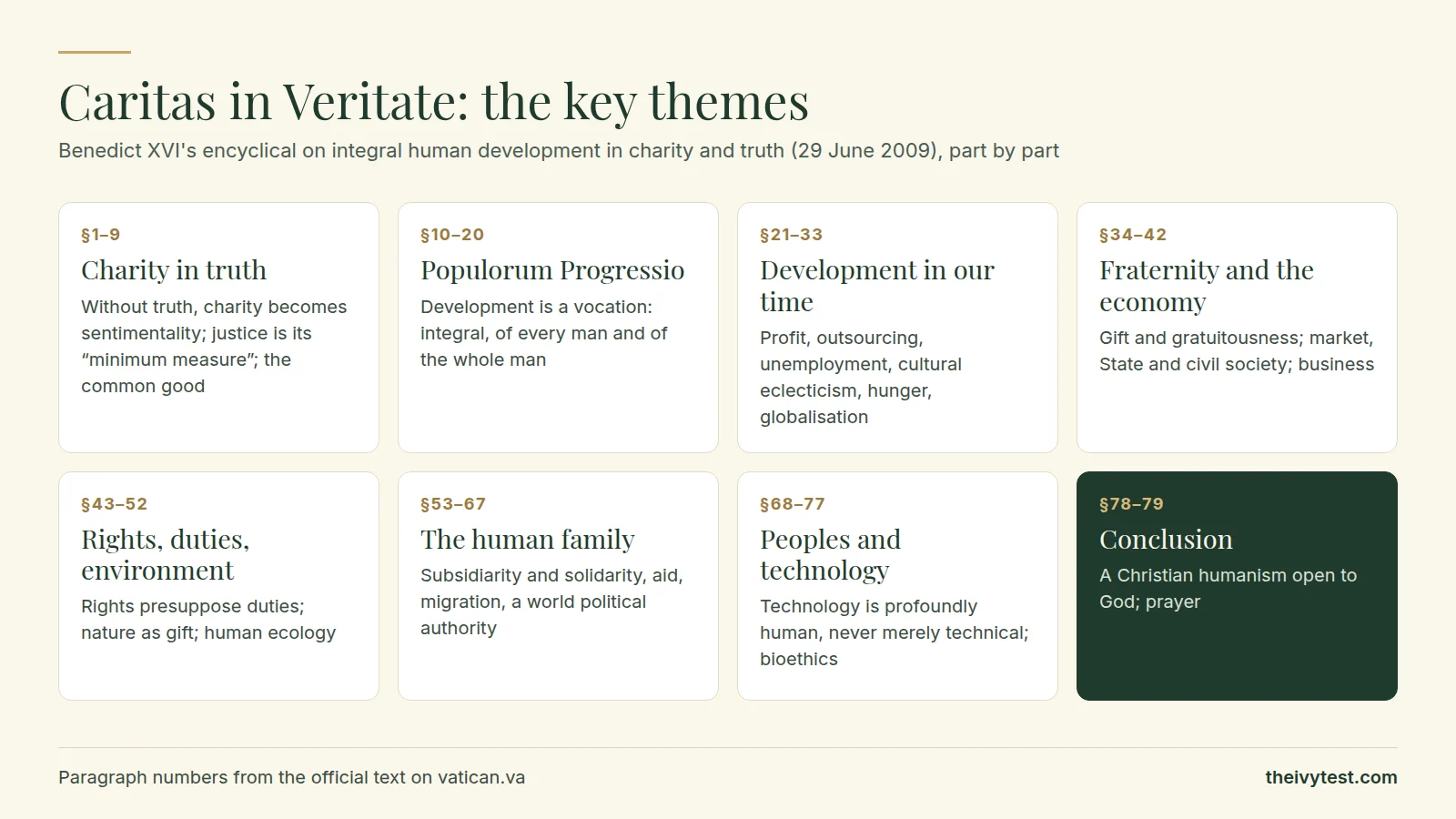
Caritas in Veritate, key themes by part: Introduction (§1–9), charity in truth, justice and the common good; Chapter 1 (§10–20), the message of Populorum Progressio and development as a vocation; Chapter 2 (§21–33), human development in our time: profit, outsourcing, unemployment, cultures, hunger and globalisation; Chapter 3 (§34–42), gift and gratuitousness, the market, the State and civil society, and business; Chapter 4 (§43–52), rights and duties, and the environment; Chapter 5 (§53–67), subsidiarity and solidarity, aid, migration and a world political authority; Chapter 6 (§68–77), technology and bioethics; Conclusion (§78–79), Christian humanism and prayer.

Introduction: charity in truth §1–9

Charity in truth "is the principal driving force behind the authentic development of every person and of all humanity" (§1). "Charity is at the heart of the Church's social doctrine" and governs not only micro-relationships but social, economic and political ones too (§2). It has to be linked with truth, both as veritas in caritate (Eph 4:15) and in the inverse order, caritas in veritate (§2): "Without truth, charity degenerates into sentimentality" (§3), and a Christianity of charity without truth would be "a pool of good sentiments" of little relevance (§4). Charity is "love received and given", and the Church's social teaching is "caritas in veritate in re sociali" (§5).

Two criteria of moral action matter most for development in a globalised society: justice and the common good (§6). Charity goes beyond justice but never lacks it: justice is "the minimum measure" of charity, which completes it "in the logic of giving and forgiving" (§6). The common good is the good of "all of us", and working for it is "the institutional path" of charity, which in a globalised society takes on the dimensions of the whole human family (§7).

The occasion is Paul VI's Populorum Progressio (1967), revisited "At a distance of over forty years" from its publication, with its hope for the "development of the whole man and of all men" (§8). The risk of our time is an interdependence of peoples not matched by ethical interaction of consciences (§9). "The Church does not have technical solutions to offer", but she does have "a mission of truth to accomplish" (§9).

Chapter One: the message of Populorum Progressio §10–20

Populorum Progressio must be read within the Tradition, outside of which it "would be a document without roots" (§10). Closely linked with the Second Vatican Council and Gaudium et Spes, it teaches two truths: the whole Church is engaged in promoting integral human development, and authentic development "concerns the whole of the person in every single dimension" (§11); "institutions by themselves are not enough, because integral human development is primarily a vocation" (§11). There is no break between pre-conciliar and post-conciliar teaching, but "a single teaching, consistent and at the same time ever new" (§12). Paul VI's wider teaching belongs with it: Octogesima Adveniens warned against the technocratic ideology (§14), Humanae Vitae linked life ethics and social ethics, and Evangelii Nuntiandi linked evangelisation and human advancement (§15).

For Paul VI "every life is a vocation" (§16), and "A vocation is a call that requires a free and responsible answer" (§17). Authentic development must be integral, "to promote the good of every man and of the whole man" (§18): "The truth of development consists in its completeness" (§18). The causes of underdevelopment are not primarily material; the most important is "the lack of brotherhood among individuals and peoples" (§19), and a globalised society "makes us neighbours but does not make us brothers" (§19). Populorum Progressio's call for urgent reform is itself a consequence of charity in truth (§20).

Chapter Two: human development in our time §21–33

Paul VI hoped to rescue peoples "from hunger, deprivation, endemic diseases and illiteracy" (§21). Profit is useful as a means, but as the exclusive goal it "risks destroying wealth and creating poverty" (§21); the development he hoped for was "real growth, of benefit to everyone and genuinely sustainable" (§21), and the current crisis becomes "an opportunity for discernment" (§21). The world's wealth grows, "but inequalities are on the increase" (§22), and the State's sovereignty is limited by the new context of international trade and finance, so its role must be re-evaluated (§24).

The search for places to outsource production at low cost has led to "a downsizing of social security systems" (§25); prolonged unemployment undermines the freedom and creativity of the person, and "the primary capital to be safeguarded and valued is man" (§25). On the cultural plane there is a twofold danger: a "cultural eclecticism" that treats cultures as equivalent and interchangeable, and "cultural levelling" (§26). Hunger depends less on a lack of material things than on a shortage of social resources, above all institutional ones, and food and water are universal rights (§27). "Openness to life is at the centre of true development" (§28), and the denial of religious freedom, by fanaticism or by practical atheism, obstructs it (§29).

"Deeds without knowledge are blind, and knowledge without love is sterile" (§30): development needs the disciplines to work together (§31), and access to steady employment for everyone remains a priority (§32). Globalisation, the principal new feature since Paul VI, is "a great opportunity", but without charity in truth it "could cause unprecedented damage and create new divisions within the human family" (§33).

Chapter Three: fraternity, economic development and civil society §34–42

"The human being is made for gift" (§34), and "Gift by its nature goes beyond merit, its rule is that of superabundance" (§34); development, to be authentically human, "needs to make room for the principle of gratuitousness as an expression of fraternity" (§34). The market rests on commutative justice, but it also needs distributive and social justice, and without trust it "cannot completely fulfil its proper economic function" (§35). It is not negative by nature: "it is not the instrument that must be called to account, but individuals" (§36), and "every economic decision has a moral consequence" (§37).

John Paul II spoke of "a system with three subjects: the market, the State and civil society" (§38). Today "without gratuitousness, there can be no justice in the first place" (§38), and "The exclusively binary model of market-plus-State is corrosive of society" (§39). Business risks being answerable only to its investors, and outsourcing can weaken its responsibility to workers, suppliers, consumers, the environment and society (§40); "investment always has moral, as well as economic significance" (§40). The State is not to be declared dead too soon, and political authority should be dispersed over several levels (§41). Globalisation, "a priori, is neither good nor bad. It will be what people make of it" (§42).

Chapter Four: the development of people, rights and duties, the environment §43–52

Many people claim only rights, but "rights presuppose duties, if they are not to become mere licence" (§43), and "The sharing of reciprocal duties is a more powerful incentive to action than the mere assertion of rights" (§43). "To consider population increase as the primary cause of underdevelopment is mistaken" (§44); the encyclical asks for responsible procreation and policies supporting the family founded on marriage (§44). The economy needs "an ethics which is people-centred" (§45), and since the word "ethical" can be abused, the whole economy, not just some sectors, should be ethical (§45). A broad area between profit and non-profit enterprise has emerged, including the "civil economy" and the "economy of communion" (§46), and development programmes should be planned with the people they serve, with transparent agencies (§47).

"The environment is God's gift to everyone" (§48): nature is neither an untouchable taboo nor raw material to abuse, nor "something more important than the human person" (§48), and it contains a grammar for its wise use (§48). Hoarding non-renewable energy harms poor countries, and technologically advanced societies "can and must lower their domestic energy consumption" (§49); the costs of using shared environmental resources should be borne by those who incur them (§50). When "human ecology" is respected, environmental ecology benefits, because "The book of nature is one and indivisible" (§51). Truth and love "cannot be produced: they can only be received as a gift" (§52).

Chapter Five: the cooperation of the human family §53–67

"One of the deepest forms of poverty a person can experience is isolation" (§53), and the development of peoples depends on recognising that the human race is "a single family working together in true communion" (§53), on the model of the Trinity's unity (§54). Discernment about cultures and religions is needed: "Religious freedom does not mean religious indifferentism, nor does it imply that all religions are equal" (§55); both the exclusion of religion from public life and fundamentalism block the dialogue between reason and faith (§56).

Subsidiarity is "first and foremost a form of assistance to the human person via the autonomy of intermediate bodies" (§57) and "the most effective antidote against any form of all-encompassing welfare state" (§57); it must stay linked with solidarity (§58). Aid can lock people into dependence, so it should involve local agents and civil society, and the main help is to let poor countries' products into international markets (§58). Cooperation is also an encounter of cultures, grounded in the natural law (§59); richer nations should give larger portions of their GDP to aid, perhaps through "fiscal subsidiarity" (§60); education includes the whole formation of the person, and tourism can educate or exploit (§61).

Migration is "a social phenomenon of epoch-making proportions" (§62): migrants "cannot be considered as a commodity or a mere workforce", and "Every migrant is a human person" (§62). Poverty is linked with unemployment, and the encyclical defines "decent" work (§63); unions should look beyond their own members (§64); finance must return to being an instrument of development, with micro-finance against usury (§65); purchasing is always a moral act, not only an economic one (§66). Finally, the encyclical calls for reform of the United Nations and for "a true world political authority", regulated by law and observing subsidiarity and solidarity (§67).

Chapter Six: the development of peoples and technology §68–77

We know that "we are a gift, not something self-generated" (§68), so the development of peoples goes awry if humanity thinks it can re-create itself through technology, a "Promethean presumption" (§68). Technology "is a profoundly human reality", and "technology is never merely technology" (§69); but it can become an ideology in which "truth has come to be seen as coinciding with the possible" (§70). "Development is impossible without upright men and women" (§71), peace is not a merely technical product (§72), and the media cannot be held to be morally neutral (§73).

Bioethics is "A particularly crucial battleground" between the supremacy of technology and moral responsibility, with a choice between "reason open to transcendence or reason closed within immanence" (§74). Following Paul VI, "the social question has become a radically anthropological question" (§75), as in vitro fertilisation, embryo research, cloning, eugenic programming of births and a pro-euthanasia mindset show (§75). Development must include spiritual growth, since the person is a "unity of body and soul" (§76), and it needs "new eyes and a new heart" to see in development what technology cannot give (§77).

Conclusion: Christian humanism and prayer §78–79

"Without God man neither knows which way to go, nor even understands who he is" (§78). "A humanism which excludes God is an inhuman humanism" (§78): the greatest service to development is "a Christian humanism" that enkindles charity and takes its lead from truth (§78). Development needs "Christians with their arms raised towards God in prayer" (§79); the letter closes at the end of the Pauline Year with Romans 12:9-10 and an entrustment to the Virgin Mary (§79).

Cattolica Medicine Test

What the test can ask of it

The 2027/28 call sets 5 ethics and religious culture questions out of 65, each with five options and one correct answer, at +1 for a correct answer, −0.25 for a wrong one and 0 for a blank, and it sends candidates to the texts the university recommends. It does not say what will be asked about each text, and nobody knows the questions in advance. From the format alone, a candidate should be able to:

  • say what the encyclical is about, who wrote it and when, and tell it apart from Dignitas Personae and Magnifica Humanitas;
  • explain its key terms: charity in truth, justice as the "minimum measure" of charity, the common good, development as a vocation, integral human development;
  • recognise what it takes from Populorum Progressio, and its reading of profit, globalisation, outsourcing, unemployment, cultural eclecticism and hunger;
  • apply its principles as it does: gratuitousness and the logic of gift, the market, the State and civil society, rights and duties, human ecology, subsidiarity and solidarity, and its view of technology and bioethics.

Ethics and Religious Culture

10 practice questions

In the Cattolica format: five options, one correct. Each answer cites the paragraphs it rests on. They were written for this page; they are not past exam questions.

Question 1

Ethics and Religious Culture · Charity in Truth and Integral Human Development · Standard

How does Caritas in Veritate describe the relationship between charity and justice?

Show answer and explanation

Answer: C

"Charity goes beyond justice, because to love is to give", "but it never lacks justice" (§6). Justice is "not an alternative or parallel path to charity": it is "inseparable from charity" and, in Paul VI's words, "the minimum measure" of it (§6), which rules out A and B. Charity is the principle of micro-relationships "but also of macro-relationships (social, economic and political ones)" (§2), and working for the common good is "the institutional path" of charity, to which "Every Christian is called" (§7), so D and E are wrong too.

Question 2

Ethics and Religious Culture · Charity in Truth and Integral Human Development · Standard

What does Benedict XVI say Populorum Progressio deserves to be considered?

Show answer and explanation

Answer: E

Benedict XVI calls Paul VI's 1967 encyclical "the Rerum Novarum of the present age" (§8): until Sollicitudo Rei Socialis marked its twentieth anniversary, "only Rerum Novarum had been commemorated in this way" (§8). There is "a single teaching, consistent and at the same time ever new", not a pre-conciliar and a post-conciliar one (§12), against A; outside the Tradition it would be "a document without roots" (§10), against B; it came immediately after the Council and is closely connected with it (§11), against C; and "The Church does not have technical solutions to offer" (§9), against D.

Question 3

Ethics and Religious Culture · Charity in Truth and Integral Human Development · Standard

In Caritas in Veritate, to regard development as a vocation means recognising that it:

Show answer and explanation

Answer: D

To regard development as a vocation "is to recognize, on the one hand, that it derives from a transcendent call, and on the other hand that it is incapable, on its own, of supplying its ultimate meaning" (§16), and "A vocation is a call that requires a free and responsible answer" (§17). A and E are ruled out because "no structure can guarantee this development over and above human responsibility" (§17) and "institutions by themselves are not enough" (§11). If development concerned only technical aspects, the Church "would not be entitled to speak on it" (§16), against B; underdevelopment is "not due to chance or historical necessity" (§17), against C.

Question 4

Ethics and Religious Culture · Charity in Truth and Integral Human Development · Standard

Which does Caritas in Veritate call "the primary capital to be safeguarded and valued"?

Show answer and explanation

Answer: B

The encyclical reminds governments that "the primary capital to be safeguarded and valued is man, the human person in his or her integrity" (§25), just after noting that a long time out of work "undermines the freedom and creativity of the person" (§25). It does warn that outsourcing has led to a downsizing of social security systems, with "grave danger for the rights of workers" (§25), but it does not call those systems the primary capital (C); it allows that "a certain amount of capital can do good, if invested abroad rather than at home" (§40), against A; and it criticises "an unduly rigid assertion of the right to intellectual property, especially in the field of health care" (§22), against E.

Question 5

Ethics and Religious Culture · Charity in Truth and Integral Human Development · Standard

According to Caritas in Veritate, hunger depends above all on:

Show answer and explanation

Answer: A

"Hunger is not so much dependent on lack of material things as on shortage of social resources, the most important of which are institutional" (§27), which rules out C: what is missing is a network of economic institutions able to guarantee regular access to food and water (§27). "To consider population increase as the primary cause of underdevelopment is mistaken" (§44), against B. The encyclical suggests the proper use of "traditional as well as innovative farming techniques", once tested (§27), against D, and it names "the high tariffs imposed by economically developed countries" as a cause of poverty (§33), so E reverses the text.

Question 6

Ethics and Religious Culture · Charity in Truth and Integral Human Development · Standard

Which statement about gratuitousness and justice does Caritas in Veritate make?

Show answer and explanation

Answer: D

"While in the past it was possible to argue that justice had to come first and gratuitousness could follow afterwards, as a complement, today it is clear that without gratuitousness, there can be no justice in the first place" (§38): A is the view the encyclical sets aside. Relationships of friendship, solidarity and reciprocity "can also be conducted within economic activity" (§36), against B; "attitudes of gratuitousness cannot be established by law" (§39), against C; and solidarity "cannot therefore be merely delegated to the State" (§38), against E. Hence the system of three subjects, "the market, the State and civil society" (§38).

Question 7

Ethics and Religious Culture · Charity in Truth and Integral Human Development · Standard

How does Caritas in Veritate ask us to regard nature?

Show answer and explanation

Answer: E

Nature is at our disposal "as a gift of the Creator who has given it an inbuilt order", with a grammar "which sets forth ends and criteria for its wise use" (§48). It is "contrary to authentic development to view nature as something more important than the human person" (§48), against A; without the Christian vision "we end up either considering nature an untouchable taboo or, on the contrary, abusing it" (§48), against B; the environment "is more than raw material to be manipulated at our pleasure" (§48), against C. And "The book of nature is one and indivisible": it takes in life, sexuality, marriage and the family as well (§51), against D.

Question 8

Ethics and Religious Culture · Charity in Truth and Integral Human Development · Standard

According to Caritas in Veritate, why must subsidiarity and solidarity stay linked?

Show answer and explanation

Answer: A

Subsidiarity without solidarity "gives way to social privatism", and solidarity without subsidiarity "gives way to paternalist social assistance that is demeaning to those in need" (§58). Subsidiarity is "the most effective antidote against any form of all-encompassing welfare state" (§57), against E, and a guiding criterion for cooperation between believers and non-believers (§57), against B; "the governance of globalization must be marked by subsidiarity" (§57), against C. Aid can "lock people into a state of dependence", so it must involve the receiving country's local economic agents and civil society (§58), the opposite of D.

Question 9

Ethics and Religious Culture · Charity in Truth and Integral Human Development · Standard

Caritas in Veritate describes "a true world political authority" as one that would be:

Show answer and explanation

Answer: B

To manage the global economy, bring about disarmament, food security and peace, protect the environment and regulate migration, "there is urgent need of a true world political authority", which "would need to be regulated by law, to observe consistently the principles of subsidiarity and solidarity" (§67) and to have "the authority to ensure compliance with its decisions from all parties" (§67), against E. Without it, international law "would risk being conditioned by the balance of power among the strongest nations" (§67), against C. "The integrated economy of the present day does not make the role of States redundant" (§41), against A, and the Church does not claim "to interfere in any way in the politics of States" (§9), against D.

Question 10

Ethics and Religious Culture · Charity in Truth and Integral Human Development · Standard

How does Caritas in Veritate describe technology?

Show answer and explanation

Answer: C

Technology "is a profoundly human reality, linked to the autonomy and freedom of man", and so "technology is never merely technology" (§69). It can seem self-sufficient when too much attention goes to the "how" questions and not enough to the "why" questions (§70), against B, and "when the sole criterion of truth is efficiency and utility, development is automatically denied" (§70), against D. Of the media the encyclical says "it seems quite absurd to maintain that they are neutral" (§73), against A, and it rejects the ideologies that see development as "radically anti-human and merely a source of degradation" (§14), against E.

Ethics and religious culture · 2027/28 reading list

The other two texts on the list

Caritas in Veritate stays on the list from 2026/27; Magnifica Humanitas is new, in place of Laudato Si'. Each has its own summary and practice questions here.