
"If a patient has condition X, then test Y will be positive." Test Y comes back positive for a patient. Which conclusion is certainly valid?
Exam guide · Updated for 2027 admissions
UniSR Admission Test 2027: Complete Preparation Guide
Everything you need to know about the UniSR admission test, the San Raffaele admission test for the International MD Program (IMDP), Vita-Salute San Raffaele University's English-taught Medicine and Surgery in Milan: dates, the ranking list, format, syllabus, scoring, sample questions, fees, preparation strategy and practice.
Updated for 2027 admissions · Last updated: 16 October 2026
UniSR Admission Test at a glance
Overview
What is the UniSR Admission Test (the San Raffaele IMDP test)?
Vita-Salute San Raffaele University (UniSR) runs its own admission test for the International MD Program (IMDP), its English-taught Medicine and Surgery degree in Milan: UniSR's own pages call it the IMDP admission test, and candidates often search for it as the San Raffaele admission test. It is set by the university under its Chancellor's Decree, not by the Italian Ministry, so it is a different exam from the national IMAT and from other Italian private schools' own tests.
The format is distinctive in three ways. First, it is sat from home: the test is delivered remotely, proctored through ProctorExam with the provider Selexi, rather than in an exam hall. Second, a wrong answer costs a fixed penalty of 0.25 points, so blind guessing is not a free bet; the Call does not state how many options each question has, but on a five-option paper, the format IvyTest's practice material uses, a random guess comes out exactly neutral. Third, San Raffaele runs two sessions per admissions cycle and counts whichever score is higher, which changes how you should treat the first sitting.
There is no minimum eligible score. Places are allocated purely by ranking: candidates are ordered by total score, with ties broken first on the logic and problem-solving section, then reading comprehension, then biology, chemistry, mathematics and physics in that order, and finally by age. San Raffaele's Italian-taught programme is admitted through a separate, differently structured process; this guide covers the English-taught International MD Program only.
Programmes that use the UniSR Admission Test
- International MD Program: Medicine and Surgery (English-taught, Milan)
Timeline
UniSR Admission Test 2027: dates and deadlines
When to expect your exam · 2027 start
- February 2027Expected
- March 2027Expected
Applications usually open 17 Dec 2026 (based on 2025).
Predicted from this university's past sittings until it publishes its own dates. See every university on the calendar →
- Applications open2027/28 dates not yet published
- Registration deadline2027/28 not published; 2026/27 closed at noon on 6 February 2026 (EU) and 5 February 2026 (non-EU)
- Session 12027/28 not published; 2026/27 ran 14 February 2026 (EU) and 11 February 2026 (non-EU)
- Session 22027/28 not published; 2026/27 ran 14 March 2026 (EU) and 4 March 2026 (non-EU)
- Enrolment deadline2027/28 not published; in 2026/27 online enrolment ran 1-20 July 2026, and non-EU candidates first had to confirm their place with a €1,500 advance payment by 9 April 2026
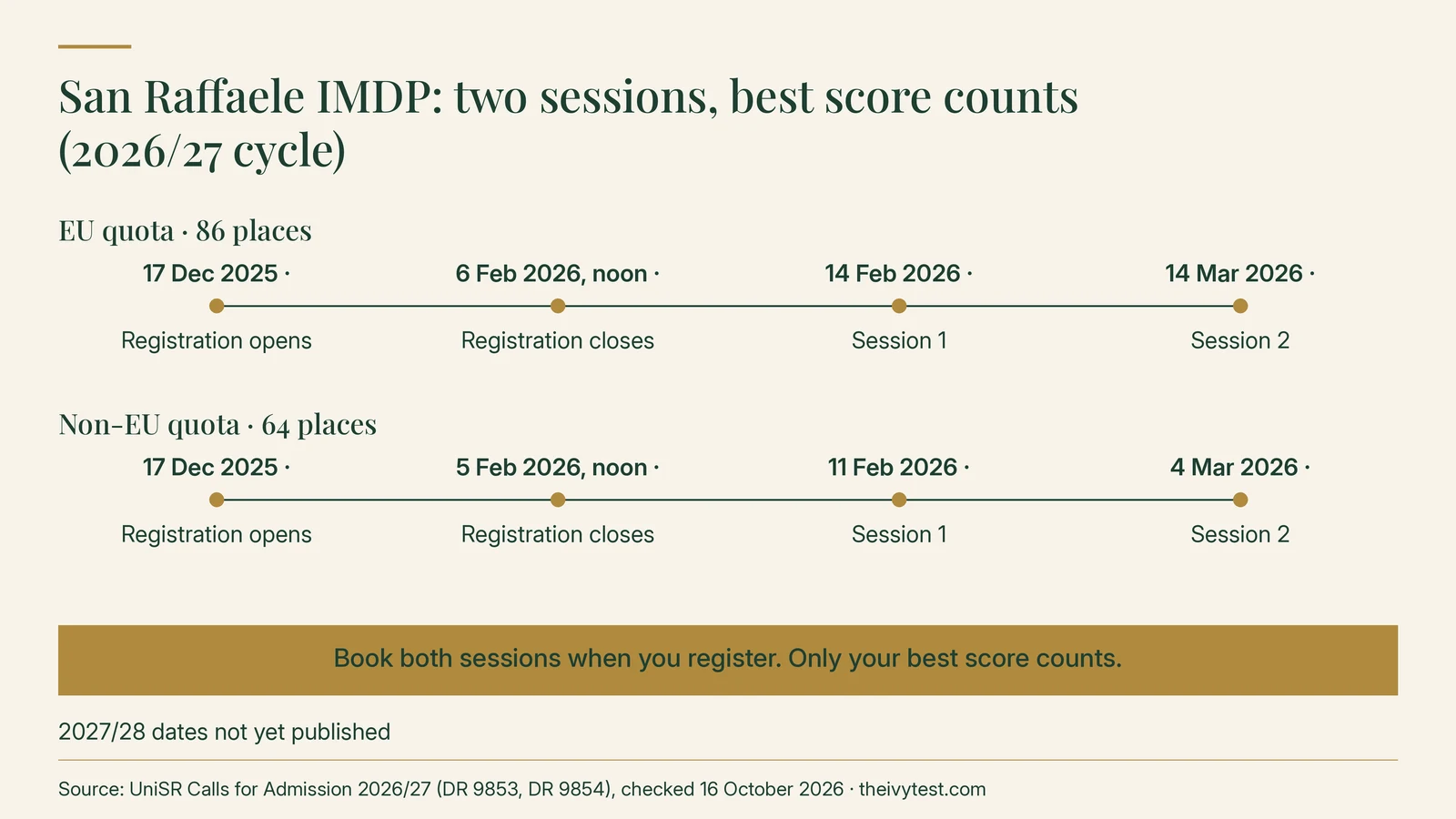
San Raffaele had not published a 2027/2028 Call for Admission as of 16 October 2026: its International MD Program admissions page still shows the 2026/2027 Calls (Chancellor's Decrees n. 9853, EU, and n. 9854, non-EU), so those are the latest published rules. They cover 2026/2027 only, and the 2027/2028 Calls may change dates, places or fees. The 2026/2027 registration opened on 17 December 2025. IvyTest reviews official UniSR announcements and updates this guide when the next Call is issued.
Structure
UniSR Admission Test format
The test is 60 scored multiple-choice questions in 80 minutes, plus 7 reserve questions used only if an item is later disqualified. It is not divided into separately timed sections: you manage the full 80 minutes across both parts yourself. Two sessions run per cycle; your better score is the one that counts.
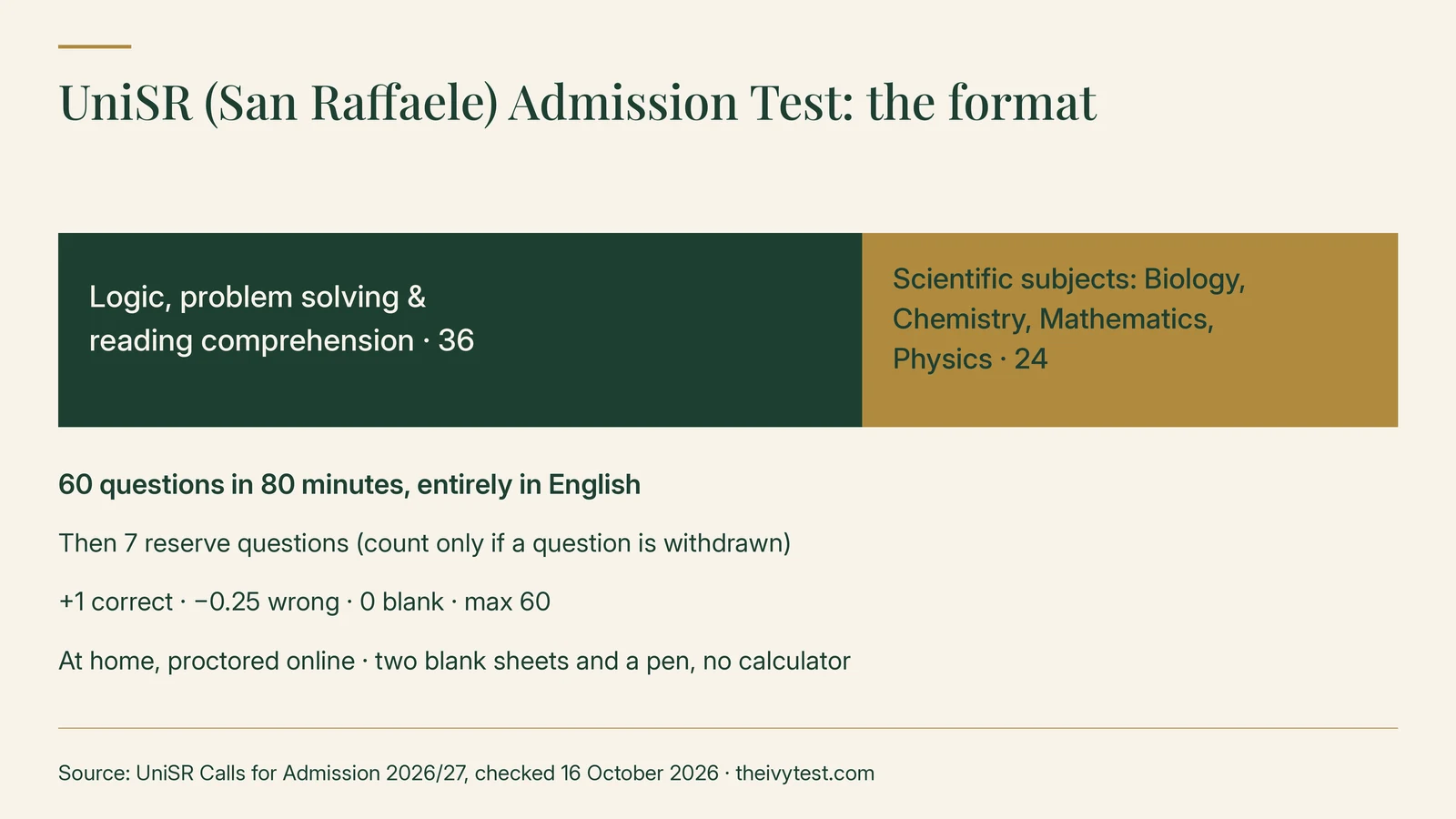
| Section | Questions | Weighting | Suggested time |
|---|---|---|---|
| Logic, Problem Solving & Reading Comprehension | 36 | 60% (36 of 60) | *see the note below the table |
| Scientific Subjects (Biology, Chemistry, Mathematics & Physics) | 24 | 40% (24 of 60) | *see the note below the table |
- UniSR does not publish separately timed sections; pacing across the 80 minutes is up to you
Content
Question and subject breakdown
San Raffaele's own Call groups its content into exactly two subjects, each covering several disciplines at once. The larger of the two, by a wide margin, is reasoning rather than science.
Logic, Problem Solving & Reading Comprehension
60%The single largest block on the paper. Formal and verbal logic, set and diagram reasoning, numerical reasoning, data interpretation, figural/abstract reasoning, and reading comprehension over short scientific and current-affairs passages.
Scientific Subjects
40%Biology, chemistry, mathematics and physics combined into one 24-question block, pitched at the level of a student finishing high school. San Raffaele publishes no breakdown of how many questions come from each of the four disciplines.
Marks
UniSR Admission Test scoring and ranking list
San Raffaele's scoring is published explicitly in its Call, and it matters more here than on a no-penalty test: a wrong answer costs 0.25 points, so blind guessing is not a way to pick up free marks (on a five-option paper, the format IvyTest's practice material uses, it is exactly break-even).
- Correct answer
- +1 point
- Incorrect answer
- −0.25 points
- Unanswered question
- 0 points
- Maximum score
- 60 points
- Minimum eligible score
- None: pure ranking, no pass/fail threshold
- Tie-break order
- Logic & problem solving → reading comprehension → biology, chemistry, mathematics, physics → younger candidate
- OFA (extra learning requirement)
- Triggered separately for any of Biology, Chemistry, Mathematics or Physics if you score below 50% correct in that specific area
Worked example
Suppose you attempt 45 of the 60 questions and leave 15 blank. Of the 45 you answer, 38 are correct and 7 are wrong. Your score is (38 × 1) + (7 × −0.25) + (15 × 0) = 38 − 1.75 = 36.25. That total is then ranked against every other candidate's best score across both sessions: there is no fixed number to clear, only a position in the list.
The IvyTest simulator scores every practice paper against these exact rules.
See the UniSR Admission Test simulatorMarks
Two sessions, best score counts: how to use them
San Raffaele gives each quota two home-based sessions in one cycle and ranks you on the better of your two scores. In 2026/27 the EU quota sat on 14 February and 14 March 2026 and the non-EU quota on 11 February and 4 March 2026, three to four weeks apart. The first three points below are the Calls' own rules; the last three are IvyTest's advice on using them.
1Book both sessions when you register
The €200 fee covers both sessions, but the Calls let you register for one or both, and only within the registration window, which closes before the first session: in 2026/27, at noon on 6 February 2026 for the EU quota and 5 February 2026 for non-EU candidates. Book both, even if you plan to do well the first time.
2After session 1 you see your score, not your mistakes
The Online Review shows only your score after the first session; the correction of your tests comes after the second. So straight after session 1, write down from memory which kinds of question you guessed, skipped or ran out of time on. That note is all you will have to plan the second attempt from.
3A breach in session 2 also costs you session 1
A breach of the testing rules in the first session bars you from the second and from the ranking; a breach in the second excludes you from the ranking and nullifies your first result too. Set up the room, camera, ID and two blank sheets exactly as the Call requires both times. A disconnection that is not your fault is different: report it to [email protected] by 23:59 on the day after the session to be considered for a spare session (in 2026/27: 18 February and 18 March for the EU quota, 16 February and 9 March 2026 for non-EU).
4Prepare for the first date, not the second
Aim to peak for session 1. A good first score takes the pressure off the second, and a poor one still leaves you a full attempt; treating the first as a rehearsal wastes one of your two chances.
5Use the weeks between them on what cost you points
Compare your session 1 score with your timed practice. If it fell well short of your practice average, the cause is usually pacing or nerves rather than knowledge, so sit more full 80-minute papers under the real penalty. If it matched your practice, the gain has to come from content, and the 36 reasoning questions are 60% of the paper.
6Sit the second session even after a good first one
Only the better score counts, so a weaker second sitting cannot lower your result; only a breach of the rules can. A second attempt costs nothing but the day, and on a list where places pass down well past the quota, a few extra points can move you a long way.
Source: UniSR's 2026/27 Calls for Admission (Chancellor's Decrees n. 9853, EU, and n. 9854, non-EU), Articles 3, 4, 6 and 11, read on 16 October 2026. The 2027/28 Calls are not yet published and may change these rules.
Syllabus
San Raffaele IMDP admission test syllabus
San Raffaele publishes no syllabus for the IMDP admission test: its Online Simulator page says that no specific syllabus is available and that the science questions are set at the level of a student finishing high school (A-level, Maturità), and the Call states only the section names and question counts. The groupings below are IvyTest's own mapping of what the test covers at that level.
Reading comprehension is scored inside this block, not as a separate subject: passage-based items belong here.
- Reading comprehension: main idea, explicit information, inference, author's purpose and tone, fact vs. opinion, vocabulary in context
- Formal logic: conditional statements, necessary vs. sufficient conditions, contrapositives and negation, quantifiers, syllogisms, chains of implication
- Verbal logic: analogies and verbal proportions, synonyms and antonyms, odd one out, cause and effect
- Set and diagram logic: Venn diagrams, inclusion/exclusion/intersection, assigning elements to regions
- Numerical reasoning: percentages, ratios and proportions, averages, speed-time-distance, basic probability, number sequences
- Data interpretation: tables, bar charts and line graphs, absolute vs. percentage change, identifying supported conclusions
- Problem solving: multi-step word problems, translating text into equations, working within stated constraints
- Figural and abstract reasoning: figure sequences, rotations and reflections, matrices, spatial pattern completion
- The chemistry of living things: water, macromolecules, enzymes, ATP
- Cell biology: prokaryotic and eukaryotic cells, membrane transport, organelles
- Cell division and genetics: mitosis and meiosis, DNA replication and the genetic code, Mendelian inheritance, pedigrees
- Metabolism and bioenergetics: respiration, fermentation, photosynthesis at concept level
- Human anatomy, physiology and homeostasis: the major organ systems and how they interact
- Evolution, ecology and biotechnology: natural selection, basic ecology and classification, recombinant DNA in outline
- Matter and atomic structure: states of matter, atomic and mass number, isotopes, electron configuration
- The periodic table and chemical bonding: groups and periods, periodic trends, ionic/covalent/metallic bonding, intermolecular forces
- Stoichiometry and solutions: the mole, balancing equations, molarity, dilution
- Acids, bases and redox: pH, buffers at basic level, oxidation number, balancing simple redox reactions
- Kinetics and equilibrium: reaction rate, catalysis, Le Chatelier's principle, exothermic vs. endothermic reactions
- Organic chemistry: functional groups, isomerism, nomenclature basics
- Numbers and algebra: powers, radicals, logarithms, polynomials, factorisation, sequences
- Equations and inequalities: first- and second-degree equations and systems, the discriminant
- Functions and graphs: domain and codomain, reading a graph, the standard function families, composite and inverse functions
- Geometry and trigonometry: polygons, circles, areas and volumes, Pythagoras and Euclid's theorems, sine/cosine/tangent, the Cartesian plane
- Probability and statistics: probability rules, basic combinatorics, frequency distributions, averages
- Measurement and kinematics: SI units, vectors, uniform and accelerated motion, circular motion
- Dynamics, work and energy: Newton's laws, momentum conservation, kinetic and potential energy
- Fluids and thermodynamics: pressure, Archimedes' and Pascal's principles, heat and calorimetry, the laws of perfect gases
- Electricity and magnetism: Coulomb's law, circuits and Ohm's law, the magnetic field of a current, electromagnetic induction
Test your UniSR Admission Test knowledge
Take free diagnosticDifficulty
How difficult is the UniSR Admission Test?
The San Raffaele test is not hard because the science is advanced: UniSR itself pitches it at final-year secondary-school level. It is hard because of how the format is built.
Reasoning dominates, not science
60% of the paper (36 of 60 questions) is logic, problem solving and reading comprehension, not biology, chemistry, mathematics or physics. Candidates who spend their preparation almost entirely on the sciences are optimising for the smaller 40% of the test.
Negative marking removes the guessing shortcut
With a −0.25 penalty for a wrong answer, a pure guess on a five-option question (the format IvyTest's practice material uses; the Call does not state the option count) has an expected value of exactly zero. That means eliminating even one implausible option before guessing is what actually shifts the odds in your favour: random guessing on its own does nothing.
It's sat at home, not in a hall
Remote proctoring through ProctorExam removes travel, but it adds a different kind of pressure: your own equipment, connection and workspace have to hold up for the full session, with only two sheets of paper and a pen allowed and no calculator.
The OFA threshold catches strong candidates too
Because Biology, Chemistry, Mathematics and Physics are marked as OFA-eligible individually, it is possible to be comfortably ranked on total score and still be assigned an additional learning requirement in one specific science if you happened to be weak in it. Balanced preparation across all four matters even once you feel 'ready' overall.
No pass mark, only a position
There is no published minimum score. The only question that matters is where your total lands relative to everyone else who sat that cycle, which is why tracking your own trajectory on full mocks tells you more than any single number.
Benchmarks
What is a good UniSR Admission Test score?
San Raffaele publishes no acceptance rate and no cutoff, but it does publish its ranking lists, anonymously, with every ranked candidate's best score, so the score at which places ran out in 2026/27 can be read off them. That is one cycle's result, not a bar UniSR sets in advance.
In 2026/27 the EU ranking list ranked 598 candidates. The 360 who then declared their intention to enrol made up the Definitive Ranking List, where the 86th place, the last offered in July, scored 41.00 out of 60; as places were turned down the offers moved on, and by 30 September 2026 they had reached the 179th place (35.00). The non-EU list ranked 391 candidates for 64 places, and the 64th scored 48.75; by 6 October 2026 non-EU offers had reached the 102nd place (46.50).
Because admission is by ranking against that year's cohort, the score that would have been competitive one cycle is not a reliable target for the next: it depends on how many candidates apply and how they perform, not on a fixed bar UniSR sets in advance.
The more useful signal during preparation is your own score on full, timed mock exams built to the real 60-question, 80-minute, negative-marking format, tracked over time and broken down by section rather than reduced to one number.
Pending verification
- · Cutoffs for cycles before 2026/27 (UniSR's rankings pages show only the current lists)
- · Scores by session (the lists give each candidate's best score only)
- · Candidates who registered but did not sit
These specific numbers aren't public yet — an IvyTest simulator score is the closest benchmark you can get today.
Check your UniSR Admission Test scoreStrategy
How to prepare for the UniSR Admission Test
12+ weeks
Build both halves of the test, not just the science
Coverage across all six subject groups, reasoning included.
- Sit a full diagnostic in week one, scored under the real +1/−0.25/0 rule, so the plan reflects the actual format and not just how each subject feels.
- Work through logic, problem solving and reading comprehension on the same schedule as biology, chemistry, mathematics and physics, not as an afterthought once the sciences are 'done'.
- Practise every question under the five-option format from the start, so eliminate-then-decide becomes automatic rather than something you learn under pressure later.
- Book a full 80-minute mock, remotely proctored where possible, every two weeks from week six onward.
8 weeks
Weight preparation 60/40 towards reasoning
Match your study time to the paper's actual balance.
- Diagnostic first, then split remaining time roughly 60% logic/reading, 40% science, matching the exam's own weighting rather than your comfort level.
- Inside the science block, keep all four disciplines alive weekly rather than mastering one and neglecting another: the OFA threshold applies per discipline, not to your overall average.
- One full timed mock a week from week two, reviewed the same day against the real scoring rule.
- Log every wrong or blank answer by cause (content gap, misread question, or ran out of time), so review time goes where it actually helps.
4 weeks
Full-length, negative-marking practice becomes the core activity
Volume of timed 60-question sittings under the real penalty.
- Two full mocks a week at the 80-minute limit, scored with the −0.25 penalty applied exactly as it would be on the day.
- Review every mock for pattern, not just score: are wrong answers clustered in one discipline, or spread evenly, which points to a different fix.
- Drill the elimination habit specifically: for any question you're unsure of, practise ruling out at least one option before deciding whether to answer.
- Rehearse the logistics of remote proctoring (device, workspace, the two permitted sheets of paper) well before the real session.
Under 4 weeks
Protect what you already have
Triage, technique and stamina for a single 80-minute sitting.
- Stop adding new content; consolidate the highest-frequency gaps only.
- Practise a simple in-exam rule: answer if you can eliminate at least one option, skip and flag otherwise, and return to flagged items only if time remains.
- Sit at least two full, scored mocks in the final ten days, then taper.
- Remember the two-session structure: if this sitting goes wrong, it does not carry over; the second session's score is what counts if it's higher.
Get your personalised UniSR Admission Test study plan
Take free diagnosticExplore the full UniSR Admission Test planPractice
Free UniSR Admission Test practice questions
Three questions in the format the exam uses. Choose an answer to see the explanation — nothing is recorded.
A clinic's patient count rose from 240 to 300 over one year. What was the percentage increase?
A cell with 46 chromosomes undergoes meiosis. How many chromosomes does each resulting gamete contain, and how many divisions did the process take?
Illustrative examples written by IvyTest to show the question style — not past UniSR Admission Test papers.
Past papers
UniSR Admission Test past papers
UniSR publishes no past papers and no sample test to download, as a PDF or otherwise: the questions are the university's property, drawn at random from its own database. Its Online Simulator, under Prepare for the test on www.unisr.it, runs paid simulations of the IMDP admission test from that historic question database, with the real timing (€20 for three, €5 for each extra one), each ending with a report by section and the correct answers; they can only be taken online. IvyTest's free practice paper, with every answer explained, is written in the same format: 60 questions, 80 minutes, +1 / −0.25 / 0.
University
Vita-Salute San Raffaele University medicine admissions
The test result feeds into a wider application. San Raffaele publishes two separate Calls, one for the EU quota and one for non-EU applicants residing abroad; for 2026/27 both set the same test format, but each quota sat on its own two dates.
- Degree
- International MD Program: Medicine and Surgery (6-year MD)
- Language
- English
- Campus
- Via Olgettina 58, Milan (northeastern edge, bordering Segrate)
- Tuition
- €20,690 for the first year in 2026/27, including the €190 regional tax, in 3 installments (€7,190 at enrolment, €7,000 by 31 January 2027, €6,500 by 31 March 2027)
- Total seats
- 150: 86 EU, 64 non-EU (43% of places reserved for non-EU applicants)
- Application fee
- €200
- EU / non-EU rules
- Separate Calls and rankings for the EU quota (86) and for non-EU applicants residing abroad (64); in 2026/27 each quota sat two home-based sessions of its own (EU: 14 February and 14 March 2026; non-EU: 11 February and 4 March 2026), with registration closing at noon on 6 February (EU) and 5 February 2026 (non-EU). Enrolment needs an English certificate at C1, unless your last two school years were taught in English
- Application process
- Exam registration, application form and required documents via UniSR's own admissions portal; no interview required
The campus
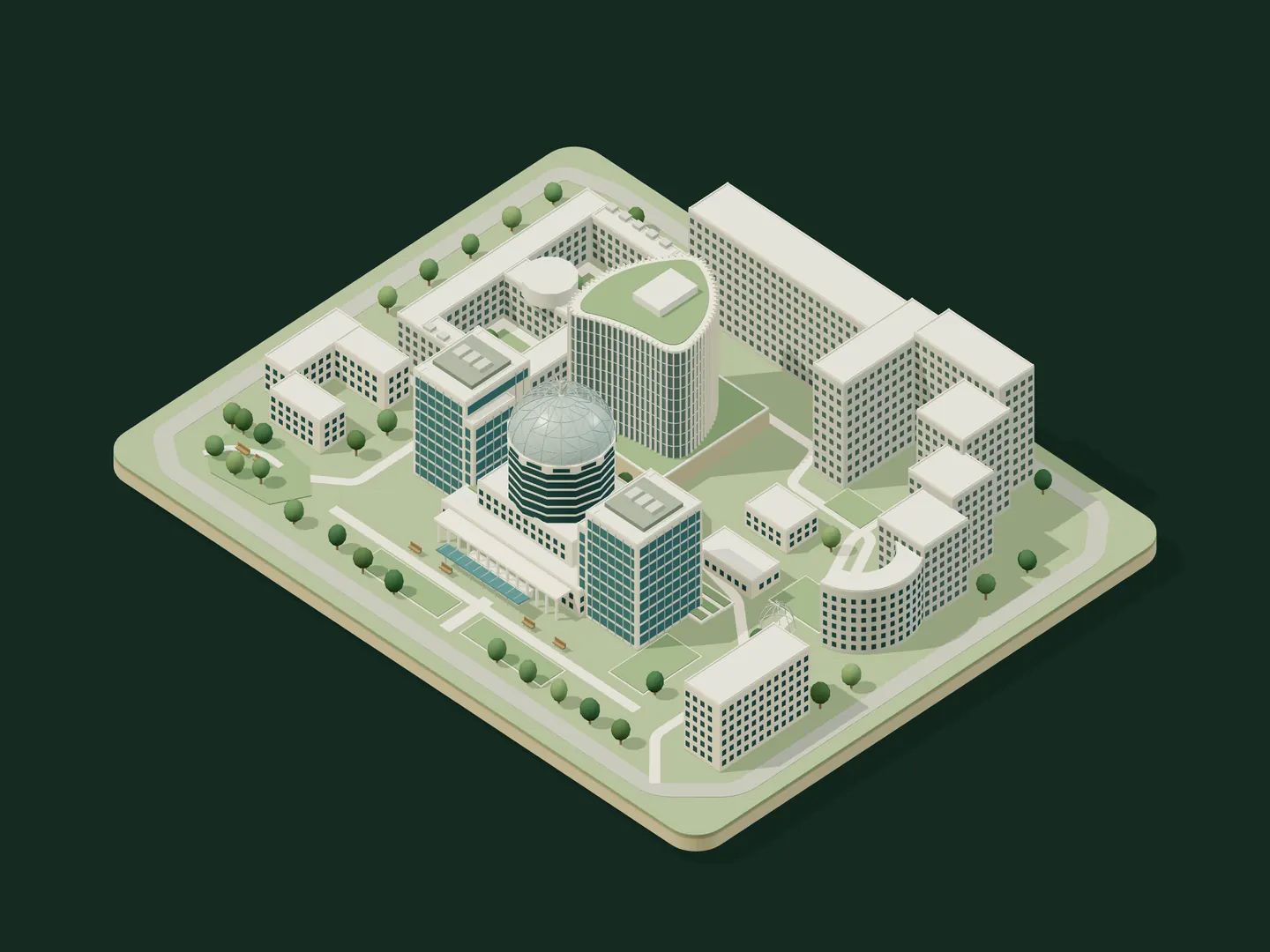
San Raffaele's Olgettina campus
UniSR's Campus Milano Olgettina, at Via Olgettina 58 in Milan, shares its site with the IRCCS Ospedale San Raffaele, which covers more than 290,000 m². The DiBit 1, DiBit 2 and San Michele buildings hold research laboratories and the university's teaching rooms; the hospital's own buildings hold its departments and clinical laboratories. The nearest metro station is Cascina Gobba on line 2 (green), then the light metro or bus 925.
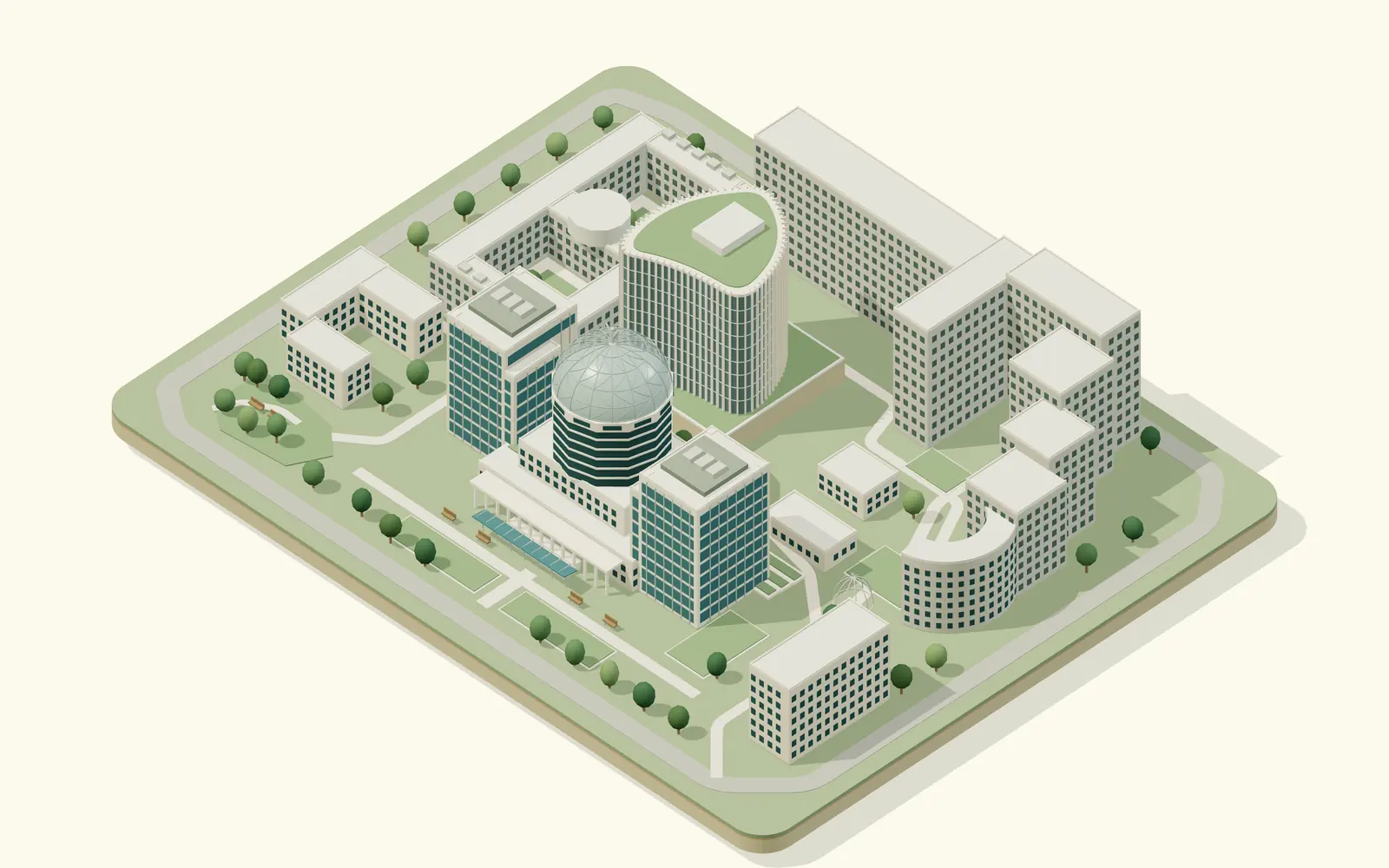
Explore the San Raffaele campus.
Open it in 3D to turn it and see what each building holds.
Stylized campus illustration, not a map or to scale.
DiBit 2
Research laboratories and university teaching rooms. The UniSR student office (Polo Studenti) is on floor -1, and an eight-metre angel stands on the dome.
San Gabriele
Part of DiBit 2, home to the hospital's blood donation centre and transfusion service.
San Michele
Research laboratories and university teaching rooms, like DiBit 1 and DiBit 2.
DiBit 1
Research laboratories and university teaching rooms.
Iceberg
The hospital's Surgical and Emergency Pole, by Mario Cucinella Architects: operating theatres, intensive care and the emergency department in its base, wards and outpatient clinics in the tower.
Ospedale San Raffaele
The IRCCS Ospedale San Raffaele, Via Olgettina 60: its buildings, lettered A to R, hold the hospital's departments and clinical laboratories.
DiMeR
Hospital departments and clinical laboratories.
Garden
The open-air garden the hospital's buildings are set around.
Address: Via Olgettina 58, 20132 Milano
IvyTest UniSR Admission Test preparation
Ready to prepare properly for the San Raffaele test?
Everything above is free and always will be. When you want structure (a syllabus-mapped book covering all six subject groups, a simulator that scores with the real +1/−0.25/0 rule, in IvyTest's five-option practice format, lessons for the gaps your results flag, and help with the application itself), that is what the IvyTest San Raffaele package is.
Study guide
The full syllabus for both the Logic/Reading and Scientific Subjects blocks, mapped to the official 36/24 split.
Exam simulator
Timed 80-minute mocks under the real negative marking, in IvyTest's five-option practice format, with per-question explanations and topic analytics.
Video courses
Focused lessons in biology, chemistry, physics, mathematics and reasoning for the topics your results flag.
Application support
MedApply: deadlines, documents, legalisation and enrolment steps carried through to a confirmed place.
FAQ
UniSR Admission Test frequently asked questions
It's the admission test Vita-Salute San Raffaele University (UniSR) uses to select candidates for its English-taught International MD Program (IMDP) in Milan: 60 scored multiple-choice questions in 80 minutes, entirely in English, sat remotely from home under proctoring. UniSR's own pages call it the IMDP admission test.
No. The IMAT is the national test used by Italian public universities and some private ones; San Raffaele sets and administers its own test under its own Chancellor's Decree, with a different structure and scoring.
Online, from home, remotely proctored through ProctorExam with the provider Selexi. You'll need a working device, camera and stable connection; no calculator is permitted, though two sheets of paper and a pen are allowed for working.
+1 point for a correct answer, −0.25 for an incorrect one, and 0 for a blank, across 60 multiple-choice questions. There is no minimum eligible score: places are allocated purely by ranking.
OFA (Obbligo Formativo Aggiuntivo, an additional learning requirement) is triggered separately for Biology, Chemistry, Mathematics or Physics if you score below 50% correct in that specific area, even if your overall result is strong. Balanced preparation across all four sciences, not just your best one, is what avoids it.
This guide covers the English-taught International MD Program only. San Raffaele's Italian-taught Medicina e Chirurgia has its own call (Decree n. 9924 for 2026/27) and its own home-based test: 60 questions in 60 minutes, 20 each of Biology, Chemistry and Physics, 10% of them in English, with the same +1/−0.25/0 scoring. In 2026/27 it ran on 8/9 and 27/28 April 2026 for 750 places, at €300 for both sessions; the 750th place on its definitive ranking scored 25.50, and by 2 October 2026 offers had reached the 1,003rd (15.50).
150 seats in 2026/27: 86 for EU applicants and 64 reserved for non-EU applicants residing abroad (43% of the total). San Raffaele publishes no acceptance rate, but its 2026/27 ranking lists ranked 598 EU candidates, 360 of whom then confirmed they wanted a place, and 391 non-EU candidates. Places turned down pass down the list: on the EU Definitive Ranking List, offers had reached the 179th place by 30 September 2026, and on the non-EU list the 102nd by 6 October 2026.
Yes. San Raffaele runs two sessions per admissions cycle (for 2026/27, 14 February and 14 March 2026 for the EU quota, 11 February and 4 March 2026 for non-EU candidates resident abroad), and your better score across the two is the one used for ranking. You must book both sessions when you register, before the first one; see the two-sessions section above for how to use them.
Within the EU, yes: automatically, as a standard Italian medical degree (LM-41). Outside the EU recognition isn't automatic as a rule. For the UK, the Medical Act 1983 (sections 21B and 21C, as in force on 12 October 2026) spares holders of an Italian medical degree the knowledge test other international graduates take through PLAB/UKMLA, but the UK's list pairs the laurea with the Diploma di abilitazione all'esercizio della medicina e chirurgia, which Italy stopped issuing in March 2020, when the practical training moved inside the degree. The GMC's Italy page therefore offers graduates since then provisional registration on the laurea, for a UK Foundation Year 1 post, and asks for evidence of supervised practice, such as a 12-month internship, for full registration. Evidence of English is still required, and the rule is UK policy that can change. US-bound graduates need ECFMG certification via USMLE Step 1 and Step 2 CK, the same requirement every international medical graduate faces.
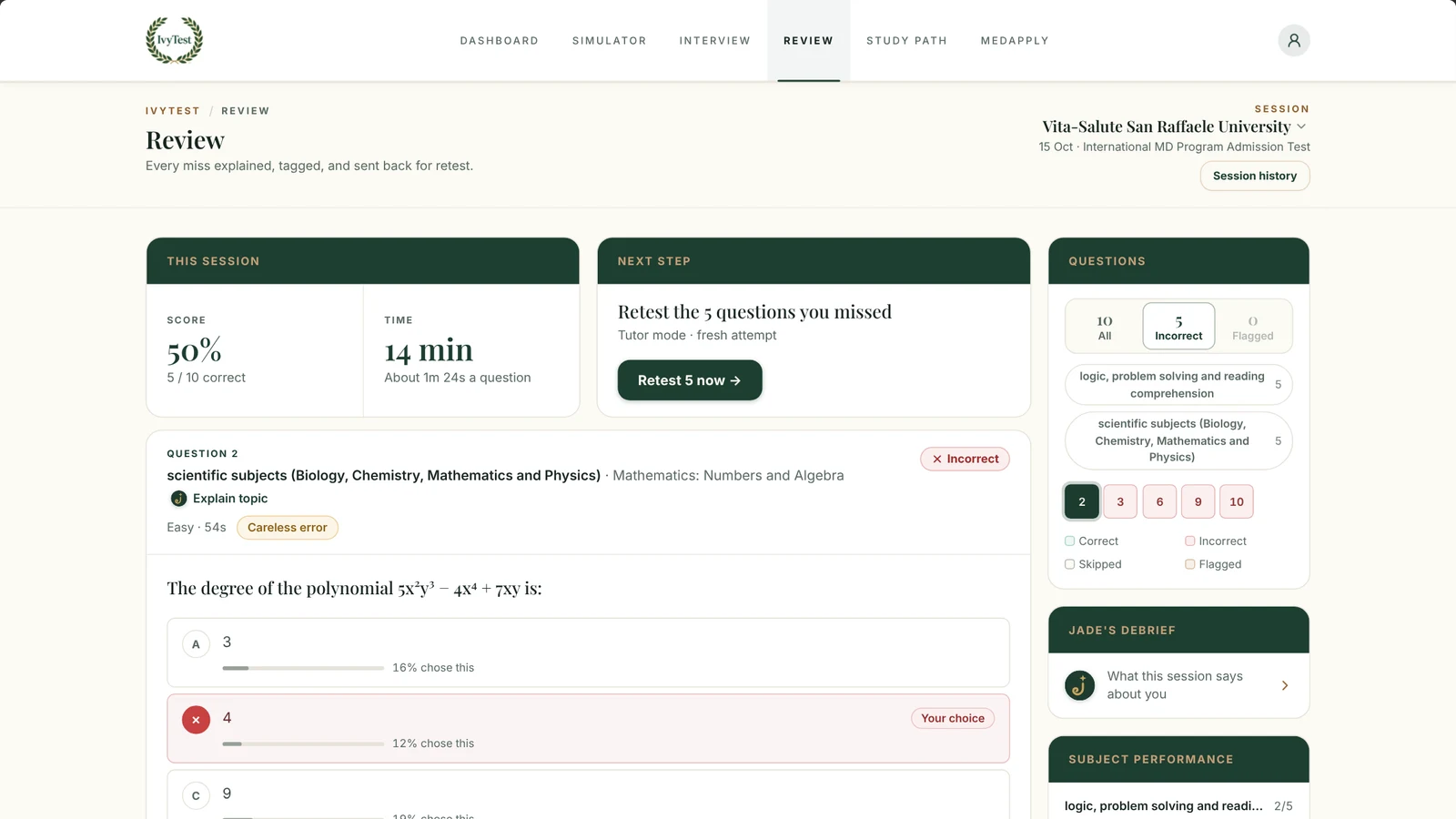
Yes. The IvyTest simulator runs San Raffaele-format practice (60 questions and the real scoring rule, in IvyTest's five-option format) in timed, tutor and review modes, with a free diagnostic available without payment.
No. UniSR publishes no past papers and no sample test to download: the questions are the university's property, drawn at random from its own database. What it offers is a paid Online Simulator built from that historic question database, with the real timing: €20 buys three simulations and each extra one costs €5. Each ends with a report by section and the correct answers, but the tests can only be taken online, not downloaded. IvyTest's free practice paper is a full 60-question paper in the same format, with every answer explained, and can be saved as a PDF with the answers.
Not announced yet: as of 16 October 2026 the 2027/28 Calls are not out, and UniSR's admissions page still shows 2026/27. For 2026/27, registration opened on 17 December 2025 and closed at noon on 6 February 2026 (EU) and 5 February 2026 (non-EU); the EU quota sat on 14 February and 14 March 2026, non-EU candidates on 11 February and 4 March 2026, all from home. The €200 fee covered both sessions.
There is no pass mark: places go down the ranking of each candidate's best score. The list comes out within 15 days of the last session; EU candidates then declare in June whether they want a place, which gives the Definitive Ranking List. In 2026/27 its 86th place scored 41.00 out of 60 and offers reached the 179th (35.00) by 30 September 2026; the 64th non-EU place scored 48.75, and by 6 October 2026 non-EU offers had reached the 102nd (46.50). The online review shows your score after the first session and your corrected test after the second.
Tuition for a first-year International MD student in 2026/27 is €20,690, including the €190 Lombardy regional tax, in three instalments: €7,190 at enrolment, €7,000 by 31 January 2027 and €6,500 by 31 March 2027. Non-EU candidates pay €1,500 of the first instalment in advance to confirm their place. On UniSR's 2026/27 fee table, year 2 is also €20,690 and years 3 to 6 are €20,190. The admission test costs €200 for both sessions, and UniSR lists financial aid and merit awards.
The International MD Program is a six-year, 360-ECTS degree in Medicine and Surgery, taught and examined in English. Year 1 covers Medical Genetics, Medicinal Chemistry and Biochemistry, Molecular Cell Biology, Medical Physics, Basic Medical Statistics and Medicine as a Human Endeavour. From year 2 students follow the General track or one of three selective tracks of up to 20 students (Medicine and Surgery, Global Health, Translational Research). The last semester is kept free for thesis research, and Italian at B1 is required by the end of year 2 for the clinical rotations.
Yes, into the years after the first, and only into places left vacant, through a transfer call: for 2026/27 it listed 1 place in year 2, 6 in year 3, 7 in year 4 and none in years 5 and 6, and closed at noon on 27 July 2026 (€50 fee, C1 English). Candidates are scored on credits, grades and fit with the IMDP study plan, plus an interview worth up to 40 points; the final ranking was due by 25 September 2026.
UniSR publishes no ranking of the International MD Program itself. On its UniSR by the numbers page it reports that it is 1st in Italy for research quality (THE World University Rankings 2025) and 20th in the world in the THE Young University Rankings 2023, and that its Medicine and Surgery is the best master's degree in Italy among non-state universities (Censis, 2024-25 edition). These are the university's own figures, quoted as it states them. On Times Higher Education's own site, Vita-Salute San Raffaele University is =247th in the World University Rankings 2027 and in the 126-150 band for Medical and Health in its 2026 subject ranking.
Yes: r/sanraffaele, where Vita-Salute San Raffaele University applicants ask each other about the UniSR Admission Test and share how their preparation is going. It is run by the IvyTest team. Dates, rules and results come only from the university's own pages, listed under Official sources on this page.
Verification
Official sources
- Vita-Salute San Raffaele University: International MD Program admissionsChecked: 16 October 2026
Vita-Salute San Raffaele University
- Official Call for Admission (EU quota), A.Y. 2026/2027: Chancellor's Decree n. 9853Checked: 16 October 2026
Vita-Salute San Raffaele University
- Official Call for Admission (non-EU quota), A.Y. 2026/2027: Chancellor's Decree n. 9854Checked: 16 October 2026
Vita-Salute San Raffaele University
- Degree Course Teaching Regulations: International MD Program (Decreto Rettorale n. 10090, 9 June 2026)Checked: 7 October 2026
Vita-Salute San Raffaele University
- Prepare for the test: Online Test Simulator for the IMDP admission test (paid simulations, no specific syllabus)Checked: 16 October 2026
Vita-Salute San Raffaele University
- Student Rankings and Matriculation: International MD Program, EU candidates (2026/2027 ranking lists and scrolling notices)Checked: 7 October 2026
Vita-Salute San Raffaele University
- Student Rankings and Matriculation: International MD Program, non-EU candidates (2026/2027 final ranking list)Checked: 16 October 2026
Vita-Salute San Raffaele University
- Bachelor's and Master's Degree fees and contributions, A.Y. 2026/2027 (International MD Program fee table)Checked: 16 October 2026
Vita-Salute San Raffaele University
- IMDP Curriculum: tracks, study plan A.Y. 2026-2027 and academic calendarChecked: 16 October 2026
Vita-Salute San Raffaele University
- Incoming Transfers: 2026/2027 call, International MD Program transfer procedure and final rankingsChecked: 7 October 2026
Vita-Salute San Raffaele University
- UniSR by the numbers (rankings as UniSR reports them)Checked: 7 October 2026
Vita-Salute San Raffaele University
- Admission to Medicina e Chirurgia taught in Italian, A.Y. 2026/2027 (Decree n. 9924)Checked: 7 October 2026
Vita-Salute San Raffaele University
- Rankings, Medicina e Chirurgia taught in Italian, A.Y. 2026/2027 (definitive ranking and scrolling notices)Checked: 7 October 2026
Vita-Salute San Raffaele University
- Medical Act 1983, section 21B: registration with a relevant European qualification, without the knowledge test, for applications made since IP completion day (Brexit)Checked: 12 October 2026
legislation.gov.uk (The National Archives)
- Medical Act 1983, section 21C: provisional registration, without the knowledge test, for those who have passed the exams for a relevant European qualificationChecked: 12 October 2026
legislation.gov.uk (The National Archives)
- Directive 2005/36/EC, Annex V point 5.1.1, as it stood on 31 December 2020 and is applied in the UK (Italy: the laurea in medicina e chirurgia with the Diploma di abilitazione all'esercizio della medicina e chirurgia)Checked: 12 October 2026
legislation.gov.uk (The National Archives)
- Evidence of qualifications from ItalyChecked: 12 October 2026
General Medical Council (GMC)
- Full registration for doctors who hold a relevant European qualification: evidence of your internship (an accompanying certificate, or else an acceptable pattern of experience)Checked: 12 October 2026
General Medical Council (GMC)
- Times Higher Education: Vita-Salute San Raffaele University (World University Rankings 2027, Medical and Health 2026)Checked: 16 October 2026
Times Higher Education
Last reviewed by IvyTest editorial team: 16 October 2026. Admission rules change every cycle — always confirm against the official Vita-Salute San Raffaele University call for applications before acting on a deadline.
Find out how ready you are for the San Raffaele test.
The diagnostic takes one sitting and returns a section-by-section picture of where you stand, no payment, no commitment.