
In a sample of double-stranded DNA, 30% of the bases are adenine. What percentage of the bases are guanine?
Exam guide · Updated for 2027 admissions
University of Navarra Medicine Admission Test 2027: Complete Preparation Guide
The University of Navarra Medicine admission test is Universidad de Navarra's own on-site exam for Medicine at its Pamplona campus: 180 questions across four areas in roughly three hours, three official subject syllabi, a subject weighting that deliberately does not match the question counts, and no calculator. This guide also covers the 2027 dates and application deadline, the entry requirements, the fees and the 200 places.
Updated for 2027 admissions · Last updated: 14 October 2026
University of Navarra Medicine Admission Test at a glance
Overview
What is the University of Navarra Medicine Admission Test?
Universidad de Navarra sets and grades its own admission test for Medicine at its Pamplona campus, and it is the longest paper in this set of guides by a wide margin: 180 questions that count, sat in roughly three hours, on site and without a calculator. It runs as two papers. The subject test is 150 questions split evenly (50 Biology, 50 Chemistry, 50 Physics), and six further reserve questions are sat in addition to it, distributed across the three sciences in a way UNAV does not publish. The second paper is 30 reading-comprehension questions on a scientific article.
The detail most worth internalising before you plan any revision is that the subject weighting does not match the question counts, and that is deliberate. Biology, Chemistry and Physics all have 50 questions each, but Biology and Chemistry are weighted 30% of the exam grade apiece while Physics is weighted 25%. Reading Comprehension has only 30 questions and is weighted 15%. Work it through and one Biology question is worth 0.60 percentage points of the exam grade against 0.50 for a Physics question: a fifth more, for identical effort. A reading question is worth the same as a physics question despite there being twenty fewer of them.
One structural oddity is confirmed and worth knowing, because UNAV's own documents disagree about it. Its admissions page states that every question has five possible answers ("Cada pregunta cuenta con cinco posibles respuestas"), and the official science model paper bears that out: every Biology, Chemistry and Physics item carries exactly five options. But the official reading-comprehension model paper is uniformly four-option across all 30 questions, with no exceptions. The item-level document is the more specific source, so this guide treats the reading paper as four-option. It matters practically: a blind guess is worth more on a reading question than on a science question.
There are two routes to the test, and which one you can use depends on where you are at school, not on your nationality. The on-site test above is open to everyone in their final school year, from Spain or abroad, and is sat in Pamplona in March. Candidates whose school is outside Spain may instead take the ISAT and the School's own test online, in English: the same 150 science questions (weighted 35/35/30) without the reading paper, plus an online Spanish test if Spanish is not their first language, and possibly an interview; their final grade is ISAT 30%, School test 40% and school record 30%. IB students can also apply on predicted grades, without a test. For Medicine the December round is for international applicants only; everyone else applies in March.
Programmes that use the University of Navarra Medicine Admission Test
- Medicine: Pamplona campus, on-site internal test route
- Medicine plus International Program: same admission test, Pamplona campus
Timeline
University of Navarra Medicine Admission Test 2027: dates and deadlines
When to expect your exam · 2027 start
- March 202713 MarPublished
Applications are open until 9 Mar 2027.
Dates the university has published for this cycle. See every university on the calendar →
- Applications open1 October 2026
- Application deadline9 March 2027
- International applicants' December window9 December 2026
- On-site exam date (Pamplona)Saturday 13 March 2027
- Results published15 April 2027
- Enrolment deadline31 May 2027
| Round | Apply by | Test | Result | Enrolment |
|---|---|---|---|---|
| December: international Medicine applicants only | 9 December 2026 | 12 December 2026 | 21 January 2027 | Until 23 February 2027 |
| March: all applicants | 9 March 2027 | 13 March 2027, afternoon | 15 April 2027 | Until 31 May 2027 |
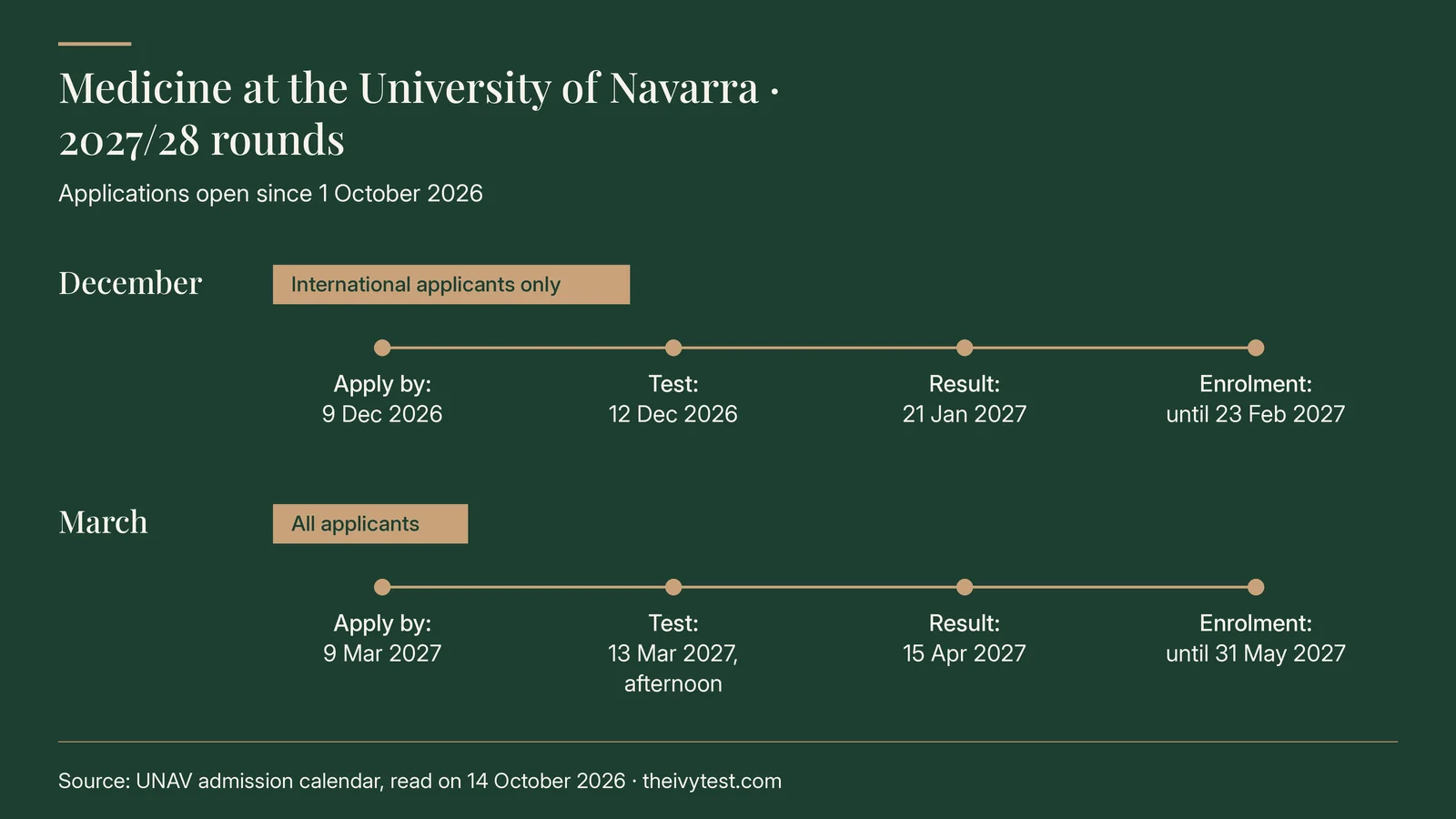
No academic-year-dated official Call was available for this exam: UNAV's Biology, Chemistry and Physics entrance-exam syllabi are undated. Its admission deadlines page, checked on 14 October 2026, opens the 2027/28 window on 1 October 2026 and gives the Medicine calendar above: apply by 9 March 2027, sit the test on Saturday 13 March 2027, resolution on 15 April 2027 and enrolment by 31 May 2027. Its later April-to-August windows are for degrees with places still free, and none of them names Medicine. The Medicine perfil-de-ingreso page confirms the entry condition, the final-grade formula and that the exact start time arrives by email. IvyTest re-checks unav.edu and updates this guide if the calendar changes.
Structure
University of Navarra Medicine Admission Test format
Two papers, 180 counting questions, roughly three hours: almost exactly one minute per counting question, or about 58 seconds each once you include the six reserve items you also have to sit. The question counts come from UNAV's own syllabi and model papers; the percentage weightings are published on its Medicine admissions page, since no dated official Call exists.
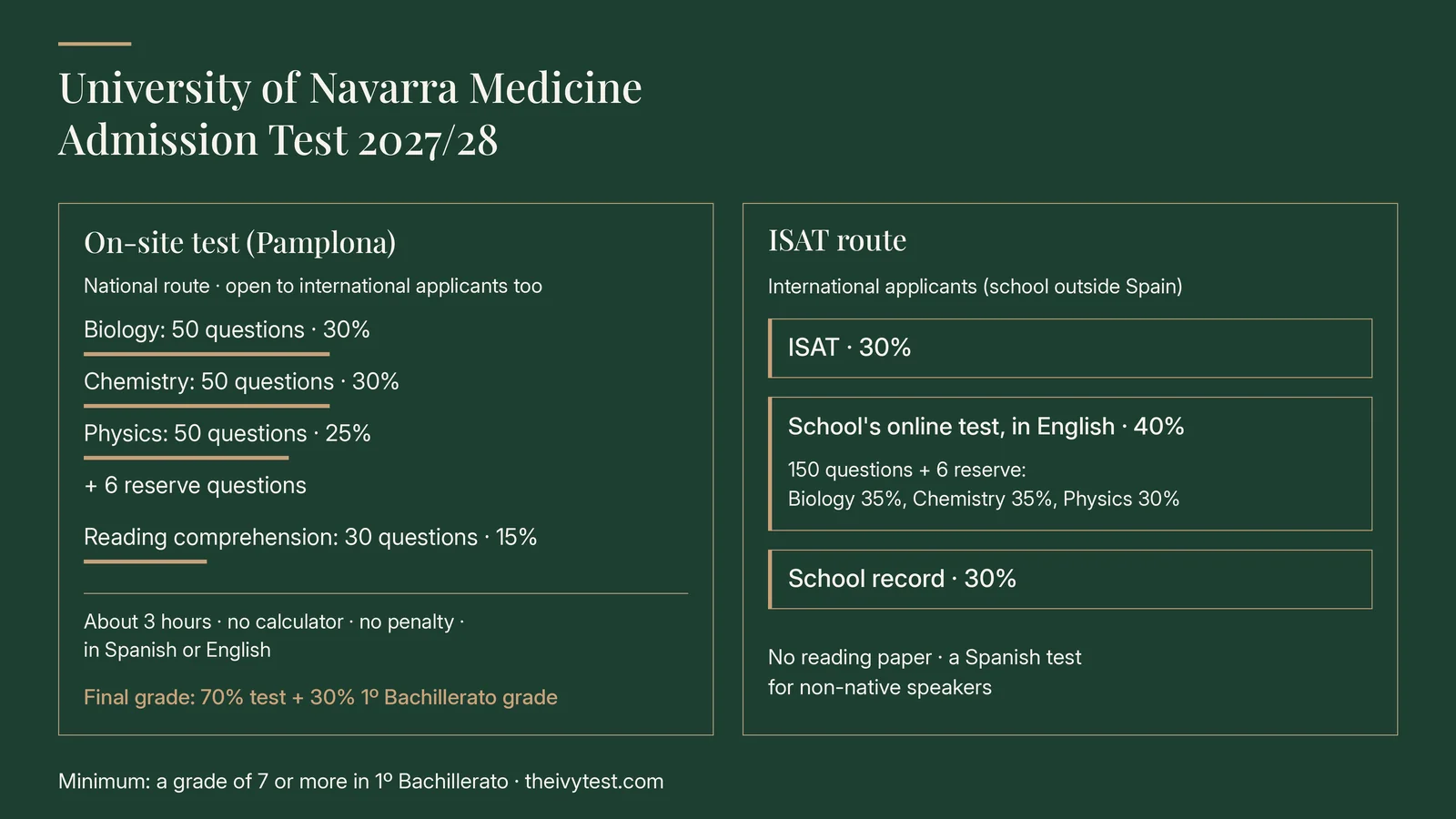
| Section | Questions | Weighting | Suggested time |
|---|---|---|---|
| Biology | 50 | 30% of the exam grade (0.60 points of the grade per question) | 1see the note below the table |
| Chemistry | 50 | 30% of the exam grade (0.60 points of the grade per question) | 1see the note below the table |
| Physics | 50 | 25% of the exam grade (0.50 points of the grade per question) | 1see the note below the table |
| Reading Comprehension (separate paper) | 30 | 15% of the exam grade (0.50 points of the grade per question) | 1see the note below the table |
| Reserve questions | 6 | 2see the note below the table | 2see the note below the table |
- UNAV publishes no per-section time limit; the stated 'approximately 3 hours' covers both papers together
- Sat in addition to the 150-question subject test, across Biology, Chemistry and Physics. UNAV does not state how they are distributed, whether extra time is allowed for them, or how they are scored
Content
Question and subject breakdown
Four areas, three of them exactly the same size and none of them weighted the way its size suggests. Read the percentages below as shares of the exam grade, not as shares of the questions: the two come apart deliberately on this paper.
Biology
30% of the exam grade (50 of 180 questions)Seven official topic blocks from UNAV's own Biology Entrance Exam Syllabus, in the syllabus's own order: unity and life diversity, human tissues, organs and systems, the molecular basis of life, cell structure and function, inheritance and molecular genetics, microorganisms and their applications, and immunity and its applications. The syllabus does not state how the 50 questions divide across the seven blocks; the official model paper leans on cell biology, genetics, human systems and microbiology terminology. Joint-largest by weight, and the best-value question on the paper at 0.60 points of the grade each.
Chemistry
30% of the exam grade (50 of 180 questions)Eight official topic blocks: basic concepts, atomic structure and the periodic table, chemical bonding and properties of substances, energy transformations in reactions, kinetics and equilibrium, acids and bases, electron transfer reactions, and organic chemistry. No per-block question split is published. Because no calculator is allowed, quantitative items have to resolve through estimation, cancellation or scientific notation rather than arithmetic grind.
Physics
25% of the exam grade (50 of 180 questions)Five official topic blocks: basic tools in physics, movements and forces, energy, work and heat, electricity and magnetism, and waves and optics. Two scope limits are unusually clean and unusually important. The official syllabus contains no direct-current circuit content at all (no Ohm's law, no resistors in series or parallel, no Kirchhoff) and no geometrical optics beyond reflection and refraction. Neither may be imported from other medical entrance syllabi. Physics is also the same size as Biology and Chemistry but weighted five points lower, at 0.50 grade points per question.
Reading Comprehension
15% of the exam grade (30 of 180 questions)A separate paper: one scientific article followed by 30 multiple-choice questions, and the only block on this exam with four options rather than five. No official syllabus exists: UNAV states only what the paper is, so its content areas are derived from the official model paper, which used a bibliometric study of Spanish tuberculosis research output indexed in MEDLINE between 1997 and 2006. Every answer has to be supported by the passage rather than by outside knowledge.
Marks
University of Navarra Medicine Admission Test scoring
The marking rule is simple: one mark for a correct answer, nothing for a wrong one, nothing for a blank, but the conversion from marks into an admission grade has two stages, and both change what a given improvement is actually worth. This is the paper in this set where being sloppy about units costs you the most.
- Correct answer
- +1 point; UNAV states no per-question mark value, only that wrong answers do not count negatively, so 1 is the neutral unit used here
- Incorrect answer
- 0 points (no negative marking)
- Unanswered question
- 0 points
- Answer options
- 5 on Biology, Chemistry and Physics; 4 on Reading Comprehension. Confirmed by reading both official model papers in full
- Subject weighting of the exam grade
- Biology 30% · Chemistry 30% · Physics 25% · Reading Comprehension 15% (published on UNAV's Medicine admissions page)
- Final admission grade
- 70% entrance exam + 30% average of the 1st-year official subjects
- Entry condition
- Enrolled in the 2nd year of the high-school diploma or equivalent, with a 1st-year final grade of 7/10 or higher, a condition on your record, not a score on this paper
- Minimum eligible score
- None published, confirmed absent. Both unav.edu/admision-y-ayudas/grado/admision/criterios-y-pruebas-de-admision and the Medicine perfil-de-ingreso page were checked directly and give only the 7/10 entry condition and the 70/30 formula
- Per-subject floors
- None: UNAV publishes no per-subject minimum, and the OFA mechanism has no Spanish counterpart
- Reserve questions
- 6, sat in addition to the 150-question subject test across the three sciences; distribution, extra time and scoring all unpublished
- Calculator
- Not permitted: calculations are worked by hand in the question booklet
Worked example
Three units are in play on this exam and they are easy to mistake for one another: percentage points of accuracy within a block, raw marks, and percentage points of the grade. Take the same improvement (ten percentage points of accuracy) and run it through each block. In Physics, ten points on a 50-question block is 5 more raw marks. Those 5 marks are 10% of the Physics block, and Physics is 25% of the exam grade, so they are 2.5 percentage points of the exam grade; the exam is 70% of the final admission grade, so they are 1.75 percentage points of that. In Biology, the identical ten-point accuracy gain is also 5 raw marks, but Biology is weighted 30%, so those same 5 marks are 3.0 points of the exam grade and 2.1 points of the final grade. In Reading Comprehension, ten points of accuracy on a 30-question block is only 3 raw marks; at 15% weighting they are 1.5 points of the exam grade and 1.05 of the final grade. One improvement, three blocks, and five different correct numbers depending on which unit you name. Per question, the cleanest way to hold it: a Biology or Chemistry question is worth 0.60 points of the exam grade, a Physics or Reading question 0.50, so Biology and Chemistry questions are worth a fifth more than Physics questions despite the blocks being the same size, and a Reading question is worth exactly as much as a Physics question despite there being twenty fewer of them. Now guessing. There is no penalty, so a blind guess is always worth something: 1/5 = +0.20 raw marks on a five-option science item, and 1/4 = +0.25 on a four-option reading item. Leave the whole paper blank and you forfeit an expected (150 × 0.20) + (30 × 0.25) = 30 + 7.5 = 37.5 marks for nothing. And the two effects nearly cancel when you convert to grade points: a blind Biology guess is worth 0.20 × 0.60 = 0.120 points of the exam grade, a blind Reading guess 0.25 × 0.50 = 0.125, a blind Physics guess 0.20 × 0.50 = 0.100. In other words, every unanswered question on this paper costs you roughly an eighth of a grade point, wherever it sits. There is no block on which a blank is defensible.
The IvyTest simulator scores every practice paper against these exact rules.
See the University of Navarra Medicine Admission Test simulatorSyllabus
Full University of Navarra Medicine Admission Test syllabus
The Biology, Chemistry and Physics groups below are official: they are the topic blocks of UNAV's own School of Medicine entrance-exam syllabi, in each syllabus's own order, with long headings shortened for readability. Those syllabi are undated, so re-verify before each cycle. Reading Comprehension is the exception: no official syllabus exists for it, so its areas are derived from the official model paper.
Seven official blocks across 50 questions. The syllabus gives no per-block split; the official model paper weights cell biology, genetics, human systems and microbiology terminology.
- Unity and life diversity: biodiversity, the species concept, classification systems, the fundamental characteristics of the five kingdoms, levels of organisation of living beings, cell theory and the cell as the unit of structure and function, prokaryotic and eukaryotic models of cellular organisation, and microscopic observation of single-celled organisms and animal tissues
- Human tissues, organs and systems: epithelial, muscular, nervous and connective tissues; the digestive, respiratory, excretory and reproductive systems; the integumentary, nervous, circulatory, endocrine, muscular, skeletal and lymphatic systems; the vital functions of nutrition, relationship and reproduction; the stages of nutrition, nutrients, balanced diet, food classification and vitamins; sensory receptors, the nerve impulse, the synapse and the central and peripheral nervous system; hormonal coordination and the main hormones; and the female and male reproductive systems, gamete formation, fertilisation, embryonic development and the menstrual cycle
- Molecular basis of life: the chemical composition of living beings, primary, secondary and trace bioelements, the organic biomolecules (carbohydrates, lipids, proteins and nucleic acids), the inorganic biomolecules water and mineral salts, chemical bonds and their importance in biology, and biocatalysts and enzymes
- Cell structure and function: cell morphology, the structure and function of the cell envelope, nucleus and organelles, membranes in cellular exchange, transport of molecules across the membrane, selective permeability, endocytosis and exocytosis, the cell cycle and its phases, mitosis and meiosis, anabolism and catabolism, energy and ATP, cellular respiration and its biological meaning, aerobic and anaerobic pathways, mitochondrial structure, composition and function, the catabolism of carbohydrates, lipids and proteins, chemosynthesis, and methods of cellular study
- Inheritance and molecular genetics: human genetics, genes, chromosomes, genotype, phenotype and karyotype, Mendel's laws, the chromosomal theory of heredity, the inheritance of sex, sex-linked and sex-influenced inheritance, the identification of DNA as the carrier of genetic information, DNA structure and function, RNA structure, types and function, replication, transcription and translation, the genetic code and the experimental evidence for it, genomics and proteomics, genetically modified organisms, mutations and mutagenic agents, mutation and cancer, genetic diseases, and the role of mutation in evolution and speciation
- Microorganisms and their applications: the diversity of microorganisms and their ways of life, bacteria and viruses including classification, structure and life cycle, interactions with other living organisms, the intervention of microorganisms in biogeochemical cycles, pathogenic microorganisms and infectious disease, asepsis and antisepsis, methods of study and cultivation, the use of microorganisms in industrial processes, and their social and economic importance
- Immunity and its applications: immunology, the immune system and immunity, types of immune response, the body's defences, the inflammatory response, cellular and humoral immunological reactions, antigens, antibody structure and function, the antigen-antibody reaction, the mechanism of the immune response, immunological memory, natural and artificial acquired immunity, vaccines and sera, allergies and immunodeficiencies, AIDS and its effects on the immune system, monoclonal antibodies and genetic engineering, and organ transplantation and rejection
Eight official blocks across 50 questions, joint-largest by weight. No calculator is allowed, so quantitative items must resolve through estimation, cancellation or scientific notation.
- Basic concepts: Avogadro's hypothesis, the concept of the mole, molecular mass, atomic mass, isotopes, inorganic formulation, solutions and the ways of expressing concentration, the kinetic theory of gases, the general law of perfect gases, Dalton's law, and the stoichiometry of chemical reactions
- Atomic structure and the periodic table: atomic mass and the atomic mass unit, the Thomson and Rutherford atomic models, quantum theory, Bohr's model and its limitations, an introduction to quantum mechanics, the de Broglie hypothesis, the Heisenberg principle, the orbital concept and atomic orbitals, electron configurations with Pauli's principle and Hund's rule, the periodic classification of the elements, and periodic properties and their relationship to position in the table
- Chemical bonding and properties of substances: the concept of bonding and the energy stability of bonded atoms, ionic bonding, lattice energy and the Born-Haber cycle, the properties of ionic substances, covalent bonding and bond parameters, Lewis theory, molecular geometry and valence bond theory, hybridisation of atomic orbitals, bond polarity and molecular polarity, intermolecular forces, the properties of covalent substances, and metallic bonding and the properties of metals
- Energy transformations in reactions: thermodynamics, systems and variables, pressure-volume work, heat, endothermic and exothermic processes, enthalpy of formation, of reaction and of bond, Hess's law, entropy, Gibbs free energy and the spontaneity of chemical reactions, energy diagrams and the reaction coordinate, and the energy applications of chemical reactions
- Kinetics and equilibrium: the dynamic aspect of chemical reactions, reaction rate and the factors influencing it, collision theory and effective collisions, activation energy, catalysts and how they work, the dynamic concept of chemical equilibrium, the equilibrium constants Kc and Kp and the relation between them, Le Chatelier's principle, heterogeneous equilibria, precipitation reactions, solubility and the solubility product, and applications to everyday life and industry including the Haber-Bosch process
- Acids and bases: the general characteristics of acids and bases, the Arrhenius and Brønsted-Lowry theories, the ionic balance of water, the concept of pH and its calculation and measurement in aqueous solutions, strong and weak acids and bases, neutralisation, the quantitative treatment of aqueous salt solutions as acid-base equilibria, buffer solutions, acids and bases of industrial and everyday interest, and acid rain and its consequences
- Electron transfer reactions: the concept of oxidation-reduction, oxidising and reducing agents, oxidation number, balancing redox reactions, the stoichiometry of redox reactions, redox titrations and their experimental treatment, standard reduction potential, oxidation and reduction potentials, the spontaneity of redox reactions, electrical cells and batteries, electrolysis, Faraday's laws, industrial and economic importance, and the corrosion of metals and its prevention
- Organic chemistry: the characteristics of the carbon atom, the nomenclature and formulation of the main oxygenated and nitrogenous organic compounds, types of organic reaction (substitution, addition, elimination and oxidation-reduction), structural and spatial isomerism, hydrocarbons, petroleum and its derivatives, alcohols, esters and acids and how they are obtained, polymers and addition and condensation polymerisation, and an assessment of the use of organic substances in society and the resulting environmental problems
Five official blocks across 50 questions. Two scope limits matter more here than anywhere else in this guide: the official syllabus contains no direct-current circuit content at all (no Ohm's law, no resistors in series or parallel, no Kirchhoff) and no geometrical optics beyond reflection and refraction. Do not import either from another medical entrance syllabus.
- Basic tools in physics: trigonometry and simple geometric relationships between angles and straight lines, vectors, scalar and vector products, the basic relation between integration and differentiation, units of the International System, and unit conversion and dimensional consistency
- Movements and forces: reference systems, velocity and acceleration, rectilinear and circular motion, normal and centripetal acceleration, Newton's laws, conservation of momentum, gravitational forces and the variation of weight with distance, friction force as a function of displacement, and Hooke's law
- Energy, work and heat: work, kinetic energy, gravitational potential, conservative forces, gravitational potential energy, conservation of energy, power, energy and heat, and the principles of thermodynamics
- Electricity and magnetism: Coulomb's law, the electric field, electric potential and potential energy and the relationships between them, equipotential surfaces, the analogy between gravitational and electric fields, the relationship between electricity and magnetism, and Lorentz's law; note that this block stops at fields and forces and never reaches circuits
- Waves and optics: simple harmonic vibratory motion, the magnitudes and characteristics of waves including amplitude, period, frequency, wavelength and propagation velocity, reading a harmonic wave equation, mechanical and electromagnetic waves, transverse and longitudinal waves, the transport of energy without transport of matter, reflection and refraction, and standing waves
Derived, not official: UNAV publishes no syllabus for this paper, stating only that it is a scientific article followed by 30 multiple-choice questions. The areas below come from the official model paper, a bibliometric study of Spanish tuberculosis research output indexed in MEDLINE between 1997 and 2006. This is also the only block with four options rather than five.
- Scientific article structure: the abstract and its objective, material-and-methods, results and conclusions; the introduction and the study question; methods including the database, search strategy, inclusion criteria, variables and statistical tools; the results section; the discussion with its interpretation, comparison against earlier work and limitations; the concluding claim and its implications; and telling a method apart from a result
- Data extraction and comparison: locating exact figures, percentages and sample sizes; rankings across countries, provinces and institutions; category comparisons such as hospitals against universities or national against foreign journals; indicators of output; reading tables and figures referenced by the text; and ordering items by frequency
- Interpretation and inference: drawing only conclusions the passage supports, comparing a finding against the study's own comparisons with other fields, recognising stated limitations, distinguishing what the article claims from what the reader assumes, and identifying which of several statements the passage rules out
- Biomedical and research vocabulary: epidemiology, incidence, prevalence and public health; microbiology, infectious disease, pulmonology and internal medicine; clinical against laboratory specialties; bibliometrics, MEDLINE, PubMed and MeSH; case report, review and clinical trial; institutional sectors such as hospital, university, research council and primary care; publication language, journal type, output and impact factor; and basic statistical comparison at reading level
Test your University of Navarra Medicine Admission Test knowledge
Take free diagnosticDifficulty
How difficult is the University of Navarra Medicine Admission Test?
This is the longest and most conventional paper in this set: no trick marking, no floor, no all-or-nothing rule. Its difficulty is volume, pace and two pieces of syllabus discipline that catch candidates who prepared for a different exam.
180 counting questions at about a minute each
Three hours across two papers, 180 questions that count plus six reserve items you also have to sit: about 60 seconds per counting question, or 58 once the reserves are included. That is not a pace at which you can afford to work anything out from first principles, and there is no calculator, so quantitative items have to resolve by estimation, cancellation or scientific notation.
The weighting is not the question count, on purpose
Biology, Chemistry and Physics are 50 questions each, but weighted 30%, 30% and 25%. Reading Comprehension is 30 questions and weighted 15%. A Biology question is therefore worth 0.60 points of the exam grade and a Physics question 0.50: a fifth more for identical work. Candidates who split revision by question count rather than by weight systematically over-invest in Physics.
The Physics syllabus stops before circuits
UNAV's official Physics syllabus contains no direct-current circuit content at all (no Ohm's law, no series or parallel resistors, no Kirchhoff) and no geometrical optics beyond reflection and refraction. Both are staples of other medical entrance exams, and both are out of scope here. Preparing them is not merely wasted; it displaces work on the fields, waves and mechanics content that is actually examined.
Two option counts on one exam
The science papers are five-option and the reading paper is four-option, confirmed by reading both official model papers in full, and in tension with UNAV's own admissions page, which states five across the board. The practical consequence is small but real: a blind guess is worth +0.25 marks on a reading item against +0.20 on a science item, and elimination pays slightly faster on the reading paper.
A reading paper you cannot revise, worth as much per question as Physics
Thirty questions on a scientific article you have never seen, with no published syllabus. The official model used a bibliometric study of tuberculosis research output: dense with percentages, rankings and institutional categories, and full of statements that are true in general but absent from the text. At 0.50 grade points per question it is worth exactly as much per item as Physics, and most candidates give it a fraction of the preparation.
Benchmarks
What is a good University of Navarra Medicine Admission Test score?
UNAV publishes no cutoff, no acceptance rate and no minimum score on the admission test, and that last absence has been verified directly: both the criterios-y-pruebas-de-admision page and the Medicine perfil-de-ingreso page were checked on 21 September 2026 and give only an entry condition and a final-grade formula.
The two published thresholds are easy to mistake for exam cutoffs and are not. The first is an entry condition: you must be enrolled in the 2nd year of the high-school diploma or equivalent, with a 1st-year final grade of 7/10 or higher. That is a condition on your school record, checked before the exam matters at all, one of the more explicit academic thresholds among Spain's private medical schools. The second is the final admission grade: 70% entrance exam plus 30% the average of your 1st-year official subjects. Neither sets a minimum score on the paper itself.
That 70/30 split is the highest exam weighting of the five Spanish schools in this set: at CEU Cardenal Herrera the test is 40% and at CEU San Pablo and CEU Fernando III the two papers together are 40%. At Navarra the exam does more than twice the work. Run the conversion once and keep it: a Biology or Chemistry question is 0.60 points of the exam grade, which is 0.42 points of the final admission grade; a Physics or Reading question is 0.50 and 0.35 respectively. Ten percentage points of Biology accuracy (five raw marks) is 3.0 points of the exam grade and 2.1 of the final. UNAV publishes no cutoff and no applicant numbers (only the 200 places on its Medicine page), so there is nothing to benchmark against; your own trajectory on full, timed, no-calculator mocks is the signal that matters.
Pending verification
- · Historical admission cutoffs by year: UNAV publishes none
- · Competitive score ranges for the March sitting
- · Applicants per cycle and an acceptance rate (UNAV publishes 200 places, not how many apply)
- · How the 50 questions in each science divide across that syllabus's topic blocks
- · How the 6 reserve questions are distributed, timed and scored
- · A dated official Call for the 2027/28 cycle (the format figures come from UNAV's admissions page)
These specific numbers aren't public yet — an IvyTest simulator score is the closest benchmark you can get today.
Check your University of Navarra Medicine Admission Test scoreStrategy
How to prepare for the University of Navarra Medicine Admission Test
12+ weeks
Cover three official syllabi, weighted by grade points not question counts
Full coverage across all four areas, with Biology and Chemistry given the edge their weighting earns.
- Sit a full 180-question diagnostic in week one, without a calculator and under a three-hour limit, and convert the result into grade points immediately (Biology and Chemistry at 30% each, Physics at 25%, Reading at 15%) rather than reading it as one percentage.
- Work through all seven official Biology blocks and all eight Chemistry blocks in the syllabi's own order. Together they are 60% of the exam grade and 100 of the 180 counting questions.
- Prepare Physics strictly within the official syllabus's five blocks, and deliberately skip DC circuits and geometrical optics beyond reflection and refraction: neither appears anywhere in UNAV's list, and both are common in other medical entrance papers.
- From week six, finish each mock with a reading-comprehension drill against a genuine open-access scientific article you have not read, ideally a bibliometric or epidemiological paper, which is the style of UNAV's own model.
8 weeks
Build no-calculator fluency and a one-minute pace
Depth in the two 30% subjects, with quantitative technique drilled explicitly.
- Diagnostic first, then split weekly hours roughly 30/30/25/15 to match the grade weighting rather than the question counts.
- Drill Chemistry quantitatively without a calculator: the mole, gas laws, concentration, pH, Hess's law and redox stoichiometry, all resolved by estimation, cancellation and scientific notation. This is the single most transferable skill on the paper.
- One full timed mock a week from week two, reviewed the same day, with each block scored separately and then converted to grade points.
- Give Reading Comprehension a fixed weekly slot. It is 0.50 grade points a question (the same as Physics), and it is the block most candidates leave until last.
4 weeks
Full three-hour sittings at 180 questions
Volume, endurance and pacing across two papers in one sitting.
- Two full mocks a week at the real length: 180 counting questions plus six reserve items, roughly three hours, no calculator. Endurance is a genuine variable at this length and it only improves by rehearsal.
- Practise the pace explicitly: about 60 seconds a counting question, and a hard rule that no question takes more than about 90 seconds before you mark an answer and move on.
- Practise the two option counts. Five options on the sciences, four on the reading paper; eliminate before guessing in both, and never leave either blank.
- Review by grade points rather than raw totals. A mock where you gained five marks in Biology is worth more than one where you gained five in Physics, and the review should make that visible.
Under 4 weeks
Consolidate the 60%, cut what is out of scope, answer everything
Triage by weighting, and by what the syllabus actually contains.
- Stop adding topics, and actively stop revising anything outside UNAV's own Physics syllabus: DC circuits and lens optics are not on this paper and every hour spent on them is a full loss.
- Consolidate Biology and Chemistry, which between them carry 60% of the exam grade. Inside Biology, the official model paper leans on cell biology, genetics, human systems and microbiology terminology.
- Sit at least two full, scored three-hour mocks in the final ten days, no calculator, then taper.
- On the day, answer every question in both papers. With no penalty, a blank costs about an eighth of a grade point wherever it falls, and 37.5 expected marks sit on the table across a fully unanswered paper.
Get your personalised University of Navarra Medicine Admission Test study plan
Take free diagnosticExplore the full University of Navarra Medicine Admission Test planPractice
Free University of Navarra Medicine Admission Test practice questions
Three questions in the format the exam uses. Choose an answer to see the explanation — nothing is recorded.
Two point charges are separated by a distance d. If the separation is tripled while both charges are unchanged, the magnitude of the electrostatic force between them becomes:
Passage extract: "Between 1997 and 2006, Spanish authors published 1,235 documents on tuberculosis indexed in MEDLINE. Hospitals accounted for 54% of this output and universities for 21%; the remainder came from research councils, primary care and other sectors. Seventy-one per cent of the documents appeared in journals published outside Spain." Which statement is supported by the passage?
Illustrative examples written by IvyTest to show the question style — not past University of Navarra Medicine Admission Test papers.
Past papers
Navarra Medicine test: model exams, past papers and a free practice paper
The Universidad de Navarra publishes no past papers. Its Medicine admissions page links two free model PDFs instead: a science model with 10 questions each in Biology, Chemistry and Physics, five options per question and no answer key, and a reading-comprehension model, a scientific article with its 30 four-option questions. The same page links the Biology, Chemistry and Physics syllabi as PDFs. IvyTest's free practice paper is a complete paper in that format, written by IvyTest, with every answer explained.
University
Universidad de Navarra medicine admissions
The exam is 70% of the final admission grade (the highest exam weighting of the five Spanish schools in this set), and there is an entry condition on your school record before it counts. The figures below describe the Pamplona campus, on-site test route.
- Degree
- Medicine, and Medicine plus International Program, Pamplona campus
- Language
- Sat in Spanish or in English
- Campus
- Pamplona, Navarre, Spain
- Tuition
- €20,400 for the first year (2026/27: €340 per ECTS × 60 credits)
- Application fee
- €100
- Entry condition
- A 1st-year high-school final grade of 7/10 or higher, with enrolment in the 2nd year
- Final admission grade
- 70% entrance exam + 30% average of the 1st-year official subjects
- Admissions calendar
- The 2027/28 window opens 1 October 2026; apply by 9 March 2027 for the on-site test on 13 March 2027 (international applicants also have a 9 December 2026 window in a format of its own)
- Interview
- Not required on the on-site test route
- Scholarships
- Prof. Jiménez Vargas scholarships: 5 a year, up to 70% of tuition
- Cost of living
- €750–1,150 / month (Pamplona)
- Other admission routes
- For candidates at a school outside Spain: the ISAT plus the School's online test in English (ISAT 30%, test 40%, record 30%), or IB predicted grades (37 or more, 6 in Biology HL and Chemistry HL) with an interview
- Seats available
- 200
The campus
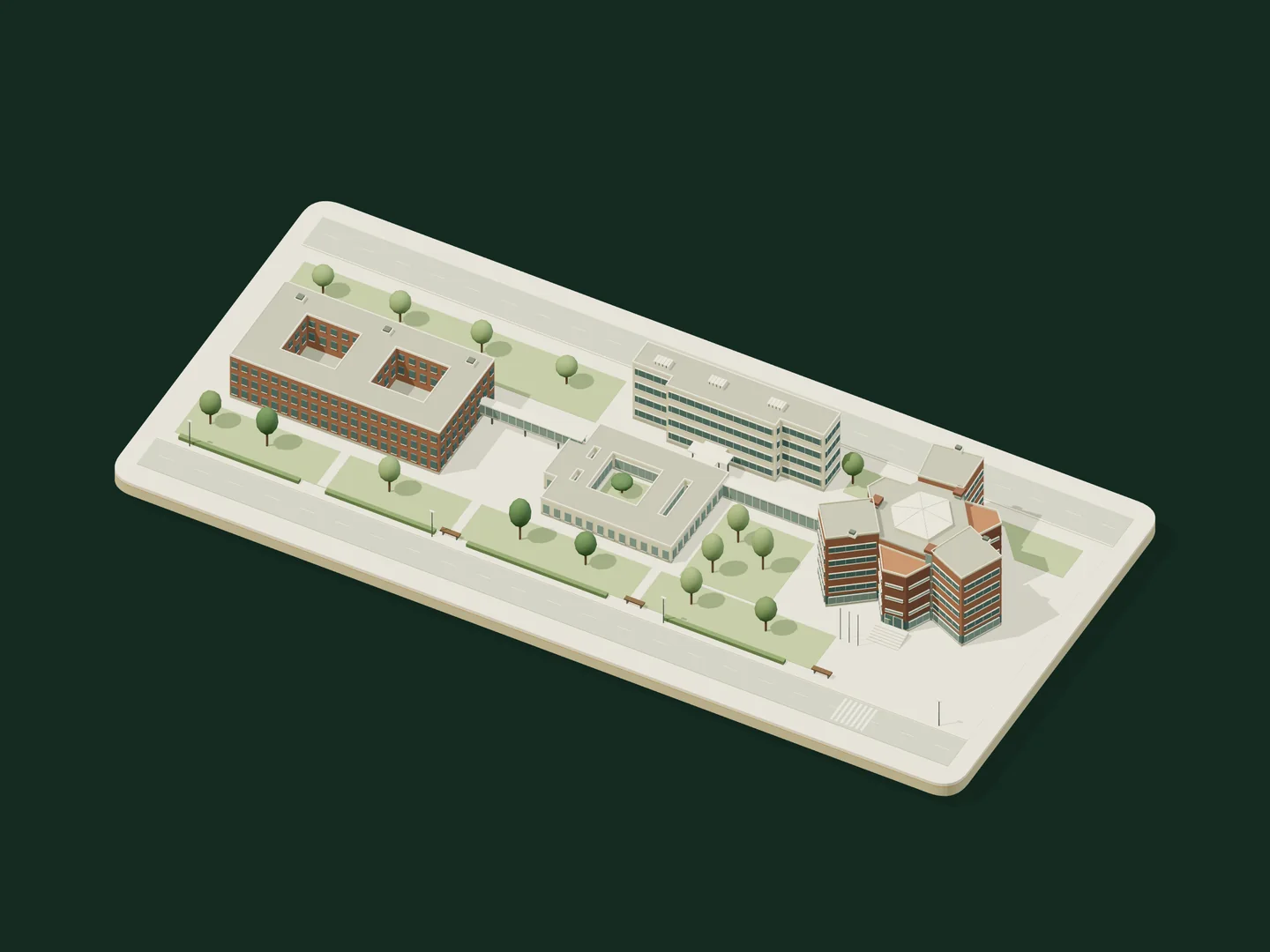
The University of Navarra's sciences buildings
The model shows one part of the University of Navarra's campus in Pamplona: its sciences buildings, shared from the start by the faculties of Medicine, Nursing, Pharmacy and Nutrition, and Sciences. The Research Building (1958) was the University's first; Los Castaños followed in 1963 and the Hexágono, designed by Carlos Sobrini, in 1970. The Science Library (1990, extended in 1997) added classrooms and laboratories, and a new building, the Centro Bioma, has been under construction since January 2026.
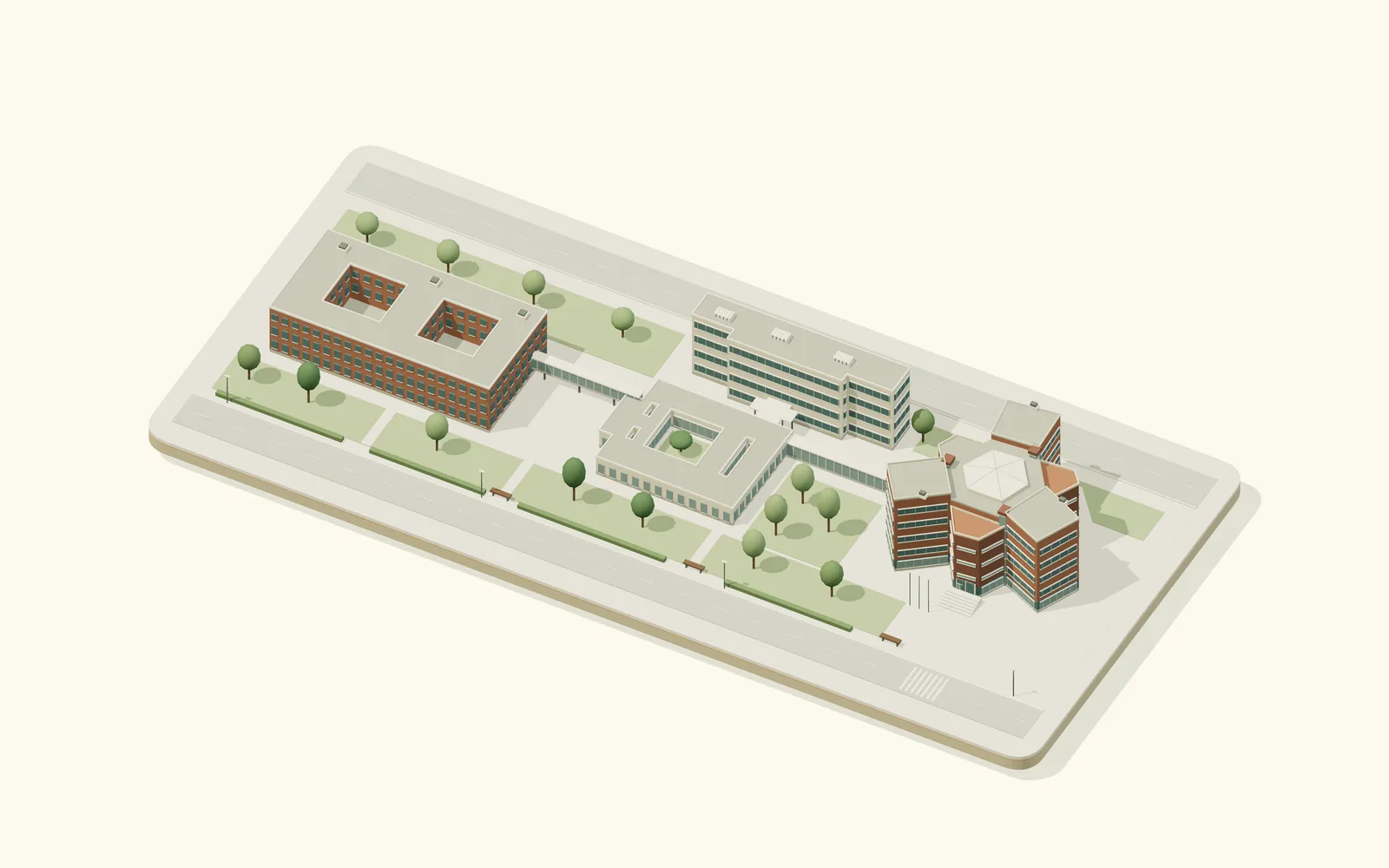
Explore the sciences buildings.
Open it in 3D to turn it and see what each building holds.
Stylized campus illustration, not a map or to scale.
Hexágono (Edificio de Ciencias)
Designed by Carlos Sobrini and finished in 1970, in dark rough brick, with its rooms organised around a central heart. The University's Museum of Sciences has shown part of its collections here since 1998.
Edificio de Investigación
The University's first building, built in 1958.
Los Castaños
Built in 1963. The first Biology students shared classrooms and laboratories on its two floors with Medicine, Nursing and Pharmacy.
Biblioteca de Ciencias
The Science Library, built in 1990 and extended in 1997, which added classrooms and laboratories.
Address: Campus Universitario, 31009 Pamplona
IvyTest University of Navarra Medicine Admission Test preparation
Ready to prepare properly for the Navarra test?
Everything above is free and always will be. When you want structure (a study guide mapped to UNAV's three official entrance-exam syllabi, a simulator that runs the full 180-question, no-calculator paper with the real 5-option and 4-option split, lessons for the gaps your results flag, and help with the application itself), that is what the IvyTest Universidad de Navarra package is.
Study guide
All seven official Biology blocks, eight Chemistry blocks and five Physics blocks, scoped exactly to UNAV's own syllabi, including what they leave out.
Exam simulator
Full 180-question three-hour mocks with five options on the sciences and four on the reading paper, scored +1/0/0 and reported in grade points, not just raw marks.
Video courses
Focused lessons in biology, chemistry and physics, with dedicated no-calculator technique for the quantitative chemistry this paper is built around.
Application support
MedApply: deadlines, documents, legalisation and enrolment steps carried through to a confirmed place.
FAQ
University of Navarra Medicine Admission Test frequently asked questions
It is UNAV's own on-site admission test for Medicine at its Pamplona campus: 180 counting questions in roughly three hours, split between a 150-question science paper (50 Biology, 50 Chemistry, 50 Physics, plus 6 reserve questions) and a separate 30-question reading-comprehension paper on a scientific article. No calculator is permitted.
No. Spain's private medical schools each write and grade their own paper, and UNAV's is the longest in this set by a wide margin: 180 questions against 75 at CEU Cardenal Herrera and 100 at Universidad Católica de Valencia. UNAV also runs other admission routes of its own for candidates at a school outside Spain, the ISAT plus an online test and an International Baccalaureate route; see "Which admission route is mine?" below.
In person, on the Pamplona campus, with calculations worked by hand in the question booklet and no calculator permitted. For 2027 entry UNAV's deadlines page gives the in-person test as Saturday 13 March 2027, in the afternoon, for applications made by 9 March. Candidates at a school outside Spain can instead take the ISAT plus the School's own test, which is sat online, in English, in December or March, with a webcam and proctoring software, starting at about 14:30 Spanish time.
One mark per correct answer, nothing for a wrong answer, nothing for a blank. So guessing always helps, and by slightly different amounts on the two papers: a blind guess is worth 1/5 = +0.20 marks on a five-option science item and 1/4 = +0.25 on a four-option reading item. Leave the whole paper blank and you forfeit an expected 37.5 marks. Converted to grade points the difference nearly vanishes: every unanswered question costs about an eighth of a point of the exam grade, wherever it sits.
Because UNAV's own documents disagree, and the more specific one wins. Its admissions page states "Cada pregunta cuenta con cinco posibles respuestas", and the official science model paper confirms five options on every Biology, Chemistry and Physics item. But the official reading-comprehension model paper is uniformly four-option across all 30 questions, with no exceptions; both PDFs were read in full on 21 September 2026. This guide follows the item-level document for the reading paper.
No, and this has been checked directly against two official UNAV pages. What exists are two other thresholds that are easy to confuse with one. The first is an entry condition: a 1st-year high-school final grade of 7/10 or higher, with enrolment in the 2nd year. The second is the final admission grade formula: 70% entrance exam plus 30% the average of your 1st-year official subjects. Neither is a pass mark on the paper.
Because UNAV weights the subjects rather than counting the questions: Biology 30%, Chemistry 30%, Physics 25%, Reading Comprehension 15%. Work it per question and a Biology or Chemistry item is worth 0.60 points of the exam grade against 0.50 for a Physics item (a fifth more for identical effort), and a reading item is worth the same 0.50 despite there being only 30 of them. Splitting revision by question count rather than by weight systematically over-invests in Physics.
Two things that appear on most other medical entrance papers. UNAV's official Physics syllabus contains no direct-current circuit content at all (no Ohm's law, no resistors in series or parallel, no Kirchhoff's laws) and no geometrical optics beyond reflection and refraction. Its electricity block stops at Coulomb's law, fields, potential and the Lorentz force. Preparing circuits or lens optics for this exam is a full loss of study time.
On site, in Spanish or in English: UNAV's Medicine admissions page says the on-site test is held "en español o en inglés". On the ISAT route the School's own test is in English, with an online Spanish test for candidates whose first language is not Spanish. The degree itself is taught in Spanish and English, and the official science model paper UNAV publishes is in Spanish. Confirm your intended language with Admissions when you apply.
Within the EU, yes: automatically, as a standard Spanish medical degree. Practising as a specialist in Spain additionally requires the MIR (Médico Interno Residente), Spain's national residency-entry exam, which sits alongside rather than instead of that recognition. Outside the EU recognition isn't automatic as a rule, but the UK is an exception. Under the Medical Act 1983 (section 21B, as in force on 12 October 2026), a Spanish medical degree is a 'relevant European qualification', so a graduate who applies to the GMC with one, whatever their nationality, is not asked to show the knowledge and skills other international graduates prove through PLAB/UKMLA; evidence of English is still required, and the rule is UK policy that can change. US-bound graduates need ECFMG certification via USMLE Step 1 and Step 2 CK, the same requirement every international medical graduate faces.
Yes. The IvyTest simulator runs the full 180-question format (five options on Biology, Chemistry and Physics, four on Reading Comprehension, +1/0/0 marking, no calculator) in timed, tutor and review modes, and reports results in grade points using the 30/30/25/15 weighting rather than as one raw total. A free diagnostic is available without payment.
UNAV publishes no past papers. Its Medicine admissions page links two free model PDFs instead: a science model with 10 questions each in Biology, Chemistry and Physics, five options per question and no answer key, and a reading-comprehension model with a scientific article and its 30 four-option questions. The same page links the three subject syllabi as PDFs. The practice questions on this page are IvyTest's own.
For 2027/28 entry the window opened on 1 October 2026. Apply through the miUNAV portal by 9 March 2027 and sit the on-site test in Pamplona on Saturday 13 March 2027, in the afternoon; the resolution follows on 15 April and enrolment closes on 31 May 2027. For Medicine the earlier window (apply by 9 December 2026, test on 12 December, resolution on 21 January 2027, enrolment by 23 February) is for international applicants only.
To sit the on-site test you must be in the 2nd year of Bachillerato or equivalent, with a 1st-year final grade of 7/10 or higher, and apply through miUNAV with the €100 processing fee. UNAV asks for the Bachillerato (preferably in health sciences) or an equivalent high-school diploma and, where Spanish law requires it, a pass in the PAU; if you sit the PAU, you must pass it at its first sitting to enrol in Medicine (international students don't need the PAU). The International Program also needs an English certificate.
There is none to look up. Navarra admits on its own test, not on a PAU cut-off: the final admission grade is 70% the entrance exam and 30% the 1st-year Bachillerato average, and UNAV publishes no cutoff or minimum score. The PAU matters for the waiting list, where a place depends on the PAU result (the two best grades of Biology, Chemistry or Physics, each multiplied by 0.2) and on places falling vacant.
No. The Universidad Pública de Navarra (UPNA) is a separate, public university, also in Pamplona, with its own Grado en Medicina: 75 places, taught in Spanish, with Bachillerato and related higher vocational qualifications as its access routes and places handled through UPNA's own pre-enrolment. Its notas de corte are UPNA's to publish. This guide covers the private Universidad de Navarra (UNAV), whose 200 places go through the admission test above.
For 2026/27 the first year costs €20,400 (€340 per ECTS × 60 credits), the same for Medicine and Medicine + International Program, plus €95 secretariat fees. Applying costs a €100 non-refundable processing fee. Admitted students pay €5,500 as the first enrolment payment, deducted from the year's tuition. UNAV's Prof. Jiménez Vargas scholarships go to 5 first-year students a year, covering up to 70% of tuition, for a Bachillerato average of 9 or more and family income of up to €20,000 per person.
UNAV publishes no acceptance rate and no applicant numbers. Its Grado en Medicina page advertises 200 places, and on 31 August 2026 the School of Medicine welcomed 220 new students from 23 nationalities, according to UNAV's own news. Admission is decided on the final grade (70% exam, 30% 1st-year average), so the exam is the part of it you can still move.
Partly. The degree is taught in Spanish and English. The Medicine + International Program, chosen when you apply on miUNAV, teaches the 1st year fully in English and part of the 2nd, adds electives taught by doctors from partner universities abroad and international rotations for a limited number of top students. It needs an English certificate (Cambridge Advanced at 180 or more, TOEFL 95 or IELTS 7, among others); without one you are admitted to Medicine. Students without Spanish need B2.2 before starting.
Yes, whatever their nationality. Students in their final school year can sit the on-site test in Pamplona, in Spanish or English; those at a school outside Spain can instead take the ISAT plus the School's online test in English (ISAT 30%, online test 40%, school record 30%), and IB students apply on predicted grades of 37 or more, with 6 in Biology HL and Chemistry HL, and an interview. The on-site and ISAT routes need a 1st-year grade of 7/10 or more.
On the measures checked, yes. QS's own Medicine table in the QS World University Rankings by Subject 2026 puts the University of Navarra =143rd in the world, and Times Higher Education ranks it =275th in its World University Rankings 2027 and 176–200th in Medical and Health 2026. UNAV adds that it is 7th in Spain in Life Sciences and Medicine and that the CYD ranking 2026 puts it first among Spanish universities overall; IvyTest has not checked those two in the rankings' own tables. Its Medicine pages add that the School holds the WFME international quality seal and that its curriculum was developed with Harvard Medical School.
Six years and 360 ECTS, in six modules: the structure and function of the human body, social medicine and research, clinical training, diagnostic and therapeutic procedures, supervised rotations with the final project, and electives. Year 1 is From the molecule to the cell I and II, Foundations of structure and function, Integrated organ systems I and II, Anthropology and Practice of Medicine I. Year 3 is a full rotating year at the Clínica Universidad de Navarra, in Pamplona or Madrid.
Yes, and it says so itself. UNAV describes itself as a university of Christian inspiration, begun in Pamplona in 1952 at the initiative of St Josemaría Escrivá, founder of Opus Dei, and its Grand Chancellor is the Prelate of Opus Dei. Theology is taught in every degree. Its stated values describe the University as open to people of every background, without discrimination by religion, and UNAV's published Medicine admission rules contain no religious condition.
It depends on where you are at school, not on your nationality, and you may apply by one route only. On site (anyone in their final school year, from Spain or abroad, with 7/10 or more in the 1st year): apply by 9 March 2027 and sit the test in Pamplona on 13 March, in the afternoon, in Spanish or English: 150 science questions plus 6 reserve and a 30-question reading paper, weighted 30/30/25/15; your final grade is 70% test and 30% 1st-year average. ISAT (a school outside Spain, 7/10 or more): share an ISAT result from the January, July/August or October/November sittings, then sit the School's test online in English in the December round (apply by 9 December 2026, test on 12 December) or the March one: 150 science questions plus 6 reserve, weighted 35/35/30, no reading paper, from about 14:30 Spanish time, plus an online Spanish test if Spanish is not your first language and possibly an interview; your final grade is ISAT 30%, School test 40%, 1st-year average 30%. IB: predicted 37 or more, with 6 in Biology HL and Chemistry HL, and an online interview, no test.
Yes: r/NavarraUniversity, where Universidad de Navarra applicants ask each other about the University of Navarra Medicine Admission Test and share how their preparation is going. It is run by the IvyTest team. Dates, rules and results come only from the university's own pages, listed under Official sources on this page.
Verification
Official sources
- Checked: 14 October 2026
- Checked: 10 October 2026
- Plazos de admisión (official deadlines page; the 2027/28 window opens 1 October 2026, Medicine deadline 9 March 2027, test 13 March 2027, resolution 15 April 2027, enrolment by 31 May 2027)Checked: 14 October 2026
Universidad de Navarra
- Precios de primer curso 2026-27 (Medicina and Medicina + International Program: €340 per ECTS, €20,400; €95 secretariat fees)Checked: 14 October 2026
Universidad de Navarra
- Modelo de examen (official science model paper, modelo-examen-castellano_2.pdf; 10 questions per subject, every Biology, Chemistry and Physics item carries five options)Checked: 10 October 2026
Universidad de Navarra, School of Medicine
- Modelo de comprensión lectora (official reading-comprehension model paper; all 30 questions carry four options)Checked: 10 October 2026
Universidad de Navarra, School of Medicine
- Biology, Chemistry and Physics Entrance Exam Syllabi (official, undated)Checked: 5 October 2026
Universidad de Navarra, School of Medicine
- Checked: 14 October 2026
- International Program in Medicine (English teaching in year 1 and part of year 2, English certificates, Spanish B2.2 before starting, a curriculum developed with Harvard Medical School)Checked: 10 October 2026
Universidad de Navarra, School of Medicine
- Plan de estudios (the six modules and their subjects)Checked: 10 October 2026
Universidad de Navarra, School of Medicine
- Asignaturas (the subjects of each year)Checked: 10 October 2026
Universidad de Navarra, School of Medicine
- Becas: Programa de Becas Prof. Jiménez Vargas (5 a year, up to 70% of tuition, a Bachillerato average of 9, income up to €20,000 per person)Checked: 14 October 2026
Universidad de Navarra, School of Medicine
- 220 alumnos comienzan sus estudios en la Facultad de Medicina (news, 1 September 2026; 23 nationalities)Checked: 10 October 2026
Universidad de Navarra
- Siete disciplinas de la Universidad, entre las 100 mejores del mundo según el ranking QS (news, 25 March 2026; Medicine 143rd, 7th in Spain in Life Sciences and Medicine)Checked: 10 October 2026
Universidad de Navarra
- La Universidad, primera universidad de España según el ranking CYD (news, 27 May 2026)Checked: 10 October 2026
Universidad de Navarra
- Conoce la Universidad (identity and mission: Christian inspiration, promoted by St Josemaría Escrivá, founder of Opus Dei; the Grand Chancellor is the Prelate of Opus Dei)Checked: 10 October 2026
Universidad de Navarra
- Grado en Medicina, Universidad Pública de Navarra (a different, public university: 75 places, taught in Spanish)Checked: 10 October 2026
Universidad Pública de Navarra
- QS World University Rankings by Subject 2026: Medicine, Spain (University of Navarra =143)Checked: 12 October 2026
QS Quacquarelli Symonds
- Medical Act 1983, section 21B: registration with a relevant European qualification, without the knowledge test, for applications made since IP completion day (Brexit)Checked: 12 October 2026
legislation.gov.uk (The National Archives)
- Directive 2005/36/EC on the recognition of professional qualifications, consolidated text of 29 October 2025, Annex V point 5.1.1 (Spain: Título de Licenciado en Medicina y Cirugía, Licenciado en Medicina or Graduado/a en Medicina, no accompanying certificate)Checked: 12 October 2026
Publications Office of the European Union (EUR-Lex)
- Evidence of qualifications from SpainChecked: 12 October 2026
General Medical Council (GMC)
- Checked: 14 October 2026
- Times Higher Education: University of Navarra (World University Rankings 2027 =275; Medical and Health 2026 176–200)Checked: 14 October 2026
Times Higher Education
Last reviewed by IvyTest editorial team: 14 October 2026. Admission rules change every cycle — always confirm against the official Universidad de Navarra call for applications before acting on a deadline.
Find out how ready you are for the Navarra test.
The diagnostic runs the real format (five options on the sciences, four on the reading paper, no calculator) and reports your result in grade points using the 30/30/25/15 weighting, not just as a raw total. No payment, no commitment.