
Premise: every candidate who clears the eligibility threshold is included in the merit ranking. Paolo is not included in the merit ranking. What can be concluded with certainty?
Exam guide · Updated for 2027 admissions
LUM Admission Test 2027: Complete Admission Test Guide
Everything you need to know about LUM Giuseppe Degennaro's admission test for its Italian-taught Medicine and Surgery programme at Casamassima (Bari): dates, format, syllabus, scoring, preparation strategy and practice.
Updated for 2027 admissions · Last updated: 14 October 2026
LUM Admission Test at a glance
Overview
What is the LUM Admission Test?
LUM Giuseppe Degennaro runs its own admission test for Medicina e Chirurgia LM-41R, its Medicine and Surgery degree at the Casamassima campus near Bari. Both the degree and the test itself are in Italian, and so are the IvyTest study guide and simulator questions for it; this page summarises in English what the test actually covers.
The Bando runs two courses side by side, with 140 and 150 places: MED_FM, run in partnership with the Ente Ecclesiastico Ospedale Generale Regionale 'F. Miulli', and MED_MD, run with the Mater Dei Hospital in Bari. Each has its own test day and its own merit ranking: in 2026/27, 26 February (MED_FM) and 27 February (MED_MD), repeated on 26 March (MED_FM) and 27 March 2026 (MED_MD). The format and syllabus are the same, you can sit every date for both courses, and where you sit twice for one course your higher score counts.
A detail worth knowing before test day: despite being a campus-based programme, the admission test itself is sat remotely from home, proctored through ProctorExam (a Chrome browser plugin plus a phone or tablet positioned as a second camera over your desk and keyboard), not in person at Casamassima. The test also runs as two genuinely sealed sections rather than one continuous block: 60 minutes for the 36 Logical Reasoning questions, then 40 minutes for the 24 science questions, and once a section closes it cannot be reopened.
Programmes that use the LUM Admission Test
- Medicina e Chirurgia LM-41R, MED_FM pathway (in partnership with Ospedale Generale Regionale 'F. Miulli')
- Medicina e Chirurgia LM-41R, MED_MD pathway (in partnership with Mater Dei Hospital, Bari)
Timeline
LUM Medicine call 2027/28: dates, places and registration
When to expect your exam · 2027 start
- February 2027late FebExpected
- March 2027late MarExpected
Applications usually open around now and run until about 23 Mar 2027 (based on 2025).
Predicted from this university's past sittings until it publishes its own dates. See every university on the calendar →
- Applications openThe 2027/28 call is not out yet (checked 14 October 2026). The 2026/27 call was published on 10 October 2025, and registration opened with it; the 2025/26 one on 19 December 2024
- Registration deadline (February sitting)2027/28 not published; 2026/27 closed at noon on 23 February 2026, extended from 19 February
- Registration deadline (March sitting)2027/28 not published; 2026/27 closed at noon on 23 March 2026, extended from 19 March
- First sitting2027/28 not published; 2026/27 ran 26-27 February 2026
- Second sitting2027/28 not published; 2026/27 ran 26-27 March 2026
- Results and rankings2027/28 not published; in 2026/27 each sitting's scores were online a few days later (27 February and 30 March 2026), and the two merit rankings came out on 9 April 2026
- Enrolment deadline2027/28 not published; in 2026/27 admitted candidates paid the first €8,500 by 13:00 on 15 April 2026 and completed enrolment between 15 and 31 July 2026
- Waiting list (scorrimenti)In 2026/27 places left free were offered down each ranking from 15 April, until filled or 31 December 2026 at the latest; by 1 October 2026 LUM had published 18 notices for MED_MD and 15 for MED_FM
No 2027/2028 Bando had been published when IvyTest rechecked lum.it on 14 October 2026; the confirmed cycle remains 2026/2027 under Bando D.P. 345/25, and every date above says which year it is from. LUM published its last five calls between October and February (10 October 2025, 19 December 2024, 4 January 2024, 14 November 2022 and 8 February 2022), so the next one can appear any day; this section will then give its dates, places, fee and any change to the format. How registration worked in 2026/27: create an account on the MYLUM portal at lum.it, sign up for each test under 'Test di ammissione', and pay €200 per test through pagoPA; registration counts only once all three steps are done, and the fee is not refunded. Article 6 also let candidates who could prove a connectivity fault resit the entire paper on 31 March 2026, at equal difficulty.
Structure
LUM Admission Test format
60 questions in 100 minutes, but not as one continuous block: the paper runs as two sealed sections with their own fixed time limits, and a section that closes cannot be reopened.
| Section | Questions | Weighting | Suggested time |
|---|---|---|---|
| Ragionamento Logico (Logical Reasoning) | 36 | 60% (36 of 60) | 60 minutes |
| Scientific Subjects (Biology, Chemistry, Physics combined) | 24 | 40% (24 of 60) | 40 minutes |
Content
Question and subject breakdown
Logical Reasoning alone is worth 60% of the paper, by far the largest single block of any school in our catalogue. The three sciences share the remaining 24 questions equally.
Logical Reasoning
60%Graph and data interpretation, formulas and units, algebraic problems with symbols, procedures and systems, sets and classification, visual-spatial reasoning, and deduction and critical reasoning: a genuinely wide mix inside one section.
Biology
13%Cell biology, the molecules of life, bioenergetics, life cycles and reproduction, Mendelian and molecular genetics, and evolution. Notably absent: human anatomy, physiology, ecology and biotechnology.
Chemistry
13%Atomic structure, bonding, inorganic nomenclature, the mole and stoichiometry, redox, and solutions and pH: unusually calculation-heavy for only 8 questions, and all by hand, since no calculator is permitted.
Physics
13%Statics and fluids, kinematics and dynamics, energy and momentum, gravitation, thermodynamics, waves and optics, electromagnetism, and a genuine slice of modern physics (relativity, radioactivity and quantum concepts), packed into just 8 questions.
Marks
LUM Admission Test scoring
LUM's scoring rewards a correct answer more than most peer schools (1.5 points) with a comparatively light penalty for a wrong one (−0.2); the combination gives blind guessing the highest positive expected value of any school in this catalogue.
- Correct answer
- +1.5 points
- Incorrect answer
- −0.2 points
- Unanswered question
- 0 points
- Maximum possible score
- 90 points (60 × 1.5)
- Minimum eligible score
- 20 points overall: score below this and you are not eligible for a place, regardless of rank
- OFA floors (Biology, Chemistry, Physics)
- At least 2 of 8 correct in each; miss this in even one science and you're assigned extra coursework in that subject after enrolment
- Technical-fault resit
- Candidates who can prove a connectivity fault may resit the entire paper on 31 March 2026, at equal difficulty
Worked example
Suppose that across both sections you answer 48 of the 60 questions and leave 12 blank. Of the 48 attempted, 40 are correct and 8 are incorrect. Your score is (40 × 1.5) + (8 × −0.2) + (12 × 0) = 60 − 1.6 = 58.4 out of a maximum 90, comfortably above the 20-point minimum. A purely random guess has an expected value of (1/5 × 1.5) + (4/5 × −0.2) = 0.30 − 0.16 = +0.14, the highest positive guessing value of any school in this catalogue, though still far below the value of actually eliminating an implausible option first.
The IvyTest simulator scores every practice paper against these exact rules.
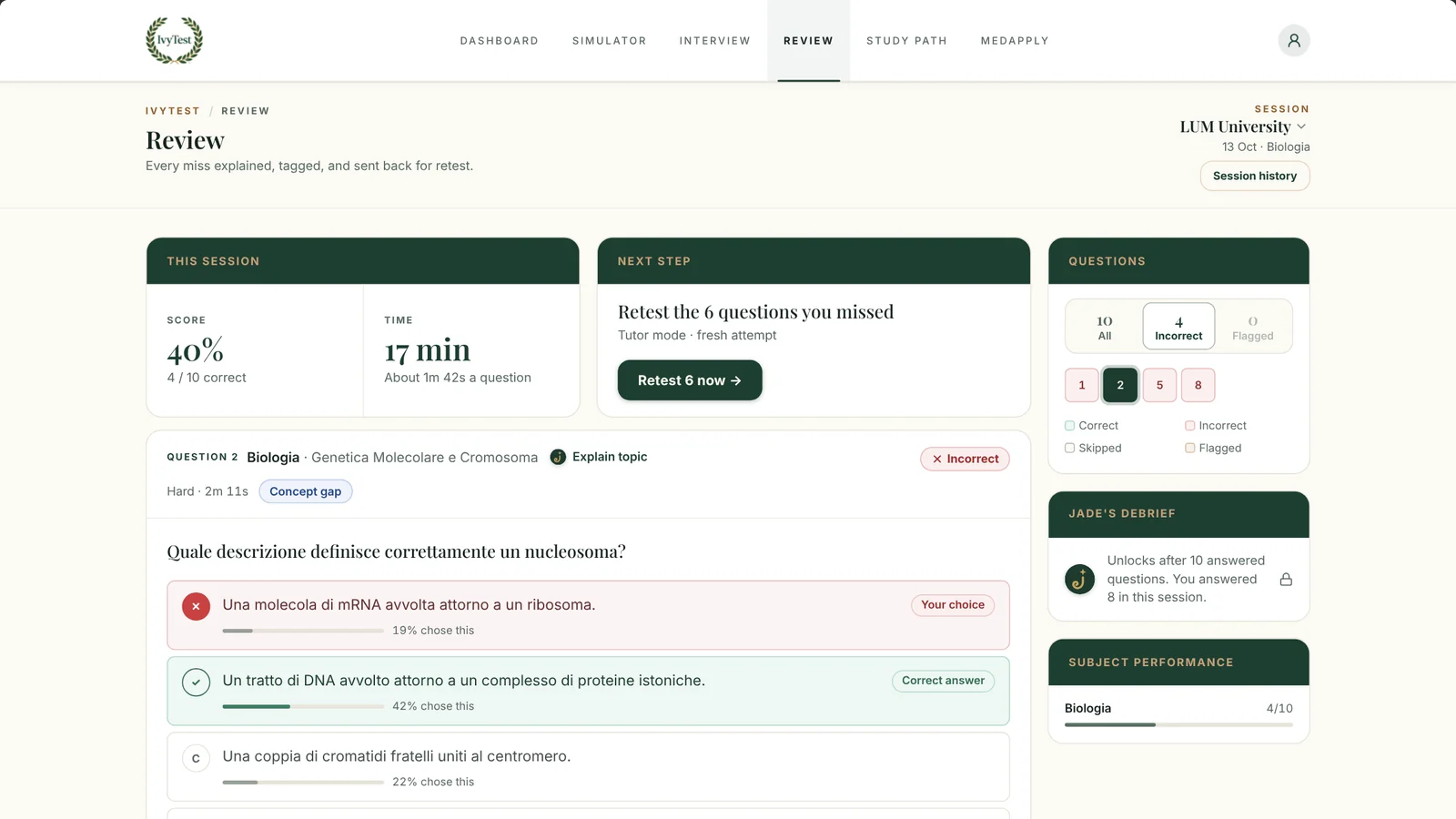
See the LUM Admission Test simulatorSyllabus
Full LUM Admission Test syllabus
Allegato A of the Bando lists each section's official macro-topics; the groupings below organise those items for readability and are translated into English for this page; the test itself is set and sat entirely in Italian.
The only section without its own OFA floor: LUM's floor rule applies to Biology, Chemistry and Physics only.
- Graph and data interpretation: charts, histograms, tables, trends, percentage changes, identifying relevant vs. irrelevant data
- Formulas and units: direct and inverse proportionality, applying formulas, unit conversion, order-of-magnitude estimation
- Symbolic and numerical problems: algebraic translation, simultaneous equations, ordering numbers including decimals, fractions and negatives
- Procedures, systems and maps: following a flowchart or protocol step by step, cause-and-effect chains, choosing the best concept map for a text
- Sets and classification: union, intersection, exclusion, multiple criteria, identifying common or anomalous elements
- Visual-spatial reasoning: mental rotation, nets of solids, mirror images, symmetry, pattern completion, figural series and matrices
- Deduction and critical reasoning: necessary vs. possible implications, distinguishing fact from opinion, evaluating whether data support a theory
No human anatomy, physiology, ecology or biotechnology on this paper: the content sits entirely inside the cell, molecular biology, genetics and evolution.
- The cell: cell theory, prokaryotic and eukaryotic cells, membrane transport, organelles, animal vs. plant cells
- The molecules of life: weak interactions, macromolecules and their functions, enzymes
- Bioenergetics: ATP, redox reactions, photosynthesis, glycolysis, respiration and fermentation
- Life cycles and reproduction: sexual and asexual reproduction, gametogenesis, mitosis and meiosis
- Mendelian and classical genetics: Mendel's laws, dominance and recessiveness, Punnett squares, linkage and genetic maps
- Molecular genetics and the chromosome: DNA structure and replication, transcription and translation, gene regulation, chromosome structure
- Evolution: natural and artificial selection, evolutionary theory, the genetic basis of evolution, speciation
Unusually calculation-heavy for only 8 questions: the mole, stoichiometry and pH calculations are all named explicitly, and there's no calculator.
- Matter, atoms and the periodic table: atomic structure, isotopes, periodic trends
- Bonding and intermolecular forces: ionic, covalent and metallic bonds, hydrogen bonding, intermolecular attractions
- Inorganic nomenclature: oxides, hydroxides, acids and salts
- The mole, stoichiometry and gases: Avogadro's number, molar mass, balancing equations, ideal gas laws
- Redox reactions: oxidation and reduction as electron transfer, assigning oxidation numbers
- Water, pH and solutions: acid-base titration, solubility, concentration calculations
- Properties of organic compounds: functional groups and their physical/biological properties only: no isomerism, reaction mechanisms or complex nomenclature
A genuinely broad syllabus for 8 questions, reaching into modern physics; keep this conceptual rather than computational.
- Equilibrium of bodies and fluids: statics, pressure, Archimedes' and Pascal's principles
- Kinematics and dynamics: motion, vectors, Newton's laws, friction
- Energy and momentum: conservation of energy and momentum, work, collisions
- Gravitation: the law of universal gravitation, gravitational potential energy
- Thermology and thermodynamics: heat, specific heat, gas laws, the laws of thermodynamics
- Waves, sound and light: wave properties, reflection and refraction, mirrors and lenses
- Electromagnetism: Coulomb's law, circuits, Ohm's law, the electromagnetic spectrum
- Modern physics: special relativity, radioactivity and nuclear decay, Planck's hypothesis, the photoelectric effect, De Broglie's hypothesis
Test your LUM Admission Test knowledge
Take free diagnosticDifficulty
How difficult is the LUM Admission Test?
LUM's difficulty comes from a genuinely unusual combination: a huge, wide-ranging reasoning section, a narrower-than-expected biology syllabus, and a physics section that reaches surprisingly far for its size.
Two sealed sections: no borrowing time
60 minutes for Logical Reasoning, then that section closes permanently and 40 minutes for the sciences begins. Unlike a single continuous 60- or 80-question block, you can't finish the sciences early and go back to recheck a logic answer, or vice versa.
Logic is 60% of the paper, and it's genuinely varied
36 questions in 60 minutes (about 100 seconds each), spanning graph reading, algebra, set theory, spatial reasoning and formal deduction. Treating 'logic prep' as one skill rather than several is the most common gap.
Biology here is narrower than you might expect
There's no anatomy, physiology, homeostasis, ecology or biotechnology at all: the entire 8-question section concentrates on cell biology, molecular biology, genetics and evolution. Candidates who prepare a general Italian-medicine biology syllabus often cover content this test never asks and under-prepare the genetics depth it actually wants.
Physics reaches further than its size suggests
For only 8 questions, the syllabus explicitly names special relativity, nuclear radioactivity, the photoelectric effect and De Broglie's hypothesis alongside the usual mechanics and electromagnetism. Aim for solid conceptual understanding across the whole list rather than deep computational practice on any one part.
The test is remote: treat your setup as part of preparation
Sat from home under ProctorExam rather than at Casamassima, your device, camera and connection are part of what can go right or wrong on the day. The only safety net is a full resit for candidates who can prove a genuine connectivity fault, not a generic technical-difficulty allowance.
Benchmarks
What is a good LUM Admission Test score?
LUM publishes its merit rankings with every candidate's score, under a masked tax code, so the scores that won a place can be read off them. They are one year's figures, not a fixed cutoff: the only rule set in advance is the 20-point minimum.
In 2026/27 the last of the 150 MED_MD places went at 68.9 points out of 90, and the last of the 140 MED_FM places at 68.7 (rankings of 9 April 2026, with 489 and 517 candidates ranked). Many candidates sit for both courses and enrol on only one, so the lists then moved a long way: by 1 October 2026 MED_MD had called candidates down to position 385, at 46.7 points, and by 10 September MED_FM down to position 246, at 59.5. A score around 69 was safe on the day; one in the high 40s needed months of waiting.
Non-EU applicants not already resident in Italy should pay particular attention to LUM's current quota status: Italy's Ministry of University decree for the 2025/2026 cycle listed LUM's non-EU-applicants-abroad quota as still 'in accreditation.' Confirm your own route directly with LUM before assuming the standard non-EU pathway applies.
Pending verification
- · Applicants per cycle: the rankings list only candidates who sat the test
- · The last admitted scores of cycles before 2026/27
- · Current resolution of the non-EU-applicants-abroad quota
These specific numbers aren't public yet — an IvyTest simulator score is the closest benchmark you can get today.
Check your LUM Admission Test scoreStrategy
How to prepare for the LUM Admission Test
12+ weeks
Build reasoning breadth first: it's 60% of the paper
Full coverage, with Logical Reasoning given proportional time.
- Sit a full diagnostic in week one, scored with the real +1.5/−0.2/0 rule, treating the two sections as two separate timed pieces.
- Since Logical Reasoning alone is worth more than the three sciences combined, give it proportional study time rather than treating it as a warm-up before the 'real' science content.
- Learn LUM's actual Biology list specifically: skip anatomy and physiology prep aimed at other Italian schools and go deep on genetics, molecular biology and evolution instead.
- Add full two-section timed sittings (60 min logic, then 40 min science, sealed) from week six onward.
8 weeks
Drill each section's timing independently
Targeted repair with separate pacing goals for each section.
- Diagnostic first, then practise Logical Reasoning and the sciences as two separate timed drills (36 questions in 60 minutes, 24 in 40) rather than one combined pace.
- Check each science against its own 2/8 OFA floor individually, not just your overall total.
- One full two-section mock a week from week two, reviewed the same day.
- For Physics, prioritise conceptual breadth across the full syllabus, including the modern-physics topics, over deep practice on any single mechanics sub-topic.
4 weeks
Full sealed-section sittings become the core activity
Volume of timed practice under the exact section structure.
- Two full mocks a week, run as genuinely sealed sections: set a timer, stop Logical Reasoning at 60 minutes without looking back, then start the sciences fresh.
- Review each science separately against its 2/8 floor as well as your overall score.
- Rehearse the remote-proctoring setup (device, second camera, workspace) well before the real sitting, given the limited resit provision.
- Keep all calculations to pen and paper only: no calculator is permitted on any section.
Under 4 weeks
Protect the floors, don't expand the syllabus
Triage by section timing and OFA risk.
- Identify whichever science sits closest to its 2/8 floor and prioritise it specifically.
- In Logical Reasoning, focus on the question types you can solve reliably within the roughly 100-second-per-question pace rather than adding new topic areas.
- Sit at least two full, scored, sealed-section mocks in the final ten days.
- Confirm your remote-testing setup at least once before the real sitting: there is no reliable second chance outside the proven-connectivity-fault resit.
Get your personalised LUM Admission Test study plan
Take free diagnosticExplore the full LUM Admission Test planPractice
Free LUM Admission Test practice questions
Three questions in the format the exam uses. Choose an answer to see the explanation — nothing is recorded.
In a cross between two heterozygous parents (Aa × Aa) for a completely dominant trait, what fraction of offspring is expected to show the recessive phenotype?
How many moles of CO2 are produced from the complete combustion of 3 moles of propane? (C3H8 + 5O2 → 3CO2 + 4H2O)
Illustrative examples written by IvyTest to show the question style — not past LUM Admission Test papers.
Past papers
LUM past papers and practice tests
LUM publishes its own past papers: its admission page for Medicine links the tests of 2021 to 2025 as free PDFs, listed below, and from 2023 each one is the full paper with every correct answer printed as option A. They belong to Selexi, the company that sets the test, so IvyTest links them rather than copying them. Read them for the kind of question, not the format: the subject mix, the timing and the penalty for a wrong answer (−0.30 until 2025, −0.20 in 2026) changed almost every year, and about one logic question in four uses a diagram or a figure. The papers of the 2026 tests are not published yet. The practice paper on this page is IvyTest's own, in Italian and in the 2026/27 format: 36 logic questions in 60 minutes, then 24 science questions in 40.
| Academic year | Test | Questions | Time | Official PDF |
|---|---|---|---|---|
| 2025/26 | 27 March 2025 | 36 + 8 + 8 + 8 | 70 + 30 min | Open the PDF |
| 2025/26 | 27 February 2025 | 36 + 8 + 8 + 8 | 70 + 30 min | Open the PDF |
| 2024/25 | 26 March 2024 | 30 + 10 + 10 + 10 | 120 min | Open the PDF |
| 2024/25 | 26 February 2024 | 30 + 10 + 10 + 10 | 120 min | Open the PDF |
| 2023/24 | 14 March 2023 | 30 + 10 + 10 + 10 | 60 + 40 min | Open the PDF |
| 2022/23 | 12 April 2022 | 12 + 10 + 18 + 12 + 8 * | 100 min | Open the PDF |
| 2021/22 | 15 September 2021 | 12 + 10 + 18 + 12 + 8 * | 100 min | Open the PDF |
Questions: logic + Biology + Chemistry + Physics; two times are two sealed sections. * 2021 and 2022: general culture + logic + Biology + Chemistry + Physics and mathematics, a written test sat in person.
University
LUM Giuseppe Degennaro medicine admissions
The test result feeds into a wider Italian-language application: several deadlines and requirements outside the test itself are worth checking directly with LUM.
- Degree
- Medicina e Chirurgia LM-41R (6-year MD, Italian-taught); MED_FM or MED_MD pathway
- Language
- Italian: both the programme and the admission test. The Bando also asks for English at B1; without a certificate you're given an OFA, cleared through a course at LUM's language centre
- Campus
- Casamassima, Bari (Baricentro complex); test itself is sat remotely, not on campus
- Tuition
- €16,500/year for 2026/27 (€8,500 at enrolment, €4,000 by 8 September 2026 and €4,000 by 6 November 2026), plus the Puglia regional tax
- Application fee
- €200 per test day you register for (each sitting is paid separately)
- Total seats
- 290 for 2026/27: 140 on the MED_FM pathway and 150 on MED_MD, subject to change by the Ministry
- Non-EU applicants abroad
- Not covered by the 2026/27 Bando, which is open to Italian and EU citizens and to non-EU citizens legally resident in Italy; confirm any route from abroad directly with LUM
- Clinical training
- MED_FM: Regional General Hospital 'F. Miulli' (Acquaviva delle Fonti), formally 'Policlinico Universitario Miulli' since a 2025 agreement. MED_MD: Mater Dei Hospital (Bari). Both also use other accredited facilities in Puglia
- Application process
- Admission test registration, application form and documents via the university's own portal; no interview
IvyTest LUM Admission Test preparation
Ready to prepare properly for the LUM test?
Everything above is free and always will be. When you want structure (a syllabus-mapped book covering all four subjects entirely in the format LUM actually uses, a simulator that reproduces the real two-sealed-section timing and +1.5/−0.2/0 scoring, lessons for the gaps your results flag, and help with the application itself), that is what the IvyTest LUM package is.
Study guide
The full syllabus across Logical Reasoning, Biology, Chemistry and Physics, matched to LUM's own narrower Biology list and broader Physics list.
Exam simulator
Timed mocks that reproduce the real sealed 60-minute / 40-minute section structure and the +1.5/−0.2/0 scoring.
Application support
MedApply: deadlines, documents, legalisation and enrolment steps carried through to a confirmed place.
FAQ
LUM Admission Test frequently asked questions
It's LUM Giuseppe Degennaro's own admission test for its Italian-taught Medicine and Surgery programme (LM-41R) at the Casamassima campus near Bari: 60 questions across two sealed, separately timed sections.
LUM has not published the 2027/28 Bando yet (checked 14 October 2026). Its last calls came out on 10 October 2025, 19 December 2024 and 4 January 2024, so expect the new one between October and January. In the 2026/27 cycle the test ran on 26 and 27 February 2026, repeated on 26 and 27 March 2026, one day for each course. Expect a similar calendar and confirm it once the new Bando is out. In 2025/26 the sittings were on 27 February and 27 March 2025, and in 2024/25 on 26 February and 26 March 2024.
Your score comes first: in 2026/27 candidates could see it online a few days after their sitting (from 27 February and 30 March 2026), with the credentials emailed by [email protected]. The merit rankings follow, one per course, MED_FM with 140 places and MED_MD with 150: the Bando set 10 April 2026, and LUM published them on 9 April. You need at least 20 points out of 90 to be ranked, and if you sit twice for the same course your higher score counts. Admitted candidates then paid the first €8,500 by 15 April. Places left free go down each ranking in scorrimenti, announced in numbered notices on LUM's admission page and by PEC, with 72 hours to enrol from the second call, until the places are filled or 31 December at the latest: in 2026/27 that took MED_MD down to position 385 by 1 October.
For 2026/27 the contribution was €16,500 a year: €8,500 at enrolment and two payments of €4,000 by September and November, plus the Puglia regional tax. Each test day you register for costs €200.
No. Both the degree and the admission test are entirely in Italian. The IvyTest study guide and simulator questions for LUM are in Italian too, so you prepare in the language you'll sit the test in.
Remotely, from home, proctored through ProctorExam, not in person at the Casamassima campus, despite this being a campus-based programme. You'll need a working device and a second camera (phone or tablet) positioned over your desk and keyboard.
60 minutes for 36 Logical Reasoning questions, then 40 minutes for 24 combined science questions (Biology, Chemistry, Physics). Once the Logical Reasoning section closes, it cannot be reopened: you can't use leftover time from one section on the other.
+1.5 points for a correct answer, −0.2 for an incorrect one, 0 for a blank, out of a maximum 90. A purely random guess has an expected value of +0.14 points (the highest positive guessing value of any school in our catalogue), though eliminating an implausible option first is worth considerably more.
Yes: 20 out of 90 overall, below which you're not eligible for a place regardless of rank. Separately, you need at least 2 of 8 correct in each of Biology, Chemistry and Physics individually, or you're assigned extra coursework in that subject after enrolling.
Two LM-41R Medicine and Surgery courses admitted through the same Bando. MED_FM runs in partnership with the Ospedale Generale Regionale 'F. Miulli' in Acquaviva delle Fonti, MED_MD with the Mater Dei Hospital in Bari, and their 2026/27 study plans list the same exams. Each has its own test day (in 2026/27, MED_FM on 26 February and 26 March, MED_MD on 27 February and 27 March) and its own ranking; the paper's format and syllabus are the same, and you can sit for both.
Candidates who can demonstrate a genuine connectivity fault may resit the entire paper on 31 March 2026, at equal difficulty. This isn't a general allowance for technical difficulty; it applies specifically to proven connection failures.
290 seats in total for 2026/27: 140 on the MED_FM pathway and 150 on MED_MD, subject to change by the Ministry. Italy's Ministry of University decree for the 2025/2026 cycle listed LUM's non-EU-applicants-abroad quota as still 'in accreditation'; if you're applying from outside the EU and not already resident in Italy, confirm your specific route with LUM directly.
As a standard Italian medical degree (LM-41), it's designed for automatic EU/EEA recognition on the same basis as any other accredited Italian programme, though non-EU applicants should confirm LUM's current accreditation status given the quota note above.
Yes. The IvyTest simulator reproduces the real two-section, sealed-timing LUM format with the +1.5/−0.2/0 scoring, in timed, tutor and review modes, with a free diagnostic available without payment.
Yes. LUM's own admission page links its past papers as free PDFs: the tests of 27 February and 27 March 2025, 26 February and 26 March 2024, 14 March 2023, 12 April 2022 and 15 September 2021. From 2023 on, every correct answer is printed as option A. Use them for the kind of question, not the format: the subject mix, the timing and the penalty have changed almost every year, and the 2026 papers are not out. The past papers section of this page lists each one with its format, and IvyTest's free practice paper follows the 2026/27 format.
Online, once the Bando is out. In 2026/27 there were three steps: register on the MYLUM portal at lum.it for a username and password, sign up for the test under 'Test di ammissione', and pay €200 per test through pagoPA at the same time. Registration counts only when all three are done, the fee is not refunded, and each test day (MED_FM or MED_MD, February or March) is a separate test. Candidates with a disability or a specific learning disorder ask for their arrangements in the same application, with a certificate no older than 3 years.
Verification
Official sources
- Test di Medicina 2026/2027: dates, deadlines and placesChecked: 14 October 2026
Università LUM Giuseppe Degennaro
- Bando di concorso D.P. 345/25 (9 October 2025) and Allegato AChecked: 14 October 2026
Università LUM Giuseppe Degennaro
- Procedure di ammissione e di scorrimento: Medicina e Chirurgia LM-41Checked: 14 October 2026
Università LUM Giuseppe Degennaro
- Laurea Magistrale in Medicina e Chirurgia (study plans 2026/27)Checked: 14 October 2026
Università LUM Giuseppe Degennaro
Last reviewed by IvyTest editorial team: 14 October 2026. Admission rules change every cycle — always confirm against the official LUM Giuseppe Degennaro call for applications before acting on a deadline.
Find out how ready you are for the LUM test.
The diagnostic takes one sitting and returns a section-by-section picture of where you stand. No payment, no commitment.